Requirements Gathering Techniques for Agile Product Teams
The Essential Guide to Requirements Management and Traceability

Requirement Gathering Techniques in Agile Development
Unlike traditional Waterfall development, where requirements are typically defined in detail before implementation begins, Agile development treats requirements gathering as an ongoing, iterative process. Teams continuously discover, refine, and validate requirements as stakeholder needs evolve and feedback emerges throughout development.
Agile requirements gathering relies on collaboration, user stories, prototyping, and regular feedback to ensure development stays aligned with user needs. Rather than attempting to define every detail upfront, teams prioritize requirements for upcoming iterations while maintaining visibility into broader product goals and constraints.
For teams developing complex or regulated products, this flexibility must also be balanced with requirements quality, change control, and traceability. This guide explores practical requirements gathering techniques in Agile development, how they fit into the sprint lifecycle, and how teams can manage evolving requirements without losing alignment with system-level objectives.
How Is Requirement Gathering Done in Agile?
Requirements gathering in Agile is a continuous process of discovering stakeholder needs, translating them into actionable requirements, and refining those requirements throughout development. Rather than defining every requirement in detail at the beginning of a project, Agile teams gather enough information to establish product goals and priorities, then elaborate on individual requirements as implementation approaches. The process typically involves five interconnected activities:
1. Discover Stakeholder Needs
Agile teams begin by understanding the problems users need to solve and the outcomes the product should deliver. Product owners, business analysts, developers, and other stakeholders use interviews, workshops, observation, and prototyping to uncover needs and clarify expectations. Initial discovery helps establish product goals, major features, constraints, and priorities. Requirements gathering continues throughout development as teams learn from users and identify new or changing needs.
2. Translate Needs Into User Stories and Backlog Items
Once stakeholder needs are understood, teams organize them into a product backlog. Larger capabilities may be captured as epics, while smaller requirements are expressed as user stories that describe a desired outcome from the user’s perspective.
A common user story format is: “As a [user], I want [capability] so that [benefit].”
For example, a medical device software team might create the following story:
“As a clinician, I want to receive an audible alert when an infusion is interrupted so that I can respond promptly.”
The user story communicates the intended outcome, while acceptance criteria clarify the conditions that must be met for the story to be considered complete. For complex or regulated products, stories may also need to remain linked to formal system requirements, safety constraints, and verification activities.
3. Refine Requirements Through Backlog Refinement
Backlog refinement is a recurring activity in which the product owner and development team review upcoming work, clarify requirements, and prepare stories for implementation. During refinement, teams may:
- Resolve ambiguous or incomplete requirements.
- Define or improve acceptance criteria.
- Split large user stories into smaller, manageable items.
- Identify technical dependencies and constraints.
- Reassess priorities based on stakeholder feedback.
The goal is to ensure that upcoming backlog items are sufficiently understood and actionable before sprint planning, while allowing lower-priority requirements to evolve as more information becomes available.
4. Validate Requirements During Sprint Planning and Development
During sprint planning, the team selects backlog items that support the sprint goal and confirms that their scope, acceptance criteria, and dependencies are understood. Requirements may continue to be clarified during development through conversations between product owners, developers, and testers. Techniques such as the Three Amigos meeting help teams align business expectations, implementation considerations, and verification criteria before or during development. For regulated or multidisciplinary products, teams must also consider how changes to sprint-level work affect approved system requirements, design artifacts, and verification activities.
5. Gather Feedback and Refine Requirements for Future Sprints
At the end of an iteration, sprint reviews and product demonstrations provide opportunities to gather stakeholder feedback on working functionality. That feedback may reveal missing requirements, changing priorities, usability concerns, or opportunities for improvement. Teams capture these findings as new or revised backlog items, then evaluate and prioritize them for future development. This continuous feedback loop allows requirements to evolve alongside the product while keeping development focused on stakeholder needs. For complex engineering projects, maintaining traceability between evolving backlog items and higher-level requirements helps teams assess change impacts, preserve verification coverage, and maintain alignment across development activities.
For a broader overview of identifying, documenting, and validating requirements across development methodologies, see our guide to the requirements gathering process.
Take Agile Requirements Further With AI
Learn how to refine requirements, plan sprints, and generate tests in our AI-Assisted Software Workflow Playbook.
Agile Requirement Gathering Techniques and Examples
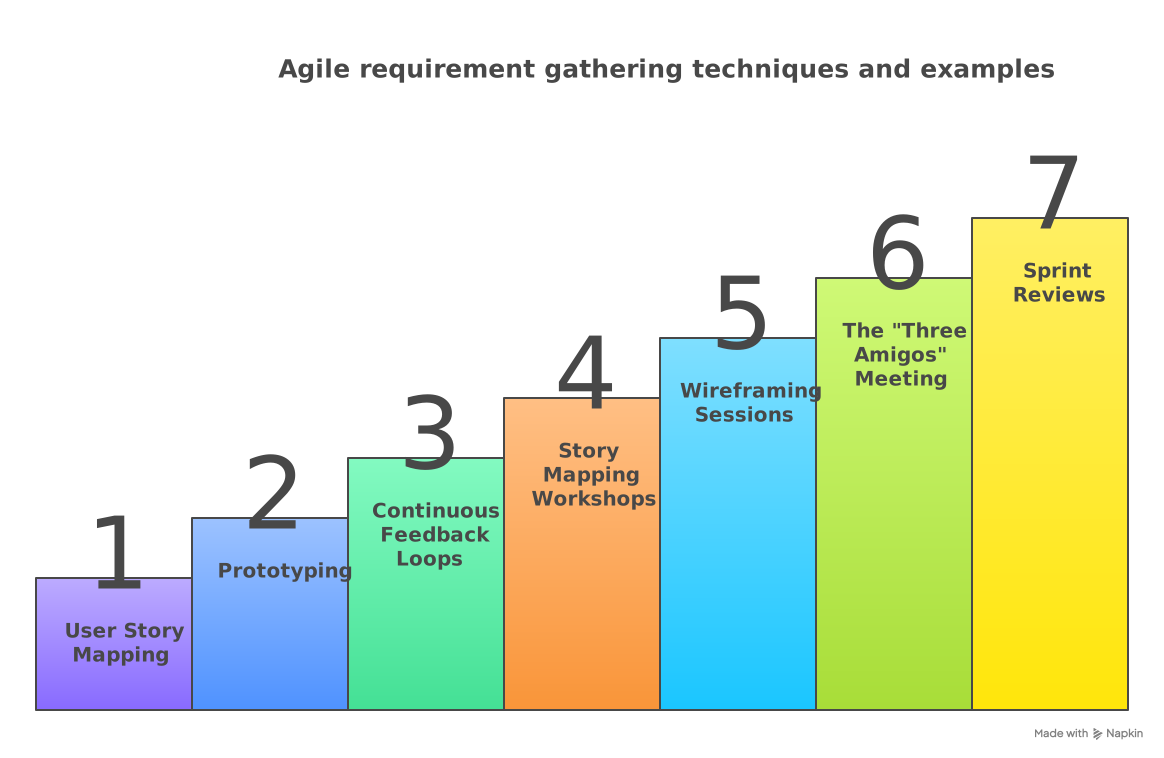
Agile teams use a variety of requirements gathering techniques to discover user needs, clarify expectations, and validate requirements throughout development. Each technique serves a different purpose, from identifying gaps in the user journey to refining acceptance criteria and incorporating stakeholder feedback.
The following techniques help teams translate what they learn into actionable user stories, backlog items, and verification criteria.
User Story Mapping
User story mapping helps Agile teams visualize the user journey, organize requirements around user activities, prioritize a Minimum Viable Product (MVP) based on the user’s critical path, and find gaps in the product backlog and workflow. Teams arrange user stories according to the steps users take to complete a task, then prioritize the functionality needed for an initial release. For example, a team developing a patient monitoring application might map the workflow from connecting a device to reviewing patient readings and responding to alerts. During the workshop, the team realizes it hasn’t accounted for what happens when the device loses connectivity. That discovery leads to new user stories and acceptance criteria for connection failures, helping the team address missing functionality before development begins.
Agile deliverable: A user story map, prioritized backlog items, and identified gaps in requirements coverage.
Observation and Job Shadowing
Observation helps Agile teams identify requirements by watching users perform tasks in their actual working environments. It can reveal workflow constraints, inefficiencies, and unmet needs that may not emerge during interviews or workshops. Teams can use active observation, asking questions while users perform tasks, or passive observation, watching without interrupting the workflow. Active observation helps clarify why users perform certain actions, while passive observation can reveal behaviors that users may not recognize or mention. For example, a team developing software for a medical device might observe clinicians repeatedly switching between screens to review patient information. That finding could lead to a new user story focused on simplifying access to critical data.
Agile deliverable: New or revised user stories, documented workflow constraints, and acceptance criteria informed by actual user behavior.
Prototyping and Wireframing
Prototyping allows Agile teams to validate requirements before committing to full implementation. By creating interactive mock-ups, wireframes, or low-fidelity prototypes, teams give stakeholders something concrete to evaluate rather than relying entirely on written descriptions. The process is iterative: users interact with the prototype, provide feedback, and the team adjusts the design and associated requirements. For example, a team designing a dashboard might use wireframes to confirm which information stakeholders need to see. Feedback may reveal missing data, confusing navigation, or additional functionality that should be captured in the product backlog. Prototyping helps teams refine user stories and acceptance criteria before development, reducing the risk of implementing functionality that doesn’t meet user needs.
Agile deliverable: Validated design concepts, refined user stories, and updated acceptance criteria.
Three Amigos Meetings
The Three Amigos technique brings together three perspectives—business, development, and testing—to clarify a user story before implementation. Typically, a product owner, developer, and tester review the story together to identify ambiguities, dependencies, and missing acceptance criteria. For example, a user story might state that a system should notify users when a transaction fails. During the discussion, the team identifies several unanswered questions: What constitutes a failure? How quickly should the notification appear? What happens if the user loses connectivity? By resolving these questions before development, the team can define clearer acceptance criteria and identify additional scenarios that require testing.
Agile deliverable: Refined user stories, testable acceptance criteria, and documented edge cases.
Sprint Reviews and Continuous Feedback
Sprint reviews provide opportunities for Agile teams to demonstrate completed work, gather stakeholder feedback, and identify requirements that need to change. Rather than treating requirements as fixed after initial discovery, teams use feedback throughout development to refine the product backlog. For example, during a sprint review, stakeholders testing a new reporting dashboard may discover that a critical data filter is missing. The product owner captures the feedback, works with the team to clarify the requirement, and prioritizes the resulting backlog item for a future sprint. Not every piece of feedback should automatically become a new requirement. Teams should evaluate requests against product goals, technical constraints, and existing requirements before adding them to the backlog.
Agile deliverable: New or revised backlog items, updated acceptance criteria, and documented stakeholder feedback.
These techniques help Agile teams discover needs, clarify expectations, and adapt requirements as development progresses. However, user stories and backlog items don’t always capture the full set of functional, technical, and regulatory requirements needed for complex products. Understanding how user stories relate to formal system requirements helps teams maintain alignment between Agile development and broader engineering objectives.
Managing Agile Requirements as Development Scales
Effective Agile requirements gathering relies on continuous collaboration, refinement, and stakeholder feedback. Techniques such as user story mapping, prototyping, and sprint reviews help teams adapt to changing needs while keeping development focused on delivering value.
As requirements evolve across teams, tools, and sprints, maintaining alignment between user stories, system requirements, and verification activities becomes increasingly important. Jama Connect® helps engineering teams manage evolving requirements with Live Traceability™, providing visibility into changes and their downstream impacts throughout development.
In This Webinar, We Discuss Requirements Engineering as a Path to Project Success
Book a Demo
See Jama Connect in Action!
Our Jama Connect experts are ready to guide you through a personalized demo, answer your questions, and show you how Jama Connect can help you identify risks, improve cross-team collaboration, and drive faster time to market.