Requirements Gathering in Software Engineering: Process, Techniques, and Best Practices
The Essential Guide to Requirements Management and Traceability

Requirements Gathering in Software Engineering: Process, Techniques, and Best Practices
Requirements gathering gives engineering teams a shared understanding of what they need to build before design and development begin. Done well, it reduces rework, supports compliance evidence, and gives every group working on the product (design, test, quality, regulatory) a common reference point.
Without it, the consequences show up later. The Project Management Institute found that inaccurate requirements gathering was a primary cause of project failure in 37% of surveyed organizations. NASA data shows that fixing a requirements error late can cost 29 to 1,500 times more than catching it during requirements work. This guide covers the requirements gathering process end to end, the techniques that work, where teams commonly get stuck, and the best practices that reduce downstream risk.
What Is Requirements Gathering?
Requirements gathering is the work of identifying, documenting, and organizing what a system or product must do. The output feeds into architecture decisions, test plans, risk assessments, and compliance documentation. In regulated industries, standards like FDA 21 CFR 820.30, DO-178C, and ISO 26262 expect rigorous traceability and evidence that requirements are fulfilled throughout development, so the output also feeds into design history files, certification packages, and audit records.
Requirements Gathering vs. Requirements Elicitation
These two terms aren’t the same thing. ISO/IEC/IEEE 29148:2018 defines requirements elicitation as the active subset of gathering, pulling needs, expectations, and constraints from engineers, end users, regulators, and domain experts through techniques like interviews, prototyping, and structured surveys.
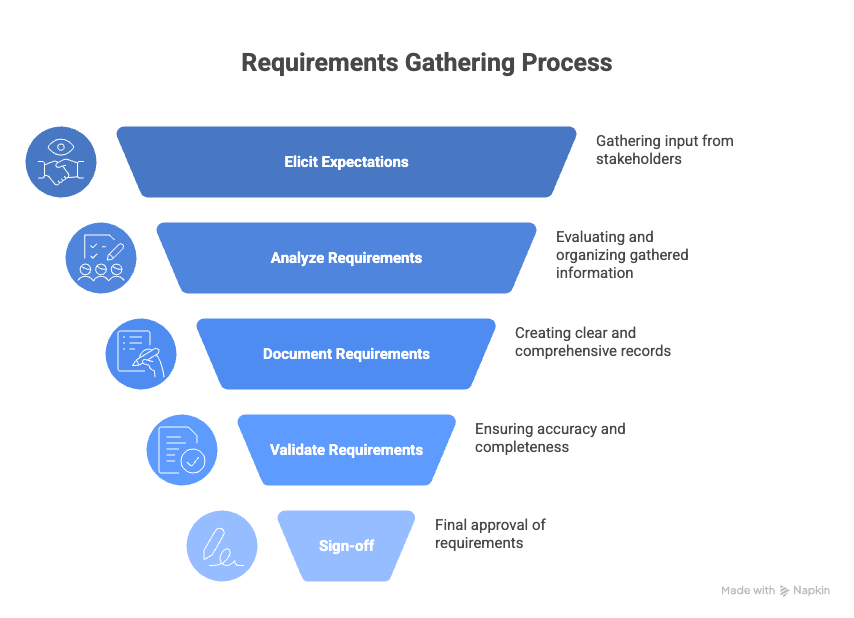
Requirements gathering covers the fuller scope, including who needs to be involved, the elicitation work itself, analysis, documentation, validation, and sign-off. For day-to-day communication, “requirements gathering” captures the complete picture.
Why Does Requirements Gathering Matter?
We’ve talked to dozens of engineering teams in regulated industries, and the same pattern keeps showing up. A vague requirement like “the system shall respond quickly” leaves room for different interpretations across hardware, software, and test groups. If one team reads “quickly” as 500 milliseconds and another reads it as 50 milliseconds, both may build correctly against their own assumptions and still fail together at integration.
The consequences of that kind of misalignment touch every part of the program:
- Rework and schedule delays: By the time an ambiguity surfaces at integration, teams aren’t debating wording. They’re reworking design, test assets, schedules, and sometimes compliance evidence.
- Rising correction costs: A NIST study estimated that inadequate software testing infrastructure costs the U.S. economy $22.2 to $59.5 billion per year. Capers Jones’ research on software defect economics showed that correction costs escalate dramatically the later a defect is found.
- Certification and compliance risk: For regulated teams, a missing or poorly traced requirement can delay certification, trigger audit findings, or force late redesign when evidence no longer supports the product baseline.
These costs compound quickly, which is why the structure of the gathering process itself deserves careful attention.
The Requirements Gathering Process
In regulated industries, the workflow typically follows a consistent set of phases, and each one should leave behind auditable evidence.
Identifying Stakeholders
Strong teams do this before writing detailed requirements, because missing someone early usually means missing a constraint, interface, or approval path that surfaces late. In regulated environments, the list extends well beyond end users and customers. It often includes regulatory authorities, subsystem suppliers, quality teams, risk specialists, cybersecurity leads, and manufacturing personnel.
Eliciting Requirements
With the right people identified, teams use interviews, workshops, observation, and prototyping to pull out needs, constraints, and assumptions. The Techniques section below covers each method in detail, but the key point here is that no single technique covers everything. Regulated projects usually require a mix, matched to the kind of knowledge each group of participants holds.
Documenting and Organizing
Once elicitation surfaces the raw needs, the next challenge is structuring them for the long term. Each requirement should have a unique identifier, stable history, source, rationale, priority, and ownership, and requirements need to be grouped so teams can trace them from the original need through system requirement, subsystem allocation, verification method, and final evidence.
Validating and Verifying
Validation asks whether the team is defining the right system for real user needs, while verification asks whether requirements are stated in a way that can later be proven. Prototypes, structured reviews, and early acceptance test planning serve both goals by exposing misunderstanding before the team commits to full development and before compliance evidence builds on weak assumptions.
Prioritizing and Signing Off
Not every requirement carries equal weight, so teams need a clear way to prioritize by criticality, risk, and implementation impact. In regulated settings, this step usually ends with controlled approval, version history, timestamps, and records of who approved what. That baseline makes later changes visible and reviewable against known intent and known downstream impact.
Requirements Gathering Techniques
With the process framework in place, the next question is which gathering methods to use at each stage. No single technique covers every layer of requirements in a regulated project, so most teams combine several of these based on the kind of uncertainty they’re trying to reduce.
Interviews and Stakeholder Conversations
One-on-one interviews are the most direct way to surface domain knowledge that a form or checklist would miss. They also uncover tacit assumptions that participants would never write down but will mention immediately when describing their real work environment. Some agile teams formalize this as a “Three Amigos” session, where a product owner, developer, and tester walk through a requirement together to catch gaps before work begins.
Cross-Functional Workshops
Workshops bring engineering, human factors, quality, and regulatory groups into the same room to resolve competing priorities in real time. Story mapping workshops, where teams arrange user stories to visualize the full user journey, are particularly effective for spotting gaps in coverage and agreeing on what belongs in an initial release. The tradeoff is that workshops require strong facilitation to stay productive and avoid letting the loudest voice dominate.
Observation and Job Shadowing
Watching a user perform a task often reveals environmental constraints, handoffs, and failure points that interviews never surface. In agile environments, sprint reviews serve a similar purpose, letting teams observe real-time reactions to working software and feed those insights back into the next iteration of requirements.
Prototyping
Prototyping gives people something concrete to react to, which makes abstract needs easier to discuss and test. Even low-fidelity wireframes or paper sketches can surface usability problems and missing requirements that weeks of written specifications would miss. The tradeoff is that participants can become attached to early design choices, so prototypes should always be framed as learning tools, not commitments to a final implementation.
Surveys and Questionnaires
Surveys work well when participants are geographically distributed or when the team needs structured input from a large group. They’re usually most effective as a supplement to interviews and workshops, not a replacement. Used well, surveys validate patterns the team has already heard elsewhere and help quantify how widely a need is shared.
Ready to Find Out More?
Our team of experts is here to answer any questions and learn how we can help enable your continued success. Get started with a free 30-day trial, or book a demo!
Common Requirements Gathering Challenges
The breakdown rarely comes from a complete lack of process. It comes from gaps in precision, coordination, or change control that look manageable early and get expensive later:
- Ambiguous language: A requirement like “the device shall be easy to clean” means different things to a manufacturing engineer and a human factors specialist. Structured syntax like EARS (Easy Approach to Requirements Syntax) forces more measurable language by applying one of six defined patterns to each requirement statement.
- Multiple sources of truth: When requirements live across documents, spreadsheets, and email threads, version conflicts accumulate. A single managed system of record eliminates the question of which copy is current.
- Missing voices: Excluding quality, regulatory, service, or manufacturing perspectives early leads to late rework. The omitted constraints still exist, even if they were absent from the first draft.
- Scope creep without impact analysis: New requirements mid-program aren’t always a sign of changing priorities. They often reveal that important user classes or constraints were missed during the initial elicitation.
These failures are preventable when teams treat requirements as a managed system of record, not a one-time documentation task.
Best Practices for Requirements Gathering
Knowing where gathering breaks down points to what quality standards should catch. These practices help teams prevent the most common failures before they compound.
Write Requirements That Can Be Verified
High-quality requirements are unambiguous, complete, feasible, verifiable, and consistent. Consider that ambiguous “respond quickly” requirement from earlier. Three months after it’s written, a test engineer has no pass/fail threshold to verify against. Every requirement should have a defined verification method (test, inspection, analysis, or demonstration) at the time it is authored.
Check Quality at Authoring Time
Jama Connect Advisor™ can catch ambiguity problems at authoring time by scoring requirements against rules from the INCOSE Guide to Writing Requirements and 6 EARS syntax patterns. If a requirement lacks a measurable threshold, Advisor flags it and suggests where the language needs tightening.
Maintain a Shared Standard for Authoring and Change
A documented requirements management guide gives the team a shared baseline for how requirements should be written. Pairing that with a change management process and regular traceability reviews closes the loop between what was defined and what was delivered.
Build Traceability from Day One
Traceability shouldn’t be something teams bolt on before an audit. Linking each requirement to its source, downstream design decisions, test cases, and risk controls from the start makes impact analysis possible when something changes. It also means compliance evidence builds naturally as the project progresses, instead of becoming a scramble at the end.
When Do You Need a Requirements Tool?
Authoring rules and quality checks can be enforced manually on small teams, but the overhead grows with product complexity. Word and Excel work when compliance needs are modest, but the problem appears when no one can reliably maintain bidirectional traceability by hand across requirements, tests, risk items, and approvals. Teams evaluating tools for regulated development usually focus on a few specific capabilities:
- Bidirectional traceability: Upstream and downstream links that stay current as requirements, risks, and tests change.
- Compliance support: Workflows and audit evidence aligned to the standards the team actually needs to maintain.
- Audit history: Change records, approvals, and version history captured in a way reviewers and auditors can trust.
- Toolchain fit: Integration with the team’s existing engineering and test environment without forcing unnecessary process breaks.
Jama Connect® is a requirements management platform built for teams working under regulatory pressure. When a requirement changes, Live Traceability™ shows every connected artifact, from upstream needs through downstream test cases and risk controls, so teams can assess impact without manually tracing links. The Advisor add-on scores requirement language at authoring time, and built-in review workflows handle formal sign-off with full audit history.
How Structured Requirements Gathering Pays Off
Requirements gathering works best when teams treat it as the starting point for design, verification, and change control, not a document-writing exercise that ends before development begins. The teams that reduce downstream rework usually do a few things consistently. They identify the right people before drafting requirements, use structured elicitation methods, check requirement quality early, and maintain traceability as changes move across the lifecycle.
Jama Connect supports this workflow with Live Traceability across requirements management, risk, and test artifacts, so teams can see the impact of every change as it happens. Start a free trial to see how it works with your development process.
Frequently Asked Questions About Requirements Gathering
Who is responsible for requirements gathering?
Systems engineers, product managers, business analysts, quality teams, and subject-matter experts all contribute different inputs, and one lead usually coordinates the process. In many companies, that coordinator is a systems engineering lead, product owner, or dedicated requirements lead.
How long does requirements gathering take?
The initial phase varies with product complexity, the number of people involved, and regulatory scope. For complex systems, the first pass establishes a baseline, but requirements continue to evolve as designs mature and verification work progresses. Strong teams plan for iterative refinement instead of assuming requirements will be complete after a single cycle.
How is requirements gathering different in agile vs. waterfall?
Waterfall pushes for more complete requirements definition before design begins, while agile allows requirements to be elaborated in smaller increments. Both approaches still need documentation, review, change control, and traceability in regulated environments. The difference is timing, not rigor.
What are the different types of requirements?
Functional requirements describe what the system does, such as processing a transaction or generating a report. Non-functional requirements describe how it performs, covering areas like response time, availability, and security. In regulated industries, teams also capture interface requirements, constraint requirements from applicable standards, and risk-related requirements that trace back to hazard analyses.
What is a requirements traceability matrix?
A requirements traceability matrix (RTM) links each requirement to its source, implementation, verification activity, and related risk controls. It helps teams check forward coverage and backward justification. In regulated industries, it’s a common way to demonstrate compliance evidence during reviews and audits.
In This Webinar, We Cover Requirements to Regulatory Best Practices Utilizing AI
Book a Demo
See Jama Connect in Action!
Our Jama Connect experts are ready to guide you through a personalized demo, answer your questions, and show you how Jama Connect can help you identify risks, improve cross-team collaboration, and drive faster time to market.