Tag Archive for: Requirements & Requirements Management Page 20
Tag Archive for: Requirements & Requirements Management
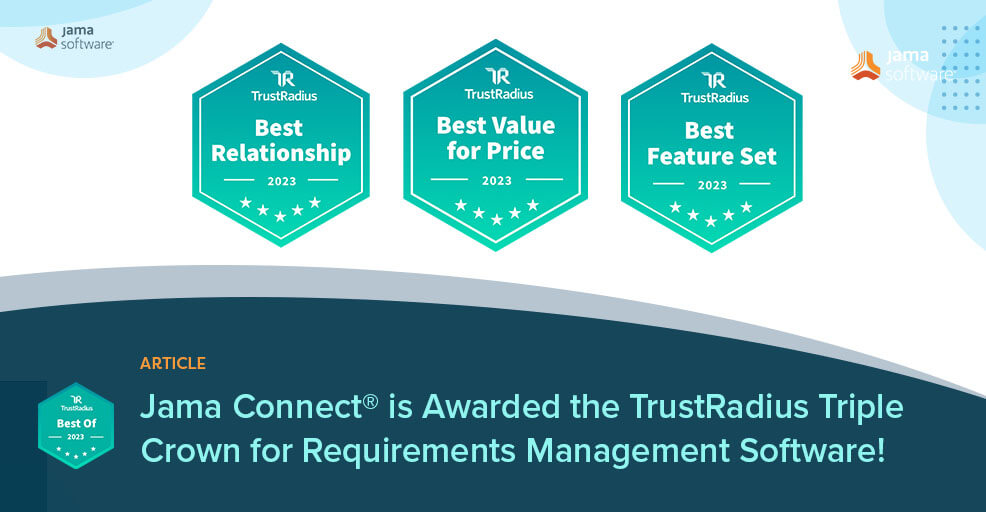
Jama Connect® is Awarded the TrustRadius Triple Crown for Requirements Management Software!
Jama Connect® has gained recognition as an outstanding solution on TrustRadius, solidifying its position as a leading platform for requirements, risk, and test management.
With its intuitive interface, robust features, and exceptional customer support, Jama Connect has received the following prestigious awards in 2023: Best Of, Feature Set, Pricing, and Relationship.
Visit the full report to see why customers love using Jama Connect for product, systems, and software development.
This recognition underscores Jama Software’s unwavering commitment to delivering a reliable and efficient solution that empowers teams to drive innovation and achieve exceptional results.
As the leading provider of requirements management software, Jama Software is proud to receive recognition for our commitment to enabling multidisciplinary engineering organizations developing products, systems, and software to maximize their success. We value the feedback from our clients who have used Jama Connect and are committed to providing them with the best support, resources, and expertise to help them succeed.
“Jama Connect is a solid framework for systems engineering that can integrate many design processes into a single tool. At a fundamental level, it is a great tool for handling requirements management and traceability but offers a variety of other features such as risk management and verification and validation. For someone who works in the medical device industry, the tool also complies with CFR requirements for electronic approvals and can be validated for such use.”
-From review collected and hosted on TrustRadius – User in Engineering, Medical Devices Company
“I’m VERY likely to recommend Jama to a colleague because they’d struggle to get anything done without using it! That’s the tool we’re using for Req Management now, so I recommend to my colleagues that they get amongst it!”
-From review collected and hosted on TrustRadius – Ian Webb, Systems Engineering Technical Writer – Enphase EnergyElectrical & Electronic Manufacturing
From all of us at Jama Software® to all of you, thank you!
In this blog, we’ll recap our whitepaper, “Cybersecurity in the Air: Addressing Modern Threats with DO-326A” Click HERE to read the entire paper.
Cybersecurity in the Air: Addressing Modern Threats with DO-326A
Introduction
Not long ago, getting on an airplane meant being largely out of touch with everyone on the ground for the duration of one’s flight. Of course, there were in-flight telephones for those who could afford them, and pilots could connect with personnel on the ground in case of emergency, but the rank-and-file passenger had limited options for connecting with the world outside the aircraft.
The 21st century has changed flying from a largely isolated endeavor that exists in a closed loop to one that integrates with ground systems through the miracle of the Internet. For travelers who want to enjoy their own personal entertainment options, conduct business, or take advantage of downtime to do online shopping, accessing the Internet during a flight is a tremendous boon. For air freight carriers and their customers, Internet connectivity improves visibility and streamlines supply chains with better real-time information.
Of course, the advantages of connectivity come with disadvantages as well. The more airborne systems are interconnected with the broader Internet, the more vulnerable systems are to hacking. In 2015, a researcher was kicked off a United Airlines flight after tweeting about security vulnerabilities; the researcher claimed to have accessed in-flight networks multiple times between 2011 and 2014, including one time when he allegedly commandeered the plane. In 2016, the US Department of Homeland Security hacked the system of a Boeing 757 using “typical stuff that could get through security.” And in 2022, Boeing announced a software update to repair a vulnerability that could allow hackers to modify data and cause pilots to miscalculate landing and take-off speeds.
Aviation cybersecurity has become a critical issue across the globe. Not only do millions of passengers depend on airlines to get them safely from point A to point B every day, but manufacturers, shipping services, and militaries rely on aircraft systems to support supply chains and execute missions. Cyberattacks have skyrocketed since the onset of the COVID-19 pandemic; a 2022 report found a 140% increase in cyberattacks against industrial operations — including four attacks that caused flight delays for tens of thousands of passengers.
Clearly, aviation systems can be vulnerable to malicious actors. For developers and manufacturers in the aviation industry, DO-326A provides compliance guidelines to address the vulnerabilities of avionics systems.
Known as the “Airworthiness Security Process Specification,” DO-326A (and its European counterpart, ED-202) is the aviation cybersecurity standard developed jointly by the Radio Technical Commission for Aeronautics (RTCA) and the European Organisation for Civil Aviation Equipment.
The original edition, DO-326, was issued in 2010; its revised version, DO-326A, was issued in 2014. The standard became mandatory in 2019.
The DO-326A/ED-202A set focuses primarily on how to prevent malware that can infect avionics systems during both development and flight operations. A cyberattack on these critical systems can impact how the aircraft works and potentially endanger operators and passengers. DO-326A/ED- 202A describes the Airworthiness Security Process that one should follow.
What is Airworthiness/Airworthiness Security Process?
“Airworthiness security” involves protecting an aircraft from intentional unauthorized electronic interaction, including malware, ransomware, and other cyber threats.
The Airworthiness Security Process (AWSP) is intended to establish that aircraft will remain safely operable if it is subjected to unauthorized interaction.
DO-326A outlines the Airworthiness Security Process in seven steps:
1. Plan for Security Aspects of Certification (Aircraft Level Planning/System Level Planning)
2. Security Scope Definition (Threat Assessment Process)
3. Security Risk Assessment (Threat Assessment Process)
4. Decision Gate (Threat Assessment Process)
5. Security Development (Definition of Security Measures and Requirements)
6. Security Effectiveness Assurance (Verification and Validation of Security Measures and Requirements)
7. Communication of Evidence (PSecAC Summary Reporting)
In this video, we’ll discuss the reuse & sync capabilities in Jama Connect.
Jama Connect® Features in Five: Reuse & Sync
Learn how you can supercharge your systems development process! In this blog series, we’re pulling back the curtains to give you a look at a few of the powerful features in Jama Connect®… in about five minutes.
In this Features in Five video, Zeb Geary – Principal Professional Services Consultant at Jama Software® – will go over the reuse & sync capabilities for requirements management in Jama Connect.
VIDEO TRANSCRIPT
Zeb Geary: Welcome to this segment of Features in Five. I’m Zeb Geary, a Principal Consultant at Jama Software. In this video, I’ll explain how your team can reduce time to market and improve quality by reusing and synchronizing requirements and other content in Jama Connect.
Teams often struggle to build on existing work when requirements and tests are spread across documents and systems. Lacking a live trace, they must manually identify and copy related content, increasing the risk of rework and gaps. Additionally, teams tend to lack visibility across efforts, causing necessary changes to not propagate across reuse content, potentially impacting quality and disconnected product design efforts.
Jama Connect simplifies and enhances the process of reusing requirements and verifications by allowing you to copy selected content with its containers and its traced items. Synchronization ensures visibility and enables key use cases such as parallel product definition, common content libraries, and product variance. Let’s look at reuse and synchronization in Jama Connect.
Geary: Here in Jama Connect, I’m looking at a project that we would consider a library or potentially a platform of 150% of our requirements. For this example, I’ve started building out the requirements and verifications for a new Jama Connect project, but I’ll be incorporating some standard or common requirements from this project. And through reuse, I’ll save time and ensure consistency with the platform.
I want to bring these common display requirements into my project from the platform. I see that these requirements have related verifications, and I want to bring these into my project as well. I’ll go ahead and select to reuse this folder. The reuse window shows me what I’ve selected for reuse and provides me with important options that reveal the significance of this capability. The first option determines if I will enable synchronization. If enabled, Jama Connect will establish a connection between the result of my reuse and its source so that I can monitor them for differences. I have options to include or exclude tags, attachments, and links, and to form a relationship to my source item from the resulting copy.
The final section of options determines how I will handle related content outside of my selection. Recall that the selective requirements have downstream verifications that I want to make sure I bring into my project. I will select the option to include related content and to mirror the relationships in my project. This saves me a lot of time since I will not have to recreate these relationships in the new project and removes the risk of missing verifications related to my selected requirements.
Finally, I indicate where I want to reuse the content to. I’ll select my project and I can have Jama Connect copy the project hierarchy as well into my target project, or I can select an existing location in my project. I selected my location and I will reuse with Sync.
Geary: In my project, the common display requirements have been reused with their related verifications. Here in my project, I can use Sync View to see how my reused items may differ from the library or any other project using these common requirements. Let’s check out this folder called “Scheduling.”
I can see from our sync items view that I’m in sync with the platform, meaning there’s no difference there, but we have a parallel effort that I am out of sync with. In Compare View, I can see exactly how we differ and bring those differences, if necessary, into my project. Sync View provides me with the visibility I need to make sure I’m working with the latest applicable requirements in my project. Here I will update the requirement text and I’ll create the missing requirement in my project. Now my project and this parallel effort are in sync.
As we have seen, reuse and synchronization is a key feature supporting critical requirements and verification activities. A Jama Software consultant can help you properly support your process with reuse and sync. If you have a Success Program with Jama Software, see our offerings under Improving Your Process to request assistance from a consultant. Your customer success manager can help you learn more about Jama Software Success Programs. If you would like to learn more about how Jama Connect can optimize your product development process, please visit our website at www.jamasoftware.com.
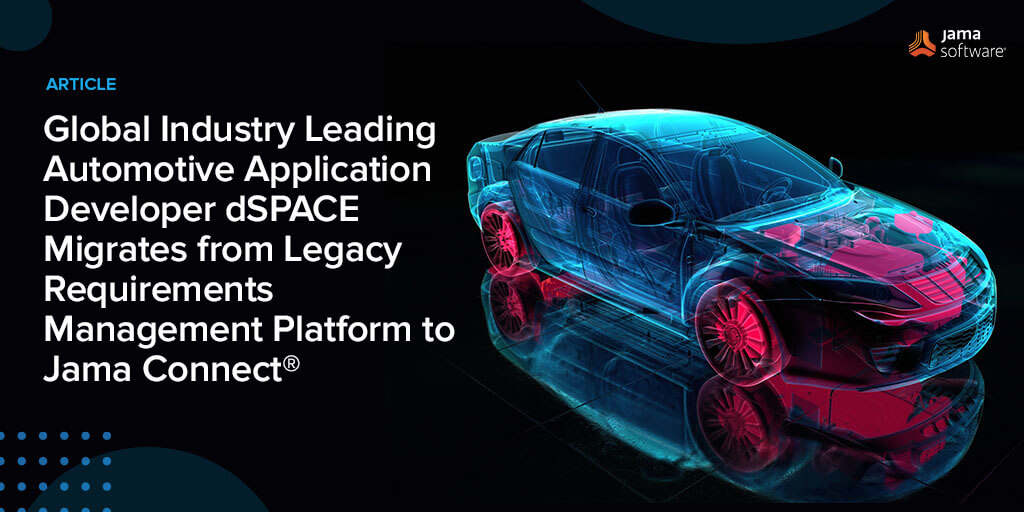
In this blog, we present a preview of our customer story, ” Global Industry Leading Automotive Application Developer dSPACE Migrates from Legacy Requirements Management Platform to Jama Connect®” – To download the entire story, CLICK HERE
Global Industry Leading Automotive Application Developer dSPACE Migrates from Legacy Requirements Management Platform to Jama Connect®
As part of a global modernization initiative, dSPACE partners with Jama Software® to migrate decades of data, increase collaboration, simplify compliance, and integrate processes across best-of-breed tools.
About dSPACE
Founded: 1988 in Paderborn, Germany (North Rhine-Westphalia)
Expertise: Solutions for automotive applications, including autonomous driving, E-mobility, power trains, V2X and connected services, communication systems, body and comfort electronics, and chassis.
Other Industries Served: On- and off-road commercial vehicles, aerospace, energy, rail, marine, machinery & power tools, and academia.
Mission: Enable technology and mobility pioneers to make life safer, cleaner, and easier.
dSPACE is one of the world’s leading providers of simulation and validation solutions that are used for developing connected, autonomous, and electrically powered vehicles.
Mainly automotive manufacturers and their suppliers use the company’s end-to-end solution range to test the software and hardware components of their new vehicles long before a new model is allowed on the road. dSPACE is not only a sought-after development partner in vehicle development, but engineers also rely on dSPACE’s expertise in aerospace and industrial automation.
dSPACE’s portfolio ranges from end-to-end solutions for simulation and validation to engineering and consulting services as well as training and support. With more than 2,400 employees worldwide, dSPACE is headquartered in Paderborn, Germany; has three project centers in Germany; and serves customers through regional dSPACE companies in the USA, the UK, France, Japan, India, China, Korea, and Croatia.
In this blog, we present a preview of our customer story, “Leading Quantum Computing Company Selects Jama Connect® to Decrease Review Cycles, Reduce Rework, and Improve Communication and Collaboration” – To download the entire story, CLICK HERE
Leading Quantum Computing Company, IonQ, Selects Jama Connect® to Decrease Review Cycles, Reduce Rework, and Improve Communication and Collaboration
With a return on their investment in less than six months, the IonQ team is confident they made the right selection.
About IonQ:
Founded in 2015 by Chris Monroe and Jungsang Kim to “build the world’s best quantum computers to solve the world’s most complex problems.”
Leveraging 25 years of academic research to build the world’s leading quantum computers.
Expanding quantum computing availability to the cloud through partnerships with Microsoft and Amazon Web Services, and Google Cloud Platform.
Headquartered in Maryland.
IonQ, Inc. is a leader in quantum computing, with a proven track record of innovation and deployment. IonQ’s latest generation quantum computer, IonQ Forte, is the latest in a line of cutting-edge systems, boasting an industryleading 29 algorithmic qubits. And IonQ Aria is the most powerful commercially available quantum system, with 25 algorithmic qubits. Along with record performance, IonQ has defined what it believes is the best path forward to scale. IonQ is the only company with its quantum systems available through the cloud on Amazon Braket, Microsoft Azure, and Google Cloud, as well as through direct API access. IonQ was founded in 2015 by Dr. Christopher Monroe and Dr. Jungsang Kim based on 25 years of pioneering research. IonQ began trading on the New York Stock Exchange in 2021, making it the world’s first public pure-play quantum computing company.
CUSTOMER STORY OVERVIEW
Growing fast in an emerging market, IonQ has implemented an ever-growing number of engineering best practices. The company’s team became frustrated managing requirements with Google Sheets and needed to solve core problems, such as linking between levels of requirements without extensive lookup tables. After rigorous evaluation, they selected Jama Connect® and are very pleased with the outcome.
CHALLENGES
Linking between levels of requirements without extensive lookup tables
Lack of clear traceability
Managing complexities across hardware and software
Lengthy review cycles
EVALUATION
Easy-to-use platform with an intuitive interface
Ability to view relationships between requirements
Change control and a review and locking function for requirements
Within budget
OUTCOMES
25% decrease in review cycle time
20% savings of systems engineers’ time (previously spent on manual processes)
25% improvement in communication and collaboration
In this blog, we recap our webinar, “Bridging the Gap in Insurance Product Development”. Click HERE to watch the entire webinar.
Looking to bridge the gap in your insurance product development?
Learn how carriers can utilize Jama Connect® to increase efficiency across the development process and more effectively deliver high quality products on time and on budget.
During this informative session, Lianne Warford, Senior Business Analyst at LHW Consulting, and Steven Meadows, Principal Solutions Lead at Jama Software®, discuss how this newly available insurance framework and dataset streamlines and simplifies product development for the insurance industry.
Gain insights into:
Overcoming common insurance industry challenges
Leveraging the benefits of a modern requirements management solution
The new insurance framework available in Jama Connect, with off-the-shelf elements for enhanced workflow and efficiency
Discover how Jama Connect allows carriers to innovate, bring products to market quicker, and ultimately better serve their customers.
Below is an abbreviated transcript of our webinar.
Bridging the Gap in Insurance Product Development
Steven Meadows: Okay, so today, we have a pretty packed agenda. We’re going to be starting off or Lianne’s going to be talking about legacy insurance requirements management. Following that, we’ll be talking about how you can overcome some of the common insurance industry challenges, some of the important considerations for streamlined insurance product development. After that, I’ll be talking about the problem with legacy tools and insurance product development, followed by best practices for an effective development strategy. I’ll then be providing a brief introduction to Jama Connect for Insurance, very high level overview. And then finally, we’ll end with a solution key takeaways and questions. And with that, Lianne, go ahead.
Lianne Watford: All right, thanks Steven so much. I appreciate this opportunity to work with Jama Software. I want to get started today with talking about different scenarios, two main scenarios where requirements are needed in the insurance industry. So we have the policy administration systems that automate the day-to-day operations of an insurance company. And the second area is the new and enhanced insurance products and services that insurance companies want to undertake. So let’s just dive right in. It has a lot of information, so let’s get started. So from the policy administration system, while every insurance company’s unique, processes that all insurance companies share for the day-to-day operations are quite common. And I’d venture to say that you would have to look long and hard to find an insurance company today that doesn’t have some type of policy admin system, whether it be a homegrown system that they’ve done themselves or utilizing some other type of software vendor.
Watford: So if you take a look at the areas that are common, you have your policy administration. So every insurance policy starts with a quote and there’s quite a bit of information that needs to be captured. You’ve got your insured name, address, and contact information among others. You have information about the risk that’s being insured, whether it’s a house, a car, or business. And there are specific details for each types of risks that have to be captured to provide an accurate rate for the policy. You’ve got your coverages that are needed for each of the specific types of risks like property damage and liability coverage, and there’s lots of information that needs to be captured around that as well. And then once the policy is bound and issued, there’s several different types of documents such as declaration pages, rating sheets, etc, that have to be generated and are dependent on specific policy details.
And while those requirements are related to the insured risk and coverages, there’ll be an entirely different set of requirements for the output that describe the information about both the static and the variable data that’s needed to be printed. So that’s a ton of information right there. If you haven’t really captured it, we’ve just hit one bullet point under the policy admin. And then you’re always going to have the need to make a change to the policy at some point. And those are processed as endorsements. And while some of these requirements can be reused from the quote bind and issue process, there’ll also be certain rules for different types of endorsements that’ll need to be captured as separate requirements. And then you also have the output that’s specific to those related endorsements. Again, more stuff. And then you also have the processes around your cancellations and reinstatements for underwriting reasons, and you’re going to have documents that go along with that as well.
Watford: All of those have to have requirements for the related output and downstream effects as well. And then hopefully the insured’s going to be happy with your service at your company and they’ll want to renew the policy for another term. So yep, there goes another set of specific requirements that are associated with the processing of the renewal as well as the output that’s associated. That’s a big mouthful of information. But then the next step you’ve got to do is collect the money for the premium that’s generated on the policy. So you gather requirements for down payments if you require them. You also provide payment plan options to allow them to pay, and installments are all at one time, so there’s lots of requirements around that. Then you also have special rules for nonpayment of premium cancellations and reinstatements that are different from your underwriting cancellations and reinstatements, different set of requirements.
And then you have to process refunds and collections. Again, and there’s all types of outputs that go along with these processes as well that have to be documented. And then of course, the big thing for an insurance company is your annual statement. That’s your accounting for what insurance companies do. And so, there’s all kinds of requirements for your annual statement, annual statement lines, and statistical reporting. Again, a ton of requirements. And then last but not least is your claims administration, which is the reason that you actually have insurance, right? So that if you need to make a claim, so you have your requirements around first notice of loss and then there’s a ton of information that they have to capture, lots of things that they have to do in that area as well. Come out and inspect, assign agents, all different types of processes for your claims.
And then you ultimately want to make a payment to the insured when it’s needed and processing of reinsurance if your company handles reinsurance. So that’s a mouthful of information and lots of requirements that maybe a lot of people don’t think about when it comes to insurance day-to-day operations. And then when you move on to thinking about the company wants to have new and enhanced insurance products and services. So you’ve got new products that you want to offer, you have new states and lines of business and coverages that you want to move into. And then if you want to enhance existing products, you’ve got rate changes, additional coverages you want to provide. And then there’s all kinds of interfaces, imager, quick rater, all types of interfaces into insurance policy admin systems that help integrate your business. And then not to mention, you’ve got to upgrade those existing interfaces because softwares are continuously evolving.
In this blog, we recap our webinar, “Compliance Made Easy with Jama Connect® for Automotive and Semiconductor Development”. Click HERE to watch the entire webinar.
Evaluate Your Compliance Against ASPICE, ISO 26262, or ISO 21434 with Diagnostic Services Offerings from Jama Software®
During the webinar, experts Steve Rush, Principal Consultant, and Sampath Yerramalla, Senior Consultant, explored various service offerings within Jama Connect that provide insights into compliance status against these critical automotive standards.
Key takeaways from this webinar:
Learn about available diagnostic offerings in Jama Connect, such as: ASPICE, ISOS26262, and ISO21434
Learn about the benefits of diagnostic offerings, how they will expose risks to compliance, and which one is best for your organization
See firsthand how Jama Connect helps teams reduce unacceptable risks
Discover how Jama Connect can empower Automotive and Semiconductor development teams to evaluate and ensure compliance.
Below is an abbreviated transcript of our webinar.
Compliance Made Easy with Jama Connect for Automotive and Semiconductor Development
Steve Rush: Hi everyone. I’m happy to be here today to take you through the presentation. I wanted to start with a high level agenda and an introduction. We’ll be discussing Automotive compliance in general. To start, we’ll be looking at specific service offerings that you can use to help leverage, to evaluate your compliance against certain Automotive standards.
There are two forces often related that I like to think about when it comes to compliance that really impact the organization as a whole, from engineers to executives and everybody really in between. And those are process and quality. And I like to think about compliance as the intersection of those two often related ideas. Meeting the objectives of these standards may achieve both process and quality, but developing a compliant process and system, this will speed up development by instituting good process and reducing rework. It will help catch and identify defects early in the development process. However, there’s many evolving regulations and standards in this Automotive sector that make the idea of compliance all the more challenging to understand, let alone demonstrate. Perhaps you don’t even know where to start when it comes to achieving compliance in an Automotive system. It might feel like you are building a car while it’s driving.
At the same time tasked with implementing the process and tools to support the process and unsure which should come first. And we want to talk a little bit about this through the lens of compliance and make the case that Jama Connect is a tool well suited to get you up and running quickly, optimized against popular Automotive standards. To assist with this, we’ll discuss the diagnostic that Jama Software offers as a service that’ll help you navigate these important compliance questions. But I fully believe that by meeting the objectives of some of these critical Automotive standards we will discuss today that you’ll balance both process and quality and achieve compliance.
Sam Yerramalla: Today we are highlighting some offerings that will help guide Automotive customers or prospects like you with your compliance process. We feel these diagnostics can be very helpful whether you are a customer of Jama Software or a prospect. If you’re a Jama Software prospect who’s not yet purchased Jama Connect, these diagnostics makes the case that Jama Connect can help you meet the objectives of the Automotive standards. And namely, there are three standards offerings that we provide. One is the ASPICE Diagnostics, the Automotive Functional Safety Diagnostics, and the Cybersecurity Diagnostics. Now these diagnostics can help you navigate the classic process versus tool conundrum. That is if you’re trying to understand whether you should build the process first or buy the tool first, you’ll first see firsthand how Jama Connect will help shape the process. If you’re a Jama Software customer, you can use these diagnostics as a baseline. Oftentimes, we get busy with our day-to-day work and we may drift away from the larger big picture.
And these diagnostics are meant to guide you to bring light into areas that you need improvement or any optimization of your current Jama Connect process. You can also be paired with a Jama Software consultant or a solutions architect who will take you through the diagnostics start to finish. The time commitment for each of these diagnostics is about two to three hours. We feel that’s reasonable considering the benefits you may get out of this. We focus on the outcomes and the objectives and how this will truly help meet your compliance needs by optimizing your Jama Connect usage. If you’re a customer or getting up and running in Jama Connect, if you’re a prospect who’s looking for purchasing Jama, you can see these diagnostics offerings along with other offerings that we provide on the Jama Software Success Program page at Jamasoftware.com/success. Here you’ll see details on the compliance offerings that we just mentioned and a lot more other offerings including offerings on onboarding Jama Connect, improving your process and requirements, quality, traceability, et cetera.
Yerramalla: You can also request an offering if you have a service program with no assigned consultant and our operations team will pair you up with someone. So as far as the Automotive standards and alignments are concerned, the diagnostics offerings that we provide are aligned to the three standards, the Automotive Spice, ISO 26262 and ISO 21434. Only certain areas of those standards are in scope. For example, things like part seven of the ISO 26262 for production and operation and decommissioning are not covered here. But you will see some of these sections here are covered by the diagnostics. So depending on which diagnostics is right for you, the risks that are identified will align to the different areas that you see on the screen. Now, it may be that you want to align to more than one standard. We certainly put you through multiple diagnostics to identify your risks pertaining to each of these standard.
The model which we use is the same, but the recommendation we provide and tailored solution that the diagnostics provides will be custom based on each scenario. And if you don’t know where to get started or you don’t know which of these diagnostics that you need to start first. Some things are obvious, again, that if you’re looking for cybersecurity compliance and that is of the greatest concern for you, then Cybersecurity Diagnostics, the 21434 is right.
And if you’re looking for developing any functional safety products that are used in the Automotive, then the ISO 26262 diagnostics is the correct one to start with. And if you’re looking for any software process improvements or quality management, then ASPICE is the place to start. But sometimes you need both APSICE and functional safety, for example, in which case we suggest the ASPICE Diagnostics first. And the reason is that we rank in the process ASPICE about the functional safety is that if you have a high level of ASPICE maturity or on the other side, if there are several risks that are flagged from the ASPICE Diagnostics, then those will impact your Functional Safety Diagnostics already.
So you would’ve covered those parts of it that as a prerequisite for the functional safety. And then the spirit of ASPICE is really the quality management. And this is important in every engineering organization. So if you’re unsure where to start, then ASPIE Diagnostics is one place. And if you don’t need to prove compliance to the latter, it’s really good because honoring it, the lead benefits in your process.
Traceable Agile – Speed AND Quality Are Possible for Software Factories in Safety-critical Industries
Automotive, aerospace and defense, and industrial companies have largely adopted Agile within rapidly growing software factories to speed time to market in order to stay competitive. These software factories have largely succeeded in speeding up software development for companies within the industries that have adopted it, but maintaining quality is still a key concern. The inability to coordinate development across engineering disciplines has led to product recalls, quality complaints, and has created significant internal challenges to satisfy functional safety requirements from regulators and confidently deliver high-quality software. These challenges — and resulting outcomes — are often so severe that leadership of the software factories have been let go.
Fundamental Questions We Hear
When we ask software factory leaders, “what keeps them up at night?” We consistently hear the following five questions:
How do I know which product requirements have been missed?
How do I know which product requirements are not fully covered by test cases?
How do I know which product requirements have failed to pass tests?
How do I identify rogue development activity?
How do I know if changes have been made at the system and / or hardware level that impact the software team?
These are fundamental questions that should be answerable from leading Agile tooling, but they are not. The reason is that Agile tools focus on tasks (define, assign, status, complete, delete) and have no notion of the current and historical state of the project. Tasks are not tied to any state of the project which often leads to drift from the actual needs and requirements of your customer or end user. As a result, these questions are not answerable with Agile tools like Jira and Azure DevOps. Project management tools like Jira Align answer important questions around staffing, sprint planning, and cost allocation, but do not address the critical questions above focused on the real-time state of the software development effort against the approved requirements.
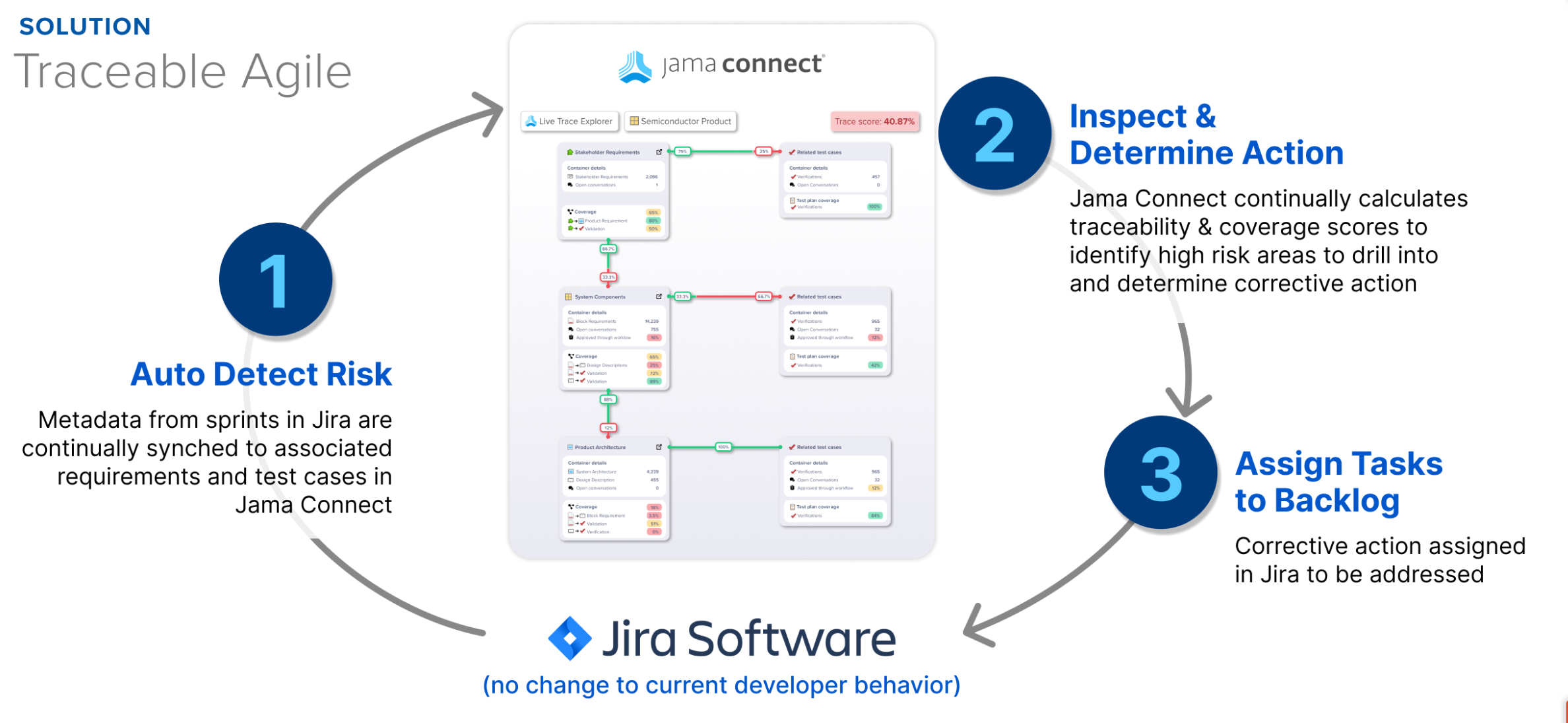
How do you best speed software and overall product development and still achieve the quality expectations of customers and company leadership? The answer is Traceable Agile. Traceable Agile speeds the FLOW of software development but also maintains the current and historical STATE of the development effort and auto-detects issues early in the software development process. Traceable Agile recognizes that developer activity is best managed as a FLOW using tasks in a tool such as Jira. What is needed to achieve Traceable Agile is to pair a system with Jira that manages the STATE of the development effort at all times. By keeping STATE and FLOW tools separate but integrated, no change is required to software developer process and tools. This is significant. Software leadership can now answer their critical questions without having to undergo a major process and tool change with resistant developers which would slow down development and/or increase staff attrition.
Here is an overview and diagram of Jama Connect® maintaining the STATE of development activity and Jira providing the FLOW.
Task activity continues as normal in Jira and risk is auto-detected in Jama Connect by comparing all user stories and bugs in Jira to the expected development and test activity for each requirement in Jama Connect.
All exceptions are identified —the ones that answer the questions that keep software factory leadership up at night — such as requirements with no user stories, user stories with no requirements, requirements with no test cases or test results, etc.
After the exceptions are inspected in Jama Connect, management can take action and assign corrective tasks in Jira as just another task in the queue for a developer.
This is a fully automated process that leverages automated synchronization of meta data between Jira and Jama Connect via Jama Connect Interchange™. The only metadata that needs to be synchronized from Jira to make Traceable Agile possible is as follows: ID, Created Date, Creator (User), Modified Date, Modifier (User), Title, Status, Link (URL), Relationships. On inspection in Jama Connect of an issue, one simply clicks on the link to go to Jira if more information is required to diagnose.
Many of our leading clients have already implemented Traceable Agile and are significantly improving their Traceability Score™ which we have demonstrated leads to superior performance on quality metrics in our Traceability Benchmark Report.
Feel free to reach out to me to learn more and I will respond.
RELATED: In this video, we will demonstrate and discuss Traceable Agile™
and how speed and quality make software factories and safety-critical industries possible.
Jama Software is always looking for news that would benefit and inform our industry partners. As such, we’ve curated a series of customer and industry spotlight articles that we found insightful. In this blog post, we share excerpts from an article, sourced from MedTech Dive, titled “UK regulators name 3 approved bodies to ease device certification bottleneck” – originally written by Nick Paul Taylor and published on August 31, 2023.
UK regulators name 3 approved bodies to ease device certification bottleneck
A MHRA leader hailed the action as “almost doubling capacity for medical device assessment in the U.K.”
Dive Brief:
The Medicines and Healthcare Products Regulatory Agency (MHRA) has designated three more bodies to certify medical devices in the U.K.
As a result of Brexit, the U.K. is requiring manufacturers of all except the lowest-risk devices to apply for UK Conformity Assessment (UKCA) certification from an approved body. The approved bodies perform the same role as the notified bodies that issue CE marks to devices sold in the European Union.
MHRA’s designation of three approved bodies helps address a capacity shortage that led the government to stagger the transition from CE marks to UKCA certification.
MHRA automatically moved the U.K.’s three existing notified bodies, BSI, SGS and UL, to the approved body scheme when the country split from the European Union. Since then, efforts to add capacity have proceeded slowly. The U.K. affiliate of DEKRA, a notified body in the EU, became the first new approved body for medical devices 11 months ago.
Now, MHRA has designated TÜV SÜD, Intertek, and TÜV Rheinland UK. The designation clears the three bodies to certify general medical devices and empowers TÜV Rheinland UK to assess in vitro diagnostic (IVD) products. IVD capacity is lagging behind, with MHRA having designated four bodies in total.
In a statement, Laura Squire, chief healthcare quality and access officer at MHRA, hailed the addition of the three approved bodies as “almost doubling capacity for medical device assessment in the U.K.” It is unclear how many applications each approved body is capable of handling.
Even so, the designations go at least some way toward addressing a long-standing concern. The Regulatory Horizons Council identified the “lack of capacity in approved bodies within the U.K.” as a risk to patient safety and access to devices in a report two years ago.
Responding to the report early this year, the government accepted recommendations about addressing bottlenecks in device approval, notably the shortage of approved bodies, and taking mitigating steps to ensure the supply of products after the transition to UKCA. The concerns informed the decision to keep accepting devices with CE marks through 2028 or 2030, depending on the regulation.
To read the complete press release, go to https://www.jamasoftware.com/press/a-new-partnership-for-digital-design-product-development-excellence/
Engineering Industries eXcellence Partners with Jama Software® to Drive Innovation in Digital Design and Product Development Across Industries
PORTLAND, Ore. and CHICAGO, September 21, 2023 – Jama Software®, the industry-leading requirements management and traceability solution provider, and Engineering Group’s Industries eXcellence division, a global leader in the field of engineering services, design automation solutions, and Industry 4.0 technologies, jointly announce a strategic consulting partnership to transform the way industrial organizations design, develop, and deliver innovative products to the market.
Jama Software’s requirements management platform, Jama Connect®, provides a collaborative environment for teams to define, design and develop their product visions. By maintaining Live Traceability™ across a best-of-breed ecosystem, Jama Connect enables organizations to navigate the intricacies of modern product development, leading to faster time-to-market and improved product quality. Engineering Industries eXcellence, with its rich experience in engineering services and global network of digital transformation experts, brings a wealth of knowledge in product design, systems engineering, and technology consulting.
“We are excited to partner with the Engineering Group to deliver a holistic approach to intelligent engineering management that leverages Jama Software’s best-in-class technology with Industries eXcellence’s industrial sector expertise,” said Tom Tseki, CRO of Jama Software. “This collaboration represents our commitment to helping organizations bring innovative products to market faster, with higher quality and greater efficiency.”
Through this partnership, clients will benefit from the synergy between Jama Software’s innovative requirements management and traceability platform and Engineering Industries eXcellence’s deep industry insights, resulting in comprehensive solutions tailored to meet the unique challenges of their respective markets.
Jama Software® is focused on maximizing innovation success in multidisciplinary engineering organizations. Numerous firsts for humanity in fields such as fuel cells, electrification, space, software-defined vehicles, surgical robotics, and more all rely on Jama Connect® requirements management software to minimize the risk of defects, rework, cost overruns, and recalls. Using Jama Connect, engineering organizations can now intelligently manage the development process by leveraging Live Traceability™ across best-of-breed tools to measurably improve outcomes. Our rapidly growing customer base spans the automotive, medical device, life sciences, semiconductor, aerospace & defense, industrial manufacturing, consumer electronics, financial services, and insurance industries. For more information about Jama Connect services, please visit www.jamasoftware.com.
ABOUT THE ENGINEERING GROUP
The Engineering Group is a leading engineering services and solutions provider, offering a wide range of expertise in product design, system engineering, technology consulting, and more. With a track record of excellence, the Engineering Group partners with clients to drive innovation and achieve exceptional results. Learn more at Engineering Industries eXcellence (indx.com).


![[Webinar Recap] Bridging the Gap in Insurance Product Development](https://www.jamasoftware.com/media/2023/10/Bridging-the-Gap-in-Insurance-Product-Development.png "[Webinar Recap] Bridging the Gap in Insurance Product Development")

![[Webinar Recap] Compliance Made Easy with Jama Connect® for Automotive and Semiconductor Development](https://www.jamasoftware.com/media/2023/09/wb-2023-09-27_Compliance-Made-Easy.png "[Webinar Recap] Compliance Made Easy with Jama Connect® for Automotive and Semiconductor Development")