The Jama Software® Discovery Center: Learn the Value of Jama Connect® for Complex Development
Welcome to the Jama Software® Discovery Center — a dynamic resource designed to guide you on your journey with Jama Connect®. Whether you’re just beginning to explore modern requirements management or you’re an experienced user looking to optimize your processes, the Discovery Center provides everything you need— right at your fingertips. Learn about Jama Connect and grow your knowledge at your own pace with this comprehensive resource.
Explore the Four Key Areas of the Discovery Center
The Discovery Center is organized into four main areas, each designed to meet you wherever you are on your journey with Jama Connect or simply better understanding how to optimize complex product, systems, and software development.
Here’s an overview of what you can expect:
Discover – Just starting out? Begin your journey in the Discover section, where you’ll find a wealth of resources to help you grasp the fundamentals of modern requirements management. This area is equipped with a comprehensive buyer’s guide, best practices for requirements management (RM), and insights on how centralizing your RM can mitigate risks in product development. Whether you’re evaluating RM tools or seeking to refine your current processes, this is the ideal starting point.
Explore – Curious about how Jama Connect can address your development challenges? The Explore section is for you. Here, you can delve into how Jama Connect® can cater to your specific product, systems, or software development needs. Access curated resources, including customer stories, a complimentary 30-day trial of Jama Connect, and our Get Started video series. This section is designed to facilitate informed decision-making by demonstrating why industry-leading organizations worldwide, choose Jama Connect.
Align & Launch – Ready to implement Jama Connect or better understand what that might look like? The Align & Launch area serves as your go-to resource for successful installation and adoption of Jama Connect within your organization. This section provides key resources to support implementation planning, including FAQs, installation tips, and an in-depth examination of the platform’s features and functionality. It encompasses everything you need to ensure a seamless transition and effective rollout.
Optimize – Already using Jama Connect and seeking to maximize its potential? The Optimize section is tailored for users who want to enhance their environment and ensure long-term success. Here, you’ll find comprehensive information on the REST API, optimization videos, workshops, tutorials, and other tips and tricks to help you fully harness the power of Jama Connect’s robust capabilities.
The Jama Software Discovery Center is more than just a resource collection — it’s a comprehensive guide that empowers you to take control of your knowledge journey with Jama Connect. Whether you’re discovering, exploring, aligning, launching, or optimizing, the Discovery Center is here to support your success every step of the way.
Note: This article was drafted with the aid of AI. Additional content, edits for accuracy, and industry expertise by Decoteau Wilkerson, Kenzie Jonsson, Karrie Sundbom.
In this blog, we’ll recap our recent webinar, “Achieving Success in Energy Storage Development: Tips & Best Practices” – Click HERE to watch it in its entirety.
Achieving Success in Energy Storage Development: Tips & Best Practices
Are you prioritizing the safety and success of your energy storage systems (ESS) development?
Teams developing ESS must prioritize product safety and effectively navigate the certification process. By learning best practices and gaining insights into Underwriter Laboratories (UL) standards, they can enhance safety and ensure compliance with industry regulations.
You’ll gain a thorough understanding of these topics and more:
Proven best practices for energy storage system development
Key tips for achieving certification to UL standards
How Jama Connect®‘s pre-defined framework supports successful energy storage systems development and ensures compliance
Don’t miss this opportunity to gain valuable insights and learn how a modern requirements management solution can streamline your energy storage development efforts.
Below is an abbreviated transcript of our webinar.
Steven Meadows: Welcome to today’s webinar on achieving success, as well as energy storage development tips and best practices. So for today’s webinar, we’re going to dive into some essential topics that are going to be very important for successful and safe energy storage system development and successful certification. So our agenda really is going to cover a few areas, including key tips for achieving certification with UL standards and development best practices, Jama Software’s perspective on development challenges, and the effective use of Jama Connect for managing the development of energy storage systems, as well as a sneak peek into our new energy storage development framework.
Now, before we get started, I’d like to briefly introduce myself and my background. My name is Steven Meadows and I’m a principal solutions lead here at Jama Software. With a pretty robust background in requirements management, I bring around about 10 years of experience in implementing software and working with hardware and software teams across a broad spectrum of industries, helping important market game changers really succeed in their development efforts. Now, throughout my career, I’ve had the privilege of working closely with many, many incredibly innovative and life-changing organizations, helping them navigate the intricate landscape of engineering. So Jama Software, my focus has been on empowering teams to achieve their project goals efficiently and with precision. Whether it’s harnessing the full capabilities of Jama connect the platform or strategizing for complex project scenarios and engineering scenarios. My passion really lies in delivering tangible results that drive innovation and enhance operational excellence. Today I’m excited to be joined by Chris Flueckiger who will be talking about energy storage development best practices and certification tips. He’s a bit of a guru in the space. Would you like to introduce yourself, Chris?
Christopher Flueckiger: Sure. Thank you. It’s nice to meet everybody. I’ve spent about the first half of my career working with the design phase of electrical equipment and then the past almost 30 years in the certification of renewable energy systems including battery energy storage systems. So I’ve been working with large companies. I work with all the certifiers currently and represent companies as they look towards certification, all the way from the concept and design of a product through the final certification in marketing and installation. So I look forward to talking with everybody.
Flueckiger: This is going to be interesting. In a half hour, we’re going to try to cover the complexity of certification, but to do so in a way that’ll provide efficient moving from the development of a product to the marketplace. And this is an image of that process when we talk about certification. It starts with a list of documentation, knowledge, and an understanding of what applies to your product. And to go back just one step, it’s understanding what your standards and codes are that are driving that certification of your device. You’ll see the blue text here that represents work that you can do ahead of time to ease the process of certification when you actually present your product to the certifier. And this blue information here is a collection of documentation and evidence, if you will, that your product indeed complies with whatever standards might apply.
When we’re talking about energy storage systems, we’re looking primarily at UL9540 and UL9540A. And the code that drives that is going to be the NFPA 855. And so all these little blue boxes are critical as we prepare for our submission for certification. I will say that not having this information as you enter into certification results in significant time delays, and resource costs as far as samples needed, retesting, redesign, etc. And so what we’re going to do is go through some of these critical points here and discuss how we can make it easier, what we can do to prepare better so that we can be as efficient as possible. Just an example of how efficiency can help you, a typical certification of an energy storage system is going to take about … Well, it could be anywhere from 14 to 16 weeks. We’ve had some certifications that have taken more than a year to complete when they haven’t been prepared properly or they’ve had to be redesigned or test results have come back that have shown a lack of compliance with the UL9540 standard. So it’s critical that we move forward in a smart, organized, and efficient manner.
Talking about the beginning of this whole process is a knowledge of all of your codes and standards that apply to your energy storage system. It’s more than just a marketing scheme. It’s a legal requirement that devices are certified or proven safe to the authorities having jurisdictions or AHJs that approve those installations in one of the many, many, approximately 3000 different jurisdictions across the United States. Those codes are called out by the building codes. From there it calls out specific codes for electrical and fire safety. And those codes are adopted by local jurisdictions giving them some teeth. They’re legislated into effect, which gives them the legal basis as a requirement in order to install an energy storage system within a particular jurisdiction. And that legal basis is important. When we talk about certification, often companies see it as a necessary step, maybe even an obstacle that they have to achieve just to get their product to market, but it has more meaning than that.
It basically establishes a bar of entry for electrical devices that are suitable and acceptable for installation in specific jurisdictions. Now in the United States, we fortunately have the NFPA 70 or National Electrical Code that drives those requirements for safe electrical equipment, and that follows through along with the fire codes. So there is a legal basis for doing this. And yes, it can be time-consuming and it can be costly to go for certification, but it’s a necessary step in order to demonstrate that our products meet the industry standards for a level of safety. We do that basically as a consensus agreement within the industry on the requirements that are established both in the codes and in the standards. So it’s not simply a checkoff, it is an integral part of the safety of our electrical systems in the United States.
Meadows: Have you worked with teams in the past, maybe missed the upfront research around codes and standard requirements, and any examples of some of the impacts of that?
Flueckiger: Oh, absolutely. And oftentimes, as I say, they’re looked at as a necessary evil and bypassed, if you will, during the design phases. And then they come back later with those requirements and try to implement them at the last minute. And that often requires redesign of electrical circuits, repackaging of the product, et cetera. So it can be rather detrimental and costly to wait until the end. Good question.
So when we look at typical requirements that are included in the standards and the codes, we’ll be referencing UL9540 quite often here. They’re broken down into three major categories. We have your general construction requirements, and this is your design, right? These are the components that you’re putting together into a package that provides whatever functionality you are advertising or you’re stating that your energy storage system will provide. For example, you may have an input voltage of 480 volts. You might have an output voltage of 120 volts, whatever the case might be. You may have a certain amount of energy storage and, a number of batteries in your system that operates in a certain way to provide either backup power or to even maybe clean up a microgrid someplace in an industry, for example. But all of those general requirements for ratings rely on construction. Everything from the wire nuts holding two wires together or the connectors, all the way to the batteries and through the whole system with cooling systems potentially, and other systems that make up a part of the whole system that you’re looking to market.
And so those general construction requirements are basically material type requirements, component requirements, and mechanical requirements, and all of them are specified or delineated in UL9540. From the electrical side, we have a little bit more to deal with as well. For example, there are different circuits in battery energy storage systems. We may have an AC connection, we may have a DC set of batteries, we may have an inverter that is making that DC energy usable to the outside world, etc. All of those different circuits within the system have to be isolated from each other so that we don’t have somebody touching an antenna on a communications device and getting 480 volts at that antenna. We want to make sure they’re safe and that they’re separated. And one of the common things that’s missed along the way is that isolation. Spacing is a word that’s commonly used in electrical to define how we develop that isolation using air, for example, as an insulator.
We also might use materials that we talked about in the general construction requirements that have certain dielectric strengths to them so that we don’t have arc over within electrical circuits going from a high voltage, for example, to low voltage. So that’s an important part that has a huge impact on whether or not design is adequate, the design of your circuit boards, your interconnection of devices, etc. Whether or not they’re adequate to meet the requirements of the standards.
And then that follows by those individual components that we’re interconnecting. Whether it’s the batteries, the interconnection to a battery management system or a charging system to an inverter, to a fan, to a cooling system, or an HVAC system depending on the size of your system. But those components that make up the structure have to be relied upon in order to function safely. Not only to function safely but to produce the desired output that’s required of your energy storage system, whether it’s AC or DC, whether your input is AC or DC. All those components work together and are interconnected to produce the output and the functionality of your system.
Jama Connect Features in Five: Jama Connect Interchange – What Sets Us Apart
Learn how you can supercharge your systems development process! In this blog series, we’re pulling back the curtains to give you a look at a few of the powerful features in Jama Connect… in about five minutes.
In this Features in Five Integration Series video, Mario Maldari, Director of Solutions Architect at Jama Software – will demonstrate the Jama Connect to Jira integration via Jama Connect Interchange™.
VIDEO TRANSCRIPT
Mario Maldari: Hello. My name is Mario Maldari and I’m the Director of solution architecture here at Jama Software. Today we’ll be discussing the Jama Connect to Jira integration via our Jama Connect Interchange. We’ll be focusing on some specific advantages and differentiators that our integration provides for our clients. These advantages provide added value to our integration and allow our clients to better meet the needs of their process and ultimately speed up their development time with improved quality.
Let’s start in Jama Connect’s Live Trace Explorer™ and analyze gaps in coverage between system requirements and user stories. We can easily drill down into the trace view and identify gaps within our coverage. Once the gaps are identified, we can create new user stories to satisfy the coverage and improve our traceability score. Let’s go ahead and do that.
You’ll now see the gap in coverage for this particular item has been satisfied and is no longer being flagged by the tool. One unique aspect of our Jira integration is that a user can configure the synchronization interval. It can range from 15 seconds to up to 24 hours. This built-in flexibility allows for the integration to be customized to meet the needs of many different process flows and organizational needs.
Maldari: Navigating back to the user story that we just created in Jama Connect, you will now see an integration URL has been populated to the corresponding user story that was just created in Jira. In this case, the synchronization was quick, 15 seconds. Any subsequent update made to the item in Jira will synchronize and reflect back in Jama Connect with the same frequency. This way the two tools are always kept in sync and there is essentially no lag time.
Another major differentiation that our integration provides is the ability to create conditional rules for the integration. This allows users to be very specific about conditions for the creation and synchronization. They do not have to worry about the burden and overhead of sinking their entire project. They can be very specific regarding the conditions.
As an example, imagine a process that dictates that a new user story in Jama Connect will only get created in Jira when the Jira status in Jama Connect is set to do. This provides the requirements manager a level of process control where they can review the user stories and determine which ones and when they should be created in Jira.
In the Jama Connect Interchange configuration, if I navigate to the creation rule tab, I can see that there is a rule for user story creation. It’s configured to be triggered when the Jira status is set to do. I can add any number of rules and conditions based on my particular process flow. This allows for customization at a lower level and does not require the entire project to be synchronized.
Now let’s see how this works in Jama Connect. Utilizing Jama Connect’s List View, I can see which stories do not currently have a Jira status field set. I can review these and determine that I would like them to be created and synchronized to my Jira project. I can utilize the bulk edit feature and set the status for multiple items at a time.
Maldari: Because of the conditional rule I have set in my Jama Connect Interchange settings, all three of these user stories will be created in Jira and participate in synchronization. You will see that the Jira URL has now been populated and the corresponding item has been created in Jira. This is just an example, but you can imagine how this flexibility can be applied across your projects and specific to your attributes.
Another important distinction to note is how relationships in Jama Connect and Jira are maintained through the integration. This allows for a more holistic, contextual view of how requirements and user stories relate outside the direct linkage of the integration. For example, as a developer in Jira, I may want to have a reference to how the requirements relate to upstream and downstream links. By choosing a relationship type and performing a field mapping, I’m able to get this reference to display as web links in Jira. As a developer in Jira, this allows me to get a sense for the overall context of the traceability.
In this example, a developer will see a user story come into their queue, and they will have a web link reference to the upstream and downstream requirements in Jama Connect. This provides them with additional context while working on developing the user story. They are even able to navigate directly to those items in Jama Connect for further detail.
One of our core philosophies at Jama Software is making our tools easy to use and therefore easy to adopt and maintain. Our integration to Jira is no exception. The user interface is point and click and the field mapping has intelligence built in that does most of the work for you. It’s also worth noting that we do not require you to be a Jama Connect administrator to set up, configure, and utilize our integration. Jama Connect Interchange also provides detailed event logging, which allows IT teams to monitor events and current status of the configured integrations.
As you can see, the Jama Connect to Jira integration offers teams a robust set of features with configuration options to meet various organizational needs. This flexibility and ease of use combined with specific well-thought-out functionality sets us apart from other requirement tools in Jira integrations. To find out more about our Jama Connect to Jira integration through our Jama Connect Interchange, please reach out to your customer success manager or visit our website today at jamasoftware.com
In this blog, we recap a section of our recent eBook, “Buyer’s Guide: Selecting a Requirements Management and Traceability Solution for Oil & Gas” – Click HERE to read the whole thing.
Buyer’s Guide: Selecting a Requirements Management and Traceability Solution for Oil & Gas
Use a Single Platform to Manage the Complexity of Standards Compliance and Product Development
Increasing complexity due to enhanced global and local regulatory scrutiny and rapidly evolving technological advancements causing cost and scheduled overruns is a top challenge for oil & gas companies in two key areas:
Standards & Practices Compliance
Oil and gas companies face numerous challenges in demonstrating compliance with the increasingly complex standards from local, state, and national regulatory agencies, as well as adhering to industry best practices and corporate guidelines. The first reason that problems arise is because these companies often attempt to manage critical processes using Word, Excel, or PDF document-based technology. While this manual approach may be adequate for simple projects, it fails as complexity and scale increase. The second reason is that companies continue to rely on legacy document management software such as SharePoint for tracing, storing, sharing, and retrieving standards documents, despite data siloes, lack of interoperability, constant changes, security threats, and limited collaboration and analysis.
As a result, companies have difficulty:
Reporting compliance to standards
Directly tracing standards to engineering requirements
Managing updates and implementing changes across concurrent projects
Collaborating effectively at a granular level around standards
Creating an audit trail around sign-off and implementation of standardsMitigating error-prone assessment of the impact of making changes to standards
Exploration and Delivery Product Development
Oil & gas companies that develop products such as undersea robots that support exploration and delivery face their own set of challenges. First, the use of document-based technology or siloed point software
solutions fails to keep up with the increasingly complex hardware and software systems and subsystems that must perform flawlessly together. Second, reliance on manual tools that are not optimized for managing a
complex development process often results in inefficient teamwork and late detection of defects. As a result, companies find themselves:
Relying on inefficient meetings or email communications involving internal, partner, and supplier teams to discuss, review, and approve product requirements and tests
Missing opportunities to detect defects and other issues early in the development process when it is typically easier and less costly to ensure product quality and performance
Incurring contractual penalties or losing revenue due to delayed availability or delivery of products
BOTTOM LINE
The increasing complexity and reliance on outdated tools make it difficult for oil & gas companies to efficiently comply with and show compliance to all relevant standards and/or develop products that meet internal or customer needs.
This Buyer’s Guide incorporates insights from Jama Software®’s more than 15 years of experience partnering with forward-thinking development teams and industry experts. We’ve designed a platform that helps oil & gas companies efficiently manage standards compliance and/or product development. This allows them to:
Take advantage of modern digital solutions
Manage standards with more confidence and efficiency
Manage exceptions throughout development to help create better-quality products
Collaborate in a single source of truth with a complete audit trail of activities
Avoid unnecessary costs and delays
Use these insights to better understand the challenges you’re up against and thoughtfully consider potential solutions. Plus, learn how to get the buy-in you need to undertake the kind of transformation necessary to succeed with complex projects.
Making the Case for Change
Jama Connect® helps oil & gas organizations to manage standards compliance and/or product development complexity by replacing documents and legacy tools with a single digital platform that provides a single source of
truth which is easily accessible by all stakeholders at any time. When standards and/or product requirements, architecture, V&V, and safety analyses are managed in a centralized platform, users benefit from a straightforward process and the business impact and value of the platform becomes clear across the organization. That makes getting executive buy-in easier.
If your company is not considering the importance of transitioning to a more modern, streamlined compliance and/or development process, time is not on your side. Failing to act quickly can leave your organization even further behind. But in order to see the value of the positive impact a system can have, stakeholders in an organization have to appreciate the challenges first.
This is where you come in. You can help quantify the problem within your organization and provide data to help make the case for change. Go through the exercises in the next section using data from your organization to identify your current situation and the size of the potential opportunity.
IDENTIFYING THE BUSINESS VALUE
Tools to Assess Compliance and Development Pain Points
Throughout the past decade of working with oil & gas among other organizations managing complex compliance and/or development projects, four common systems development pain points continuously arise for those who
have yet to transform their process.
We’ll provide context around the problems and share equations with examples to help you uncover the savings from a modern standards compliance and development solution. Remember to adjust the variables according to your company’s metrics to get a more precise estimate, and rethink how your team functions.
Improving any one of these four aspects of your process produces real savings. While the calculations on the following pages aren’t cumulative, they impact one another and can add up to significant value for your
organization.
This is the potential of using a modern digital platform. If realized, it can radically change your business and be the competitive edge you need in today’s market.
THE FOUR COMMON COMPLIANCE AND/OR DEVELOPMENT PAIN POINTS
In this blog, we recap a section of our recent Datasheet, “Why Choose Jama Connect Over Codebeamer for Requirements Management” – Click HERE to read the whole thing.
Why Choose Jama Connect Over Codebeamer for Requirements Management
Jama Connect is rated highest above Codebeamer by the market for its Live Traceability™ across best-of-breed ALM and other tools, fastest time-to-value/ROI, industry frameworks and guides, Review Center & collaboration features, and Jama Software’s customer-focused consultative approach and support.
To adapt to increasing industry challenges and complexities, innovative organizations are now requiring best-in-class software to scale development, reduce risk, save time, and ensure compliance to quality, safety, and security regulations. Users insist on a requirements management and traceability solution that is easy to use so that all internal and external stakeholders can efficiently access, share and review information in a single source of truth.
Jama Connect stands out above Codebeamer for overall satisfaction, user experience, collaboration, reviews and approvals, implementation, usability, user adoption, and overall ROI. And Jama Connect integrates with market-leading tools for design and simulation, task management, lifecycle management, quality assurance, and testing to improve productivity. With Jama Connect, teams can work in their preferred tools while ensuring all requirements are verified and validated to achieve complete end-to-end traceability.
Teams are choosing Jama Connect over Codebeamer to drive Live Traceability™, enhance collaboration, manage complexity, utilize a best-of-breed ecosystem, time to value, and accelerate speed to market:
Fastest Time-to-Value/ROI
Deploy in weeks, not months, with easy updates and high performance
Pre-configured with data frameworks to satisfy industry regulations and best practices
Multi-tenant cloud and on-prem deployment options
Intuitive user interface and workflows that drive efficiency
Jama Software in-house industry-focused subject matter experts and exceptional customer support
Maximum Communication & Collaboration
Designed for connecting remote / distributed development teams and disciplines
Real-time communication captured in context to improve productivity
Secure access for internal and external stakeholders to provide reviews and approvals for as many collaborators as needed without additional costs
Enables cross-tool collaboration based on traceability
Review Center streamlines review cycles across stakeholders
Highest Adoptability
Intuitive design with a better user experience and ease of use that enables adaptability across teams and disciplines
Lowest learning curve, with minimal training required
Actionable visibility into status, progress, and risks
Role-based permissions-controlled access for your entire organization
Built for the Modern Engineering Stack
Jama Connect is the industry leader for requirements management and traceability activities to support your hardware, software, and systems development
Integrate with market leading tools through Jama Connect’s open REST API
Teams can work in preferred tools with complete traceability through proven integrations with Jira and other best-of-breed ALM task management, test automation & verification, design & simulation, risk management, PLM & PLE, and DevOps, to provide a holistic end-to-end traceability perspective across tool boundaries
Proactive and Live Traceability™ in Jama Connect® vs. Retroactive and Lagging Traceability in Excel
Incremental increases in product development complexity can lead to an exponential increase in the effort required from Engineering and Research and Development teams to keep up in a document-based (Word/Excel) environment.
PROBLEM
Our medical device & life sciences team has thousands of conversations per year with people interested in product and systems development improvements.
When we look at customer data over the two years prior to adopting Jama Connect, 83% of these organizations had their traceability maintained in an Excel-based matrix.
In this environment, all of the traceability components are maintained in a separate system (in other documents or tools). What we found was that this led to traceability being disconnected from the actual design. And in these cases, this delta was maintained and updated manually.
Updating the Excel-based traceability matrix to reflect changes or new artifacts is always a manual process.
Because this process is not automated, it takes a significant effort and is also highly error-prone. On a small scale, it can be manageable. But once a change is made, managing it effectively in this way becomes a significantly greater problem. We found that these events can exponentially increase both the level of effort needed to maintain traceability and the risk of a negative outcome or occurrence. We’ll provide some examples of this shortly.
As organizations make incremental improvements and changes, or grow and scale the company further, the manual, Excel-based process can become a major bottleneck. Because the level of effort associated with changing this workflow can seem too big of a task to complete, process improvements are de-prioritized. We see an exponential scale difference between an increase in complexity and the difficulty in managing traceability in Excel manually – tightening this bottleneck. Even a slight increase in complexity can lead to a high-severity issue/business impact/time waste.
As an example, let’s take a simpler medical device (a single-use catheter). Here are a few examples of how you could have the traceability schema established:
1-2 levels of requirements traceability (e.g., User Need > Product Requirement > Verification, or User Need > Validation)
Few items per level at each level in the hierarchy (e.g., 5 User Needs, 10 Product Requirements, and 1-2 Verifications/Validations)
As described in the example below, this means for simple products like a single-use catheter, there are roughly 225-440 possible trace relationships:
Let’s now imagine that we want to make a seemingly simple change and additional functionality to the device. We want to connect the catheter to a mobile application, so it can monitor its usage and analyze it for diagnostics purposes.
As this device is now part of a “system” with two major sub-system components, we break down the “product requirements” into two separate levels: “system” and “sub-system” requirements.
The complexity associated with managing requirements and maintaining traceability increases exponentially. For example, we’ve outlined a common example of a Class II system, where you can see that a 4x – 10x increase in the number of User Needs translates to a 15x – 24x increase in the total number of trace relationships that need to be managed.
An increase of 4x-10x in the number of User Needs translates to a 15-24x increase in the total number of trace relationships that need to be managed.
Here are a few common real-world scenarios where we see this complexity change occurring; A couple of examples of other complexity increases for a medical device organization:
A medical device with a newly added component and functionality (software, electrical, mechanical, hardware, etc.)
A research use application (RUO) that is reclassified as an IVD – becoming a diagnostic device
A medical device startup going from an R&D phase into having a product out in the market
A medical device being implemented into a larger system
Expanding into different markets and adhering to new regulations (US FDA, EU MDR, etc.)
Introducing product families, product lines, and variations to more effectively reuse existing components
The more this process/tool improvement is delayed, the higher the risk to the business.
We see this happening to medical device companies both big and small. Here are a few of our customers describing the problem.
“With Word and Excel, if something is changed and a link is broken, that document is gone and it’s literally floating around somewhere in the cloud without linkage to anything. This makes it very scary, especially from a quality or regulatory perspective. Our Word and Excel process evolved with the organization and therefore it was put together layer by layer, making it really hard to have the full depth of knowledge about how the quality system works.” – Rene Wenmekers, Director of Quality & Regulatory, Microsure
“We work in a highly regulated environment, and Microsure’s product has hundreds of requirements on system, subsystem unit, and component levels. And from a regulatory documentation standpoint, information is scattered.” – Robin Brounds, Software Team Lead, Microsure
“When we make changes in medical device development, they need to be reported to the notified body. And when that change hits the level of ‘significant change,’ the whole documentation set needs to be provided to the notified body to be reassessed on safety and efficacy. Every time a requirement changed, it needed to be updated across the whole documentation path. This was not sustainable using Word and Excel, and it was risky.” – Rene Wenmekers, Director of Quality & Regulatory, Microsure
Convergent Dental
While using Word and Excel, Convergent Dental found themselves tracking across multiple documents, all with their own trace matrix tables relating to different requirements. The fallout from this process is that even a single word or letter change in a low-level subsystem requirement led to updating corresponding requirements documents in their trace matrix tables. So, a single letter turns into not one change but potentially six changes across five different documents.
“We have a small team with a large amount of features and updates to perform on an ongoing basis. We all work really hard here, and there’s no option to be dead weight. Getting rid of that wasted time in Word and Excel and getting our test engineers back to work is the ultimate goal.” – Craig Woodmansee, Electrical Systems Engineer, Convergent Dental
NEGATIVE BUSINESS IMPACTS – of not changing
Wasted Time and Inefficient Processes
In a complex setting (working with a complex product, highly regulated environment, high-risk product, cross-functional teams working together, lots of different product variations, target customers/markets, etc.), this can be a person or a team’s full-time effort to keep up to date.
Time is being spent on people trying to find the right and most up-to-date documents
Sitting through review and alignment meetings with all stakeholders
Increased Risk of Negative Outcomes
This process relies on people constantly monitoring and updating each change. If a change goes unnoticed or people forget to update traceability, this gap is difficult to notice. If traceability gaps are noticed later during the product development lifecycle, there is a significant increase in the risk of one of the following negative events happening:
Releasing a faulty & untested product, quality compromise, product callbacks
Forcing organizations into late-stage changes that are costly to implement
Regulatory issues and audit findings (non-conformities, FDA warning letters, etc.)
Product not meeting the original requirements and customer/stakeholder needs
The expected outcome – backfilling documentation and traceability at the very end of the project.
Real outcome – Many issues/gaps went under the radar, leading to project delays, missed deadlines, or regulatory/quality issues:
Decreased Organization Maturity, Disconnected and Siloed Teams
Enforce the defined process – In a document-based environment, it’s close to impossible to monitor and enforce the defined process
Impact on employee tenure – Engineering and R&D are forced into manual documentation instead of actual design & development
Impact on talent acquisition – High-quality talent is more attracted to companies with proper tooling and processes in place
Communication and Transparency – Audit trails and change logs are often lost, hard to keep people accountable for changes
The solution to this problem is having integrated risk management with Live Traceability™ in Jama Connect®. Jama Connect will be the overarching system across all product development initiatives, bringing together all disciplines, making it significantly easier to visualize complex traceability hierarchies, replacing the manual effort needed to keep the documentation up to date, etc.
Jama Connect® brings comprehensive and detailed insights into your complex product, systems, and software development processes – automating the measurement of requirements traceability and coverage across disciplines and your organization’s toolchain.
This level of visibility helps eliminate rework due to out-of-date information; and the biggest fear for engineering leadership – that the greatest risks to a project are unseen until it is too late.
In this blog, we’ll recap our recent webinar, “Managing Functional Safety Development Efforts for Robotics Development” – Click HERE to watch it in its entirety.
Managing Functional Safety Development Efforts for Robotics Development
Industrial manufacturing firms are undergoing rapid transformation as they navigate talent shortages, supply disruptions, digital adoption acceleration, and more. At the same time, they work diligently to accelerate time to market, streamline risk management, and keep accuracy and safety at the forefront.
In this webinar, learn about functional safety challenges during the development of complex robotics systems, and how to conform to IEC 61508. Also, learn about how Jama Software’s new robotics solution allows developers to quickly leverage a template and documentation to kickstart development efforts ensuring quicker time to market, and higher quality and safer products.
You’ll learn more about:
Functional safety development challenges
IEC 61508 best practices
Tips and tricks on certification
Jama Software’s new robotics solution offering and benefits
Below is a preview of our webinar. Click HERE to watch it in its entirety.
The following is an abbreviated transcript of our webinar.
Managing Functional Safety in Development Efforts for Robotics Development
Steven Meadows: Hi everyone, and welcome to the webinar on Managing Functional Safety and Development Efforts for Robotics Development. In terms of the agenda today, this is what we’re going to be covering. We’re going to start off with a speech and company introductions. We’ll then look at functional safety and providing IEC 61508 overview, associated challenges, and associated best practices. We’ll then switch gears and talk a little bit around Live Traceability™ followed by robotics development best practices. And then we’ll finally wrap up with Jama Software’s Robotics Solution. So let’s start with some speaker introductions. Go ahead, Nicole.
Nicole Pappler: Okay. Hey everybody. My name’s Nicole Pappler. I am a Senior Functional Safety Expert at AlektoMetis. I started working with safety-critical systems more than 20 years ago, working with automation, working with automotive, and other domains, and always moving around in safety-critical projects with safety-critical systems, being a developer, being a tester, being on the complete system side. About 10 years ago, I started then to work as an assessor of for functional safety at TÜV SÜD. And about three years ago, started together with my business partner, AlektoMetis to provide independent consulting and assessment services using all the experiences that we had up to now. If you want to Google me, I’m also active in several open source for functional safety, so you should be able to follow me around. If you want to contact me, my social media handle is nicpappler, so you can find me on GitHub Discord, and usually wherever you want to look.
As AlektoMetis, our company, together we have more than 20 years of experience. We provide a network of experts for functional safety, for cybersecurity, for multiple domains, so automation, railway, and automotive. And also, we can provide you with services regarding license compliances, processes, and quality management. We have a set of trainings and workshops available for functional safety, for security, or with our network, also for other topics that you need to cover for critical systems and to keep up to date and to drive topics forward, we participate actively in international committees for standard digitization like the IEC, ISO or DIN or also industry networks like the Bitkom, or the Industry Business Network 4.0.
Nicole Pappler: So first of all, I’d like to give you an overview of what’s all this about with functional safety and with IEC 61508. So I’m sure you are here because you already heard about functional safety. Maybe you’re a pro or beginner with functional safety. So first of all, functional safety is the topic that’s associated with reducing risks that are associated with products that can be caused either by random faults, which means faults of a sense, or faults by the controller, just random things stop working or start working in a very inconsistent way. So one of the big topics in functional safety is really avoiding random faults, avoiding faults due to hardware components just dying on you. And the other big topic in functional safety is the avoidance of risk due to systematic faults.
So systematic faults are usually faults that happen during the development, that happen during deployment, or maintenance of a product that is due to topics that are not covered, that are due to hazards you have not considered. This is due to functions you haven’t implemented correctly or that haven’t been tested if they are correctly implemented and then go into the field in an inconsistent or insufficient way. So functional safety can be achieved then by the methods of engineering and of process application. It means the random faults you avoid by systematically identifying what are the critical components, what are critical parts, and other critical functions within your system. Then choose suitable and robust system architectures suitable and robust components and hardware parts to be integrated into your system.
And then to avoid systematic fault by applying a suitable development process, by applying suitable verification measures, by using a suitable deployment and maintenance process. And then also going into a suitable change management process for your system, so that you don’t add bugs and sufficiencies to your system that wouldn’t be there by definition. So easily, you don’t need to start thinking about how to do this on your own. So there are standards around. And the main functional safety standard is the IEC 61508. It’s a standard that talks about functional safety for electrical and electronic and in any kind of ways programmable safety related systems. And although there are a lot of other safety standards around, IEC 61508 is still not only the most generic, but also the most used and most applied standard, not only in other industries but specifically also in the automation industry.
Pappler: So what will IEC 61508 help you with? So what is defined there? Most of it really consists of methods and definitions and explanations, how to do engineering and how to do the planning of your engineering, of the safety-relevant systems and equipment. Then with the process, how to reduce your development issues by planning ahead, by planning your resources, and by deciding what kind of methods are suitable for your kind of development. There are standard planning methods defined. You need to have a safety plan that’s more or less the project management plan thingy for your safety-relevant tasks. You have the definition of processes, so everything will be done in a consistent and traceable way. You will have templates though that you won’t have to invent the structure of a document that invents the structure of your definitions every time. Again, the standard also talks, let’s say on a very high level, but on a very important level about safety architectural requirements.
It walks you through a few basic architectural topics like one-channel systems, two-channel systems, and three-channel systems. How do you need to set them up? What are the minimum requirements regarding diagnosis you want to do live on these channels? So that already gives you a lot of help with the basic setup. What is the minimum requirement? And then you can go from there really deciding if is this sufficient for my use case. IEC 61508 also is very strong in the definition of verification activities, be this on the one hand side for inspections, for analyzers, for reviews of your plant concept, of your requirements of your specifications. And also on how to do testing on multiple stages of your development after deployment or during maintenance. It also guides you then after development, after production of your system, how to mitigate the issues or to avoid issues that might be introduced during installation or during the integration of your system into a bigger system.
This has been an abbreviated transcript of our webinar.
Jama Connect® Features in Five: Cameo Systems Modeler Integration
Learn how you can supercharge your systems development process! In this blog series, we’re pulling back the curtains to give you a look at a few of the powerful features in Jama Connect®… in about five minutes.
In this Features in Five Integration Series video, Gary Hayes, Senior Solutions Architect at Jama Software® – will demonstrate the Cameo Systems Modeler integration with Jama Connect® using Intercax Syndeia.
VIDEO TRANSCRIPT
Gary Hayes: Hello, and welcome to the Features in Five Integration series. My name is Gary Hayes, and I am a Senior Solutions Architect at Jama Software. Today, we will be walking through the Cameo Systems Modeler integration for Jama Connect. We make it possible for you to integrate Jama Connect with preferred best-of-breed software to achieve Live Traceability™ across the end-to-end development cycle. Live requirements traceability is the ability for any engineer at any time to see the most up-to-date and complete upstream and downstream information for any requirement, no matter the stage of systems development or how many siloed tools and teams it spans. This enables significant productivity and quality improvements, dramatically reduces the risk of product delays, cost overruns, defects, rework, and recalls, and ultimately results in faster time to market.
Let’s start off today by looking at the two environments that we’ll be working with, Jama Connect and Cameo Systems Modeler. In Jama Connect, in our project here, we have a folder called swarming along with five requirements we’ve identified that we wanna be using. If we look over the Cameo System Modeler, you notice that we have the same folder, but we only have four requirements listed there.
Hayes: We can easily compare the items that exist in both environments, the four that you see here. We go into the plug-in that we’re using, identify the SysML repository, and we drill down on that folder that contains those requirements, and we can do a comparison between the source and the target. The plug-in will do the comparison for us. We don’t have to drill down and do a close examination.
When we get our results, we see that everything is green, indicating to us that the items in the folders that have been synchronized indeed match at this point. We can close this out for the time being, but you’ll keep in mind that we only have four requirements in Cameo, but we have a fifth one that does not exist currently in Cameo that is in Jama Connect. So we want to make sure that both environments do indeed match, and we can do that easily by dragging and dropping using that same plug-in.
We go back into our dashboard. We find our SysML repository, and we find our Jama Connect project that we’re working with. Drill down on that to find those requirements that currently are being synchronized between the two environments. We can easily see that we have the swarming folder along with its five requirements from Jama Connect and four from our Cameo environment. And to match those up, we want to drag and drop this into our Cameo environment.
And you’ll notice over here as it brings that over, you notice in the background, the cameo environment updates automatically to reflect the fact that we’ve brought a new requirement into the cameo environment. We can further confirm that by doing a synchronization check, doing that comparison once again at the folder level, compare our source and target, and hopefully, we’ll get all green one more time to show that the environments do indeed match up. But we don’t always have the luxury of dragging and dropping and never making any changes in any environment, so what we’ll want to do is make a change in one environment and push that from one side to the other. So let’s go into this individual requirement, broadcast to Swarm, and it’s annotated that it is indeed from Jama Connect. So we’re gonna remove that annotation in its title.
Hayes: We’ll go ahead and save that in our Jama Connect environment. You’ll notice that’s updated. Now we want to be able to show that same type of update. We’ll do that comparison first to see where we’re at because we never know when changes will occur. We can do our compare, make sure that comparison actually works, and flag us for a change. And indeed, we do. It comes up as pink or red, depending on your monitor, and flags us that there has been a there’s a discrepancy between the two environments. And you’ll notice too that it does the comparison. It doesn’t automatically make the change, and you can see that in the background. And in our Cameo environment, that change has not rolled over from Jama Connect to Cameo. So let’s make that change, permanent now. Let’s go ahead and do that push. We can push from our target to our source.
Keep your eyes on the Cameo environment in the background. As we make that change and it gets pushed over, you’ll notice that the name or the description of the requirement in Cameo indeed has changed, and so that has been updated automatically for us. We can do one last check with our compare tool, comparing source and target. So we get all green just for one additional factor of confidence that we get there, and you can see it there. So that’s one way to keep your Cameo and Jama Connect environments in sync using a plug-in.
Thank you for watching this Features in Five session on the Cameo Systems Modeler integration for Jama Connect. If you’re an existing customer and want to learn more, please reach out to your customer success manager or consultant. If you’re not yet a client, please visit our website at jamasoftware.com to learn more about the platform and how we can help optimize your development process.
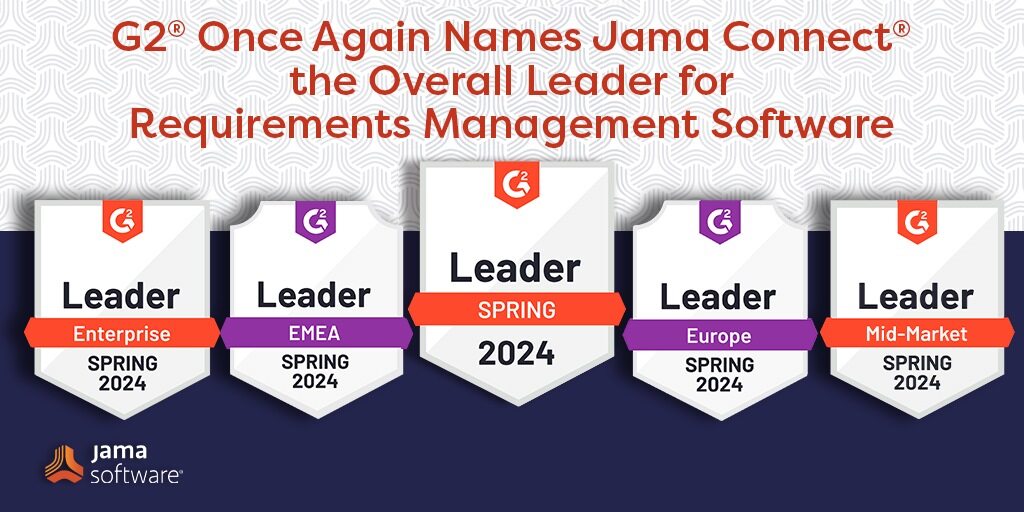
Jama Connect® Strengthens its Lead as the #1 Requirements Management Solution in G2®’s Summer 2024 Report
We are thrilled to announce that Jama Connect® has once again been named the overall leader in the G2 Grid® Report for Requirements Management Software for Summer 2024.
G2’s rankings are based on authentic user reviews and data gathered from online sources and social networks, analyzed through their unique v3.0 algorithm. The Summer 2024 G2 Grid® Report reflects scores calculated up until June 4, 2024.
In addition to being recognized as the top requirements management software, Jama Connect® has earned several other accolades for Summer 2024:
Overall Leader
Enterprise Leader
EMEA Leader
Europe Leader
Small-Business Leader
Mid-Market Leader
Momentum Leader
Learn more about the Summer 2024 G2 Grid for top Requirements Management Software products: DOWNLOAD IT HERE
Jama Software® is honored to receive this recognition, which highlights the value we bring to our customers, especially those moving from document-based approaches to complex product, systems, and software development. We are grateful to our customers for their valuable feedback on our product, services, and support.
Customer Feedback Highlights
“Jama [Connect] is not only a ‘document-oriented’ ALM tool, it gives the organization the ability to map the project structure the product structure making it an easy entry point for R&D folks. Configured properly, it is a real technical and regulatory ‘single source of truth.” – Frederic Fiquet, Director, Systems Engineering
“Product Design teams need a requirements management tool like Jama [Connect]. Using Jama Connect allows our software development team to have a well-organized and well-written set of requirements. It allows us to more easily maintain a baseline of features in our continuously evolving software.” — Mark M., Mid-Market
Our commitment is to provide the best possible experience for our users, and being named the overall leader is a testament to their satisfaction and success with Jama Connect.
From all of us at Jama Software, thank you!
How to Overcome Development Challenges: Proving Regulatory Compliance in Complex Product and Systems Development
As we enter the second half of 2024, development of complex products and systems often encounters the intricate web of regulatory compliance. From medical devices and automotive components to aerospace systems and software applications, ensuring adherence to stringent regulations is critical for both market access and consumer safety. However, proving regulatory compliance presents a multitude of challenges that can impede development timelines, inflate costs, and complicate project management. Fortunately, tools like Jama Connect® offer robust solutions to these challenges, streamlining the compliance process and enhancing overall efficiency.
The Challenges of Proving Regulatory Compliance
1: Diverse and Evolving Regulation
Complexity: Different industries are governed by a myriad of regulatory bodies, each with its own set of rules and standards. For example, the medical device industry must comply with FDA regulations in the U.S., CE marking in Europe, and various other international standards.
Evolution: Regulations are not static; they evolve to keep pace with technological advancements, emerging risks, and geopolitical changes. This continuous evolution necessitates constant monitoring and adaptation.
2: Traceability and Documentation
Traceability: Ensuring traceability from requirements through to testing and validation is essential for demonstrating compliance. This involves linking every design decision, change, and test result back to the initial regulatory requirements.
Documentation: Regulatory bodies demand extensive documentation as proof of compliance. Managing and organizing these documents can be a herculean task, particularly in large-scale projects with numerous stakeholders.
3: Collaboration and Communication
Interdisciplinary Teams: Complex systems development typically involves interdisciplinary teams, including engineers, designers, testers, and compliance officers. Effective collaboration and communication across these teams are crucial for ensuring that compliance is maintained throughout the development lifecycle.
Stakeholder Alignment: Aligning all stakeholders on compliance goals and processes can be challenging, especially in large organizations with decentralized teams.
4: Risk Management
Identification: Identifying potential risks related to regulatory compliance early in the development process is critical. These risks can stem from technological uncertainties, supply chain issues, or changes in regulatory requirements.
Mitigation: Developing and implementing strategies to mitigate identified risks requires a proactive and systematic approach, integrating risk management into the overall development process.
Jama Connect is a comprehensive requirements management platform designed to address the complexities of regulatory compliance in product and systems development. Here’s how it helps teams navigate and overcome these challenges:
“We develop complex products that require multidisciplinary work and V-cycle traceability. A tool like Jama Connect is required, and Jama Connect does the job well.” – Nicolas Ohlmann, CTO, CIXI
1: Centralized Requirement Management
Unified Platform: Jama Connect provides a centralized platform where all requirements, tests, and risks can be managed and tracked. This unified approach ensures that all compliance-related information is easily accessible and up-to-date.
Real-Time Updates: With real-time updates and version control, teams can ensure that everyone is working with the most current information, reducing the risk of compliance breaches due to outdated data.
“Jama Connect is a modern solution for requirement management. Other tools are either outdated, cheap, modern-looking clones of IBM DOORS, or insufficient in functionality.” – Requirement Manager, Professional Services Company
2: Enhanced Traceability
End-to-End Traceability: Jama Connect enables end-to-end traceability by linking requirements, design decisions, test cases, and validation results. This comprehensive traceability ensures that all regulatory requirements are met and can be easily demonstrated during audits.
Audit Trails: Detailed audit trails provide a clear record of all changes and decisions, facilitating smoother and more efficient compliance audits.
3: Collaboration and Communication Tools
Cross-Functional Collaboration: Jama Connect fosters collaboration across interdisciplinary teams through its integrated communication tools. This ensures that all team members are aligned on compliance objectives and can easily share information and updates.
Stakeholder Engagement: The platform supports stakeholder engagement by providing customizable dashboards and reports, enabling clear and effective communication of compliance status and progress.
“Investing in a good requirements management tool is a logical step to avoiding the common pitfalls of software development projects. Jama Connect provides the necessary tools to allow a team to manage huge amounts of requirements.” – Director, Solutions Delivery
4: Robust Risk Management
Risk Identification and Assessment: Jama Connect includes tools for identifying and assessing compliance risks, integrating risk management into the overall development process from the outset.
Risk Mitigation Plans: The platform supports the development and tracking of risk mitigation plans, ensuring that potential compliance issues are addressed proactively and systematically.
“I have used various requirements management tools throughout my career spanning over two decades and Jama Connect scores big when it comes to user interface. It is very easy to onboard the tool into the system with minimal training needs for the user groups. This does not belittle the functional core that a creator could do with the tool configuring it. I highly recommend Jama Connect for any organization working on safety-critical systems.” – Senior Manager, Biotechnology Company
Proving regulatory compliance in complex product and systems development is fraught with challenges, from navigating diverse and evolving regulations to ensuring traceability and effective collaboration. Jama Connect provides a powerful solution to these challenges, offering a centralized platform for requirement management, enhanced traceability, robust collaboration tools, and comprehensive risk management capabilities. With Jama Connect, teams can keep up with the ever-changing regulations thanks to our solutions developed and updated by our leading industry experts. By leveraging Jama Connect, teams can streamline the compliance process, reduce risks, and ultimately deliver high-quality, compliant products to market more efficiently.
“We use Jama Connect for requirements, risk, and verification/validation management, as well as integrating Jira and Enterprise Architect. Having traceability in one tool is going to be so helpful for our product development.” – Principal Systems Engineer, Health Care Providers & Services Company
Whether you’re developing cutting-edge medical devices, innovative automotive systems, or advanced software applications, Jama Connect can help you navigate the complexities of regulatory compliance and achieve your development goals with confidence.
Note: This article was drafted with the aid of AI. Additional content, edits for accuracy, and industry expertise by McKenzie Jonsson, and Mark Levitt.