What Is a Software Design Specification? Key Components + Template

The Essential Guide to Requirements Management and Traceability

What Is a Software Design Specification? Key Components + Template
Every downstream engineer eventually asks the same question: how exactly are we building this? A software design specification gives your team a shared, reviewable description of architecture, interfaces, data, and design decisions before code and integration work begin.
In regulated industries, the same document ties requirements to implementation and verification, so design intent is recorded before development moves too far ahead. This guide covers what a software design specification is, what it should include, how it differs from a software requirements specification, and how to write one that supports clear review and traceability.
What Is a Software Design Specification?
A software design specification is a document that describes how software will be built to satisfy its requirements. IEEE 1016 defines it as a representation of a software system used to communicate design information. Where a requirements document captures what the software must do, the design specification captures how the team plans to implement it, from architecture and module structure through data models, interfaces, and the rationale behind each design decision.
Regulators and auditors expect both artifacts, and they expect the design specification to come before implementation, not after. The document should guide how the software gets built, not retroactively describe what was already built.
Software Design Specification vs. Software Requirements Specification
The software requirements specification (SRS) and the software design specification are distinct, sequential documents. An SRS defines functional, performance, interface, and safety requirements, while the design specification translates those requirements into an implementable architecture with module designs, algorithms, data structures, and interface definitions.
Here’s how they compare across four dimensions:
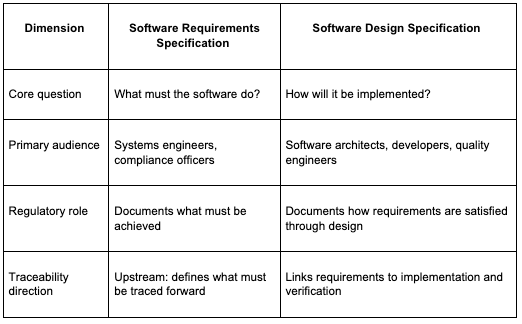
Safety standards like ISO 26262 (automotive functional safety) and DO-254 (airborne hardware) commonly expect separate requirements and design documentation, with rigor scaled to the software’s safety classification, meaning how severe the consequences would be if the software failed.
Where the Software Design Specification Fits in the Development Lifecycle
The software design specification sits in the design phase of the V-model, a development framework where each design stage on the left side has a corresponding verification stage on the right. Requirements flow down through decomposition, design activities define the implementation approach, and the right side of the model verifies those decisions at the appropriate level.
Within the V-model, verification starts when the design is specific enough for review, inspection, and forward tracing into implementation and test. A strong design specification gives you a reviewable baseline before the first integration milestone forces unresolved issues into the open.
Why Your Team Needs a Software Design Specification
Skipping or underspecifying the design specification shifts effort into debugging, integration, and audit preparation, where the cost is higher and the timeline is longer. A well-maintained design specification pays for itself in a few specific ways:
- Alignment across disciplines: When teams interpret the same requirement differently, the first integration milestone turns into a discovery exercise. A design specification makes design intent concrete enough to review and challenge. Connected requirements traceability workflows keep interfaces and verification artifacts tied to the same source requirements so reviewers don’t have to reconstruct the chain by hand.
- Traceability from requirements to implementation: The traceability matrix linking the SRS to the design specification is one of the artifacts auditors check most closely. Each design element should trace back to a requirement, and each requirement should trace forward to design and test. If the chain breaks, you’ll usually find the gap later, when correcting it costs more.
- Reduced rework and scope drift: Engineers fill in the blanks, teams make conflicting assumptions, and the product grows away from its approved requirements. A design specification limits that drift by defining boundaries, recording decisions and their rationale, and making downstream impact visible when requirements change.
These controls give your team a clearer way to evaluate change before it turns into avoidable rework.
Key Components of a Software Design Specification
Regulated environments typically expect the software design specification to cover architecture, data, interfaces, and constraints with enough detail for review. The content categories stay consistent across industries, even when the format doesn’t. A complete software design specification typically includes:
- System architecture and module design: How the system is partitioned, how modules interact, and where each major requirement is realized. At the module level, include algorithms, data structures, interface definitions, and safety segregation boundaries.
- Data models and persistence: The data structures that affect behavior and verification, including core entities, data flow, and storage constraints that could affect correctness or safety.
- Interface and API definitions: Data formats, protocols, timing behavior, and error handling for both internal and external interfaces. This is where mismatched assumptions between teams tend to surface first.
- Non-functional constraints and design rationale: Non-functional constraints describe how the system must perform, not what it must do. Cover performance limits, security controls, and scalability assumptions, and pair each one with the rationale behind the chosen approach.
- User interface design (where applicable): Screen layouts, navigation flows, and interaction patterns for user-facing systems. Safety-critical systems may also need operator display and alarm specifications.
If your team undervalues the data model and interface sections, the gap usually shows up during integration, when different groups interpret data ownership or lifecycle differently.
How to Write a Software Design Specification
Writing a software design specification is about preserving design intent in a form reviewers can follow. You’ll get better results when you organize the specification around traceability and change control from the start.
1. Define the Scope and Purpose
The first step is establishing the system context and document boundary, clarifying which requirements are covered, which subsystems are included, and which interfaces cross into other specifications or teams.
That clarity prevents two common problems: designing work nobody requested, and leaving an interface undescribed because each team assumed the other owned it.
2. Map Design Decisions to Requirements
A design specification is much easier to review when every major architectural choice maps to a requirement in the SRS. That connection tells reviewers why each element exists and whether it belongs.
In regulated environments, missing links quickly become audit issues. If a design element has no upstream requirement, reviewers question it. A requirement with no downstream design element raises the same concern from the opposite direction, because it suggests the requirement was never actually implemented.
3. Add Diagrams and Visual Aids
Once you’ve mapped decisions to requirements, the next challenge is making them reviewable. Diagrams give reviewers a faster way to understand module boundaries, interfaces, and deployment assumptions than prose alone can.
Two standardized visual modeling languages are common here. Unified Modeling Language (UML) works well for software-dominant systems. Systems Modeling Language (SysML) is usually the better fit when the design includes meaningful hardware, firmware, and system interactions because it supports requirement views and constraint modeling alongside structure and behavior.
4. Review, Iterate, and Maintain
Software design specifications are rarely complete in one pass. They improve through peer review and formal baseline control as requirements and interfaces mature.
You should plan reviews early, update the document when changes occur, and connect design updates to verification and validation planning so each design element still has a defined path to test.
Software Design Specification Template
The template below gives you a working starting point. Most teams adapt the depth and section order to fit their industry and regulatory context, but the structure stays consistent across projects.
1. Introduction
1.1 Purpose. This document describes the software design for [System Name], version [X.X]. It translates the requirements defined in [SRS Document ID] into an implementable architecture, module design, and interface specification.
1.2 Scope. This specification covers [subsystems included]. It does not cover [subsystems excluded or owned by other teams]. Interfaces to external systems are defined in Section 6.
1.3 Referenced documents. [SRS Document ID], [applicable standards such as IEEE 1016, ISO 26262, DO-178C], [related design or test specifications].
1.4 Definitions and acronyms. [Define terms, abbreviations, and acronyms used in this document that readers may not know or that carry a specific meaning in this project.]
2. System Overview
[Provide a brief, high-level description of the system being designed, its primary functions, and its operating environment. This section gives readers context before the detailed architecture sections.]
3. System Architecture
3.1 Architecture overview. [Describe the top-level decomposition. Include a block diagram showing major components, their responsibilities, and how they communicate. Identify where each high-level requirement is realized.]
3.2 Design rationale. [Explain why this architecture was chosen over alternatives. Reference any trade studies or prototyping results.]
4. Module Design
Repeat this section for each module.
4.N.1 Module name and purpose. [What does this module do? Which requirements does it satisfy?]
4.N.2 Processing logic. [Describe algorithms, control flow, and timing behavior. For safety-related modules, specify isolation boundaries.]
4.N.3 Data structures. [Define internal data representations and storage formats that affect behavior or interface compatibility.]
4.N.4 Interfaces. [List inputs, outputs, dependencies, and communication contracts with adjacent modules.]
5. Data Design
5.1 Data model. [Define database schemas, core entities, and relationships. Include an entity-relationship diagram if applicable.]
5.2 Data flow and storage constraints. [Describe how data moves through the system, any transformation rules, and persistence requirements that affect correctness or safety.]
6. Interface Definitions
6.1 Internal interfaces. [Specify data formats, protocols, and error handling expectations between internal components.]
6.2 External APIs. [Define external-facing interfaces, including authentication, data contracts, timing behavior, and versioning.]
7. Non-Functional Constraints
[For each constraint (performance, security, reliability, scalability), state the requirement, the design approach, and the rationale for choosing it over alternatives.]
8. User Interface Design (if applicable)
[Document screen layouts, navigation flows, operator display requirements, and alarm presentation for user-facing or safety-critical systems.]
9. Traceability Matrix
[Map each design element to its source requirement (backward trace) and to its verification activity (forward trace). Flag any requirements without a design element or design elements without a source requirement.]
10. Revision History
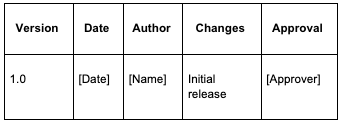
Adapt the depth of each section based on your project’s risk level and regulatory requirements. Higher-risk software typically needs more formal detail in Sections 4 and 7, while lower-risk systems can keep those sections lighter.
Ready to Find Out More?
Our team of experts is here to answer any questions and learn how we can help enable your continued success. Get started with a free 30-day trial, or book a demo!
Best Practices for Software Design Specifications
Three things tend to keep a design specification useful over time:
- Consistent terminology across sections: If one section says “module” and another says “service” for the same thing, reviewers have to guess whether the terms are equivalent. Pick one name for each concept and use it everywhere, including in trace links and test references.
- Cross-discipline review before sign-off: Systems engineers, software leads, test engineers, and quality reviewers each catch different classes of risk. Getting their input before the design feels finished surfaces interface mismatches and verification gaps while they’re still cheap to fix.
- Version control with change rationale: A design specification loses value when your team can’t tell which version is current. Preserve revision history and the reasoning behind each change so that later reviewers don’t have to reconstruct decisions from memory.
These habits keep the specification useful throughout development, not just at release time.
Choosing the Right Tools for Software Design Specifications
Once the process is clear, the question becomes where to manage it. Word and Excel can work for small teams with limited complexity, but the challenge appears when your software design specification has to stay aligned with hundreds or thousands of requirements, test cases, and review records across multiple disciplines. At that point, document files become maintenance burdens, and teams spend time reconciling versions instead of reviewing design decisions.
Your evaluation should focus on a few capabilities:
- Trace link support: Connect requirements, design elements, risk items, and tests without rebuilding relationships by hand.
- Review control: Capture approvals and revision history in a form that can be checked during audits and milestone reviews.
- Downstream impact visibility: Show what changed, which items are affected, and which baselines remain valid.
Jama Connect® is one example of a tool built for this. It connects requirements, design, test, and risk artifacts in a single traceable record and uses Live Traceability™ to flag downstream impacts automatically when upstream items change, so you can assess the scope of a design change before it turns into unplanned rework.
Close the Gap Between Design and Verification
A software design specification gives engineers the architectural detail they need and gives quality teams a record they can audit without reconstruction. The format is less important than whether the design stays explicit, current, and linked closely enough to requirements that reviewers can follow the chain without guesswork.
If you want to see how design elements, requirements, and test cases connect in practice, you can start a free 30-day trial of Jama Connect and explore Live Traceability with your own project data.
Frequently Asked Questions About Software Design Specifications
Who is responsible for writing a software design specification?
Software architects or lead developers typically own it, with input from systems engineers and quality engineers. In regulated environments, quality or regulatory reviewers will usually check the document before formal baseline approval, so it’s worth involving them early.
How detailed should a software design specification be?
That depends on software risk, system complexity, and regulatory expectations. Higher-risk software usually requires more formal detail for algorithms, interfaces, and unit-level design. Lower-risk systems can use a lighter format, but you’ll still need enough detail for meaningful review and verification.
Do agile teams still need software design specifications?
Yes. Agile changes how teams create and revise the document, not whether they need it. Most agile teams don’t write the whole specification upfront. Instead, they update it iteratively so architecture and trace links stay current as requirements evolve.
When should you update a software design specification?
You should update the software design specification whenever a requirement or design decision changes in a way that affects implementation or verification. Don’t wait until after development moves ahead on the changed design. Controlled baselines at major milestones make it easier to compare revisions and explain decisions during review or audit.