Live Traceability vs. After-the-Fact Traceability
The Essential Guide to Requirements Management and Traceability

Chapters
- 1. Requirements Management
- Overview
- 1 What is Requirements Management? A Complete Guide
- 2 Why Do You Need Requirements Management?
- 3 Four Stages of Requirements Management Processes
- 4 Adopting Agile Requirements Management Tools
- 5 Status Request Changes
- 6 Conquering the 5 Biggest Challenges of Requirements Management
- 7 Three Reasons You Need a Requirements Management Solution
- 8 Guide to Poor Requirements: Identify Causes, Repercussions, and How to Fix Them
- 9 What Is a Requirements Management Plan? A Practical Guide
- 10 Enterprise Requirements Management: Keeping Traceability Current
- 2. Writing Requirements
- Overview
- 1 Functional Requirements Examples and Templates
- 2 What Is a Product Requirements Document? A Complete PRD Guide
- 3 What Is a User Requirement Specification (URS)? How to Write and Manage One
- 4 Identifying and Measuring Requirements Quality
- 5 How to Write a System Requirements Specification (SRS) Document
- 6 The Fundamentals of Business Requirements: Examples of Business Requirements and the Importance of Excellence
- 7 What Is a Compliance Risk Assessment? Steps, Framework, and Examples
- 8 Adopting the EARS Notation to Improve Requirements Engineering
- 9 Jama Connect Advisor™
- 10 Frequently Asked Questions about the EARS Notation and Jama Connect Advisor™
- 11 How to Write an Effective Product Requirements Document (PRD)
- 12 Functional vs. Non-Functional Requirements
- 13 What Are Nonfunctional Requirements and How Do They Impact Product Development?
- 14 What Is a Software Design Specification? Key Components + Template
- 15 Characteristics of Effective Software Requirements and Software Requirements Specifications (SRS)
- 16 8 Do’s and Don’ts for Writing Requirements
- 17 Project Requirements: Types, Process, and Best Practices
- 18 INCOSE Guide to Writing Requirements
- 19 How to Write Technical Requirements That Survive Verification
- 20 Types of Requirements in Engineering: A Complete Guide
- 3. Requirements Gathering and Management Processes
- Overview
- 1 Requirements Engineering
- 2 Requirements Analysis
- 3 A Guide to Requirements Elicitation for Product Teams
- 4 Requirements Gathering Techniques for Agile Product Teams
- 5 Requirements Gathering in Software Engineering: Process, Techniques, and Best Practices
- 6 Defining and Implementing a Requirements Baseline
- 7 Managing Project Scope — Why It Matters and Best Practices
- 8 Requirements Decomposition and How AI Supports It
- 9 How Long Do Requirements Take?
- 10 How to Reuse Requirements Across Multiple Products
- 11 Requirements Prioritization Techniques: 7 Methods for Engineers
- 12 How to Run a Requirements Gathering Workshop
- 4. Requirements Traceability
- Overview
- 1 What Is Traceability in Product Development? A Guide for Regulated Teams
- 2 Tracing Your Way to Success: The Crucial Role of Traceability in Modern Product and Systems Development
- 3 Bidirectional Traceability: What It Is and How to Implement It
- 4 Change Impact Analysis (CIA): A Short Guide for Effective Implementation
- 5 What is Engineering Change Management (ECM)? A Complete Guide
- 6 What is Meant by Version Control?
- 7 Key Traceability Challenges and Tips for Ensuring Accountability and Efficiency
- 8 The Role of a Data Thread in Product and Software Development
- 9 Unraveling the Digital Thread: Enhancing Connectivity and Efficiency
- 10 What is a Traceability Matrix? A Guide to Requirements Traceability
- 11 How to Create and Use a Requirements Traceability Matrix (RTM)
- 12 Requirements Traceability Matrix Pros and Cons: A Practical Guide
- 13 Live Traceability vs. After-the-Fact Traceability
- 14 Overcoming Barriers to Live Requirements Traceability™
- 15 Requirements Traceability, What Are You Missing?
- 16 Requirements Traceability: Links in the Chain
- 17 What Are the Benefits of End-to-End Traceability During Product Development?
- 18 Requirements Volatility: 7 Essential Management Strategies
- 19 FAQs About Requirements Traceability
- 20 What Is AI Traceability? How to Implement It
- 21 Product Traceability for Regulated Industries: A Complete Guide to Audit-Ready Compliance
- 22 What Is the Traceability Information Model?
- 23 Supply Chain Traceability: What to Send Suppliers and What to Get Back
- 24 What Is an Engineering Change Order (ECO)?
- 5. Solutions for Capturing and Tracking Requirements
- Overview
- 1 Selecting the Right Requirements Management Tools
- 2 Why Investing in Requirements Management Software Makes Business Sense During an Economic Downturn
- 3 Why Word and Excel Alone is Not Enough for Product, Software, and Systems Development
- 4 Can You Track Requirements in Excel?
- 5 What Is Application Lifecycle Management (ALM)?
- 6 Is There Life After DOORS®?
- 7 Requirements Management Tools Jira
- 8 Requirements Management Checklist: Selecting the Right Tool
- 6. Requirements Validation and Verification
- 7. Meeting Regulatory Compliance and Industry Standards
- Overview
- 1 Understanding ISO Standards
- 2 Understanding ISO/IEC 27001: A Guide to Information Security Management
- 3 What is DevSecOps? A Guide to Building Secure Software
- 4 Compliance Management
- 5 What Is Functional Safety (FuSa)? Standards, Lifecycle, and Where Programs Fail
- 6 Failure Mode and Effects Analysis (FMEA) Explained
- 7 TÜV SÜD: Ensuring Safety, Quality, and Sustainability Worldwide
- 8 What is IEC 62443? A Guide to Industrial Cybersecurity
- 9 DFARS Compliance: A Guide for Defense Contractors
- 10 CMMC vs FedRAMP: What’s Different and Which One Applies to You
- 11 Automotive SPICE (ASPICE) 4.0: A Complete Guide
- 12 Restriction of Hazardous Substances (RoHS) Compliance Guide
- 13 MISRA C and MISRA C++ Explained: Rules for Safer Embedded Code
- 14 REACH Compliance for Product Engineering Teams
- 15 Radio Equipment Directive (RED) Cybersecurity Requirements
- 8. Systems Engineering
- Overview
- 1 What is Systems Engineering? A Guide for Modern Engineering Teams
- 2 How Do Engineers Collaborate? A Guide to Streamlined Teamwork and Innovation
- 3 The Systems Engineering Body of Knowledge (SEBoK)
- 4 What Is MBSE? Model-Based Systems Engineering Explained
- 5 Digital Engineering Between Government and Contractors
- 6 Digital Engineering Tools: The Key to Driving Innovation and Efficiency in Complex Systems
- 7 What Is Bill of Materials (BOM) Management? A Guide to Controlling Product Data
- 9. Automotive Development
- Overview
- 1 Understanding IATF 16949: A Quick Guide to Automotive Quality Management
- 2 What Is ISO 21434? Automotive Cybersecurity Engineering Explained
- 3 What Is ISO 26262? A Guide to Functional Safety in Automotive
- 4 What Is ASIL? A Guide to Automotive Safety Integrity Levels in ISO 26262
- 5 What Is SOTIF? A Guide to ISO 21448 for ADAS Safety
- 10. Medical Device & Life Sciences Development
- Overview
- 1 The Importance of Benefit-Risk Analysis in Medical Device Development
- 2 Software as a Medical Device: Revolutionizing Healthcare
- 3 What’s a Design History File, and How Are DHFs Used by Product Teams?
- 4 Navigating the Risks of Software of Unknown Pedigree (SOUP) in the Medical Device & Life Sciences Industry
- 5 What Is ISO 13485? A Guide to Medical Device Quality Management Systems
- 6 What Is a Device Master Record (DMR)? Definition and FDA Requirements
- 7 What Is IEC 62304? Medical Software Guide
- 8 ISO 13485 vs ISO 9001: Understanding the Differences and Synergies
- 9 What You Need to Know: ANSI/AAMI SW96:2023 — Medical Device Security
- 10 Failure Modes, Effects, and Diagnostic Analysis (FMEDA) for Medical Devices: What You Need to Know
- 11 Embracing the Future of Healthcare: Exploring the Internet of Medical Things (IoMT)
- 12 What Is General Safety and Performance Requirements (GSPR)? What You Need To Know
- 13 What Is IEC 62366? Usability Engineering for Medical Devices
- 14 What Is the Quality Management System Regulation (QMSR)?
- 15 510(k) vs PMA: Differences in FDA Device Approval and Clearance
- 16 EU MDR Compliance Requirements and Timeline
- 17 Essential Performance Requirements and How to Identify Them
- 18 DHF vs DMR vs DHR: What Changed Under the FDA QMSR
- 19 Computer Software Assurance for Production and Quality Systems
- 20 IVDR Compliance: What Manufacturers Need to Know
- 21 IEC 60601-1 Guide for Medical Devices
- 22 A Guide to Medical Device Requirements Management
- 11. Aerospace & Defense Development
- Overview
- 1 What is ITAR Compliance? What Engineering Teams Need to Know
- 2 What Is DO-278A? A Guide for Compliance Teams
- 3 ARP4754B Explained: Changes, Recognition, and Compliance
- 4 What Is a Safety Integrity Level (SIL)? How to Calculate and Apply It
- 5 A Guide to Aerospace Requirements Management
- 6 What Is ARP4754A? A Complete Guide to Civil Aircraft and Systems Development Assurance
- 7 Understanding ARP4761A: Guidelines for System Safety Assessment in Aerospace
- 8 What Is DO-254? A Complete Guide to Airborne Hardware Design Assurance
- 9 What Is DO-178C? A Guide to Airborne Software Certification
- 12. Architecture, Engineering, and Construction (AEC industry) Development
- 13. Industrial Manufacturing & Machinery, Automation & Robotics, Consumer Electronics, and Energy
- 14. Semiconductor Development
- 15. AI in Product Development
- Overview
- 1 What Is AI in Product Development? A Complete 2026 Guide
- 2 AI Test Case Generation: A Complete Guide for Regulated QA Teams
- 3 Using AI to Write Software Requirements: What Works and What Doesn’t
- 4 What Is the Model Context Protocol (MCP) for Requirements Management?
- 5 AI for Systems Engineering: Benefits, Risks, and How to Start
- 6 How to Automate Requirements Management
- 7 Artificial Intelligence in Requirements Management
- 16. Risk Management
- 17. Product Development Terms and Definitions
Chapter 4: Live Traceability vs. After-the-Fact Traceability
Chapters
- 1. Requirements Management
- Overview
- 1 What is Requirements Management? A Complete Guide
- 2 Why Do You Need Requirements Management?
- 3 Four Stages of Requirements Management Processes
- 4 Adopting Agile Requirements Management Tools
- 5 Status Request Changes
- 6 Conquering the 5 Biggest Challenges of Requirements Management
- 7 Three Reasons You Need a Requirements Management Solution
- 8 Guide to Poor Requirements: Identify Causes, Repercussions, and How to Fix Them
- 9 What Is a Requirements Management Plan? A Practical Guide
- 10 Enterprise Requirements Management: Keeping Traceability Current
- 2. Writing Requirements
- Overview
- 1 Functional Requirements Examples and Templates
- 2 What Is a Product Requirements Document? A Complete PRD Guide
- 3 What Is a User Requirement Specification (URS)? How to Write and Manage One
- 4 Identifying and Measuring Requirements Quality
- 5 How to Write a System Requirements Specification (SRS) Document
- 6 The Fundamentals of Business Requirements: Examples of Business Requirements and the Importance of Excellence
- 7 What Is a Compliance Risk Assessment? Steps, Framework, and Examples
- 8 Adopting the EARS Notation to Improve Requirements Engineering
- 9 Jama Connect Advisor™
- 10 Frequently Asked Questions about the EARS Notation and Jama Connect Advisor™
- 11 How to Write an Effective Product Requirements Document (PRD)
- 12 Functional vs. Non-Functional Requirements
- 13 What Are Nonfunctional Requirements and How Do They Impact Product Development?
- 14 What Is a Software Design Specification? Key Components + Template
- 15 Characteristics of Effective Software Requirements and Software Requirements Specifications (SRS)
- 16 8 Do’s and Don’ts for Writing Requirements
- 17 Project Requirements: Types, Process, and Best Practices
- 18 INCOSE Guide to Writing Requirements
- 19 How to Write Technical Requirements That Survive Verification
- 20 Types of Requirements in Engineering: A Complete Guide
- 3. Requirements Gathering and Management Processes
- Overview
- 1 Requirements Engineering
- 2 Requirements Analysis
- 3 A Guide to Requirements Elicitation for Product Teams
- 4 Requirements Gathering Techniques for Agile Product Teams
- 5 Requirements Gathering in Software Engineering: Process, Techniques, and Best Practices
- 6 Defining and Implementing a Requirements Baseline
- 7 Managing Project Scope — Why It Matters and Best Practices
- 8 Requirements Decomposition and How AI Supports It
- 9 How Long Do Requirements Take?
- 10 How to Reuse Requirements Across Multiple Products
- 11 Requirements Prioritization Techniques: 7 Methods for Engineers
- 12 How to Run a Requirements Gathering Workshop
- 4. Requirements Traceability
- Overview
- 1 What Is Traceability in Product Development? A Guide for Regulated Teams
- 2 Tracing Your Way to Success: The Crucial Role of Traceability in Modern Product and Systems Development
- 3 Bidirectional Traceability: What It Is and How to Implement It
- 4 Change Impact Analysis (CIA): A Short Guide for Effective Implementation
- 5 What is Engineering Change Management (ECM)? A Complete Guide
- 6 What is Meant by Version Control?
- 7 Key Traceability Challenges and Tips for Ensuring Accountability and Efficiency
- 8 The Role of a Data Thread in Product and Software Development
- 9 Unraveling the Digital Thread: Enhancing Connectivity and Efficiency
- 10 What is a Traceability Matrix? A Guide to Requirements Traceability
- 11 How to Create and Use a Requirements Traceability Matrix (RTM)
- 12 Requirements Traceability Matrix Pros and Cons: A Practical Guide
- 13 Live Traceability vs. After-the-Fact Traceability
- 14 Overcoming Barriers to Live Requirements Traceability™
- 15 Requirements Traceability, What Are You Missing?
- 16 Requirements Traceability: Links in the Chain
- 17 What Are the Benefits of End-to-End Traceability During Product Development?
- 18 Requirements Volatility: 7 Essential Management Strategies
- 19 FAQs About Requirements Traceability
- 20 What Is AI Traceability? How to Implement It
- 21 Product Traceability for Regulated Industries: A Complete Guide to Audit-Ready Compliance
- 22 What Is the Traceability Information Model?
- 23 Supply Chain Traceability: What to Send Suppliers and What to Get Back
- 24 What Is an Engineering Change Order (ECO)?
- 5. Solutions for Capturing and Tracking Requirements
- Overview
- 1 Selecting the Right Requirements Management Tools
- 2 Why Investing in Requirements Management Software Makes Business Sense During an Economic Downturn
- 3 Why Word and Excel Alone is Not Enough for Product, Software, and Systems Development
- 4 Can You Track Requirements in Excel?
- 5 What Is Application Lifecycle Management (ALM)?
- 6 Is There Life After DOORS®?
- 7 Requirements Management Tools Jira
- 8 Requirements Management Checklist: Selecting the Right Tool
- 6. Requirements Validation and Verification
- 7. Meeting Regulatory Compliance and Industry Standards
- Overview
- 1 Understanding ISO Standards
- 2 Understanding ISO/IEC 27001: A Guide to Information Security Management
- 3 What is DevSecOps? A Guide to Building Secure Software
- 4 Compliance Management
- 5 What Is Functional Safety (FuSa)? Standards, Lifecycle, and Where Programs Fail
- 6 Failure Mode and Effects Analysis (FMEA) Explained
- 7 TÜV SÜD: Ensuring Safety, Quality, and Sustainability Worldwide
- 8 What is IEC 62443? A Guide to Industrial Cybersecurity
- 9 DFARS Compliance: A Guide for Defense Contractors
- 10 CMMC vs FedRAMP: What’s Different and Which One Applies to You
- 11 Automotive SPICE (ASPICE) 4.0: A Complete Guide
- 12 Restriction of Hazardous Substances (RoHS) Compliance Guide
- 13 MISRA C and MISRA C++ Explained: Rules for Safer Embedded Code
- 14 REACH Compliance for Product Engineering Teams
- 15 Radio Equipment Directive (RED) Cybersecurity Requirements
- 8. Systems Engineering
- Overview
- 1 What is Systems Engineering? A Guide for Modern Engineering Teams
- 2 How Do Engineers Collaborate? A Guide to Streamlined Teamwork and Innovation
- 3 The Systems Engineering Body of Knowledge (SEBoK)
- 4 What Is MBSE? Model-Based Systems Engineering Explained
- 5 Digital Engineering Between Government and Contractors
- 6 Digital Engineering Tools: The Key to Driving Innovation and Efficiency in Complex Systems
- 7 What Is Bill of Materials (BOM) Management? A Guide to Controlling Product Data
- 9. Automotive Development
- Overview
- 1 Understanding IATF 16949: A Quick Guide to Automotive Quality Management
- 2 What Is ISO 21434? Automotive Cybersecurity Engineering Explained
- 3 What Is ISO 26262? A Guide to Functional Safety in Automotive
- 4 What Is ASIL? A Guide to Automotive Safety Integrity Levels in ISO 26262
- 5 What Is SOTIF? A Guide to ISO 21448 for ADAS Safety
- 10. Medical Device & Life Sciences Development
- Overview
- 1 The Importance of Benefit-Risk Analysis in Medical Device Development
- 2 Software as a Medical Device: Revolutionizing Healthcare
- 3 What’s a Design History File, and How Are DHFs Used by Product Teams?
- 4 Navigating the Risks of Software of Unknown Pedigree (SOUP) in the Medical Device & Life Sciences Industry
- 5 What Is ISO 13485? A Guide to Medical Device Quality Management Systems
- 6 What Is a Device Master Record (DMR)? Definition and FDA Requirements
- 7 What Is IEC 62304? Medical Software Guide
- 8 ISO 13485 vs ISO 9001: Understanding the Differences and Synergies
- 9 What You Need to Know: ANSI/AAMI SW96:2023 — Medical Device Security
- 10 Failure Modes, Effects, and Diagnostic Analysis (FMEDA) for Medical Devices: What You Need to Know
- 11 Embracing the Future of Healthcare: Exploring the Internet of Medical Things (IoMT)
- 12 What Is General Safety and Performance Requirements (GSPR)? What You Need To Know
- 13 What Is IEC 62366? Usability Engineering for Medical Devices
- 14 What Is the Quality Management System Regulation (QMSR)?
- 15 510(k) vs PMA: Differences in FDA Device Approval and Clearance
- 16 EU MDR Compliance Requirements and Timeline
- 17 Essential Performance Requirements and How to Identify Them
- 18 DHF vs DMR vs DHR: What Changed Under the FDA QMSR
- 19 Computer Software Assurance for Production and Quality Systems
- 20 IVDR Compliance: What Manufacturers Need to Know
- 21 IEC 60601-1 Guide for Medical Devices
- 22 A Guide to Medical Device Requirements Management
- 11. Aerospace & Defense Development
- Overview
- 1 What is ITAR Compliance? What Engineering Teams Need to Know
- 2 What Is DO-278A? A Guide for Compliance Teams
- 3 ARP4754B Explained: Changes, Recognition, and Compliance
- 4 What Is a Safety Integrity Level (SIL)? How to Calculate and Apply It
- 5 A Guide to Aerospace Requirements Management
- 6 What Is ARP4754A? A Complete Guide to Civil Aircraft and Systems Development Assurance
- 7 Understanding ARP4761A: Guidelines for System Safety Assessment in Aerospace
- 8 What Is DO-254? A Complete Guide to Airborne Hardware Design Assurance
- 9 What Is DO-178C? A Guide to Airborne Software Certification
- 12. Architecture, Engineering, and Construction (AEC industry) Development
- 13. Industrial Manufacturing & Machinery, Automation & Robotics, Consumer Electronics, and Energy
- 14. Semiconductor Development
- 15. AI in Product Development
- Overview
- 1 What Is AI in Product Development? A Complete 2026 Guide
- 2 AI Test Case Generation: A Complete Guide for Regulated QA Teams
- 3 Using AI to Write Software Requirements: What Works and What Doesn’t
- 4 What Is the Model Context Protocol (MCP) for Requirements Management?
- 5 AI for Systems Engineering: Benefits, Risks, and How to Start
- 6 How to Automate Requirements Management
- 7 Artificial Intelligence in Requirements Management
- 16. Risk Management
- 17. Product Development Terms and Definitions
Live Traceability™ vs. After-the-Fact Traceability Explained
For decades, engineering teams relied on manual documentation to prove compliance, often scrambling just before an audit to link requirements to tests. This legacy approach (known as after-the-fact traceability) was sufficient when products were simpler, and development cycles were longer. However, in modern systems engineering, complexity has skyrocketed, rendering these manual methods obsolete. Today, successful organizations must anchor their innovation on interconnected data that updates in real time.
The shift from reactive documentation to proactive management is not just a preference; it is a necessity for reducing risk and ensuring quality. By understanding the distinction between Live Traceability and traditional methods, teams can better navigate the complexities of compliance and market demands.
What is Live Requirements Traceability?
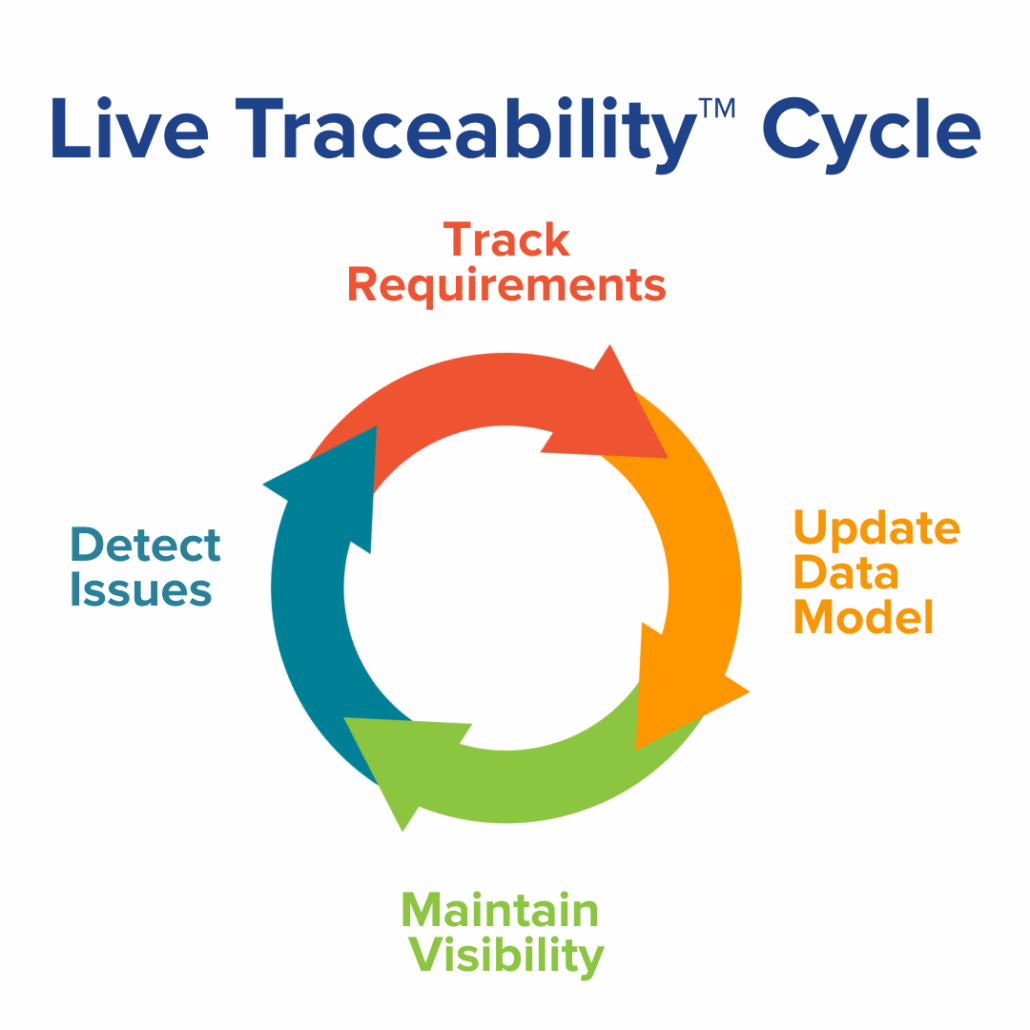
Live Traceability is the automated, continuous tracking of product requirements across the entire development lifecycle. Instead of static documents, it utilizes a dynamic data model where every requirement, test case, and risk is interconnected. This approach ensures that upstream and downstream information is always up-to-date, regardless of the tools or teams involved. By maintaining real-time visibility, engineering teams can detect issues instantly, rather than waiting for late-stage verification cycles.
RELATED ARTICLE: Experience Live Traceability™
What is After-the-Fact Traceability?
After-the-fact traceability is a reactive process that occurs after product development is largely complete. It typically involves a highly manual effort to recreate links between artifacts solely to satisfy industry standards or auditor requests. Because this documentation is generated at the end of the process, it often fails to reflect the actual state of the product during design. This “tick-the-box” exercise offers little value to the engineering process itself and frequently masks gaps in coverage until it is too late to fix them cost-effectively.
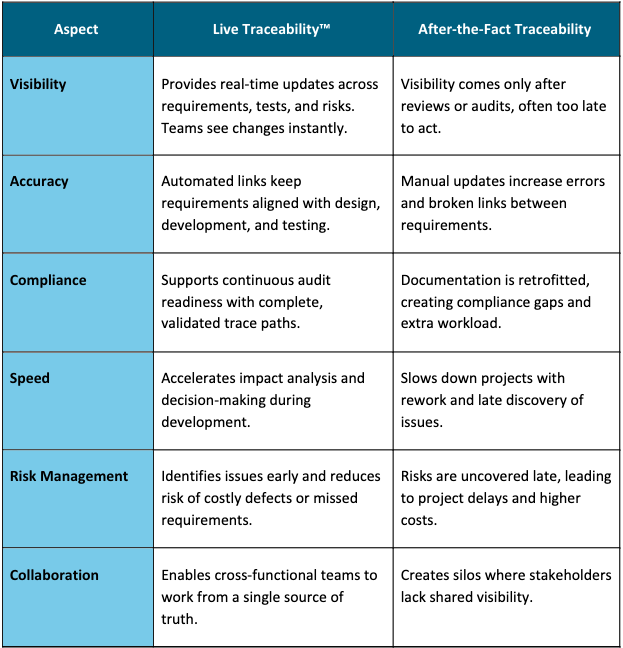
Key Differences Between Live and After-the-Fact
The distinction between these two approaches fundamentally changes how an organization manages risk and speed. While one treats traceability as a byproduct of compliance, the other leverages it as a strategic asset for development.
Ready to Find Out More?
Our team of experts is here to answer any questions and learn how we can help enable your continued success. Get started with a free 30-day trial, or book a demo!
Why Automation Improves Traceability Outcomes
Transitioning to Live Traceability relies heavily on requirements automation. When traceability is automated, the friction of maintaining links between siloed tools disappears. Engineers no longer need to update spreadsheets manually; instead, the system preserves the integrity of data relationships as changes occur. This automation leads to significantly improved outcomes, including reduced rework and continuous compliance. By removing the manual burden, teams can focus on innovation while trusting that their traceability data is accurate, complete, and audit-ready at any moment.
Conclusion
Live Traceability has effectively replaced manual methods as the industry standard for complex product development. It transforms traceability from a compliance burden into a competitive advantage, ensuring safety and quality from day one.
In This Webinar, We Cover Best Practices for Requirements Traceability
Live Traceability is the ability to see the most up-to-date and complete upstream and downstream information for any requirement, no matter the stage of systems development or how many siloed tools and teams it spans.
Book a Demo
See Jama Connect in Action!
Our Jama Connect experts are ready to guide you through a personalized demo, answer your questions, and show you how Jama Connect can help you identify risks, improve cross-team collaboration, and drive faster time to market.