How to Create and Use a Requirements Traceability Matrix (RTM)

The Essential Guide to Requirements Management and Traceability

How to Create and Use a Requirements Traceability Matrix (RTM)
Creating a Requirements Traceability Matrix (RTM) is more than just a documentation exercise; it is a critical step for ensuring product quality and achieving regulatory compliance. In the previous section, we defined the purpose of an RTM. Now, we will shift focus to the practical application: how to build one that effectively tracks requirements through the development lifecycle.
Without a properly structured RTM, teams risk “orphan” requirements — features that are built but never tested — or scope creep, where features are built without a defined requirement. By following a structured approach to creating and using an RTM, you ensure that every requirement is accounted for, tested, and validated before release.
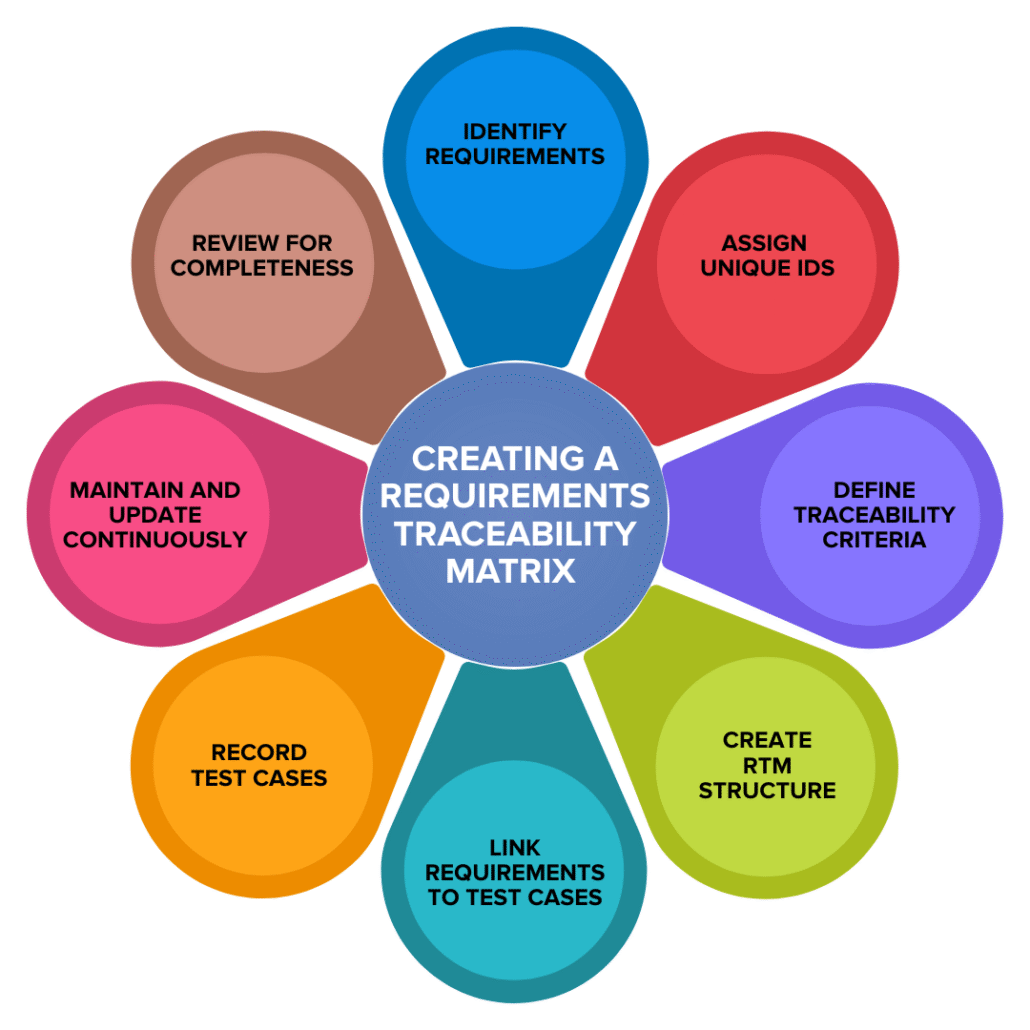
Steps to create a requirements traceability matrix
Building an RTM doesn’t need to be complex. Whether you are using a spreadsheet or a dedicated requirements management tool, teams can follow these standardized steps to ensure complete traceability:
- Identify requirements: Start by gathering all functional and non-functional requirements from stakeholders, specifications, or user stories. Ensure these are finalized and agreed upon before mapping begins.
- Assign unique IDs: Give each requirement a unique identifier (e.g., RQ-001) for easy tracking and reference. This ID allows you to trace the requirement across different documents and stages of the lifecycle.
- Define traceability criteria: Decide exactly what you need to trace. Common criteria include mapping requirements to test cases, requirements to design documents, or requirements to specific compliance standards.
- Create the RTM structure: Build your matrix. If using a spreadsheet, create columns for Requirement ID, Requirement Description, Test Case ID, and Status. Best-in-class software, like Jama Connect, will automatically generate this structure.
- Link requirements to test cases: Map each requirement to one or more test cases that validate it. This creates your “forward traceability,” ensuring that development goals are being met by testing.
- Record test results: As testing occurs, update the matrix with execution results (Passed, Failed, In Progress) for each requirement. This provides a snapshot of project health.
- Maintain and update continuously: An RTM is a living document. Keep it current throughout the project lifecycle as requirements evolve or change.
- Review for completeness: Regularly check that every requirement has at least one linked test case and that no test is “orphaned” (unlinked to a requirement).
While these steps provide the necessary structure, maintaining an RTM manually can become time-consuming as projects scale. That’s where automation becomes critical.
Ready to Find Out More?
Our team of experts is here to answer any questions and learn how we can help enable your continued success. Get started with a free 30-day trial, or book a demo!
Best practices for using a traceability matrix
Once an RTM is created, strict adherence to best practices ensures it delivers maximum value and doesn’t become a bottleneck.
- Keep it simple but complete: Avoid unnecessary complexity. Focus on essential columns like Requirement ID, Test Case ID, and Status to ensure the document remains readable and usable.
- Update continuously: Maintain the RTM throughout the lifecycle, not just at milestones. Waiting until the end of a project to update the matrix often leads to gaps in coverage and rushed documentation.
- Integrate with testing tools: Wherever possible, connect your RTM with QA systems so test results update automatically.
- Validate both directions: Ensure you have forward traceability (checking that requirements are tested) and backward traceability (checking that the code written actually serves a requirement).
- Include compliance references: For regulated industries (like medical devices or automotive), add a specific column linking requirements to standards or regulations to streamline audits.
- Use automation where possible: Manual spreadsheets are prone to human error. Using specialized software ensures accuracy, saves time, and prevents version control issues.
The real power of an RTM comes to life when applied to real-world projects, moving from theory to practice.
Example of a requirements traceability matrix in action
An RTM becomes most valuable when applied to tangible development scenarios. For example, consider a development team building a secure login feature for a banking app. The RTM ensures each security requirement is strictly validated through linked test cases and results.
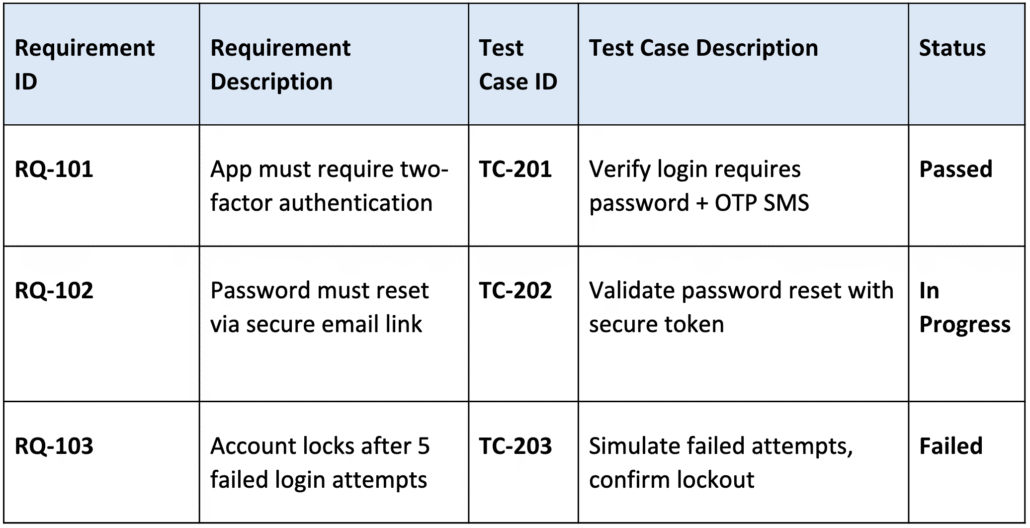
This example shows how requirements, test cases, and results are linked in a single view, providing full visibility and compliance evidence. In this scenario, the “Failed” status on TC-203 immediately alerts the team that a critical security feature is not functioning, preventing a potential vulnerability from reaching production. Without an RTM, missing test cases or failed validations might go unnoticed until late in the project.
Supporting Automated RTM Creation with Jama Connect
Manually creating and maintaining a requirements traceability matrix can be difficult to scale as requirements change over time. Jama Connect helps teams move beyond static spreadsheets by supporting automated traceability across requirements, test, and validation artifacts, improving visibility and alignment as development progresses.
This approach helps teams:
- Maintain traceability as requirements evolve
- Reduce manual effort associated with managing RTMs
- Improve visibility into requirement changes across teams
- Support collaboration between engineering, QA, and compliance
- Prepare for reviews and audits with greater confidence
Closing
Modern teams can’t scale RTM processes manually — automation with Live Traceability™ is the new standard for success. See how Jama Connect simplifies RTM creation and compliance reporting.
In This Webinar, Learn How to Improve Traceability and Enhance Coverage with Live Trace Explorer™
Book a Demo
See Jama Connect in Action!
Our Jama Connect experts are ready to guide you through a personalized demo, answer your questions, and show you how Jama Connect can help you identify risks, improve cross-team collaboration, and drive faster time to market.