As of today, we have completed the re-architecture of Jama Connect to AI-Native. This journey began two years ago, when we made the hard decision to re-architect to fully enable regulated, multidisciplinary engineering organizations to transition to AI-Driven Development. At the time, it was an aggressive decision given the level of investment, the uncertainty in the trajectory of LLM capability, its impact on product velocity and the adoption rates for regulated, multidisciplinary products. Now, it has become clear that AI-Driven Development can deliver step change improvements in product velocity across industries.
AI-Driven Development Requires AI-Native Architecture
AI-Driven Development requires reconfiguring the product development process and retooling to fully leverage AI engineering agent speed into product velocity gains. The product context layer (requirements, decompositions, relationships, test cases, test/simulation results, comments, reviews, etc.) that Jama Connect provides across all engineering disciplines and across all product versions, variants, branches, baselines and releases is even more critical in AI-Driven Development since AI agents can only leverage explicit knowledge (not tacit knowledge in engineers’ heads) and automated, parallel activity is required to achieve the desired product velocity gains.
An AI-native architecture at the product context layer must solve the following challenges for engineering organizations to achieve the desired product velocity gains from AI-Driven Development:
- Spec Driven Development | Engineers and AI engineering agents via MCP must be able to iterate and version in a shared context for specifications and context engineering.
- LLM Inference Quality & Token Efficiency | A product graph of explicit semantic relationships across all disciplines, specifications and versions must be accessible via MCP.
- Parallel Development | Engineers, AI agents, teams and disciplines must all be able to work in parallel in their natural cycle times.
- X-Discipline Automation | CI/CD pipelines must be deployed across all engineering disciplines to automate the state change actions of parallel development.
- Live State | The live state of product development across all disciplines and branches must be continuously maintained in the system.
- Scale | Projects must scale to 10 million items and instances to 100 million items to handle enterprise live state volumes.
- Compliance | All AI governance and industry standard compliance met with approvals and audit trails.
Addressing these challenges requires an architecture that at its core can manage and relate semantic data across all elements in the product graph and maintain a live state while they transform, branch/merge and trigger events. While competitors offer simple object relationships (object A has a link to object B), we provide semantic relationships that carry intent, direction, and logic. These semantic relationships are necessary for LLMs to make accurate, consistent and efficient inferences from product context information.
In competitive comparisons, our product graph delivers significantly greater LLM inference accuracy, consistency and token efficiency. This is critical as software development teams are already exceeding token utilization budgets and looking for efficiency gains.
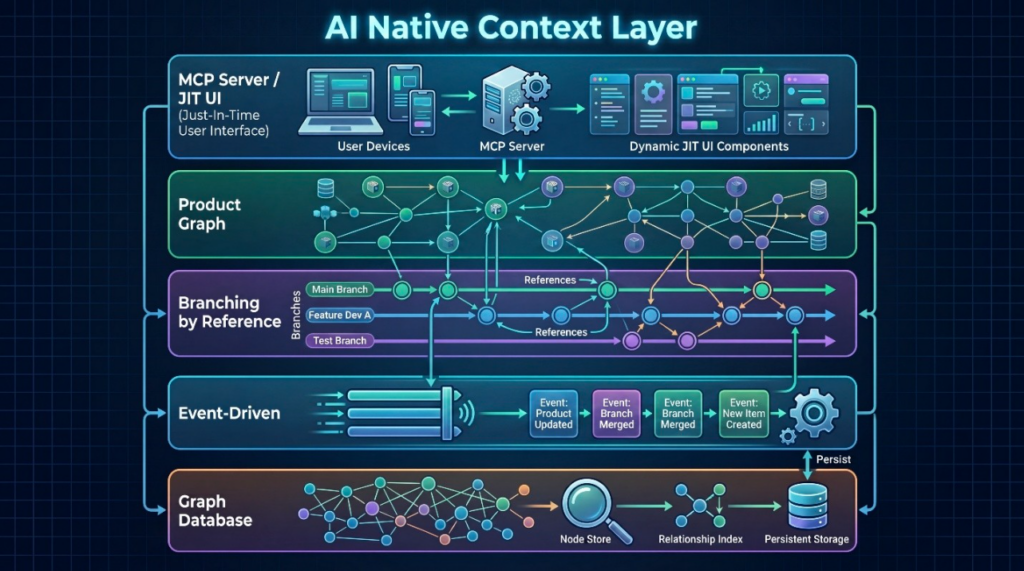
The graphic below shows the five layers of our AI-native architecture leveraging the most interoperable, proven and scalable approaches:
- MCP Server/JIT UI | To enable AI engineering agents and engineers with just in time UI generation or no UI at all (headless).
- Semantic Product Graph | To consistently manage combinatorial relationships across all disciplines, variants, versions, baselines, branches and releases.
- Branching by Reference | To perform at enterprise product line scale and complexity in a highly efficient manner.
- Event Driven | To satisfy the high demand for external requests for live state updates and CI/CD pipelines.
- Graph Database | To best handle the algebraic graph theory required to manage semantic relationships and 10X scalability requirements.
How does an AI-Native Architecture Differ from Legacy Tools?
AI-Driven Development fundamentally changes core assumptions of how engineering happens and requires an AI-native product context layer. Legacy architectures were built decades ago and assumed that the product context layer was tacit knowledge in engineers’ heads and not something that needed to be semantically modeled in the system. But LLMs require all relevant tacit knowledge to be explicit and infused with meaning in a semantic product graph.
Legacy tools focused on making the manual tasks of individual engineers more efficient through the UI of a discipline-specific desktop tool with information saved in flat data structures that do not support semantic relationships. Legacy architectures cannot support AI-Driven Development because they lack the 5 key AI-native architecture elements.
Achieving the 10X product velocity gains from AI-Driven Development requires an AI-native architecture at the product context layer. We invite you to engage with us and start working with the Jama Connect MCP™ released today.