Tag Archive for: Jama Software Company and Community News
As of today, we have completed the re-architecture of Jama Connect to AI-Native. This journey began two years ago, when we made the hard decision to re-architect to fully enable regulated, multidisciplinary engineering organizations to transition to AI-Driven Development. At the time, it was an aggressive decision given the level of investment, the uncertainty in the trajectory of LLM capability, its impact on product velocity and the adoption rates for regulated, multidisciplinary products. Now, it has become clear that AI-Driven Development can deliver step change improvements in product velocity across industries.
AI-Driven Development Requires AI-Native Architecture
AI-Driven Development requires reconfiguring the product development process and retooling to fully leverage AI engineering agent speed into product velocity gains. The product context layer (requirements, decompositions, relationships, test cases, test/simulation results, comments, reviews, etc.) that Jama Connect provides across all engineering disciplines and across all product versions, variants, branches, baselines and releases is even more critical in AI-Driven Development since AI agents can only leverage explicit knowledge (not tacit knowledge in engineers’ heads) and automated, parallel activity is required to achieve the desired product velocity gains.
An AI-native architecture at the product context layer must solve the following challenges for engineering organizations to achieve the desired product velocity gains from AI-Driven Development:
Spec Driven Development | Engineers and AI engineering agents via MCP must be able to iterate and version in a shared context for specifications and context engineering.
LLM Inference Quality & Token Efficiency| A product graph of explicit semantic relationships across all disciplines, specifications and versions must be accessible via MCP.
Parallel Development| Engineers, AI agents, teams and disciplines must all be able to work in parallel in their natural cycle times.
X-Discipline Automation| CI/CD pipelines must be deployed across all engineering disciplines to automate the state change actions of parallel development.
Live State| The live state of product development across all disciplines and branches must be continuously maintained in the system.
Scale| Projects must scale to 10 million items and instances to 100 million items to handle enterprise live state volumes.
Compliance| All AI governance and industry standard compliance met with approvals and audit trails.
Addressing these challenges requires an architecture that at its core can manage and relate semantic data across all elements in the product graph and maintain a live state while they transform, branch/merge and trigger events. While competitors offer simple object relationships (object A has a link to object B), we provide semantic relationships that carry intent, direction, and logic. These semantic relationships are necessary for LLMs to make accurate, consistent and efficient inferences from product context information.
In competitive comparisons, our product graph delivers significantly greater LLM inference accuracy, consistency and token efficiency. This is critical as software development teams are already exceeding token utilization budgets and looking for efficiency gains.
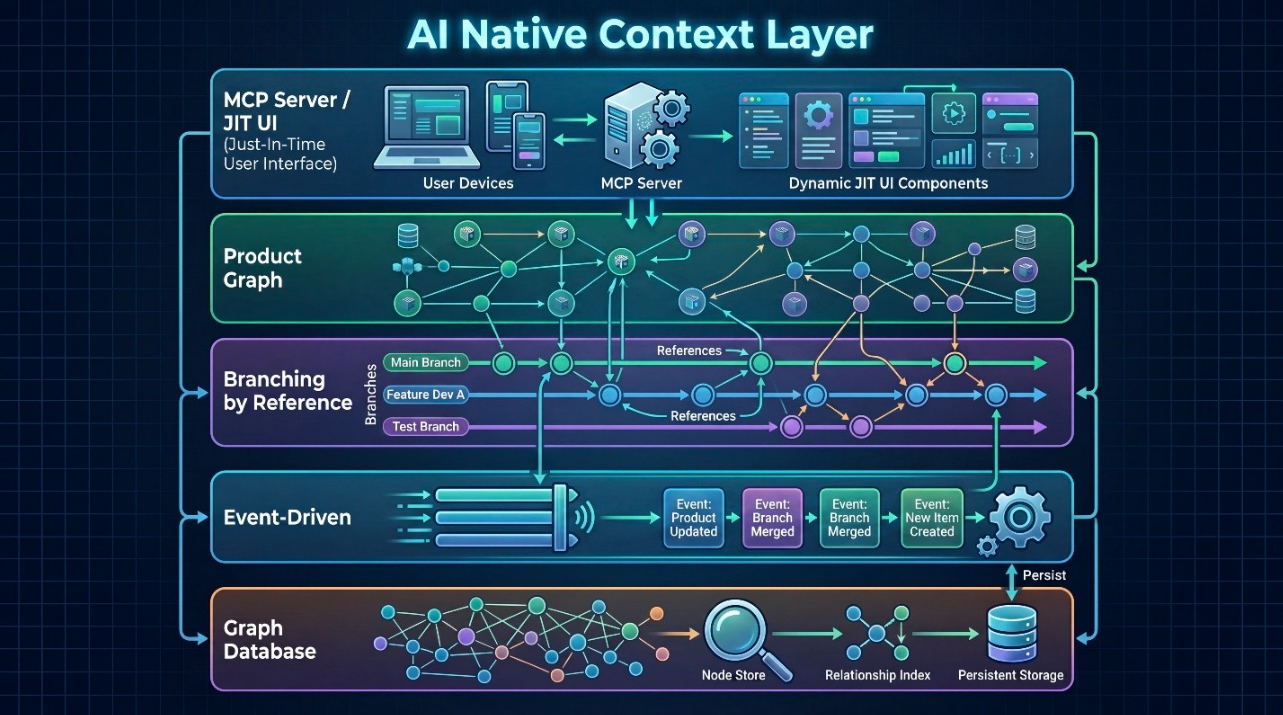
The graphic below shows the five layers of our AI-native architecture leveraging the most interoperable, proven and scalable approaches:
MCP Server/JIT UI| To enable AI engineering agents and engineers with just in time UI generation or no UI at all (headless).
Semantic Product Graph| To consistently manage combinatorial relationships across all disciplines, variants, versions, baselines, branches and releases.
Branching by Reference| To perform at enterprise product line scale and complexity in a highly efficient manner.
Event Driven| To satisfy the high demand for external requests for live state updates and CI/CD pipelines.
Graph Database| To best handle the algebraic graph theory required to manage semantic relationships and 10X scalability requirements.
How does an AI-Native Architecture Differ from Legacy Tools?
AI-Driven Development fundamentally changes core assumptions of how engineering happens and requires an AI-native product context layer. Legacy architectures were built decades ago and assumed that the product context layer was tacit knowledge in engineers’ heads and not something that needed to be semantically modeled in the system. But LLMs require all relevant tacit knowledge to be explicit and infused with meaning in a semantic product graph.
Legacy tools focused on making the manual tasks of individual engineers more efficient through the UI of a discipline-specific desktop tool with information saved in flat data structures that do not support semantic relationships. Legacy architectures cannot support AI-Driven Development because they lack the 5 key AI-native architecture elements.
Achieving the 10X product velocity gains from AI-Driven Development requires an AI-native architecture at the product context layer. We invite you to engage with us and start working with the Jama Connect MCP™ released today.
2026 Predictions for Medical Device & Life Sciences: AI, Wearables, and Navigating Regulatory Change
With 2026 on the horizon, the medical device and life sciences industries are moving through a landscape defined by fast-paced innovation, changing regulations, and dynamic market shifts.
From the transformative potential of Artificial Intelligence (AI) in product development and diagnostics to the growing role of wearables and personalized medicine, the industry is embracing change while addressing critical challenges like cybersecurity, data privacy, and supply chain resilience.
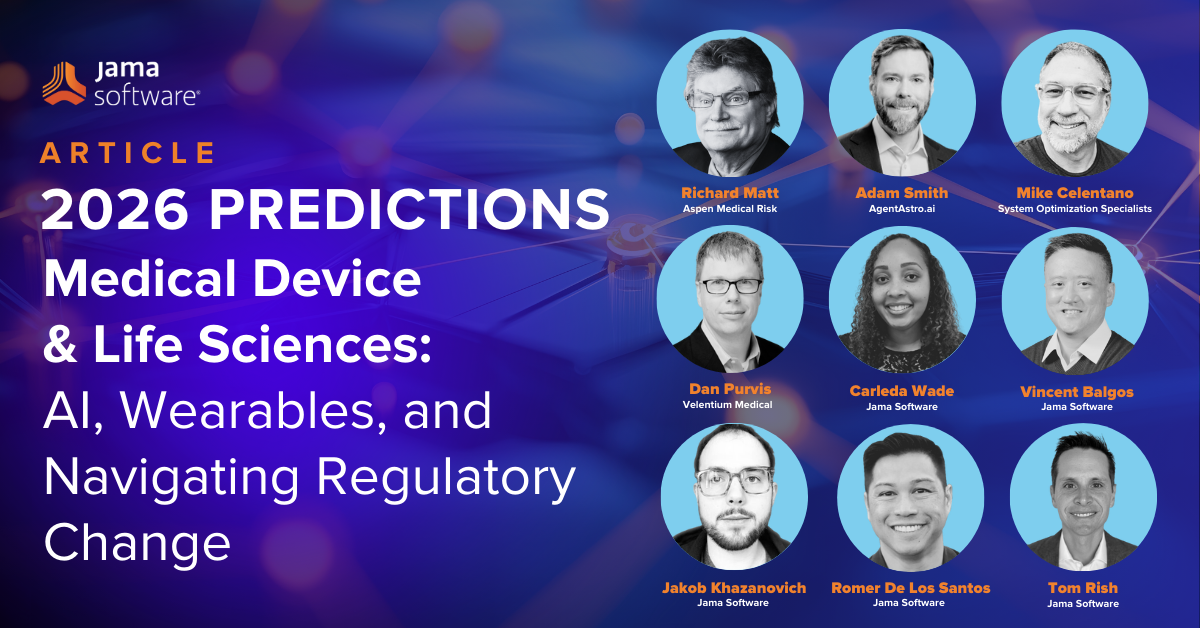
In this year’s predictions series, we’ve gathered insights from leading experts across the field, including:
Tom Rish, Senior Business Development Manager, Medical Device & Life Sciences
Together, they explore the opportunities and hurdles that lie ahead, offering a glimpse into the future of medical devices and life sciences.
Join us as these experts share their perspectives on the technologies, strategies, and innovations that will define the next chapter of the industry. From AI’s growing influence to the challenges of regulatory harmonization and the rise of wearables and personalized medicine, this piece highlights the trends shaping 2026 and beyond.
Q: How do you see AI shaping the future of medical device design and manufacturing, diagnostics, and patient engagement in 2026 and beyond?
Richard Matt: I see AI organizing and mining information that predicts more effective use of medical devices. AI will be used in product development to predict more effective product design and in post-market assessments to confirm or refute assumptions about the treatment’s effectiveness.
Adam Smith: AI has become the connective layer across the device lifecycle, replacing manual research with automated analysis of predicates, guidances, standards, and historical evidence. This reduces ambiguity, improves consistency, and supports more adaptive systems that learn from real-world performance. It also drives more personalized, device-integrated insights, bringing engineering, clinical, and regulatory teams into tighter alignment.
Mike Celentano: AI is already shaping the MedTech development space and will continue to increase its influence in 2026 and beyond. For example, systems engineers I work with already use AI to summarize and affinitize voice of customer interview verbatims into stakeholder needs. Some are also using AI to help organize their requirement statements. Others are using various AI personas as independent reviewers of their deliverables. In 2026, these uses will become more common. But other AI uses will emerge including AI-based trade analysis based on MBSE models since there is now a strong textual component to SysML. AI will also emerge more in risk analysis and root cause analysis. In short, wherever AI can make developers more efficient and/or increase quality, it will emerge as such.
Dan Purvis: AI has amazing abilities when harnessed well. There are many places where an algorithm can do a much better job than a person. I think that you are going to see more therapies with an AI component that makes a suggestion that is then reviewed by a person.
Vincent Balgos: What we’ve seen in industry so far is the continued strong interest in exploring how AI can contribute in developing safe and effective products, but with the limited ROI to date, industry seems to be taking a more methodical and deeper approach in discussing the more how and why of AI. Example, there is initiative to discuss data standardization of AI information following IEEE 2801 or other best practices gleaned from BigTech companies such as Microsoft, Amazon, and Google.
Carleda Wade: I’m seeing more customers looking to explore how they can incorporate AI into their development process. While many companies have yet to create full-blown policies on the use of AI at their organization, I can see this increasing in the coming years with the popularity of AI in everyday life. I think that people in our industry will be a bit conservative in their initial use of AI until FDA standards and guidelines are released. I could see it being very useful in processes like post-market surveillance.
Jakob Khazanovich: AI is becoming ubiquitous, but it will be a tool to work faster and smarter rather than a replacement for human engineers. In the future, initial draft requirements, test cases, or even entire trace matrices will be created by AI and then refined by engineers. Many companies will be slow to formally adopt the use of AI, but there is no question that engineers have a ChatGPT window open on the side to help them refine design artifacts quickly. In manufacturing generally, I could see AI being used to optimize part designs for strength, cost, and moldability.
Romer De Los Santos: AI has been growing fastest in imaging and genomic analysis for a while now. However, I’ve been seeing growing interest in using AI to accelerate their product development process by handling repetitive and tedious tasks. Jama Software is already moving towards automated test case generation, for example. I expect AI will help enable increased modularity of medical devices, manage complex product variants, and quickly identify and patch components with security issues.
Tom Rish: There is no escaping AI, and it is certainly poised to play a huge part in the evolution of the industry. I think most people thought it would revolutionize the products directly, and that will come with time. However, my takeaway from recent conferences is that companies are starting to take a more methodical approach to incorporating AI. After the initial surge in AI popularity, people are starting to realize how important it is to have a strong foundation of data. I believe companies will spend the immediate future organizing data and building good frameworks so that they can better incorporate AI into internal processes like product development and manufacturing.
Q: What ethical considerations should companies keep in mind as they integrate AI/ML into clinical decision-making and device functionality?
Matt: Companies need to rely on evidence of what AI can contribute and avoid rolling out product features based on speculation of what AI ‘should’ be able to accomplish.
Smith: I think companies need to be clear about how AI-driven decisions are made so clinicians can actually understand and trust what the system is doing. I also believe they need to watch for bias in the training data, because uneven performance across patient groups can create real clinical risk. And I think it’s important to stay accountable for how these models evolve over time, making sure updates are monitored so the systems remain safe and reliable in practice.
Celentano: ML in medical devices has been around for a couple of decades now. I worked on an ML fuzzy logic bG meter diagnostic algorithm in the early 2000’s. Then, and now, human verification and validation is essential. Just like when we use ChatGPT for something, we always double check the answer ourselves. Why? Because AI gets it’s knowledge from us, the internet, our databases, our programming, and all of that is not perfect. So the same applies for clinical decision making. Health Care providers must verify and validate the AI conclusions themself, and ultimately, humans must always take responsibility for the final answers.
Purvis: Keep a person “in the loop” as it allows for review, edit, and potential correction.
Balgos: Considering Med Industry’s ethos is to “do no harm,” I was happy to hear the talk about using standards such as ISO 42001 to ensure the responsible and ethical use of AI, including addressing the known bias in medical decision making in the clinical settings.
Wade: They should think about the inherited bias of the AI tool that they use, since it could unfairly classify data about certain demographics.
Khazanovich: Intellectual property concerns will need to be addressed to ensure AI-suggested content is not putting companies in any sticky situations.
De Los Santos: Companies need to have clear rules and controls around when and how to use AI when dealing with private health information.
Rish: It is hard to put anything other than data privacy at the top of this list. Whether it is patient data, information about clients, or proprietary product details, companies need to train their employees to use AI responsibly. It is so easy to copy/paste information into AI tools in the name of efficiency, but people need to think twice about what they are sharing.
Q: What emerging technologies do you believe will have the biggest impact on life sciences innovation in the next 12–18 months?
Matt: AI is the hands-down favorite.
Celentano: AI is one for sure. mRNA is also going to be huge in life sciences since it makes vaccines fast to develop, and any mRNA vaccine appears to have cancer-fighting benefits with immunotherapy that are next-level. One negative impact that will be felt for the next year to 10 years are the 2025 US budget cuts to NIH, CDC, and other long-term research activities.
Purvis: There are big things happening in wearables. The purchase of Nalu. The Medicare reimbursement for Cala. The market is beginning to realize that wearable neurotech has a lot of growth potential to benefit patients’ lives in a less invasive way.
Balgos: AI is the hottest tech right now to make the biggest impact, but the bigger impact is when these AI-enabled devices start talking to each other, with the common goal of supporting the patient and medical professionals. The Model Context Protocol (MCP) will be a key part of that impact.
De Los Santos: I expect that AI will be applied to product development processes to reduce bottlenecks.
Rish: Wearable devices have already had a profound impact on the industry, and I think their influence will only continue to grow. Companies are pushing the limits when it comes to providing excellent data, all from rather simple devices like rings, watches, etc. Details still need to be figured out on the regulatory side when it comes to indications, but patients want to know more about their health. My hope is that the trend of people taking a more proactive approach with their health continues with the continued rise of wearables.
Q: What regulatory shifts (e.g., EU MDR/IVDR enforcement, FDA changes, global harmonization) do you anticipate will most affect medical device and life sciences companies in 2026?
Matt: ISO 13485 brings with it a tremendous amount of explicit detail that was only present in regulations by ‘reading between the lines’. This increased detail about the behavior expected for compliance will affect medical device companies both broadly and deeply.
Smith: I think we’re about to see a wave of impact from AI systems that are purpose-built for regulated work, especially tools that can interpret standards, guidances, historical submissions, and clinical evidence in a structured way. I also believe digital twins and simulation platforms will start to play a bigger role in both device design and verification as companies look for faster ways to generate defensible evidence.
Celentano: There has been more regulatory focus on Interoperability and Cybersecurity lately. This will continue to intensify in terms of enforcement in 2026. More AI guidelines and perhaps regulations will also emerge.
Purvis: All agencies are continuing to focus on cybersecurity. Companies should make sure that they have a product cybersecurity (as opposed to general business/IT cyber) strategy right alongside development and manufacturing strategy.
Wade: The FDA’s harmonization of 21 CFR 820 with ISO 13485, which is slated to be effective in February 2026, will have a large impact on US-based companies. Many have known about this upcoming change for years, but will need to be fully compliant very soon.
De Los Santos: Of course, the FDA’s harmonization effort will have a large impact on the development of US medical devices. Meanwhile, in the EU, I expect that bottlenecks around full compliance with MDR for legacy medical devices will continue as manufacturers struggle, not only with making legacy development documentation compliant with the MDR, but getting it reviewed in a timely manner due to the limited capacity of notified bodies.
Rish: Without a doubt, QMSR is the thing I hear the most about. For those of us that have been in the industry for a while, we have seen a lot of changes (ISO13485 in 2016, ISO 14971 in 2019, EU MDR, and more). This is one change that feels like it is actually helping us out as the FDA is harmonizing with ISO 13485. It seems like this will help the industry become a little more streamlined, which hopefully leads to more and safer products being launched.
Balgos: QMSR transition will cause some immediate local impact on medical companies, especially those that are non-compliant to ISO 13485. Even those that are compliant, a revisit oftheir Quality Procedures will be needed. On a broader, global level scale, the continual changes in general strategy and the reduction in force in the medical related US Federal Agencies (FDA, NIH, CDC, etc) experienced personnel, will have longer term impacts in the way industry and academia pursue new medical innovation, the path to bring products to market, and the overall medical welfare of the general population.
Q: How are companies adapting their software and systems to meet evolving cybersecurity and data privacy requirements across global markets?
Matt: Cybersecurity is greatly under-considered in medical device design, resulting in extensive and growing opportunities for medical cyberattacks.
Celentano: Well, most MedTech companies are finally getting serious about Cybersecurity and privacy as well as data integrity, now that regulators are enforcing the regulations and standards more. Years ago, MedTech companies used to hire one person to be responsible for Cybersecurity. Now most companies have cyber teams, privacy teams, and data integrity teams, all with standard operating procedures, which makes each employee responsible for compliance.
Purvis: The best way to answer this is “systemically.” Companies are setting a comprehensive product cybersecurity strategy that bakes cybersecurity into every aspect of the pre-market cycle. Also, companies are realizing that post-market cybersecurity (ongoing surveillance) must be budgeted and planned for.
De Los Santos: Companies are purchasing or repurposing tools to help them generate new cybersecurity deliverables and update their customer notification systems to be in compliance with the final guidance on Cybersecurity in Medical Devices released just this year.
Rish: I believe the best companies will take a step back and rethink their approach to risk management. A lot of organizations complete risk activities in separate buckets. Things like cybersecurity, human factors, process risk, and more are all done at separate times and then merged into a disjointed system. Since technology is rapidly evolving, I think people need to take a more holistic view of risk. Put the patient or end user first by thinking about everything that can go wrong and how you can mitigate those risks at a systemic level.
Balgos: Due to the FDA’s Final Guidance on Cybersecurity in mid 2025, organizations are taking a more proactive approach to cybersecurity since it is now a required deliverable for device submissions. In addition, Med companies are seeking an integrated approach to both security + safety risk management in the processes & tools since both can impact each other’s associated Risk level, especially in this early era of AI.
Market Forces & Strategy
Q: What macro trends (e.g., supply chain resilience, sustainability, workforce shifts) do you think will influence strategic decisions in the industry next year?
Matt: The macro trend to bring employees who worked remotely back to the office after the rapid and uncontrolled increase in remote workers during the COVID pandemic.
Celentano: 2025 tariff wars will still have residual supply chain impacts in 2026 for MedTech. Reduced funding for research and other economic factors will make MedTech jobs more precious and harder to get. Reduced emphasis on sustainability will continue to flood the employment market with those specialists who now need to become more multi-disciplined. Software-related MedTech jobs will likely grow in comparison to electrical and mechanical job opportunities. Systems Engineering and Program Management jobs will likely increase next year due to the need for more integration of existing technologies and less investment in new technologies.
Purvis: The industry is seeing some positive changes in reimbursement. Several firms are seeing their strategic plan around study data pay off with reimbursement.
Wade: A lot of companies are very conservative with their make or buy decisions due to current tariffs, which will impact how they design their products.
Rish: It seems like the economy has been the main question mark ever since 2020. There have been some major highs and major lows. While private investment seems to be down, there is no denying that large companies are making news lately with some big mergers and acquisitions. I believe the larger players will continue to identify promising technology and take steps to acquire or partner with the organizations developing that technology.
Balgos: With lessons learned from the Covid Era and the current potential dynamics with the US Federal government, companies are focused on strengthening their supply chain to prevent or lessen global market & trade changes. Whether sourcing more locally, identifying equivalent substitutes, or even manufacturing their own materials, flexibility will be key to mitigate any turbulence in the supply chain.
Q: What differentiates companies that are thriving in this rapidly evolving landscape from those that are struggling to keep up?
Matt: A laser focus on the patient. This drives everything in medical devices, but many companies get distracted by technology, profit margins, or timelines. A laser focus on the patient cures all of these ills, but many companies don’t see the connection.
Smith: I think the companies that are thriving are the ones treating regulatory and quality work as a strategic asset, not a bottleneck, and adopting tools that give them clearer evidence and faster decision cycles. I also believe they’re the ones breaking down silos between engineering, clinical, and regulatory teams, so requirements, risks, and documentation stay aligned from the start. And I think the organizations that struggle are usually the ones holding onto legacy systems and manual processes, which makes it much harder to keep pace with shifting standards, rising submission volume, and growing complexity.
Celentano: Adapting to the sometimes surprising demands of the public and the governments. Being nimble to move resources toward new cash cows. For example, marketing Trizepitide, GLP, and GIP more for weight loss rather than diabetes.
Purvis: There are four key stakeholders in every MedTech business: patients, caregivers, corporate (hospital, surgery center, payers), and investors (which includes employees, management, and financial backers). The thriving companies have found a way to satisfy all of them well.
De Los Santos: Companies that are slow to use AI/ML may start to feel like their competition is speeding ahead of them.
Rish: From my experience in the industry, the companies that thrive fully reject the idea that regulations slow you down. Instead, they use regulations to build business practices that create efficiency and excellence. Those that set up smart business processes as part of a QMS significantly increase their chance of hitting product deadlines. They get products to the market faster and are also typically producing much safer products. They increase their revenue and reduce their audit findings.
Balgos: With the constant dynamics in the regulatory landscape, having a solid regulatory strategy that includes sub-topics like cybersecurity, quality compliance, and an actual commercialization plan will help keep companies nimble in the face of change.
Q: What’s the most innovative thing you’ve seen in the industry this year that you believe others will adopt in 2026?
Matt: A novel method to assess whether the benefits of a treatment exceed its risks. This has the ability to both bring new products to market more quickly and relaunch existing products into new patient populations and indications for use.
Smith: I think the most innovative shift I have seen this year is the way AI is beginning to shape entire medical device roadmaps rather than just isolated tasks. The work we are doing with the University of California is a good example, where Agent Astro is being used from the earliest concept conversations all the way through regulatory planning, predicate selection, testing expectations, and submission strategy. I believe this end –to-end use of AI will accelerate a broader shift in the industry, where regulatory affairs is no longer treated as a process-driven function at the end of development, but as a strategic driver that informs design choices, materials decisions, and overall product direction. I think this approach will spread quickly in 2026 because it brings consistency, reduces rework, and gives teams a much clearer path from idea to approval.
Celentano: Weight loss drugs will continue to make record profits. mRNA treatments will emerge to fight cancers. The most innovative products next year will solve medical problems for all patients and doctors, perhaps related to common pain points like healthcare access, healthcare insurance, or prescription drug costs.
Purvis: Bioelectric therapies that directly target the patient’s condition. More firms are realizing that a device play is valuable (in addition to pharmaceutical-based solutions).
Rish: I probably can’t claim it is the most innovative thing I’ve seen, but one of the most surprising innovative ideas is the FDA committing to using AI in their review process. It is great to see that the FDA is willing to modernize a bit, and I hope that leads to more streamlined and effective reviews for all parties. The goal shouldn’t be to just catch random things, but to focus on important topics so that safer products will be launched. I know companies are starting to use AI to prep for things like submissions and audits, and I think that will ultimately help them launch better products and reduce audit findings.
Balgos: The extraordinary rise in continuous glucose monitoring (CGM) devices and at-home testing kits (ala Covid) in the market demonstrates that device manufacturers can effectively market directly to consumers. This may open a wider range of wearables, at-home kits, and DIY applications that may broaden the adoption of FDA’s initial “Healthcare at Home”
Q: What’s one mistake or blind spot you see companies making that could hinder their success in the coming years?
Matt: Focusing on compliance instead of the patient.
Celentano: Many MedTech companies do a terrible job of eliciting and analyzing their stakeholder needs. They often build what they think their stakeholders want instead of providing them solutions they actually need.
Purvis: For startups: stick with what you are uniquely gifted to do and outsource everything else to quality partners. Your IP, your clinical, and your science should stay with you – all other aspects can be handled more cheaply and effectively by others.
De Los Santos: One of the biggest mistakes I see is companies creating huge and complex product development and risk management processes in response to regulatory changes. Congress has directed the FDA to take the least burdensome approach to evaluation of premarket medical devices. The amount of documentation and evidence should be commensurate with the security and safety risk of the device.
Rish: As discussed previously, I think rushing the use of AI increases the risk of a company falling greatly behind the competition. I highly recommend focusing on organizing data, building processes around usage, and training employees on how to use it. The longer you wait to do that, the deeper the hole gets before you can use AI effectively.
Balgos: Believing that only technical prowess is needed for a successful device submission and market penetration. I like the colloquial phrase of “it takes a village to raise a child,” with adaption that it takes a “system of systems approach” to develop a safe, effective, and successful medical product.
Q: Are there any major disruptors on the horizon that you believe could reshape the industry in 2026?
Matt: I don’t believe any disruptors are on the horizon that are so powerful they could reshape the industry in just one year. AI will be the disruptor that will reshape the industry over the next decade.
Smith: I think one of the biggest disruptors will be the shift in how companies access regulatory expertise. For years, firms have charged tens or hundreds of thousands of dollars to help MedTech companies navigate predicates, draft documentation, and map out submission strategy, and there is still real value in working with consultants who bring human judgment and trusted relationships. But I believe the nature of that work is changing because AI is turning regulatory affairs into a strategic driver instead of a downstream, process-heavy function, and for only a few hundred dollars, any company can now access the equivalent of a team of regulatory veterans. I think this will make advanced regulatory support accessible to far more innovators than ever before and will reshape how new devices reach the market in 2026.
Celentano: The confluence of AI with other multipliers will be a dominating success factor in 2026. For instance, MBSE with AI will enable nearly automatize system architecture options based on requirements or vice versa, saving tons of manpower and reducing time to market.
Purvis: BCI is hot – and lots of investment has been thrown at it. I think that “data from the brain” is going to start opening more and more MedTech opportunity in the years ahead. Also, personalized medicine with tailored devices to individual anatomy will continue to grow (think Invisalign for many more conditions).
Wade: The recent government shutdown caused a huge backlog at the FDA for submissions, which will inevitably take a while to sort out.
De Los Santos: The possibility of more federal layoffs or cuts in funding to the sciences will cause uncertainty and may stall development. Innovation often requires significant public investment for technology to develop.
Rish: It is hard to think of anything that can match the potential AI holds when it comes to reshaping the industry. Those that use it wisely and effectively will equip their employees to do amazing things. I truly believe it will help the best minds in the industry spend more time on innovation, which will ultimately improve the quality of life of people all throughout the world!
Balgos: The continued dynamics of the US Federal Government and its impact on global businesses/trade, regulatory, international affairs, and the scientific and medical community.
2026 Predictions for Consumer Electronics Product Development: AI, Sustainability, and the Rise of Connected Ecosystems
As we move closer to 2026, product development feels more like an evolving journey full of fresh ideas, new challenges, and real opportunities to create something better.
To kick off our annual predictions series, we turned to our own expert, Patrick Garman – Manager, Solutions & Consulting, Jama Software, for his take on what’s around the corner in the world of Consumer Electronics. If there’s one thing that stands out, it’s how fast everything is changing. New technologies are always pushing the boundaries of how products are dreamed up, built, and experienced.
In part one of this series, Patrick dives into how AI is shaking up the design process, why making products more sustainable and built to last matters more than ever, and how connected ecosystems are rewiring our expectations. He also tackles big-picture topics like data privacy and the need to build stronger, more adaptable supply chains.
Keep reading as Patrick takes a closer look at where consumer electronics might be headed, from the latest tech breakthroughs to the real-life hurdles and wins shaping the industry’s next chapter.
Q: What emerging technologies (e.g., edge computing, IoT, AI-driven automation, smart materials) will most transform the electronics industry in the next five years? How should companies prepare to adapt and innovate?
Patrick Garman: The next five years will be transformative for the electronics industry with innovations like modular chips, Edge AI, and AI driven engineering as the principal drivers.
Historically, chip performance has depended on how many transistors can fit onto a single die, and we are near a physical limit on this approach. Luckily, UCIe (Universal Chiplet Interconnect Express) open standard allows designers to mix and match process nodes, IP, and vendors to build tailor-made systems faster and cheaper.
Edge AI is moving intelligence and inference closer to the source of data – in the actual device. With neural processing units (NPUs) and advances in connectivity like WIFI 7 and 5G-Advanced, devices can perform sophisticated inference in real time. Consider Apple Intelligence, which runs most operations locally, only connecting to data centers or external services as needed. Edge AI means lower latency, better data privacy, and less dependence on cloud bandwidth – meaning smarter, more responsive products. For manufacturers, this also enables predictive maintenance, adaptive control, and more efficient energy use.
And finally, AI not just as a feature but as a collaborator in the design process. AI-assisted electronic design automation (EDA) is already accelerating design cycles, with early adopters reporting 2-3x productivity gains and faster time to market, often with improved design quality. These systems can learn from thousands of past layouts and simulations to guide engineers toward optimal designs faster than human intuition alone, and we are not far from reliable agentic design flows, where an AI model coordinates the entire toolchain, from schematics to verifications, autonomously.
Ultimately, competitive differentiation will no longer be based on performance and cost, but on how quickly and intelligently companies can adapt.
Sustainability and Circular Design
Q: How are sustainability initiatives—like reducing e-waste, improving recyclability, and minimizing carbon footprint—shaping product development and manufacturing strategies? What practices will define leaders in this space?
Garman: Sustainability is really starting to change how consumer electronics are designed and made. Companies are starting to think about how to make products that last longer and create less waste. That means designing things that are easier to repair or upgrade, using recycled materials, and finding ways to take apart and reuse components when a product reaches the end of its life. Some manufacturers are even rethinking how circuit boards are built so the parts can be separated more easily for recycling. On the production side, many are switching to cleaner energy sources and trying to reduce packaging and transportation emissions.
For a long time, sustainability has been more of a social cause, but now regulation is coming that will make sustainability its own requirement for products. The EU seems to be leading this charge with Sustainable Design Regulations and Digital Product Passports. I think savvy companies will be proactive in complying with the EU standards – taking the strictest state approach. In the long run, the brands that focus on making durable, repairable, and responsible products are the ones that will earn the most trust from customers.
Q: How do you see connectivity and data analytics changing the way products are designed, used, and supported? What are the most promising opportunities for delivering value through connected ecosystems?
Garman: One of the biggest benefits is that designers no longer have to rely on assumptions about how products are used – embedded sensors and connected feedback loops provide real-world and real-time observations. This not only shortens design cycles; it reveals new use cases and patterns and supports predictive modeling so that companies can develop more reliable, efficient, and user-centered products.
This connectivity also provides benefits for consumers – over-the-air updates, edge AI, and cloud coordination allow products to adapt to users, optimize performance in context, and anticipate service needs before failures occur. HP’s ink subscription program is a good example – their connected printers track ink supply levels and proactively order replacement cartridges just in time to avoid outages.
The greatest opportunity, though, is to move from individually connected devices to connected ecosystems. When devices, analytics, and digital services share data securely, companies can deliver cross-domain experiences. Smart home hubs are just scratching the surface in terms of automation – they are still pre-programmed routines that are responsive to conditions rather than predictive or even contextual.
AI and Automation
Q: How is AI transforming design verification, testing, and quality assurance in electronics design and manufacturing? What challenges do companies face in scaling automation while maintaining flexibility?
Garman: Ultimately, AI will transform verification, testing, and quality assurance into intelligent, adaptive processes rather than static checklists. We are already seeing machine learning models that can predict where design flaws are most likely to occur, automatically generate test scenarios (a la Jama Connect AdvisorTM’s Test Case Generation feature currently in beta), and analyze simulation or production data to optimize coverage. This means faster V&V cycles without sacrificing quality – most likely increasing quality over time. Human judgement will not be replaced in our lifetime, but the efficiency gains mean engineers focused on engineering rather than administration and management.
Ethical and Responsible AI
Q: As electronics become more intelligent, how can companies ensure responsible use of AI and protect consumer privacy? What frameworks or standards are most critical for responsible implementation?
Garman: Data stewardship and privacy protection should be core design principles. Ensuring privacy and ethical use begins with transparency, consent, and control – consumers should know when AI is making decisions, what data is being collected, and how it will be used. It’s also incredibly important that AI systems are auditable – you can clearly trace outcomes and prove that they are justifiable, especially in safety-critical or consumer facing applications.
Q: With consumers expecting seamless connectivity, personalization, and sustainability, how do you see these preferences influencing the next generation of products? What innovations will drive brand loyalty?
Garman: Three pillars that influence consumer expectations and brand loyalty are seamless connectivity, meaningful personalization, and visible sustainability. The next generation of products will succeed not by adding more features, but by delivering frictionless, adaptive experiences that feel integrated across devices and ecosystems.
Products will increasingly communicate and learn from one another—phones coordinating with vehicles and wearables, appliances responding to home energy data—creating personalized environments that anticipate needs rather than react to commands. AI and edge computing will make this contextual intelligence local, fast, and privacy-preserving, while modular hardware and software platforms will allow updates and upgrades throughout the product’s life.
Sustainability will also become a defining factor in brand loyalty. Consumers want devices to be designed for longevity and repairability. Companies that combine intelligent design with ethical production—using recycled materials, energy-efficient architectures, and verifiable carbon reporting—will differentiate themselves as trusted, forward-looking brands. Ultimately, successful products will simplify ownership and offer more personal experiences.
Q: What lessons from recent supply chain challenges can the electronics industry apply to improve resilience and reduce dependency on vulnerable regions or components?
Garman: The past few years have shown the electronics industry that running super-lean supply chains can backfire. When the pandemic and chip shortages hit, companies learned the hard way how risky it is to depend on just a few factories, regions, or single-source parts.
The big takeaway is that resilience matters as much as efficiency. Leading manufacturers are now spreading production across multiple regions, qualifying backup suppliers, and designing products that can use alternative components when needed. They’re also using data and digital twins to spot weak links early and plan around potential disruptions instead of reacting after the fact.
Modular products and standardized interfaces make it easier to swap parts or shift suppliers without starting from scratch. Teams are breaking down silos between engineering, procurement, and logistics so they can move faster when problems arise. In short, the focus is shifting from chasing the lowest cost to building smarter, more balanced supply chains—ones that can bend without breaking. Having live traceability from product requirements to parts is key to success.
Cybersecurity in Connected Devices
Q: As the number of connected devices grows, what cybersecurity threats are most pressing for manufacturers and users? How can companies build trust through secure-by-design principles?
Garman: Companies need to move from “add-on” security to secure-by-design thinking. There are probably more smart devices in market today than non-connected devices, making cyber security a top concern for consumers (and thus for companies designing products). The biggest risks come from things like hacked supply chains (where bad code slips in before a product ships), weak passwords or outdated firmware, and unprotected data in transmission.
Secure-by-design means building protection in from the start – using strong encryption, verified software updates, and secure hardware to keep data safe. It also means being clear and transparent with consumers about what data is collected and how it will be used. Conforming to standards like ISO 27001 and the NIST Cybersecurity Framework, and proactive compliance with the EU Cyber Resilience Act or US Cyber Trust Mark demonstrate a commitment to cybersecurity principles and build trust with consumers, but again, transparency is going to be key.
Regulatory and Compliance Challenges
Q: How are global regulations on safety, energy efficiency, and data protection affecting electronics innovation? How can companies balance compliance with speed to market?
Garman: Overall, governments have been slow to keep regulatory pace with technical innovations, but this is rapidly changing. We’re seeing new rules to help make products safer, more energy efficient, and to protect consumer data. Things like the EU’s Cyber Resilience Act or new energy labeling standards are pushing companies to design electronics that are not just clever, but also secure and sustainable. It does make development a bit more complicated, but it’s also forcing better design—like using parts that are easier to recycle, making software more secure, and being upfront about how data is handled.
It’s difficult to achieve compliance – especially when regulations are continually evolving – without sacrificing speed, but that does not mean it’s impossible! The key is to build compliance into your requirements management process so you have traceability from regulatory requirements to your product requirements, so you can show how you are complying, and V&V so that you can prove that you are compliant.
Future Trends
Q: What technological or market trends do you believe will still be shaping the electronics industry in five to ten years? How can companies remain agile and competitive in an era of rapid innovation?
Garman: For companies, staying competitive will mean staying flexible. That means designing products and organizations that can adapt quickly using modular architectures, software-driven features, and strong digital ecosystems that make updates easy. It also means keeping close ties between engineering, supply chain, and compliance teams so they can respond fast when technology or regulations shift. The winners will be the ones that move quickly and keep trust: innovating at speed, but with security, sustainability, and customer experience built in from the start.