Tag Archive for: Product Development & Management Page 11
Tag Archive for: Product Development & Management
Jama Software is always looking for news that would benefit and inform our industry partners. As such, we’ve curated a series of customer and industry spotlight articles that we found insightful. In this blog post, we share an article, sourced from MedTech Dive, titled “FDA Seeks Feedback On Health Equity for Medical Devices” – originally published on August 6, 2024, and written by Nick Paul Taylor.
FDA Seeks Feedback On Health Equity for Medical Devices
The agency plans to develop a framework for when devices should be evaluated in diverse populations to support marketing authorization.
Dive Brief:
The Food and Drug Administration is seeking feedback on health equity for medical devices to inform a potential regulatory approach to the topic, the agency said Monday. The paper is open for comment until Oct. 4.
In the discussion paper, the FDA shared its thinking on how sponsors can select study populations that adequately reflect the intended use for a particular medical device.
The discussion paper is part of a broader focus on health equity, one of the Center for Devices and Radiological Health’s strategic priorities, that also includes advice on diversity action plans.
The FDA framed the discussion paper as a response to the “urgent public health need for innovative technologies that help to reduce barriers to achieving health equity.” Seeking to address that need, the CDRH has committed to developing “a framework for when a device should be evaluated in diverse populations to support marketing authorization” as part of its strategic focus on health equity.
Running clinical trials that generate results consistent with how a device will perform in the real world is a way to improve health equity. Acknowledging that generating clinical data “can be complex,” the agency said it has focused its discussion paper on “a few important considerations that may be relevant for FDA’s evaluation of clinical evidence.”
The paper outlines factors that may help sponsors and investigators develop study objectives. To inform early trial design, the FDA recommends asking how the burden of disease and how the prognosis of a disease varies across a device’s intended use population. Sponsors can also ask how a device may introduce, exacerbate or mitigate differences in outcomes across the study population.
Another section of the document describes considerations related to the FDA’s evaluation of safety and effectiveness. The FDA reviews marketing authorization filings to determine whether there is reasonable assurance the device will be safe and effective in the intended population. As such, the agency is looking at whether clinical data “are generalizable to, and representative of, the intended use population.”
The FDA said it “considers it important to understand a sponsor’s rationale regarding the relevance of the provided clinical data to the intended use population.” The rationale could cover the processes used to select and enroll study populations, the agency said, or help the FDA understand difficulties a sponsor encountered when trying to obtain data from certain populations.
In the final section of the paper, the FDA describes example scenarios intended to prompt feedback on its assessment of the benefits and risks of devices. The section features a table that shows how the FDA may respond depending on whether the evidence suggests there are differences in patient populations and health outcomes, as well as whether the sponsor included specific populations in the clinical study.
In some cases, clinical trial sponsors may choose to design studies with “enriched” populations, meaning they intentionally enroll people from groups where differences are expected. The table suggests sponsors that fail to enrich study populations to reflect the intended use may face difficulties at the FDA if the available information suggests differences in patient populations.
The FDA said the absence of enriched populations may “introduce uncertainty” on the applicability of the data to the intended use population.
In this blog, we recap our webinar, “Application of Systems Engineering in Healthcare”. Click HERE to watch the entire webinar.
When it comes to healthcare, the first to market usually gains 80% of the market share, making development speed one of the most crucial aspects of success – or failure. That’s why many organizations are looking at systems engineering as a way of connecting needs to solutions.
In this webinar, Chris Unger of PracticalSE LLC and Vincent Balgos Director, Medical Device Solutions at Jama Software® have partnered up for an engaging webinar on the application of systems engineering in healthcare.
We invite you to join in as we delve into transformative role systems engineering is playing in the healthcare industry.
What to Expect:
1. The Power of Simplicity:
Discover how focusing on the basics, while maintaining world-class performance levels, can yield astonishing returns. We’ll show you how simplicity can be a game-changer in the complex world of healthcare systems engineering.
2. Market-Driven vs. Contract-Driven:
Intrigued by the difference between market-driven and contract-driven industries? We’ll explore how systems engineering varies in these two landscapes. Learn why “Market Driven” industries emphasize competitive value creation and use cases more than traditional requirements, and how this shift can redefine your approach in healthcare.
3. Striking the Perfect Balance:
Explore the ideal state of systems engineering in healthcare, often a harmonious blend of Agile, Lean Startup, and more traditional systems approaches. Uncover strategies to adapt, innovate, and succeed in this dynamic field.
Don’t miss this opportunity to gain a comprehensive understanding of how systems engineering can revolutionize healthcare. Whether you’re a seasoned professional or just beginning your journey in healthcare systems, this webinar promises valuable takeaways for all.
Below is an abbreviated transcript of our webinar.
Application of Systems Engineering in Healthcare
Chris Unger: We’re going to talk today about systems engineering in the medical industry, particularly medical device development. So the medical device industry faces several challenges. There’s clearly constant time pressure in developing and launching safe and effective products. We’ve got to be faster than the competition with better products. And as you can see from the statistics, this is a challenge. Part of the challenges in delivering things on time is the shifting regulatory landscape. I’m sure everyone’s aware of MDR. There’s software for medical devices. The FDA is going to think about redoing design controls next year. When we were at GE Healthcare, there were like 8,000 regulations we had to monitor. So it’s a very challenging and shifting regulatory landscape. Not only do you have to be compliant with regulations, but you have to ensure your device is safe. And so quality issues, safety and just keeping performance are key elements of delivering on time and that’s getting more and more expensive as you can see here, billions of dollars of financial risk of getting this wrong.
So to make all that harder, there’s a constant increase in complexity. When I first started, there were typical software development teams were 20 to 40 people. It’s now hundreds of people and lots of interactions. So additional things like AI, machine learning, or new technologies, really have to manage a lot of complexity inside of your devices. The organizational structure is getting more and more complex. There’s a heavy focus on acquisition, so you’re integrating new teams, new cultures, and geographically distributed development teams. So that makes it all challenging. So we’re going to talk about how systems engineering can help address some of these particular challenges.
Unger: As I mentioned, a key differentiator is getting to market faster. So the success of a program in a market-driven environment is basically profits. The first mover tends to collect the lion’s share of the profits. We typically have many customers. You don’t have a single customer marketing and product management tells you roughly what they think the competition will be and what differentiates versus in a contract-driven environment, success is satisfying the contract. So within GE Healthcare, the avionics and oil and gas businesses typically had a single customer. We would produce a floating city block to British Petroleum or Shell, go to the North Sea or the Caribbean and you had a contract and you delivered to that contract versus an engine, an aircraft engine, or a medical device, we deliver to the marketplace. We decide the timing, we decide the features.
So the stakeholders and market-driven are internal to the business and you can negotiate budget and time. If you get a really, really cool feature, you can take an extra month or quarter to develop it, versus in a contract-driven, it’s really fixed. So the challenges of market-driven and contract-driven are different. Contract-driven requirements are a key commitment. You’ve got to negotiate a formal design control versus within a market-driven environment they’re critical. You have to deliver validated requirements, but they’re definitely an internal business tool that helps communication across all the business functions.
So what’s the value of systems engineering in a market-driven industry? We basically turn the ambiguous needs that we get from product marketing or product management and turn them into clear and feasible solutions to be implemented by the hardware and software teams. The key value we produce is that those implementations seamlessly integrate into the customer’s workflow and work systems. So they work really well from day one, they reliably meet their needs. They work really well after five years and not just meet their needs, they delight the customer. We really want to deliver something that the customer enjoys using. So we have to make it work day one, we need to make it work day 50. We need to make it work for every single customer. So you have to deal with all the known variability of hardware and process. Every installation and every service event has to produce a uniform, high-quality, high-performing product.
So with those constraints, we want to optimize the business value. So when we have multiple options, marketing will tell us the customer value of these options. The implementation teams will tell us the delivery and product cost of those functions. The role of systems engineering is to make trade-offs between those and really optimize the business impact based on the cost of implementation. So we want to make sure the work done by those implementation teams is tied to the maximum market impact. And associated with that is managing technical risks. If you go down a path and it turns out to be infeasible, while it might’ve been nice if it worked, you just wasted a lot of that work. So that cost has to be scaled by risk.
In doing all those first four bullets, our key value is making sure design decisions are identified and closed predictably, and that the team acts with one voice. So decisions are framed, the options are agreed to, the decision criteria are agreed to and the final decision is closed and stays closed as stakeholders change. So once you have a frozen design, do you want to make sure that actually integrates easily and when you have integration or quality problems, they’re found early and resolved early. When you have time to react, it’s a lot easier to adjust your design in the first half of your program. It’s really hard when you find severe quality issues with a month left before shipping.
Unger: And so really winning products happen when systems thinkers are effective. So clearly there’s going to be a need for some systems engineering process thinkers, but they’re system thinkers across the entire program. And so we want to make sure that everybody’s involved in systems and that the creativity of the entire program is maximized. So getting specific to GE Healthcare, what is systems engineering at GE Healthcare? Well, we have the essential customer-perceived performance. So a lot of our programs are imaging, so we have the image quality. Still, we also have things like maternal-infant care where we deliver the right humidity and temperature around the neonate. In delivering that essential performance, you’ve got to make sure it’s safe and you’ve got to make sure you have regulatory compliance. And I mentioned we really want products that are easy to use and delight the customer. So usability is a critical part of systems engineering. In doing that, we make sure we define the right implementation requirements and the right reliability strategy, and that it can be installed and serviced properly.
So with that being the overall goal, how do we organize? Well, there are a lot of things that are common across all of our product teams. We do have common program milestones. We do have a common systems’ lifecycle. It’s basically the V-cycle with iteration and agile built in. What differs is that different product teams at GE Healthcare have different levels of safety hazards, so FDA risk. We go from anesthesia where you can easily kill somebody down to ultrasound, where it’s non-ionizing equipment, that’s the light handheld probes. You can’t pinch or crush anybody to even service software that has zero patient impact. There are also almost no risks for anybody and we respond to that by adjusting the process rigor so that the higher-risk safety risk modalities have higher process rigor.
Additionally, things vary across the world or we have different locations with different cultures and different sizes of organizations. We have many systems engineers across the company, but the SE team sizes vary from less than 10. In fact, we had some sites with maybe 10 engineers and the systems engineer was half a person to teams that had over a hundred systems engineers. The scale of the programs we work on is less than 10 engineers and months-long programs to many hundred as engineers applied to a program that might last three years and were based on technology developed over the prior decade. And you want some systems engineering thinking even during that basic research decade.
Unger: The organization goes from product centralized, it’s like the SE GM for that hundred engineering group where they all reported to a dotted or solid line, to decentralized in where that team of 10 with one or half a systems engineer, there the manager was a general engineering manager and did not have a lot of systems engineering experience. So I joke that if there is a way of organizing systems engineering, we have one of those within our group somewhere.
But how did we think about tailoring? And so this is a page I put together that was generalized that you might be able to use. Obviously, as I mentioned, higher technical risks including safety risks. One way of measuring that is how many risks there are in your hazard analysis. For things that are a higher risk we looked for a higher level of functional excellence, more process documentation, more process compliance, and higher rigor of the technical design reviews, and maybe more independent reviewers. Team experience. This is subjective to measure, but Joel Goldstein did a very nice study, from Carnegie Mellon, that the value of systems engineering increases with program complexity, but it decreases with a more experienced team if you have a small team that is experiencing the technology and the application, they can get by with less process rigor and while systems engineering excellence delivers some value, it delivers less value.
In this blog, we recap a section of our recent eBook, “Buyer’s Guide: Selecting a Requirements Management and Traceability Solution for Oil & Gas” – Click HERE to read the whole thing.
Buyer’s Guide: Selecting a Requirements Management and Traceability Solution for Oil & Gas
Use a Single Platform to Manage the Complexity of Standards Compliance and Product Development
Increasing complexity due to enhanced global and local regulatory scrutiny and rapidly evolving technological advancements causing cost and scheduled overruns is a top challenge for oil & gas companies in two key areas:
Standards & Practices Compliance
Oil and gas companies face numerous challenges in demonstrating compliance with the increasingly complex standards from local, state, and national regulatory agencies, as well as adhering to industry best practices and corporate guidelines. The first reason that problems arise is because these companies often attempt to manage critical processes using Word, Excel, or PDF document-based technology. While this manual approach may be adequate for simple projects, it fails as complexity and scale increase. The second reason is that companies continue to rely on legacy document management software such as SharePoint for tracing, storing, sharing, and retrieving standards documents, despite data siloes, lack of interoperability, constant changes, security threats, and limited collaboration and analysis.
As a result, companies have difficulty:
Reporting compliance to standards
Directly tracing standards to engineering requirements
Managing updates and implementing changes across concurrent projects
Collaborating effectively at a granular level around standards
Creating an audit trail around sign-off and implementation of standardsMitigating error-prone assessment of the impact of making changes to standards
Exploration and Delivery Product Development
Oil & gas companies that develop products such as undersea robots that support exploration and delivery face their own set of challenges. First, the use of document-based technology or siloed point software
solutions fails to keep up with the increasingly complex hardware and software systems and subsystems that must perform flawlessly together. Second, reliance on manual tools that are not optimized for managing a
complex development process often results in inefficient teamwork and late detection of defects. As a result, companies find themselves:
Relying on inefficient meetings or email communications involving internal, partner, and supplier teams to discuss, review, and approve product requirements and tests
Missing opportunities to detect defects and other issues early in the development process when it is typically easier and less costly to ensure product quality and performance
Incurring contractual penalties or losing revenue due to delayed availability or delivery of products
BOTTOM LINE
The increasing complexity and reliance on outdated tools make it difficult for oil & gas companies to efficiently comply with and show compliance to all relevant standards and/or develop products that meet internal or customer needs.
This Buyer’s Guide incorporates insights from Jama Software®’s more than 15 years of experience partnering with forward-thinking development teams and industry experts. We’ve designed a platform that helps oil & gas companies efficiently manage standards compliance and/or product development. This allows them to:
Take advantage of modern digital solutions
Manage standards with more confidence and efficiency
Manage exceptions throughout development to help create better-quality products
Collaborate in a single source of truth with a complete audit trail of activities
Avoid unnecessary costs and delays
Use these insights to better understand the challenges you’re up against and thoughtfully consider potential solutions. Plus, learn how to get the buy-in you need to undertake the kind of transformation necessary to succeed with complex projects.
Making the Case for Change
Jama Connect® helps oil & gas organizations to manage standards compliance and/or product development complexity by replacing documents and legacy tools with a single digital platform that provides a single source of
truth which is easily accessible by all stakeholders at any time. When standards and/or product requirements, architecture, V&V, and safety analyses are managed in a centralized platform, users benefit from a straightforward process and the business impact and value of the platform becomes clear across the organization. That makes getting executive buy-in easier.
If your company is not considering the importance of transitioning to a more modern, streamlined compliance and/or development process, time is not on your side. Failing to act quickly can leave your organization even further behind. But in order to see the value of the positive impact a system can have, stakeholders in an organization have to appreciate the challenges first.
This is where you come in. You can help quantify the problem within your organization and provide data to help make the case for change. Go through the exercises in the next section using data from your organization to identify your current situation and the size of the potential opportunity.
IDENTIFYING THE BUSINESS VALUE
Tools to Assess Compliance and Development Pain Points
Throughout the past decade of working with oil & gas among other organizations managing complex compliance and/or development projects, four common systems development pain points continuously arise for those who
have yet to transform their process.
We’ll provide context around the problems and share equations with examples to help you uncover the savings from a modern standards compliance and development solution. Remember to adjust the variables according to your company’s metrics to get a more precise estimate, and rethink how your team functions.
Improving any one of these four aspects of your process produces real savings. While the calculations on the following pages aren’t cumulative, they impact one another and can add up to significant value for your
organization.
This is the potential of using a modern digital platform. If realized, it can radically change your business and be the competitive edge you need in today’s market.
THE FOUR COMMON COMPLIANCE AND/OR DEVELOPMENT PAIN POINTS
Proactive and Live Traceability™ in Jama Connect® vs. Retroactive and Lagging Traceability in Excel
Incremental increases in product development complexity can lead to an exponential increase in the effort required from Engineering and Research and Development teams to keep up in a document-based (Word/Excel) environment.
PROBLEM
Our medical device & life sciences team has thousands of conversations per year with people interested in product and systems development improvements.
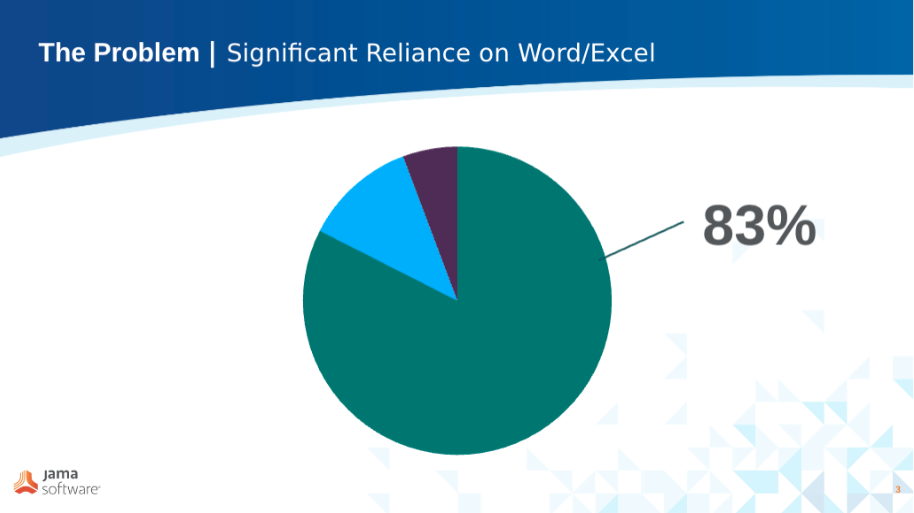
When we look at customer data over the two years prior to adopting Jama Connect, 83% of these organizations had their traceability maintained in an Excel-based matrix.
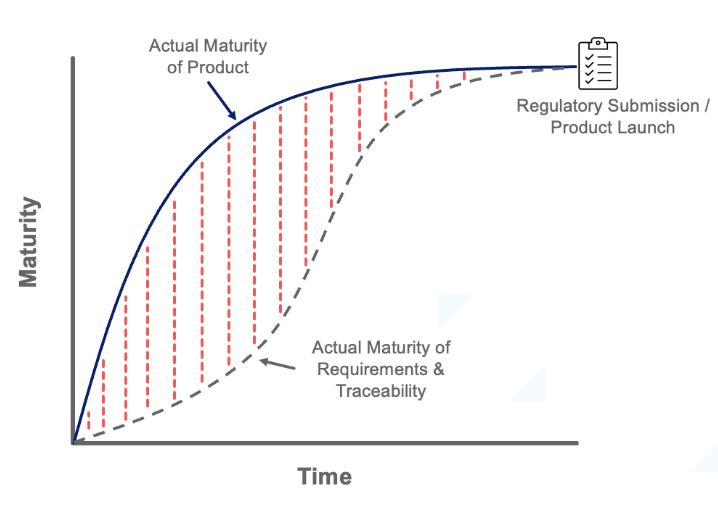
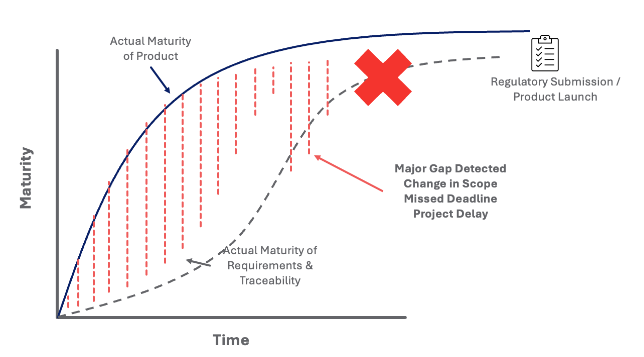
In this environment, all of the traceability components are maintained in a separate system (in other documents or tools). What we found was that this led to traceability being disconnected from the actual design. And in these cases, this delta was maintained and updated manually.
Updating the Excel-based traceability matrix to reflect changes or new artifacts is always a manual process.
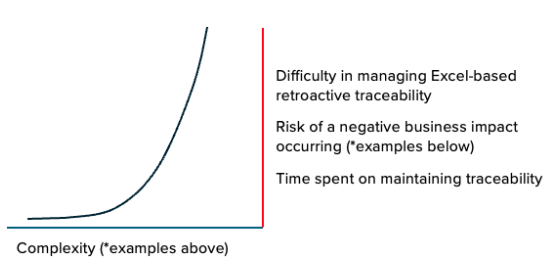
Because this process is not automated, it takes a significant effort and is also highly error-prone. On a small scale, it can be manageable. But once a change is made, managing it effectively in this way becomes a significantly greater problem. We found that these events can exponentially increase both the level of effort needed to maintain traceability and the risk of a negative outcome or occurrence. We’ll provide some examples of this shortly.
As organizations make incremental improvements and changes, or grow and scale the company further, the manual, Excel-based process can become a major bottleneck. Because the level of effort associated with changing this workflow can seem too big of a task to complete, process improvements are de-prioritized. We see an exponential scale difference between an increase in complexity and the difficulty in managing traceability in Excel manually – tightening this bottleneck. Even a slight increase in complexity can lead to a high-severity issue/business impact/time waste.
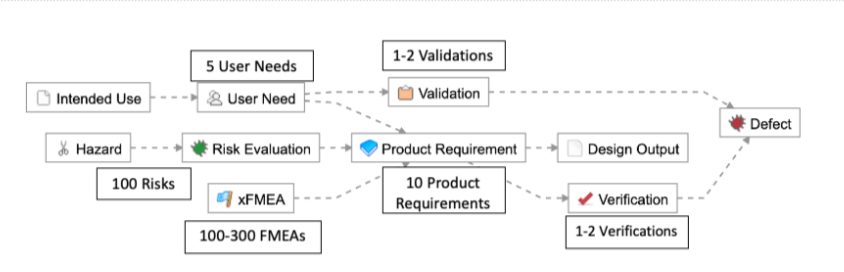
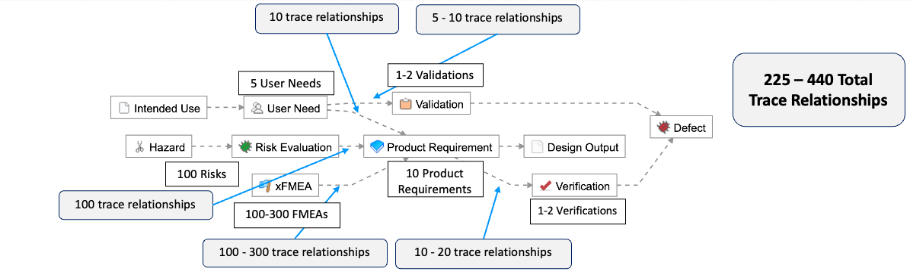
As an example, let’s take a simpler medical device (a single-use catheter). Here are a few examples of how you could have the traceability schema established:
1-2 levels of requirements traceability (e.g., User Need > Product Requirement > Verification, or User Need > Validation)
Few items per level at each level in the hierarchy (e.g., 5 User Needs, 10 Product Requirements, and 1-2 Verifications/Validations)
As described in the example below, this means for simple products like a single-use catheter, there are roughly 225-440 possible trace relationships:
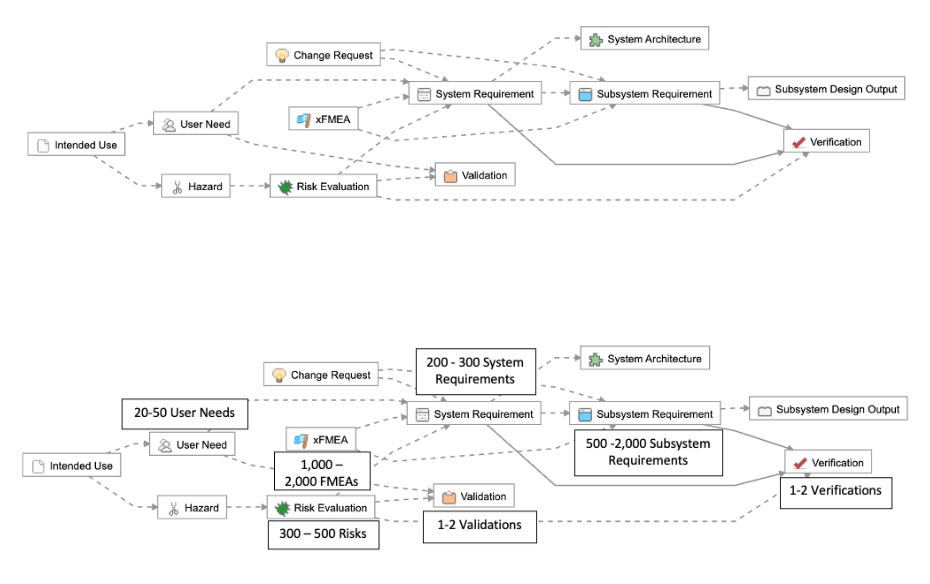
Let’s now imagine that we want to make a seemingly simple change and additional functionality to the device. We want to connect the catheter to a mobile application, so it can monitor its usage and analyze it for diagnostics purposes.
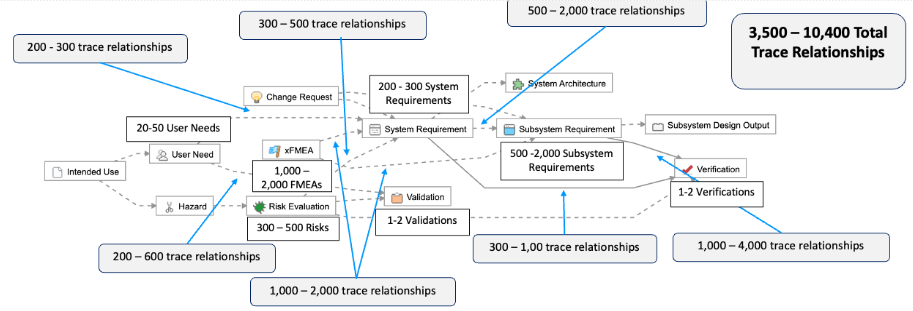
As this device is now part of a “system” with two major sub-system components, we break down the “product requirements” into two separate levels: “system” and “sub-system” requirements.
The complexity associated with managing requirements and maintaining traceability increases exponentially. For example, we’ve outlined a common example of a Class II system, where you can see that a 4x – 10x increase in the number of User Needs translates to a 15x – 24x increase in the total number of trace relationships that need to be managed.
An increase of 4x-10x in the number of User Needs translates to a 15-24x increase in the total number of trace relationships that need to be managed.
Here are a few common real-world scenarios where we see this complexity change occurring; A couple of examples of other complexity increases for a medical device organization:
A medical device with a newly added component and functionality (software, electrical, mechanical, hardware, etc.)
A research use application (RUO) that is reclassified as an IVD – becoming a diagnostic device
A medical device startup going from an R&D phase into having a product out in the market
A medical device being implemented into a larger system
Expanding into different markets and adhering to new regulations (US FDA, EU MDR, etc.)
Introducing product families, product lines, and variations to more effectively reuse existing components
The more this process/tool improvement is delayed, the higher the risk to the business.
We see this happening to medical device companies both big and small. Here are a few of our customers describing the problem.
“With Word and Excel, if something is changed and a link is broken, that document is gone and it’s literally floating around somewhere in the cloud without linkage to anything. This makes it very scary, especially from a quality or regulatory perspective. Our Word and Excel process evolved with the organization and therefore it was put together layer by layer, making it really hard to have the full depth of knowledge about how the quality system works.” – Rene Wenmekers, Director of Quality & Regulatory, Microsure
“We work in a highly regulated environment, and Microsure’s product has hundreds of requirements on system, subsystem unit, and component levels. And from a regulatory documentation standpoint, information is scattered.” – Robin Brounds, Software Team Lead, Microsure
“When we make changes in medical device development, they need to be reported to the notified body. And when that change hits the level of ‘significant change,’ the whole documentation set needs to be provided to the notified body to be reassessed on safety and efficacy. Every time a requirement changed, it needed to be updated across the whole documentation path. This was not sustainable using Word and Excel, and it was risky.” – Rene Wenmekers, Director of Quality & Regulatory, Microsure
Convergent Dental
While using Word and Excel, Convergent Dental found themselves tracking across multiple documents, all with their own trace matrix tables relating to different requirements. The fallout from this process is that even a single word or letter change in a low-level subsystem requirement led to updating corresponding requirements documents in their trace matrix tables. So, a single letter turns into not one change but potentially six changes across five different documents.
“We have a small team with a large amount of features and updates to perform on an ongoing basis. We all work really hard here, and there’s no option to be dead weight. Getting rid of that wasted time in Word and Excel and getting our test engineers back to work is the ultimate goal.” – Craig Woodmansee, Electrical Systems Engineer, Convergent Dental
NEGATIVE BUSINESS IMPACTS – of not changing
Wasted Time and Inefficient Processes
In a complex setting (working with a complex product, highly regulated environment, high-risk product, cross-functional teams working together, lots of different product variations, target customers/markets, etc.), this can be a person or a team’s full-time effort to keep up to date.
Time is being spent on people trying to find the right and most up-to-date documents
Sitting through review and alignment meetings with all stakeholders
Increased Risk of Negative Outcomes
This process relies on people constantly monitoring and updating each change. If a change goes unnoticed or people forget to update traceability, this gap is difficult to notice. If traceability gaps are noticed later during the product development lifecycle, there is a significant increase in the risk of one of the following negative events happening:
Releasing a faulty & untested product, quality compromise, product callbacks
Forcing organizations into late-stage changes that are costly to implement
Regulatory issues and audit findings (non-conformities, FDA warning letters, etc.)
Product not meeting the original requirements and customer/stakeholder needs
The expected outcome – backfilling documentation and traceability at the very end of the project.
Real outcome – Many issues/gaps went under the radar, leading to project delays, missed deadlines, or regulatory/quality issues:
Decreased Organization Maturity, Disconnected and Siloed Teams
Enforce the defined process – In a document-based environment, it’s close to impossible to monitor and enforce the defined process
Impact on employee tenure – Engineering and R&D are forced into manual documentation instead of actual design & development
Impact on talent acquisition – High-quality talent is more attracted to companies with proper tooling and processes in place
Communication and Transparency – Audit trails and change logs are often lost, hard to keep people accountable for changes
The solution to this problem is having integrated risk management with Live Traceability™ in Jama Connect®. Jama Connect will be the overarching system across all product development initiatives, bringing together all disciplines, making it significantly easier to visualize complex traceability hierarchies, replacing the manual effort needed to keep the documentation up to date, etc.
Jama Connect® brings comprehensive and detailed insights into your complex product, systems, and software development processes – automating the measurement of requirements traceability and coverage across disciplines and your organization’s toolchain.
This level of visibility helps eliminate rework due to out-of-date information; and the biggest fear for engineering leadership – that the greatest risks to a project are unseen until it is too late.
Understanding UN155 and Its Impact on Cybersecurity Management
In the ever-evolving landscape of cybersecurity, staying ahead of emerging threats and regulations is crucial for organizations worldwide. One such regulatory framework making waves in the cybersecurity community is UN155. This post aims to shed light on UN155 and its significance in cybersecurity management.
What is UN155?
UN155 is a regulatory framework established by the United Nations to enhance cybersecurity practices across various sectors. The framework sets forth comprehensive guidelines and standards for organizations to protect their information systems, data, and infrastructure from cyber threats. It emphasizes a proactive approach to cybersecurity, encouraging organizations to implement robust security measures and continuously monitor and adapt to the evolving threat landscape.
UN155 encompasses several critical components designed to strengthen cybersecurity management:
Risk Assessment and Management: Organizations are required to conduct regular risk assessments to identify potential vulnerabilities and threats. This involves evaluating the likelihood and impact of various cyber risks and implementing appropriate mitigation strategies.
Incident Response and Reporting: UN155 mandates the establishment of incident response plans to swiftly address and mitigate cybersecurity incidents. Organizations must also report significant incidents to relevant authorities, ensuring transparency and accountability.
Data Protection and Privacy: Protecting sensitive data is a cornerstone of UN155. Organizations must implement stringent data protection measures, including encryption, access controls, and data minimization, to safeguard personal and sensitive information.
Continuous Monitoring and Improvement: UN155 emphasizes the importance of continuous monitoring and improvement of cybersecurity practices. Organizations are encouraged to regularly review and update their security measures in response to new threats and vulnerabilities.
Training and Awareness: Educating employees about cybersecurity risks and best practices is crucial. UN155 requires organizations to conduct regular training and awareness programs to ensure that staff members are equipped to recognize and respond to cyber threats.
The implementation of UN155 has significant implications for cybersecurity management:
Enhanced Security Posture: By adhering to the guidelines set forth by UN155, organizations can significantly enhance their security posture. Proactive risk assessments, robust incident response plans, and continuous monitoring contribute to a more resilient cybersecurity framework.
Regulatory Compliance: Compliance with UN155 is not just a best practice; it is often a legal requirement. Organizations that fail to comply with the framework may face legal penalties, reputational damage, and financial losses.
Improved Incident Response: With established incident response plans, organizations can respond more effectively to cybersecurity incidents. This minimizes the impact of breaches and ensures a quicker recovery, reducing downtime and financial losses.
Increased Stakeholder Confidence: Demonstrating compliance with UN155 can enhance stakeholder confidence. Clients, partners, and investors are more likely to trust organizations that prioritize cybersecurity and adhere to recognized standards.
Global Harmonization: UN155 promotes a standardized approach to cybersecurity, fostering global harmonization of security practices. This is particularly important for multinational organizations operating in diverse regulatory environments.
UN155 represents a significant step forward in the global effort to enhance cybersecurity management. By adopting the framework’s guidelines and principles, organizations can bolster their defenses against cyber threats, ensure regulatory compliance, and build trust with stakeholders. As the cybersecurity landscape continues to evolve, frameworks like UN155 play a pivotal role in shaping a secure and resilient digital future.
Note: This article was drafted with the aid of AI. Additional content, edits for accuracy, and industry expertise by McKenzie Jonsson and Matt Mickle.
Leveraging Artificial Intelligence in Requirements Management
Artificial Intelligence (AI) is everywhere – from healthcare, to finance, to customer service – the integration of AI into various business processes has become a game-changer. One area where AI’s impact is particularly profound is in requirements management, a key process in product, systems, and software development.
Effective requirements management is crucial for the success of any project, ensuring that the final deliverables align with stakeholders’ needs and expectations. By leveraging AI, organizations can enhance their requirements management processes, leading to improved project outcomes, increased efficiency, and reduced risks.
Understanding Requirements Management
Requirements management involves the process of gathering, analyzing, documenting, and managing the needs and requirements of stakeholders throughout the project lifecycle. It ensures that all project requirements are clearly defined, tracked, and verified, minimizing the chances of misunderstandings and errors. Traditional requirements management, while effective, can be time-consuming and prone to human error. This is where AI steps in, offering innovative solutions to streamline and enhance the process.
Automated Requirements Elicitation: AI-powered tools can automatically gather requirements from various sources, such as emails, documents, and meeting notes. Natural Language Processing (NLP) algorithms can analyze text data to extract relevant information, saving time and ensuring that no critical requirements are overlooked.
Intelligent Document Analysis: AI can analyze and interpret complex documents, identifying key requirements and relationships between them. This capability allows for more accurate and comprehensive requirements documentation, reducing the risk of misinterpretation and gaps.
Enhanced Traceability and Impact Analysis: AI can improve traceability by automatically linking requirements to their corresponding design elements, test cases, and implementation tasks. In the event of a change in requirements, AI can quickly assess the impact on the project, providing valuable insights for decision-making.
Predictive Analytics and Risk Management: AI can analyze historical project data to identify patterns and predict potential risks and challenges. By leveraging predictive analytics, organizations can proactively address issues before they escalate, ensuring smoother project execution.
Real-time Collaboration and Feedback: AI-powered collaboration tools facilitate real-time communication and feedback among stakeholders, ensuring that everyone is on the same page. These tools can also provide intelligent suggestions and recommendations, enhancing the quality of discussions and decisions.
Continuous Learning and Improvement: AI systems can continuously learn from past projects and refine their algorithms, leading to ongoing improvements in requirements management processes. This continuous learning capability ensures that organizations stay ahead of the curve and adapt to evolving project needs.
Case Study: AI in Action
Consider a software development company implementing AI in their requirements management process. By using an AI-driven tool, the company automated the elicitation of requirements from client emails and documents. The tool identified and categorized requirements, linking them to specific project tasks and design elements. This automation reduced the time spent on manual documentation by 50%, allowing the team to focus on higher-value activities.
Moreover, the AI tool provided real-time impact analysis when changes were requested by the client. It quickly identified affected areas, allowing the team to make informed decisions and adjust project plans accordingly. The result was a more agile and responsive project management process, leading to increased client satisfaction and successful project delivery.
Conclusion
The integration of Artificial Intelligence in requirements management represents a significant advancement in how organizations handle complex projects. By automating routine tasks, enhancing traceability, and providing predictive insights, AI empowers teams to deliver high-quality projects on time and within budget. As AI technology continues to evolve, its impact on requirements management will only grow, offering even more innovative solutions to meet the challenges of tomorrow’s projects.
Organizations that embrace AI in their requirements management processes will not only improve their project outcomes but also gain a competitive edge in an increasingly dynamic and demanding business environment.
Note: This article was drafted with the aid of AI. Additional content, edits for accuracy, and industry expertise by McKenzie Jonsson and Mario Maldari.
Unleash the Full Potential of Your Requirements with Jama Connect Advisor™
Successful product delivery starts with precise, well-written requirements that align design, software, and hardware teams with clear project goals. Jama Connect Advisor™ is a cutting-edge tool powered by natural language processing, guiding system engineers and product developers to create effective requirement specifications based on INCOSE and EARS standards.
Teams are using Jama Connect Advisor to:
Improve the quality and usability of requirements
Save time authoring, reviewing, and updating requirement statements
Continuously enhance team requirement authoring skills with regular use
Deliver programs and projects on time and on budget with long-term success
How to Overcome Development Challenges: Collaboration & Alignment in Complex Product, Systems, and Software Development
In the dynamic world of product and software development, effective collaboration is crucial for success. However, teams often face significant challenges that can hinder progress and innovation. Understanding these challenges and finding robust solutions is essential for seamless and productive teamwork. One such solution is Jama Connect®, a powerful platform designed to enhance collaboration and streamline development processes. In this blog post, we will explore the common challenges in collaboration and how Jama Connect can help overcome them.
Common Collaboration Challenges in Product and Software Development
1: Communication Gaps
Problem: Miscommunication or lack of communication can lead to misunderstandings, errors, and delays. With team members often working remotely or across different time zones, keeping everyone on the same page can be difficult.
Solution: Jama Connect provides a centralized communication platform where all team members can access the latest information, updates, and discussions. This helps ensure everyone is aligned and informed, reducing the risk of miscommunication.
2: Fragmented Documentation
Problem: Keeping track of documentation and ensuring it is up-to-date can be challenging, especially when it is spread across multiple tools and platforms. This fragmentation can lead to confusion and inconsistencies.
Solution: Jama Connect offers a unified repository for all project documentation. Teams can create, store, and manage documents in one place, making it easier to maintain consistency and quickly find the necessary information.
“Jama Connect has a very powerful user interface, traceability, coverage, revision history, and review collaboration. The verification and validation plan runs are great for program tests traceability.” – Ander Solorzano, Principal Systems Engineer, Astrobotic
3: Requirement Mismanagement
Problem: Managing requirements effectively is critical in product development, but it can be challenging to track changes and ensure all requirements are met. Mismanagement can result in overlooked or unmet requirements, leading to product issues and customer dissatisfaction.
Solution: Jama Connect’s requirements management capabilities allow teams to define, track, and manage requirements throughout the development lifecycle. This ensures that all requirements are documented, tracked, and verified, reducing the risk of oversight.
Problem: Limited visibility into the project’s progress and status can hinder decision-making and delay issue resolution. Team members and stakeholders need a clear view of the project’s health to make informed decisions.
Solution: Jama Connect provides real-time visibility into project status, progress, and potential roadblocks. Dashboards and reporting tools offer insights into key metrics, helping teams identify issues early and take corrective action.
5: Inefficient Review and Approval Processes
Problem: Traditional review and approval processes can be time-consuming and prone to bottlenecks. Delays in getting approvals can slow down the entire development process.
Solution: Jama Connect streamlines review and approval workflows, allowing teams to collaborate efficiently. Automated notifications and reminders ensure that reviews and approvals are completed promptly, keeping the project on track.
“Prior to selecting Jama Connect, we had experience with other platforms, we had multiple trials and settled on Jama Connect because of how innovative it is. Especially in areas of Collaboration, Ease of Use, and the ability to configure and integrate with other lifecycle tools.” – Sr Principal Business Analyst and Enterprise Architect, Biotechnology Company
How Jama Connect® Facilitates Effective Collaboration
1: Centralized Platform
Jama Connect serves as a single source of truth for all project-related information, enabling seamless collaboration. Team members can easily access and share information, ensuring everyone is working with the latest data.
2: Real-Time Collaboration
With real-time collaboration features, Jama Connect allows team members to work together on documents, requirements, and tasks simultaneously. This reduces delays and fosters a more collaborative environment.
3: Traceability
Jama Connect ensures end-to-end traceability, allowing teams to trace requirements, design, implementation, and testing back to the original source. This traceability helps maintain alignment and accountability throughout the development process.
“Jama Connect is a centralized platform for managing requirements, fostering collaboration, and ensuring alignment across global teams.” – Sekhar Ghandikota, Senior Engineer, Ford Motor
The platform offers customizable workflows that can be tailored to fit the specific needs of the team. This flexibility ensures that teams can implement processes that work best for them, improving efficiency and collaboration.
5: Integration with Other Tools
Jama Connect integrates seamlessly with other popular development tools, such as Jira, Slack, and GitHub. This integration helps teams maintain a connected ecosystem, reducing the need to switch between different tools and platforms.
“Jama Connect offers robust collaboration features, traceability and API endpoints. Throughout the development process, efficiency is gained.” – Sekhar Ghandikota, Senior Engineer, Ford Motor
Conclusion
Collaboration is the cornerstone of successful product and software development, but it comes with its own set of challenges. Jama Connect addresses these challenges by providing a robust platform that enhances communication, documentation, requirement management, visibility, and workflows. By leveraging Jama Connect, teams can overcome collaboration hurdles, streamline their development processes, and ultimately deliver high-quality products.
Are you ready to transform your collaboration and take your product development to the next level? Explore Jama Connect today and see how it can help your team achieve its goals.
Note: This article was drafted with the aid of AI. Additional content, edits for accuracy, and industry expertise by Kenzie Jonsson.
Jama Software is always looking for news that would benefit and inform our industry partners. As such, we’ve curated a series of customer and industry spotlight articles that we found insightful. In this blog post, we share an article, sourced from Engineering News-Record, titled “ENR 2024 Top 500 Sourcebook: Plant Tests Ocean Carbon Dioxide Removal” – originally published on July 16, 2024, and written by David Godkin.
Arup begins feasibility study of commercial-scale facility set for Canada site
Engineering has begun on a project its developers say could mark a new foray into ocean-based carbon dioxide removal.
The Quebec-based plant would be North America’s first commercial-scale, ocean-based carbon dioxide-removal facility, according to startup developers Equatic Inc., based in Los Angeles, and Deep Sky Inc., a Montreal firm. They say the facility would remove nearly 110,000 tonnes of carbon dioxide from the atmosphere annually—10% of which will be ocean-borne emissions. It also would produce 3,600 tonnes of hydrogen.
The plant technology uses a seawater electrolysis process developed at the UCLA Samueli School of Engineering’s Institute for Carbon Management. The system draws ocean seawater into an electrolysis chamber where carbon dioxide molecules are separated from the water and its natural acidity is neutralized. “This in turn allows the ocean water to draw down more CO2,” says Phil De Luna, Deep Sky chief carbon scientist and head of engineering. “These carbon emissions are some of the hardest to abate and most difficult to electrify.”
Extracted carbon dioxide is stored in the form of solid calcium and magnesium-based substances that the firm says could be used to produce construction materials.
The technology is based on a $20-million demonstration plant, called Equatic-1, which is set to commission next year in Singapore in collaboration with its national water agency, the developers said.The commercial plant will have easy access to the ocean-connected St. Lawrence River, and could tap into Quebec’s massive hydroelectric grid.
The facility would use less than 1.4 MW hours per ton of carbon dioxide, with removal cost estimated at less than $100 per ton by 2030, according to Equatic. Luna estimates the project’s cost at about $366 million. The plant may also be in line for carbon removal credits under a new U.S. Energy Dept. program, Equatic says, noting that such credits, as well as green hydrogen from this plant and future ones “have been pre-sold to companies such as Boeing, and further sales are ongoing.”
Engineering firm Arup has just begun a six-month plant feasibility study that is set to launch front-end engineering design work, environmental assessment and permitting, with a final investment decision estimated at the end of 2026.
If affirmed, construction on a 30-acre site would begin shortly after, with startup set for 2028. Deep Sky is currently exploring a plant location about 900 km northeast of Montreal, with a final site decision to be made by the end of 2024, the firm says.
In this blog, we’ll recap our recent webinar, “Managing Functional Safety Development Efforts for Robotics Development” – Click HERE to watch it in its entirety.
Managing Functional Safety Development Efforts for Robotics Development
Industrial manufacturing firms are undergoing rapid transformation as they navigate talent shortages, supply disruptions, digital adoption acceleration, and more. At the same time, they work diligently to accelerate time to market, streamline risk management, and keep accuracy and safety at the forefront.
In this webinar, learn about functional safety challenges during the development of complex robotics systems, and how to conform to IEC 61508. Also, learn about how Jama Software’s new robotics solution allows developers to quickly leverage a template and documentation to kickstart development efforts ensuring quicker time to market, and higher quality and safer products.
You’ll learn more about:
Functional safety development challenges
IEC 61508 best practices
Tips and tricks on certification
Jama Software’s new robotics solution offering and benefits
Below is a preview of our webinar. Click HERE to watch it in its entirety.
The following is an abbreviated transcript of our webinar.
Managing Functional Safety in Development Efforts for Robotics Development
Steven Meadows: Hi everyone, and welcome to the webinar on Managing Functional Safety and Development Efforts for Robotics Development. In terms of the agenda today, this is what we’re going to be covering. We’re going to start off with a speech and company introductions. We’ll then look at functional safety and providing IEC 61508 overview, associated challenges, and associated best practices. We’ll then switch gears and talk a little bit around Live Traceability™ followed by robotics development best practices. And then we’ll finally wrap up with Jama Software’s Robotics Solution. So let’s start with some speaker introductions. Go ahead, Nicole.
Nicole Pappler: Okay. Hey everybody. My name’s Nicole Pappler. I am a Senior Functional Safety Expert at AlektoMetis. I started working with safety-critical systems more than 20 years ago, working with automation, working with automotive, and other domains, and always moving around in safety-critical projects with safety-critical systems, being a developer, being a tester, being on the complete system side. About 10 years ago, I started then to work as an assessor of for functional safety at TÜV SÜD. And about three years ago, started together with my business partner, AlektoMetis to provide independent consulting and assessment services using all the experiences that we had up to now. If you want to Google me, I’m also active in several open source for functional safety, so you should be able to follow me around. If you want to contact me, my social media handle is nicpappler, so you can find me on GitHub Discord, and usually wherever you want to look.
As AlektoMetis, our company, together we have more than 20 years of experience. We provide a network of experts for functional safety, for cybersecurity, for multiple domains, so automation, railway, and automotive. And also, we can provide you with services regarding license compliances, processes, and quality management. We have a set of trainings and workshops available for functional safety, for security, or with our network, also for other topics that you need to cover for critical systems and to keep up to date and to drive topics forward, we participate actively in international committees for standard digitization like the IEC, ISO or DIN or also industry networks like the Bitkom, or the Industry Business Network 4.0.
Nicole Pappler: So first of all, I’d like to give you an overview of what’s all this about with functional safety and with IEC 61508. So I’m sure you are here because you already heard about functional safety. Maybe you’re a pro or beginner with functional safety. So first of all, functional safety is the topic that’s associated with reducing risks that are associated with products that can be caused either by random faults, which means faults of a sense, or faults by the controller, just random things stop working or start working in a very inconsistent way. So one of the big topics in functional safety is really avoiding random faults, avoiding faults due to hardware components just dying on you. And the other big topic in functional safety is the avoidance of risk due to systematic faults.
So systematic faults are usually faults that happen during the development, that happen during deployment, or maintenance of a product that is due to topics that are not covered, that are due to hazards you have not considered. This is due to functions you haven’t implemented correctly or that haven’t been tested if they are correctly implemented and then go into the field in an inconsistent or insufficient way. So functional safety can be achieved then by the methods of engineering and of process application. It means the random faults you avoid by systematically identifying what are the critical components, what are critical parts, and other critical functions within your system. Then choose suitable and robust system architectures suitable and robust components and hardware parts to be integrated into your system.
And then to avoid systematic fault by applying a suitable development process, by applying suitable verification measures, by using a suitable deployment and maintenance process. And then also going into a suitable change management process for your system, so that you don’t add bugs and sufficiencies to your system that wouldn’t be there by definition. So easily, you don’t need to start thinking about how to do this on your own. So there are standards around. And the main functional safety standard is the IEC 61508. It’s a standard that talks about functional safety for electrical and electronic and in any kind of ways programmable safety related systems. And although there are a lot of other safety standards around, IEC 61508 is still not only the most generic, but also the most used and most applied standard, not only in other industries but specifically also in the automation industry.
Pappler: So what will IEC 61508 help you with? So what is defined there? Most of it really consists of methods and definitions and explanations, how to do engineering and how to do the planning of your engineering, of the safety-relevant systems and equipment. Then with the process, how to reduce your development issues by planning ahead, by planning your resources, and by deciding what kind of methods are suitable for your kind of development. There are standard planning methods defined. You need to have a safety plan that’s more or less the project management plan thingy for your safety-relevant tasks. You have the definition of processes, so everything will be done in a consistent and traceable way. You will have templates though that you won’t have to invent the structure of a document that invents the structure of your definitions every time. Again, the standard also talks, let’s say on a very high level, but on a very important level about safety architectural requirements.
It walks you through a few basic architectural topics like one-channel systems, two-channel systems, and three-channel systems. How do you need to set them up? What are the minimum requirements regarding diagnosis you want to do live on these channels? So that already gives you a lot of help with the basic setup. What is the minimum requirement? And then you can go from there really deciding if is this sufficient for my use case. IEC 61508 also is very strong in the definition of verification activities, be this on the one hand side for inspections, for analyzers, for reviews of your plant concept, of your requirements of your specifications. And also on how to do testing on multiple stages of your development after deployment or during maintenance. It also guides you then after development, after production of your system, how to mitigate the issues or to avoid issues that might be introduced during installation or during the integration of your system into a bigger system.
This has been an abbreviated transcript of our webinar.
Jama Connect® Features in Five: Cameo Systems Modeler Integration
Learn how you can supercharge your systems development process! In this blog series, we’re pulling back the curtains to give you a look at a few of the powerful features in Jama Connect®… in about five minutes.
In this Features in Five Integration Series video, Gary Hayes, Senior Solutions Architect at Jama Software® – will demonstrate the Cameo Systems Modeler integration with Jama Connect® using Intercax Syndeia.
VIDEO TRANSCRIPT
Gary Hayes: Hello, and welcome to the Features in Five Integration series. My name is Gary Hayes, and I am a Senior Solutions Architect at Jama Software. Today, we will be walking through the Cameo Systems Modeler integration for Jama Connect. We make it possible for you to integrate Jama Connect with preferred best-of-breed software to achieve Live Traceability™ across the end-to-end development cycle. Live requirements traceability is the ability for any engineer at any time to see the most up-to-date and complete upstream and downstream information for any requirement, no matter the stage of systems development or how many siloed tools and teams it spans. This enables significant productivity and quality improvements, dramatically reduces the risk of product delays, cost overruns, defects, rework, and recalls, and ultimately results in faster time to market.
Let’s start off today by looking at the two environments that we’ll be working with, Jama Connect and Cameo Systems Modeler. In Jama Connect, in our project here, we have a folder called swarming along with five requirements we’ve identified that we wanna be using. If we look over the Cameo System Modeler, you notice that we have the same folder, but we only have four requirements listed there.
Hayes: We can easily compare the items that exist in both environments, the four that you see here. We go into the plug-in that we’re using, identify the SysML repository, and we drill down on that folder that contains those requirements, and we can do a comparison between the source and the target. The plug-in will do the comparison for us. We don’t have to drill down and do a close examination.
When we get our results, we see that everything is green, indicating to us that the items in the folders that have been synchronized indeed match at this point. We can close this out for the time being, but you’ll keep in mind that we only have four requirements in Cameo, but we have a fifth one that does not exist currently in Cameo that is in Jama Connect. So we want to make sure that both environments do indeed match, and we can do that easily by dragging and dropping using that same plug-in.
We go back into our dashboard. We find our SysML repository, and we find our Jama Connect project that we’re working with. Drill down on that to find those requirements that currently are being synchronized between the two environments. We can easily see that we have the swarming folder along with its five requirements from Jama Connect and four from our Cameo environment. And to match those up, we want to drag and drop this into our Cameo environment.
And you’ll notice over here as it brings that over, you notice in the background, the cameo environment updates automatically to reflect the fact that we’ve brought a new requirement into the cameo environment. We can further confirm that by doing a synchronization check, doing that comparison once again at the folder level, compare our source and target, and hopefully, we’ll get all green one more time to show that the environments do indeed match up. But we don’t always have the luxury of dragging and dropping and never making any changes in any environment, so what we’ll want to do is make a change in one environment and push that from one side to the other. So let’s go into this individual requirement, broadcast to Swarm, and it’s annotated that it is indeed from Jama Connect. So we’re gonna remove that annotation in its title.
Hayes: We’ll go ahead and save that in our Jama Connect environment. You’ll notice that’s updated. Now we want to be able to show that same type of update. We’ll do that comparison first to see where we’re at because we never know when changes will occur. We can do our compare, make sure that comparison actually works, and flag us for a change. And indeed, we do. It comes up as pink or red, depending on your monitor, and flags us that there has been a there’s a discrepancy between the two environments. And you’ll notice too that it does the comparison. It doesn’t automatically make the change, and you can see that in the background. And in our Cameo environment, that change has not rolled over from Jama Connect to Cameo. So let’s make that change, permanent now. Let’s go ahead and do that push. We can push from our target to our source.
Keep your eyes on the Cameo environment in the background. As we make that change and it gets pushed over, you’ll notice that the name or the description of the requirement in Cameo indeed has changed, and so that has been updated automatically for us. We can do one last check with our compare tool, comparing source and target. So we get all green just for one additional factor of confidence that we get there, and you can see it there. So that’s one way to keep your Cameo and Jama Connect environments in sync using a plug-in.
Thank you for watching this Features in Five session on the Cameo Systems Modeler integration for Jama Connect. If you’re an existing customer and want to learn more, please reach out to your customer success manager or consultant. If you’re not yet a client, please visit our website at jamasoftware.com to learn more about the platform and how we can help optimize your development process.

![[Webinar Recap] Application of Systems Engineering in Healthcare](https://www.jamasoftware.com/media/2023/10/Application-of-Systems-Engineering-in-Healthcare-1.png "[Webinar Recap] Application of Systems Engineering in Healthcare")

 In this environment, all of the traceability components are maintained in a separate system (in other documents or tools). What we found was that this led to traceability being disconnected from the actual design. And in these cases, this delta was maintained and updated manually.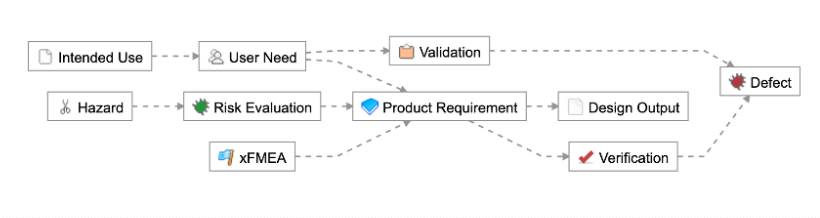

![[Webinar Recap] Managing Functional Safety in Development Efforts for Robotics Development](https://www.jamasoftware.com/media/2024/08/Functional-Safety-Webinar-Recap-Blog.png "[Webinar Recap] Managing Functional Safety in Development Efforts for Robotics Development")

