In this blog, we recap our press release, “Jama Software® Delivers Major Enhancements to the Jama Connect® for Airborne Systems Solution” – To read the entire thing, click HERE
Jama Software® Delivers Major Enhancements to the Jama Connect® for Airborne Systems Solution
Accelerate and optimize airborne systems development with a new set of supported frameworks, projects, and standards
Jama Software®, the industry-leading requirements management and traceability solution provider, has announced enhancements to its Jama Connect® for Airborne Systems solution. Jama Software is committed to continuously enhancing its industry solutions, enabling customers to easily manage requirements, achieve Live Traceability™ and accelerate systems development.
The Jama Connect for Airborne Systems Solution is a complete set of frameworks, example projects, and procedural documentation used to accelerate the implementation of Jama Connect for organizations developing airborne systems and components. This is the third major upgrade to the solution since 2019 and these new capabilities are available to existing and new customers alike. The update both refines the existing solution elements and expands the scope of the solution to meet airborne safety and cybersecurity standards ARP4761A and DO-326A respectively.
“Having all of the applicable 14 CFR regulations preloaded at the beginning of a new project greatly accelerates assigning the driving requirements without extensive data entry.”
Jeffrey Spitzer, Chief Engineer at Transcend Air
The newly upgraded Jama Connect for Airborne Systems provides the following benefits:
Reduced adoption time of new standards such as ARP4754A/DO-178C/DO-254/ARP4761A when developing complex airborne systems
Reduced deployment time and risk of negative outcomes with defined and justified configuration, export templates, and reports
Increased confidence and decrease time-to-value with an established scope and direct alignment of requirements for Airborne Systems
“Jama Software continues to lead with innovation and work alongside our customers to invest deeply and cater to the needs of the Aerospace and Defense (A&D) industry. The Jama Connect for Airborne Systems solution has enhanced support and provides a standards-compliant framework that can streamline compliance demonstration for aviation system development. This is a major milestone for us! And we are here to help our customers stay ahead of the rapidly changing Aviation industry.”
Cary Bryczek, Director of Aerospace and Defense Solutions at Jama Software
The Jama Connect for Airborne Systems Solution consists of multiple components that make up a ready- to-use configuration including:
Airborne Systems Dataset: Includes frameworks and sample sets aligned to ARP4754A, ARP4761A, DO-178C, DO-254, DO-326A along with US Code of Federal Regulations Airborne Systems Library (eCFR) – pre-imported Title 14, Subchapter C, Parts 21-59.
Procedure Documentation and Reports: The procedure documentation provides teams with straightforward processes that they can follow to make the best use of Jama Connect in compliance with the standards included in the dataset.
Data Exchange (Add-On): This utility allows the exchange of requirements, architecture, and tests across the supply change and between tools using the industry standard ReqIF format.
Success Program (Add-on): Includes an Aerospace and Defense Jama Consultant to optimize your Jama Connect configuration, teach best practices, and train your team.
“Jama Connect has enabled Ursa Major to document airborne systems requirements and track verification closure in a streamlined and organized way which has enhanced communication and success between our teams.”
Maggie Mueller, Systems Engineer at Ursa Major Technologies, Inc.
To learn more about Jama Connect for Airborne Systems Solution, please visit our Aerospace and Defense page.If you would like to speak with one of our industry experts and book a free Jama Connect trialclick here.
Editors Note: In this blog post, we cover the five advantages of cloud over on-premise software deployment. To learn more about the advantages of a Jama Connect® cloud deployment and key considerations when choosing a cloud-based engineering tool provider, please read the full whitepaper here.
Cloud over On-Premise: An Introduction
Business is changing. In a world where remote work models are growing more common, teams are widely dispersed, and technology services are commonly hosted in the cloud, companies that are still managing requirements and traceability with an on-premises system may find themselves losing competitive advantage. Keeping an edge over the competition could come down to how quickly you can develop a product and get it to market, thus your requirements management system is of paramount importance.
Wading into the world of cloud deployments might seem risky. How can you manage data and software when it’s not on your premise? How can you ensure data security? Can you ensure uptime when the infrastructure is not under your control? Does it matter where my data is stored? Plus, numerous other questions you might be asking yourself.
While some kind of formalized requirements management solution is certainly better than none, there are distinct and significant advantages to a cloud deployment over an on-premises deployment.
Hosting your software and data on-premises essentially means that your organization is responsible for installing and maintaining all the deployment of updates and patches, server and memory sizing, redundancy, disaster recovery, back-ups, performance, latency, data storage and management, security, uptime, accessibility, and the items go on and on. This responsibility could include keeping everything in your own physical location with your own servers, but it can also mean using your own cloud storage or cloud service, such as AWS, for hosting. With an on-premises deployment of your requirements management software, your IT department will be responsible for all the management and upkeep of your software and data, including any troubleshooting.
With a cloud deployment, you purchase the number of licenses you need, and then all the responsibility for the hosting and management of software and data is held by the software provider. The software provider manages all aspects of the set-up and running of the software. In this model, you are only responsible for paying for the subscription; the software provider updates and patches, maintains security, hosts and backs up the data, ensures uptime, and provides troubleshooting when necessary.
A cloud deployment offers a host of advantages for even the smallest deployments. Here are five reasons to think about moving your requirements management solution to a multi-tenant SaaS environment:
1. A cloud deployment reduces your risks
When you deploy on-prem, you place all the risk of equipment failure, downtime, performance and latency, and data breaches on your own organization. If servers go down, you bear the cost of downtime, including lost productivity and potential lost data. Downtime is expensive, both in real dollars lost and in lost reputation. Uptime Institute’s 2022 report found that 60% of outages cost over $100,000; in manufacturing, downtime can cost up to $5 million per hour, according to ITIC.
Data breaches could cost even more. A data breach into your own servers or your hosted cloud service could compromise progress on projects. In addition, your organization becomes responsible for all regulatory compliance that concerns your data and software. The additional steps to satisfy compliance could add time to market in addition to adding cost to your projects.
By moving your requirements management solution to the cloud, your software vendor bears the risk. Your provider must fulfill the terms of the contract with guaranteed uptime and security protocols, relieving your organization of responsibility for those risks. More importantly, when your software provider must meet industry security standards through independent auditing, you can rest assured that your data is safe and secure without undergoing rigorous auditing within your own organization.
2. A cloud deployment allows you to better manage IT resources
Most IT departments are understaffed and overwhelmed. A 2019 survey of IT decision makers found that 86% of them say it’s challenging to find IT professionals. Once they are hired, they often have to manage everything from servers to phone equipment to onsite security to software rollouts, making it difficult to gain or hone expertise in any single technology.
When you opt for an on-premises deployment, your IT department will bear the responsibility for managing software updates, data storage, and troubleshooting for your requirements management software. Not only does this type of deployment add one more thing to your overworked IT staff, but it also puts this business-critical software in the regular queue with everything else.
With a cloud deployment hosted by your software provider, you can transfer the resource management of your software and data to people who are already experts in requirements management software and cloud hosting. Software updates roll out quickly in the cloud, and you gain instant access to a knowledge base and expertise that your on-site IT staff may not have while freeing IT to pursue other critical projects.
Deploying an on-premises solution doesn’t just involve hardware expenses and software licenses. In addition to the cost of IT resource management, your on-premises deployment will also likely involve costs such as security software for every server, fees to upload to your own cloud service for backup, extra firewalls, security reviews, and PEN tests. These costs add up quickly and come straight out of your IT budget.
In contrast, with a cloud deployment, you pay one fee per license required, and your software vendor takes on the obligation for maintaining security, uptime, and all other IT costs. The total cost of your per user licenses will likely be far less than the total cost of an on-premises deployment.
4. A cloud deployment improves business continuity
Building and IT emergencies happen, and if you lose access to your building or servers go down, it will take time to restore servers or access data stored from a remote location. Even a short period of downtime can result in tens of thousands of lost dollars, and yet a PWC survey found that 95% of business leaders say their crisis management capabilities “need improvement.”
With cloud deployment, your team can work from anywhere, anytime, with guaranteed access to software and data, allowing you to rest assured knowing that your data is protected. Your software vendor bears the responsibility for uptime guarantees, and with built-in layers of redundancy, outages are rare or very brief.
5. A cloud deployment offers easy scalability
With an on-premises deployment, your organization is limited by its available data capacity, whether that involves a physical server room or an amount of data capacity purchased in the cloud. As your organization grows, additional physical servers or additional cloud storage become necessary, and it’s possible that hiring just one or two people could require purchasing more hardware and attendant software licenses than are necessary.
A cloud deployment makes scalability easy by allowing the purchases of individual licenses as your company grows, so that you are never paying for more licenses than you need. In addition, data storage comes with the license, so you never have to worry about outgrowing your server room, your IT staff, or your cloud storage subscription fee.
Jama Connect® Cloud Deployment
Jama Connect is the only requirements management platform that creates Live Traceability™ through a multi-tenant cloud deployment. Ensure you understand the cloud deployment model of your potential software providers and evaluate the pros and cons while also understanding where the system and your data will be stored. It may be the difference between a scalable, highly available, secured environment vs. a single point of failure that isn’t secured or compliant with today’s rigorous security standards.
In this blog, we recap our press release on Jama Software® partnering with Sterling PLM.
Jama Software® Partners with Sterling PLM (Now Vantage Medtech)
Expands Lifecycle Management and Live Traceability™ Expertise Offerings
Jama Software®, the industry-leading requirements management and traceability solution provider and Sterling PLM (now Vantage Medtech), an industry leader in engineering management problem-solving, have partnered together to expand expertise and offerings across requirements management and Live Traceability™ solutions.
“Jama Software’s world-class consulting organization — that spans across multiple verticals including medical device development — will be greatly complemented by this partnership with Sterling PLM. Sterling PLM expands on our already comprehensive services that drive measured improvements across product development processes that result in faster time to market and higher product quality.”
Tom Tseki, Chief Revenue Officer at Jama Software®
Jama Connect® is the only platform that delivers Live Traceability™ across engineering disciplines through the entire product development process to reduce defects, delays, rework, and cost overruns. Sterling PLM‘s team has decades of combined experience consulting in highly regulated industries for a variety of medical device manufacturers. By partnering with Jama Software, Sterling PLM (now Vantage Medtech) will collaborate and support lifecycle management services around configuration, training, and process development.
“At Sterling PLM, we have years of experience cultivating superior technical and lifecycle management know-how. We pride ourselves on our ability to anticipate problems before they become apparent to our clients. We are excited to add Jama Connect to our arsenal of technology solutions, adding to our capability to apply our specialized expertise and customized approach to solving problems for our clients.”
Dan Sterling, President, Chief Executive Officer, and Founder at Sterling PLM
Jama Software has consistently been listed as the leader in Requirements Management software tools by G2® for the fourth consecutive reporting period. By combining Sterling PLM’s customized solutions and seasoned expertise in lifecycle management technologies and Jama Software’s industry-leading requirements management and traceability offerings, Jama Software and Sterling PLM will continue to accelerate transformation to serve the needs of medical device developers.
“We’re especially excited to leverage the expertise and experience of the Sterling PLM (now Vantage Medtech) team with our Medical Device customers. They’ll be a great addition to our out-of-the-box solutions for medical device developers and provide specialty services such as computer systems validation and legacy tool data migration.”
Vincent Balgos, Director, Medical Solution at Jama Software
About Sterling PLM
Sterling PLM helps engineering companies across the globe implement proven processes that govern the design and development of their engineered products while leveraging software that tracks processes with greater visibility across the enterprise. Our team has decades of combined experience consulting in highly regulated industries for a variety of manufacturers—from small start-ups to large global organizations—and we’ve spent years cultivating unique skills and concentrated expertise in the business of engineering. We specialize in regulatory-compliant software programs that help customers track the project artifacts that they care about—across the entire project lifecycle.
About Jama Software
Jama Software is focused on maximizing innovation success. Numerous firsts for humanity in fields such as fuel cells, electrification, space, autonomous vehicles, surgical robotics, and more all rely on Jama Connect® to minimize the risk of product failure, delays, cost overruns, compliance gaps, defects, and rework. Jama Connect uniquely creates Live Traceability™ through siloed development, test, and risk activities to provide end-to-end compliance, risk mitigation, and process improvement. Our rapidly growing customer base of more than 12.5 million users across 30 countries spans the automotive, medical device, life sciences, semiconductor, aerospace & defense, industrial manufacturing, financial services, and insurance industries. For more information about Jama Connect services, please visit www.jamasoftware.com
In this blog, we’ll break down key elements of our Jama Connect for Semiconductor Software.
Jama Connect® for Semiconductor Software
It can take months or even years to complete the development of a new chip. To avoid costly mistakes, semiconductor requirements need to be clearly communicated to the entire team across the development lifecycle. While most teams acknowledge their communication challenges, the risk of process change or adopting a new tool can be daunting. Jama Connect for Semiconductor provides an intuitive, leading-edge semiconductor requirements management solution for complex chip development with methods in use today by top manufacturers.
Supercharge Your Systems Development and Engineering Process
Jama Connect® is a solution for managing product requirements from idea through development, launch, and iteration. It brings people and data together in one place, providing visibility and actionable insights into the product development lifecycle. Jama Connect equips teams to analyze impacts, track decisions, and ensure quality of the product you set out to build.
Simplify Complex Product Development With Jama Connect
Jama Connect is a hub for understanding your complete product development lifecycle, enabling product managers and engineers to track requirements, decisions, and relationships on multiple levels to deliver compliant, market-driven products effectively. Jama Connect helps teams deliver high-quality products on time and on budget by aligning stakeholders, identifying risks early on and visualizing connections between regulations, requirements, and test cases throughout the development process.
Key Benefits
In the increasingly complex semiconductor industry, market forces are creating new challenges for semiconductor product developers. Jama Connect was designed to help teams:
Confidence – Trace requirements throughout the development process, illuminate risk, and proceed with confidence that you are building what you set out to build.
Visibility – Gain visibility into the product development process by monitoring relationships and dependencies between systems, teams, activities, and results.
Speed – Align teams, track decisions efficiently, and minimize rework to create high-quality products on time and on budget.
Adaptability – Easily adapt Jama Connect to your project and organizational workflows to create an intuitive experience so your teams can get up to speed quickly.
Performance – Benchmark and monitor team performance over time to understand the benefits of retooling your product development process. Store and reuse existing intellectual property and best practices from multiple product lines.
Infineon Transitions From a Document-Centric to Data-Centric Development Flow with Jama Connect
Founded in 1999 as a spin-off of Siemens AG, German semiconductor manufacturer, Infineon Technologies AG is a world leader in semiconductor solutions that make life easier, safer, and greener. Ranking among the 10% most sustainable companies in the world, Infineon is a leading player in automotive, digital security systems, power and sensor systems, and industrial power control.
In our Infineon customer story, we examine how Jama Software helps Infineon manage complex product development subject to regulatory compliance and increase efficiency. Read the full customer story to find out how Infineon’s shift from a document-based approach to a more modern requirements management solution resulted in:
Better management of product complexities throughout the development cycle
Systematic handling of requirements from product definition to product development and verification
Improved collaboration with distributed teams both inside and outside of their organization
More effective exchange of requirements to ensure functional safety standards are met
Database-centric approach increases the efficiency of Infineon product development
Jama Connect helped Infineon shift from a document-based approach to a more modern requirements management solution enabling newfound product development efficiencies around complexities, communication, reviews, and compliance.
CHALLENGES
• Keep the overview on ever-increasing product complexities and avoid requirements misunderstandings
• Provide compliance without compromising time-to-market goals
• Manual document versioning makes review cycles and alignment difficult
• Improve the review & sign-off process, making it an integral part of the requirement management system
• Need for enhanced reuse capabilities • Exchange requirements information with customers and suppliers
• Overcome the scaling limits of a document-centric approach
SOLUTIONS
• Jama Connect’s scalability supports complex projects
• Easier to show compliance to industry regulations
• Jama Connect Review Center supports an efficient process
• Provide requirements-accurate versioning to backtrace decisions
• Reuse requirements to shorten development cycles
• Digital exchange of requirements between customers and suppliers
RESULTS
• Better management of product complexities throughout the development cycle
• Systematic handling of requirements from product definition to product development and verification
• The traceability of requirements enables functional safety standards compliance
• Improved collaboration with distributed teams both inside and outside of their organization
• More effective exchange of requirements to ensure functional safety standards are met
As the developer of a coastal transportation vehicle, REGENT must adhere to rigorous safety standards for both aviation and maritime travel, and they take that process very seriously. And in order to create the safest, highest quality vehicle, they know that they must implement a world-class development process. With that in mind, REGENT implemented Jama Connect.
After implementing Jama Connect®, the REGENT team has realized the following outcomes:
Ability to complete an entire design review in three weeks
Reuse library of compliance with more than 25 sets of external regulations and standards
Documenting verification and collecting artifacts for compliance is a simple, automated process
Electric Transportation Startup, REGENT, Speeds Time to Market by Choosing Jama Connect to Simplify and Prove Compliance for Complex Safety-Critical Product Development with Strict Regulatory Oversight
ABOUT | REGENT
Founded in 2020 by MIT-trained, ex-Boeing engineers
Building their flagship product, the seaglider, a wing-in-ground-effect craft
Sub-scale prototype built and a goal of having paying passengers on their 12-passenger seaglider Viceroy by 2025
Headquartered in the Boston area
With a mission to drastically reduce the cost and headache of regional transportation between coastal cities, REGENT is building a revolutionary new category of electric vehicle called a seaglider that will service routes up to 180 miles with existing battery technology, and routes up to 500 miles with next-gen batteries. The vehicles will be as safe as aircraft and have better wave and wind tolerance than existing seaplanes and WIGs.
By coupling the high speed of an airplane and the lower operating cost of a boat, REGENT is revolutionizing regional coastal travel.
Founded in late 2020, REGENT has already built a sub-scale prototype of the seaglider and will have a full-scale prototype by 2023.
Backed by many big-name investors, including Mark Cuban Companies, Hawaiian Airlines, and Founders Fund, REGENT aims to safely transport commercial passengers by 2025.
REGENT CUSTOMER STORY OVERVIEW
As the developer of a coastal transportation vehicle, REGENT must adhere to rigorous safety standards for both aviation and maritime travel, and they take that process very seriously. And in order to create the safest, highest quality vehicle, they know that they must implement a world-class development process. With that in mind, REGENT implemented Jama Connect®.
OBJECTIVES
Demonstrating compliance with stringent aviation and maritime safety standards
Meeting aggressive development timelines in order to safely transport commercial passengers by 2025
Building an inclusive, efficient review process
EVALUATION
Cloud-based solution
Easy-to-use platform with a modern, intuitive interface
Ability to scale multiple projects
Industry experience and aviation market presence
OUTCOME
Ability to complete an entire design review in three weeks
Reuse library of compliance with more than 25 sets of external regulations and standards
Collecting artifacts for compliance is a simple, automated process
As a new company, REGENT knew that they needed to get things right the first time around. With little wiggle room for error, the team set out to find a requirements solution that could help the team turn their ideas into reality.
The main objectives that REGENT needed their requirements management platform to support were:
Demonstrating compliance with stringent aviation and maritime safety standards
Meeting aggressive development timelines in order to safely transport commercial passengers by 2025
Building an inclusive, efficient review process
“As a developer of seagliders which are essentially flying boats, REGENT connects the aviation and maritime domains. In the future we will also need to comply with international maritime regulations as well. Because of this, we knew we needed to take a rigorous approach to safety and vehicle development. It was important for us to find a solution that could track requirements and be used to generate the artifacts necessary to certify a flying boat,” said Ted Lester, Vice President, Certification at REGENT. “We wanted to lay the groundwork for the kind of safety-critical development that’s used in the aviation industry. Ultimately, we knew that if you’re developing a new aerospace vehicle from scratch, a good requirements management tool is key.”
From the start, REGENT knew they needed the best available requirements management platform available.
As part of their evaluation process, they began searching for a solution that met the following criteria:
Cloud-based solution
Easy-to-use platform with a modern, intuitive interface
Ability to scale multiple projects
Industry experience and aviation market presence
REGENT evaluated a number of solutions, including IBM® DOORS® and Intland codebeamer, but Jama Connect was the only platform that met all of their needs.
“As a startup, we were working with a very small, agile team. We knew that we couldn’t stand up a hosted solution, so it was important to us that we find a solution that could be Software as a Service (SaaS). And with Jama Connect, we were able to stand the platform up very quickly with very little IT work” said Ted Lester, VP, Certification.
“It was also very important to us that our team could easily use the platform. We knew we needed a solution that allowed us to easily trace requirements from design all the way through verification and validation,” said Lester. “Between the more than 25 sets of external regulations and standards we need to follow, our requirements, and our sub-system requirements, we knew were going to have an extensive number. The ability to scale and do traceability easily was key to our selection process, and nobody did that better than Jama Connect.”
Another factor that played into REGENT’s decision was Jama Software®’s deep knowledge of the aviation industry, extensive resources, and industry templates that help teams build the infrastructure for regulatory
compliance with aviation standards.
“Although IBM DOORS and IBM Telelogic probably have the largest market penetration in aviation, we had many people on our team who had worked in the tool in the past and did not have good experiences. With
Jama Software, we had templates available for DO178 and ARP4754 available to help us get up to speed faster.” said Lester.
In the medical device industry, proving that there are no unvalidated or unverified requirements is critical for compliance. While Convergent prepared to demonstrate compliance with De Novo Classification Request standards, they began to seriously consider the challenges of their documents-based requirements management process.
In this customer story, we examine how Jama Connect helps Convergent Dental increase efficiency and manage complex product development subject to regulatory compliance. Read the full customer story to find out how Convergent Dental has shifted from cumbersome document-based processes to a more modern requirements management solution, resulting in:
Audit preparation decreased from three weeks to one day
Streamlined review cycles
Plans for leveraging Jama Connect for test management
Convergent Dental chooses Jama Connect to manage compliance through in-depth reviews and to save valuable engineering time.
ABOUT | Convergent Dental
Headquartered in Needham, MA
Expertise: Creating breakthrough laser technology that completely changes how people think of dentistry.
Awards: The Company’s flagship product, Solea®, was voted a Gold Winner for innovation at Edison Awards 2016.
Headquartered in Needham, MA, Convergent Dental, Inc., is the creator of Solea, the world’s first computer-aided hard, soft, and osseous tissue dental laser.
With an isotopic CO2 beam of 9.3 µm, Solea cuts significantly finer and faster than any other dental laser, with virtually no noise or need for anesthesia. Their unique system, with patented technologies and controls, nearly eliminates the need for the drill – the thing that many dread about going to the dentist.
CONVERGENT DENTAL CUSTOMER STORY OVERVIEW
CHALLENGES
Manual, cumbersome processes were slowing teams down significantly
Difficulty compiling necessary documentation for compliance
Proving all requirements are tested
EVALUATION CRITERIA
Easy-to-use platform with a low barrier to entry
Out-of-the-box configurations
Automated traceability
THE OUTCOME AND THE FUTURE
Audit preparation decreased from three weeks to one day
Streamlined review cycles
Plans for leveraging Jama Connect for test management
Manual, cumbersome processes were slowing teams down significantly
As a small team, the development team’s motto is that no one has the option to be “dead weight.” So, when their engineers were forced to spend hours manually editing requirements and tracking traceability using Word and Excel documents, it wasn’t great for team morale, or for their pace of development.
While using Word and Excel, they found themselves tracking across multiple documents, all with their own trace matrix tables relating to different requirements. The fallout from this process is that even a single word or letter change in a low-level subsystem requirement led to updating the corresponding requirements documents and their trace matrix tables. So, a single letter turns into not one change but potentially six changes across five different documents.
This manual method of digging through Word documents led to cumbersome requirements management and traceability tracking from engineers whose time should be devoted to systems engineering for product development.
We have a small team with a large amount of features and updates to perform on an ongoing basis. We all work really hard here, and there’s no option to be dead weight. Getting rid of that wasted time in Word and Excel, and getting our test engineers back to work, is the ultimate goal.” – Craig Woodmansee, Electrical Systems Engineer, Convergent
Difficulty compiling necessary documentation for compliance
In the medical device industry, proving that there are no unvalidated or unverified requirements is critical for compliance. While Convergent prepared to demonstrate compliance with De Novo Classification Request standards, they began to seriously consider the challenges of their documents-based requirements management process.
They knew their requirements were tested, but in order to show proof, they had to go through hundreds and hundreds of pages. They tediously combed through all their records, which took weeks, significantly impacted productivity, and slowed time to market.
“So instead of just being able to reference the reports and say, ‘Look, they’re here,’ I had to put together the list and then ask a team member to go dig down those. And that took him a couple of days to dig up all that testing. So that was the loss, time from our test engineers.” – Craig Woodmansee, Electrical Systems Engineer, Convergent
Preparing for the De Novo Submission was a catalyst for this in-depth review of their requirements. If they continued down the path of Word and Excel, an auditor — if they decided to pull on any small little string — would have resulted in more time trying to track down the requirements. This experience was the deciding factor that led them to understand that the Convergent team needed a better tool.
To solve the above challenges, and in order to save valuable time in the development process, the Convergent team knew they needed to move to a modern and proactive requirements management tool.
Many team members had shared their past experience with Perforce Helix, however, when they began evaluating new solutions, they realized they needed more robust configurations and a more intuitive interface than what those could offer.
“When comparing Jama Connect and Helix, ease of use and the interface played a large role in that decision. While Perforce has many strong applications, this specific area is one where Helix fell short.” – Craig Woodmansee, Electrical Systems Engineer, Convergent
The evaluation process for selecting a modern requirements and test management solution ultimately came down to Intland codebeamer and Jama Connect®.
The following capabilities and features were ultimately why Convergent selected Jama Connect:
Easy-to-use platform with a low barrier to entry
Throughout the evaluation process, it was important to the Convergent team that they found a platform that was easy to use, allowing all team members to easily get started without spending significant time learning a complex platform.
As a small team, Convergent needed a platform that would allow them to move quickly and be agile. They didn’t have time to waste when looking for the requirement management tool that would solve their challenges. After completing trials of both Jama Connect and codebeamer, they knew they needed to make a timely decision. They gathered as a team for an internal review where they asked each other questions such as, “How easy was it to learn?”, “How good and intuitive did it feel to use?”, and “How fast can we be onboarded?”
During their evaluation, Jama Connect’s online training videos demonstrated just how easy the platform was to use. After watching tutorials, critical team members felt they already knew how to use the platform and that Jama Connect would provide a good level of support. After their trial, they discovered that the low barrier to entry and quick adoption helped Jama Connect stand out from other platforms and made their team excited when they received approval to start using Jama Connect.
Out-of-the-box configurations
Implementing a new system is a big deal for any company, and while the team knew onboarding a modern requirements management solution would greatly improve the team’s efficiency, they knew that they were facing a relatively significant change. To save time for their quality team, they prioritized finding a solution with out-of-the-box configurations aimed at the design control process.
While evaluating Jama Connect, they found preconfigured design rules that closely matched what they currently used.
“You can’t beat it. It’s too easy. Using the out-of-box configurations, I can just click and view the trace matrix. That was phenomenal.” – Craig Woodmansee, Electrical Systems Engineer, Convergent
Automated traceability
When evaluating solutions, Convergent knew that a key component of their search revolved around a platform’s ability to automatically — and proactively rather than reactively — create traceability from design, all the way through to verification and validation.
What they found was that Jama Connect was the only platform that could create Live Traceability™, the ability to see the most up-to-date and complete upstream and downstream information for any requirement, no matter the stage of systems development or how many siloed tools and teams it spans.
The Convergent team knew that this level of traceability would allow the team to work faster, simplify their process, and improve the quality of their project management.
After importing user needs and requirements, creating relationships, and running tests in Jama Connect, the Convergent team realized that traceability became semiautomatic.
“We don’t have to manually maintain traceability because Jama Connect does it for us. Once requirements are in place, Jama Connect just says ‘if you make a change, then here are all the things it affects.’” – Craig Woodmansee, Electrical Systems Engineer, Convergent
Incorporating Risk Traceability into Manufacturing Production Software and Preparing for the Transition from CSV to CSA
Intro
Over the years, the burden of Computer Systems Validation (CSV) has resulted in medical device manufacturers avoiding implementation of automated manufacturing production systems or upgrading long-outdated versions of software. As part of the FDA’s ‘Case for Quality’ initiative in 2011 to study quality best practice in medical device manufacturing, the FDA found that the burden of compliance, such what is expected for Computer Systems Validation (CSV), deterred technology investments and as a result, inhibited quality best-practice.
As an outcome, the FDA is expected to release a draft guidance in 2022 that outlines their new approach of Computer Software Assurance (CSA) for Production and Quality System Software. The goal is to improve software quality by focusing on the software’s impact to patient safety, impact to product quality, and impact to quality system integrity. Using a risk-based approach, manufacturers can spend more time testing to ensure software meets its intended use, instead of ensuring test protocols and reports are fully scripted are error free.
As the key to right-sizing CSA activities is based on risk, managing risk, and risk traceability and incorporating is a key activity. And there’s no need to wait for the publication of the FDA CSA draft guidance, medical device manufacturers can incorporate these risk management and traceability practices now in their CSV activities.
Keep reading below for best practices on how to extend risk management and risk traceability from the medical device development to your manufacturing production software used to manufacture your devices.
Main Points for How
Consider the product risks and hazards
Even though we are discussing manufacturing production software and the software used on manufacturing equipment, the first step is to consider the product risks and hazards. Start with your master list of hazards, hazardous situations, and associated harms developed during medical device development and determine where and how failures in the manufacturing production software and production equipment can result in those risks and hazards. These are the areas to consider as the highest risks to control, mitigate, and validate.
Next, perform additional risk analysis from the lens of the environment and manufacturing personnel that will operate said equipment and software. It is important to also protect the environment and prevent injury and harm to those interacting with the equipment. You don’t want the unintended release of hazardous chemical reagents or equipment fires that could have been prevented with built-in high temperature shut-down feature.
Create manufacturing production software intended uses and requirements
Just as one determines the intended use and design input requirements of a medical device, the same is to be done for the manufacturing production software and equipment. Incorporate the necessary features as manufacturing requirements (analogous to the design inputs of your medical device) that address the risks identified in the previous step.
One example is based on risk of the product and demonstrates how risk traces from the development of the medical device. Consider the design of a semi-automated assembly machine for a drug-delivery device. The machine aligns and press-fits together two plastic injection-molded halves of the delivery sub-assembly. One of the main product associated risks is ensuring proper flow efficiency to ensure the proper amount of drug is delivered correctly and to the proper anatomical location.
In this case the risk traceability and translation to the assembly machine design inputs is:
Perform software testing and equipment validation based on risk
Once ready to test the production equipment software and perform equipment validation, incorporate, you guessed it, risk. All manufacturing requirements then need to be verified, however, scale the amount and type of testing for each manufacturing requirement based on the risk. Aspects of the software and equipment that are of high risk, such as preventing severe harm to operators, or the end users and patients of the medical device will have more testing and documentation than those of lower risk.
Document risk traceability of testing and equipment validation
Just as documenting risk traceability for medical device is important, it’s also important for manufacturing production software and equipment. Using a tool like Jama Connect® makes it easy to link your master list of hazards, hazardous situations, and harms to your manufacturing requirements for manufacturing production software and equipment. This increases consistency and efficiency in the risk analysis and prioritizing efforts on where it matters for patient and operator safety. The interface of Jama Connect® also makes the traceability and documentation of the associated testing and validation easy to visualize, alerting teams to gaps and incomplete testing.
Closing
Extending risk traceability from your medical device development to your manufacturing production software and equipment brings focus to what can impact patient safety and scales the testing and validation work appropriately. Incorporate risk and you’ll also be well on your way for the upcoming FDA transition from CSV to CSA.
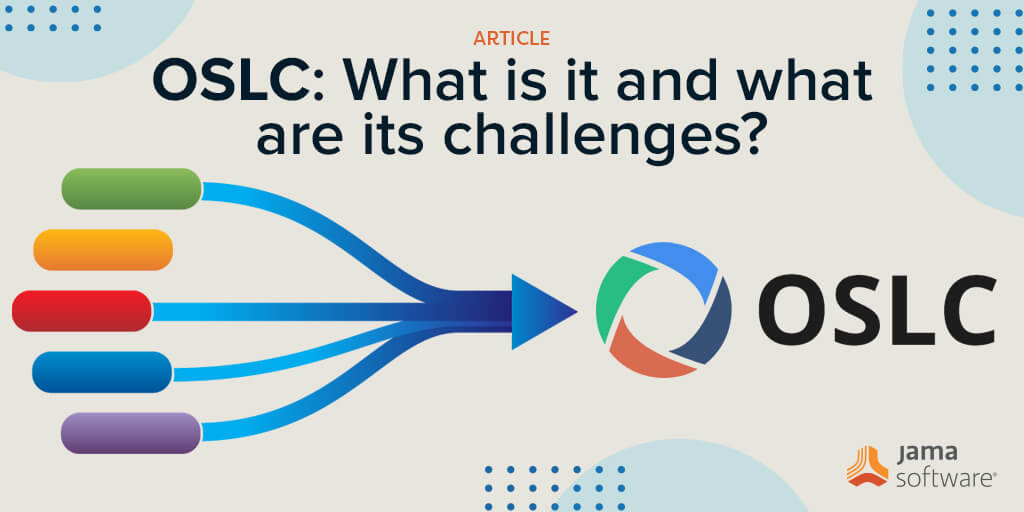
What Is OSLC?
OSLC (Open Services for Lifecycle Collaboration) is an “open” standard designed to facilitate communication between tooling primarily used in engineering disciplines. The initial work was done by IBM in 2009 and in 2013 governance moved to OASIS. The idea behind OSLC is to provide a common layer for tool vendors so that connection between tools can be created without having to write and maintain individual connectors between each set of tools. In theory, this reduces the burden on tool vendors and gives users confidence that tools that support OSLC will interoperate without issue.
What tools support OSLC?
Many tool vendors do not directly support OSLC. Jama Software® integrates with a wide variety of best-of-breed tools and most of them do not come with native OSLC connectors. Of the 25 most prevalent tools that we see in the market, 20% have some OSLC capability, and only 16% have a company- supported connector. Contrast that with the fact that 100% of these tools have a company-supported REST API and you can clearly see the direction of the market.
OSLC services a relatively small niche that often requires consulting and some technical assistance to setup. Given that many of the tools that utilize OSLC are desktop based, the IT environment becomes a challenge for integration. This has led many to rely on third-party vendors to broker the OSLC integration layer and provide the support necessary. At Jama Software we have partnered with MiD and their product Smartfacts to enable this connection. Jama Connect® has a robust REST API and through our partnership with MiD we can support those customers who need an OSLC integration, while extending our integration capabilities to the much wider systems engineering ecosystem.
Using the integration hierarchy to achieve Live Traceability™
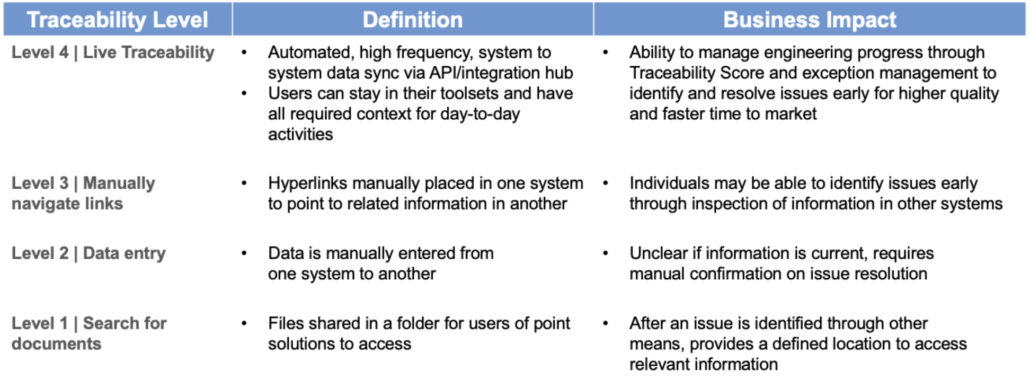
Most companies who are considering an OSLC integration are doing so to improve requirements traceability across their product development process. Requirements traceability approaches range from rudimentary, manual approaches, to automated synchronization across tools. At Jama Software we’re focused on helping our customers achieve Live Traceability™ via automated synchronizations of best-of-breed tools to a common traceability model. For those desktop tools that do not fully support automated synchronization, a lower level of traceability is the best that can be achieved.
Organizations that are heavily invested in a specific toolchain suite can leverage OSLC to reduce the interop challenge inherent in suites that have been created through acquisition. Embedding user interfaces into other applications and maintaining links allows a user to navigate through the “suite” without having to open each application. When dealing with desktop applications, this can reduce the need to load up each tool individually. It is certainly better than trying to sync information through manual efforts.
In desktop tool scenarios and with tools that do not have a web API, OSLC might be as far as you can go. In which case, Jama Software has you covered. For those who want to move beyond the single user context and achieve Live Traceability, we recommend Level 4 integrations. Utilizing easy-to-implement, universal web standards we’ve helped hundreds of organizations achieve the user-level benefits of contextual data while also elevating the systems engineer’s visibility to the process and organization level.
Contact Jama Software today to find out how we can help you with OSLC and further you on your journey towards Live Traceability.
Best Practices for Change Impact Analysis
Impact analysis is a key aspect of responsible requirements management. It provides an accurate understanding of the implications of a proposed change, which helps the teams make informed business decisions about which proposals to approve.
The analysis examines the proposed change to identify components that might have to be created, modified, or discarded and to estimate the effort associated with implementing the change.
Skipping impact analysis doesn’t change the size of the task. It just turns the size into a surprise. In product development surprises are rarely good news. Before a developer says, “Sure, no problem” in response to a change request, he or she should spend a little time on impact analysis.
Understand the possible implications of making the change. Change often produces a large ripple effect. Stuffing too much functionality into a product can reduce its performance to unacceptable levels.
Identify all the files, models, and documents that might have to be modified if the team incorporates the requested change.
Identify the tasks required to implement the change, and estimate the effort needed to complete those tasks.
Traceability data that links the affected requirement to other downstream deliverables helps greatly with impact analysis. On complex projects with thousands of artifacts, to manually determine what and who is affected by a change is time-consuming and error-prone. Alternatively, you could adopt a product development solution like Jama Connect, which includes built-in functionality for end-to-end traceability and impact analysis, and automatically highlights the items and people that are impacted when a change occurs.
Whichever route you take, understanding the impact enables teams to quickly and accurately respond to change requests. The team can be responsive while maintaining control over the scope and customer expectations.
Lastly, impact analysis is essential on projects where quality and safety are an issue such as in healthcare, automotive, and aerospace projects. In these situations, it’s critical to understand the specific set of requirements and features that need to be retested after a change is implemented.
Steps in a typical impact analysis process look like this:
Identify the sequence in which the tasks must be performed and how they can be interleaved with currently planned tasks.
Determine whether the change is on the project’s critical path. If a task on the critical path slips, the project’s completion date will slip. Every change consumes resources, but if you can plan a change to avoid affecting tasks that are currently on the critical path, the change won’t cause the entire project to slip.
Estimate the impact of the proposed change on the project’s schedule and cost.
Evaluate the change’s priority by estimating the relative benefit, penalty, cost, and technical risk compared to other discretionary requirements.
Report the impact analysis results to all stakeholders so that they can use the information to help them decide whether to approve or reject the change request.
In most cases, this procedure shouldn’t take more than a couple of hours to complete. This may seem like a lot of time to a busy developer, but it’s a small investment in making sure the project wisely invests its limited resources. If you can adequately assess the impact of a change without such a systematic evaluation, go right ahead; just make sure you aren’t stepping into quicksand.
Money Down the Drain
What can happen if you don’t take the time to perform impact analysis before diving into implementing a significant change request?
Imagine two developers on your team estimate that it will take four weeks to add an enhancement to one of your product lines. The customer approves the estimate, and the developers set to work. After two months, the enhancement is only about half done and the customer loses patience: “If I’d known how long this was really going to take and how much it was going to cost, I wouldn’t have approved it. Let’s forget the whole thing.”
In the rush to gain approval and begin implementation, the developers didn’t do enough impact analysis to develop a reliable estimate that would let the customer make an appropriate business decision. Consequently, you waste several hundred hours of work that could have been avoided by spending a few hours on an up-front impact analysis.
Editor’s Note: This section was added to this blog post on 4/08/2025. It was written with assistance from AI and reviewed and updated by McKenzie Jonsson.
The Importance of Traceability in Change Impact Analysis
Effective change impact analysis is not just about identifying affected requirements, tests, and risks—it’s about doing so with confidence, speed, and accuracy. This is where traceability becomes critical.
Traceability is the ability to track and document the lineage and history of requirements throughout the development process. It ensures that every requirement, test case, design element, and risk assessment is connected in a structured way, providing full visibility into all dependencies in the full process. When a change in one element is introduced, whether in response to evolving customer needs, regulatory updates, or system modifications, traceability enables teams to easily assess the impact of that change on all related artifacts.
How Traceability Enhances Change Impact Analysis
The truth is, the two go hand in in, really. Traceability supports change impact analysis in many ways, including:
Identifies Downstream and Upstream Effects
Changes in one part of a system can have cascading effects on related requirements, tests, and risk assessments. With end-to-end traceability, teams can immediately see what is impacted and take proactive steps to mitigate risks.
Reduces Rework and Late-Stage Surprises
Without traceability, overlooked dependencies often result in late-stage failures, expensive rework, or compliance gaps. A traceability-enabled approach to change impact analysis allows teams to plan changes with greater precision, minimizing unexpected disruptions.
Strengthens Compliance and Audit Readiness
Many industries, from medical devices to automotive and aerospace, require stringent documentation of changes and their impact. Traceability ensures that organizations can quickly generate reports that demonstrate compliance with regulatory requirements.
Enhances Collaboration Across Teams
By maintaining a single source of truth, traceability tools ensure that stakeholders across engineering, quality, and compliance teams stay aligned. This reduces miscommunication and streamlines decision-making.
Leveraging Traceability Tools for Smarter Change Management
Manual impact analysis is time consuming and error prone. Modern requirements management platforms like Jama Connect® provide real-time traceability (Live Traceability™), allowing teams to visualize relationships between artifacts and perform change impact analysis efficiently. These tools help teams:
Instantly generate trace reports to understand how a change affects the system.
Perform gap analysis to ensure all impacted areas are accounted for.
Automate notifications to relevant stakeholders when changes occur.
By integrating robust traceability into change impact analysis, organizations can reduce risk, accelerate development cycles, and maintain compliance with confidence —ensuring that every change is made with clarity and precision.
Supply chain collaboration: Interactive or ReqIF. Which is right for you?
There are two main types of requirement collaboration in the supply chain: Interactive and ReqIF. While interactive collaboration is on the rise and offers the most benefits, there are cases where it is not feasible. Jama Software supports both methods and, in this post, we will discuss each method’s use-case and pros/cons.
Interactive Collaboration: The High-fidelity Option
We all know that collaboration in product development helps improve quality, reduces risk and speeds up development. For this reason, Jama Connect® has context-based, interactive collaboration built into the platform. Reviews are a formal, effective collaboration method that guides teams in fulfilling regulatory requirements.
In addition to using these industry leading capabilities in-house, our customers frequently use these capabilities to collaborate with external stakeholders. For instance, Jama Connect allows you to invite reviewers simply by email (Jama Connect licenses include more than enough reviewer licenses for this purpose). This works extremely well in practice. In fact, one medical device developer, RBC Medical Innovations(now known as Vantage Medtech), was able to shed hundreds of team-member days during development to save $150,000 in cost savings per project.
As a fully web-based software as a service (SaaS) product, Jama Connect offers customers a standard and secure web interface for cross-department or cross-company collaboration. Inviting customers or suppliers into your Jama Connect system is as easy as sending an email. User security can limit what is seen and allows for granular control of permissions. Our full version tracking enables everyone to see what has changed, who changed it and all impacts on upstream/downstream traceability.
The Alternative: Controlled Data Exchange via ReqIF
Data exchange between organizations is nothing new, and many organizations have collaborated for decades, typically by exchanging documents. While this approach technically works, it results in unstructured data that provides no traceability, no understanding of changes between versions and no easy way to provide structured feedback.
The automotive industry is a great example of complexity across the supply chain with OEM’s traditionally working with hundreds of suppliers. It’s not unusual to find tens of thousands of requirements in an automotive specification, so managing these requirements is a challenge. In response, the industry developed an international standard for the lossless exchange of requirements called Requirements Interchange Format (ReqIF) and the standard was finalized in 2011.
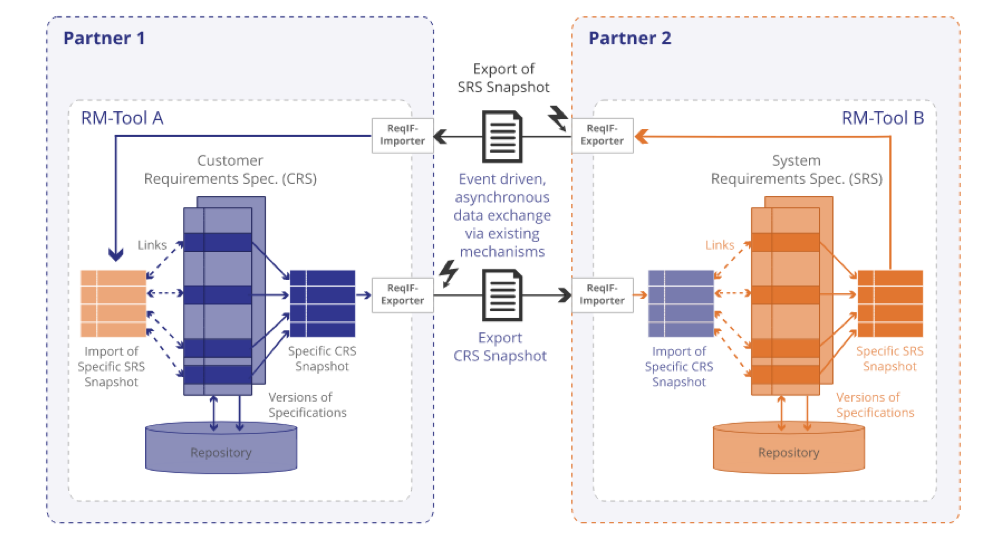
A requirements exchange with ReqIF has some similarities to the old (and dreaded) document exchange process: One party exports a ReqIF file and hands it to the other party. The transfer can happen via a portal upload, automated exchange or even as an email attachment.
But here’s where the similarities end: A ReqIF file contains structured requirements data consisting of individual requirements with visibility into structure, attributes, related elements, and traces. ReqIF also supports incremental updates. If one party creates another version and exports a month later, you could import that version into your environment and the tool would show you clearly which elements, attributes, and traces have changed. For instance, you could use suspect links to re-validate only those items that have changed. Compared to trading .pdf files, which yes believe it or not many organizations still do, this is an extremely significant time saver and error avoiding capability.
While the standard is certainly more advanced than simple document sharing, it does have drawbacks. Not every tool adheres to the standards in the correct way. Data exported can be missing embedded images, required fields in one system are not required in another and user information (meta-data) is not universally available.
ReqIF is commonly used to solicit feedback from a supplier. A producer could export the requirements for a supplier, including attributes for providing status feedback and comments. The supplier would then import the ReqIF file into the tool of their choice, where they could fill out the supplier attributes and send the resulting export back.
In addition, they could start integrating the imported requirements into their own development system. For example, they could establish traceability from the customer requirements through to design while keeping the process invisible to their customer.
There are other use cases that ReqIF supports as well, but for all of them, the foundation is a controlled asynchronous exchange of structured requirements that keeps individual items, attributes and traces intact. Jama Connect supports this workflow and we have many customers that are using it today.
Bottom Line: How to Collaborate?
If you are using Jama Connect, the built-in collaboration capabilities are the most effective way to work together. Having 100% Live Traceability™ has been proven to increase product quality while reducing time to market.
However, if you are working with people outside your organization, that may not be able to collaborate using your Jama Connect instance a ReqIF-based collaboration could be an acceptable alternative.

 In this blog, we recap our press release on Jama Software® partnering with Sterling PLM.