Engineering for the Cyber Resilience Act: Navigating Compliance Across the Product Lifecycle
Preparing for the Cyber Resilience Act: What Engineering Teams Need to Know Now
The EU Cyber Resilience Act (CRA) is setting new expectations for digital product development. It introduces mandatory requirements for vulnerability management, secure-by-design engineering, traceability, and post-market monitoring. For manufacturers of connected or software-enabled products, this represents a critical shift in how you build, document, and maintain your technology.
In this webinar,Patrick Garman, Manager of Solutions & Consulting at Jama Software, breaks down the complexities of the CRA, reviews enforcement timelines, and demonstrates how to integrate cybersecurity directly into your product lifecycle.
What You’ll Learn:
Deconstruct CRA Requirements: Gain a clear understanding of obligations for manufacturers, importers, and distributors, including secure development practices and vulnerability handling.
Operationalize Secure-by-Design: Learn practical strategies to embed security into your engineering workflows from day one.
Master Software Bill of Materials (SBOM) Transparency & Traceability: Discover how to maintain the rigorous documentation and traceability of the new regulation demands.
Navigate the Enforcement Timeline: Get a clear view of upcoming deadlines to help you prepare your organization strategically.
Leverage Jama Connect® for Compliance: Explore how a modern requirements management tool helps track threats, link mitigations to requirements, integrate testing, and prove compliance.
Don’t wait until the deadline approaches to address these critical changes. Watch now to ensure your team has the knowledge and tools to navigate the CRA successfully.
The video above is a preview of this webinar – Click HERE to watch it in its entirety!
TRANSCRIPT PREVIEW
Patrick Garman: Hi, everyone, and thank you for joining today. My name’s Patrick Garman, and I am the Solutions Manager for Energy, Industrial, and Consumer Electronics sectors here at Jama Software. Today, I’m going to be talking about the EU’s Cyber Resilience Act, or the CRA. I’ll explain what the CRA actually is, what it means for product developers, and how you can show evidence of secure by design without creating unnecessary overhead. I’m also going to briefly show how Jama Connect supports your CRA compliance. At a high level, the Cyber Resilience Act is an EU regulation that applies to products with digital elements, so hardware with software, firmware, or connectivity, and standalone software products as well. It’s not a technical standard, and it does not tell you how to implement security; it focuses on outcomes. Did you consider cybersecurity risks? Did you define mitigations? Can you show how those were implemented and maintained? It’s also worth saying what it’s not. It’s not saying that products must be perfectly secure, and it’s not trying to turn product teams into security researchers. It’s really about making cybersecurity part of normal product engineering, just integrating it into your process.
And the motivation behind the CRA is pretty straightforward: products today rely heavily on software, but cybersecurity practices across manufacturers vary a lot. Some teams are very disciplined, and others rely more on informal knowledge and experience. From a regulatory point of view, that makes it hard to assess product risk and hard to respond when vulnerabilities show up later, so the CRA is really about creating a consistent baseline, so cybersecurity is treated more like safety, reliability, or quality, something you design for, document, and revisit throughout the product lifecycle. And the penalties can be pretty stiff for non-compliance. You hear, for non-compliance, up to 15 million euros or 2.5% of your global annual turnover. Products can be barred from the EU market for non-compliance. It does include mandatory incident reporting, and it also establishes liability for manufacturers for unsafe or insecure products, so it is something that is very important to prepare for and be ready for. If you strip away the legal language, the CRA requirements really fall into a few practical buckets. First, you’re expected to identify cybersecurity risks that are relevant to your product and how it’s used.
Garman: Second, those risks should lead to actual security requirements, design constraints, controls, or behaviors that mitigate the risks. Third, there needs to be evidence, not just that you thought about security, but that the requirements were implemented and verified. And finally, the CRA expects manufacturers to manage vulnerabilities after release, things like intake, assessment, updates, and communication. And the challenge is doing it consistently and in a way that you can explain later, especially if this information is spread across different repositories. Before I jump into a demo in Jama Connect, I want to set up how to think about CRA compliance in Jama Connect. The CRA is ultimately asking for something pretty specific, can you prove a clean line from the cybersecurity risk to mitigation to verification, and then keep that story intact as the product changes? And Jama Connect’s a great tool for this because it’s designed for exactly this kind of lifecycle traceability with definable traceability information models that provide guardrails for your process. And the model I’m showing here, threats must link to one or more security requirements, and security requirements must link to verification evidence like test cases or analysis.
And if we want to go deeper, we can link into design and implementation artifacts as well. And the reason that this matters is that once these rules are in place, you’re not relying on memory or tribal knowledge. Jama Connect can guide teams towards consistent linking, and it becomes much easier to answer the questions that come up in audits and reviews, such as which risks are unmitigated, which mitigations aren’t verified, and what changed since the last release? And the other big benefit is the change impact. Sorry. When a new vulnerability pops up or a design decision shifts, Jama makes it practical to see what requirements, tests, and releases are affected without manually stitching it together across documents and spreadsheets. With that framing, what I’ll show next is a simple example. We’ll take a threat and author a requirement against it, and then see the verification evidence, so you’ll see how the relationship rule set keeps the traceability clean and reviewable. For this dem,o I’m going to keep the model intentionally simple. We’re going to start with a cybersecurity threat analysis, trace that to a security requirement, and then to a validation.
Garman: And in this scenario, I’m going to use the CVSS, which stands for the Common Vulnerability Scoring System, the 3.1 model, to score severity consistently. CVSS is traditionally used for vulnerabilities, but teams often use that same scoring structure for threat scenarios because it is familiar and repeatable. And I have a pre-created threat analysis item so that we can focus on the traceability aspects. But here you can see I have a place where I can provide a name, a description of the threat or vulnerability, and also select all of the appropriate vectors within the CVSS scoring model. And I’m also using Jama Connect Interchange™‘s Excel functions to calculate the base score and assign a severity rating, along with the temporal score and environmental score. Again, these are all calculated automatically on the backend as you define your threat vectors. And the reason I like capturing all of these attributes here in Jama Connect is it makes the assumptions explicit. Stakeholders can review the score, disagree with it, and adjust it, but we’re not hand-waving severity. And because it’s all on the same system as our requirements and validations, the cybersecurity story stays connected.
2026 Predictions for Semiconductors: AI, Chiplets, and the Path to Sustainable Innovation
As we step into 2026, the semiconductor industry stands at the crossroads of unprecedented technological advancements and complex global challenges. From the rise of AI-driven chip design and heterogeneous integration to the growing emphasis on sustainability and geopolitical shifts, the sector is navigating a transformative era.
The next wave of innovation will be defined by breakthroughs in advanced lithography, chiplet architectures, and quantum computing, while sustainability efforts will reshape manufacturing processes to address energy efficiency, water usage, and materials recycling. At the same time, the industry faces critical hurdles, including talent shortages, supply chain realignments, and the need for robust cybersecurity measures.
In this year’s predictions series, we’ve gathered insights from leading semiconductor experts:
Together, they explore the trends and technologies shaping the future of semiconductors. From AI-driven automation and edge computing to the challenges of regulatory shifts and the promise of chiplet-based architectures, this piece highlights the innovations and strategies that will define 2026 and beyond.
Q: What emerging technologies (e.g., advanced lithography, AI-driven chip design, quantum computing, heterogeneous integration) will have the most transformative impact on the semiconductor industry in the next five years?
Simon Bennett: In the next five years, the semiconductor industry will continue to grow, almost doubling in size from today to $1Trillion by 2030. But to sustain that growth, the industry will go through some extreme changes and challenges. The first trend to note is actually due to a declining trend as Moore’s Law continues to slow. [Editor’s note: Moore’s law is the observation that the number of transistors in an integrated circuit (IC) doubles about every two years.]
Moore’s Law has driven the growth of the Semiconductor industry for many decades, but it is bumping up against the fundamental laws of physics. The economics of scaling to the next node are increasingly prohibitive and taking longer and longer to reach fruition.
Whilst keeping an eye on what is coming out of China, there will be some more mundane but equally challenging technology trends that are emerging and will become increasingly important in 2026 and beyond. These are AI driven design, and both chiplet and wafer scale designs (two opposite ends of the spectrum, but both an engineering reaction to the slowing of Moore’s Law).
Neil Stroud: Given the ever-increasing innovation around AI and its associated deployment, chip development is under continued pressure to keep up. This is applicable across all architectures, including Central Processing Units (CPUs), Graphics Processing Units (GPUs), and Neural Processing Units (NPUs). Naturally, continued optimization will happen around acceleration and emerging technologies like process node shrinks (advanced lithography), AI-driven chip design, and the chiplet approach (heterogeneous integration). Process node shrinks will contribute. However, the chiplet approach will also drive heterogeneity across architectures and nodes. All these factors will intimately impact the next generation of chip families for AI in the datacenter and at the edge.
2: Sustainability and Manufacturing Efficiency
Q: How do you see sustainability influencing semiconductor manufacturing, particularly in areas like energy efficiency, water usage, and materials recycling? What strategies will help the industry achieve greener fabrication processes?
Bennett: This is a great question, and right now, the elephant in the room. From Fabs to datacenters, the environmental impact is huge. Water consumption alone is a huge factor. Twenty years ago, visionary realtors quietly purchased acres of land close to a bountiful supply of water and close to a large data pipe. Those realtors are now wealthy, and the secret is out. Now the price of that land is at a premium. So, the investors behind the fabs and the datacenters are using government subsidies and their own funds to find alternative sources of energy and resources. Nuclear is making a comeback, driven in part by the energy demands of the datacenters. Municipal areas like Phoenix are making guarantees of plentiful water to companies to attract them to their region; that will put them in direct conflict with farmers in California.
Most of this is happening off the radar of the mainstream media, and the political arena is presented as a battle for the best jobs. The concern over the environmental impact is not yet front and center. Two events will likely happen to change this:
The AI bubble will inevitably burst. Just like in the early days of the internet, there will be market correction as reality catches up to expectation. Just like the internet bubble, this doesn’t mean that AI is not going to be a societal change; it just means the market got too overheated.
Unfortunately, there will be some kind of accident related to the overbuild of the infrastructure around Datacenters and Fabs. A dam will burst (Phoenix – see Roosevelt Dam), or a multibillion fab will be damaged by a natural disaster (see fault lines in Taiwan). These two events will raise awareness of environmental costs relating to sustainability and manufacturing efficiency.
In other words, in the next five years, we will be forced to take a pause, a breath, and truly measure the value vs the cost. This isn’t a bad thing. Our human history of technology transformations is punctuated with these pauses and resets. Usually for the better.
Steve Rush: Sustainability is hugely influential and important. Energy demand is forecasted to accelerate with new data centers and the demand for AI. Semiconductor companies need a system to help manage their sustainability requirements and, very importantly, validate them. Implementation to hit targets and balance, power, efficiency, and sustainability will be a series of trade-offs – semiconductor organizations will need a tool to trace all of this information and prove that they meet sustainability targets and goals.
Sarah Crary Gregory: While the semiconductor industry is obviously fiercely competitive, it can match that intensity with fierce collaboration on critical issues. Sustainability is probably the most prominent area where industry consortia such as the Semiconductor Climate Consortium bring companies together to tackle common problems. Initiatives to enable water reclamation, reduce emissions, and produce data quantifying the return on investment of sustainability practices will be more critical with the burden placed on these resources from the exponential expansion of AI. The semiconductor industry is highly interdependent, and nobody believes that there’s a way to get a competitive advantage by monopolizing natural resources. The way forward is through innovations that decrease resource consumption and minimize waste, and initiatives for water reclamation/”net zero” resource use will continue to be essential investments.
Stroud: I think there are two parts to this. Firstly, the environmental impact of actually building the chips in foundries. A huge amount of effort and investment has gone into sustainability in semiconductor manufacturing, including energy efficiency, water usage, and materials recycling. semiconductor manufacturing and materials. A great example of this is massive recycling of water used in fab processes, as well as optimizing processes and the associated chemicals used, including minimizing atmospheric emissions.
Secondly, there is the environmental impact related to the deployment of the device itself, as it consumes power and emits heat. Of course, the extreme example of this is the data center where huge racks of GPUs or CPUs are deployed, collectively consuming Megawatts of power to both power them and cool them. Again, huge investment is going into driving data center efficiency. One way to contribute is through chip design optimization to improve ‘performance per Watt.’ That is simply a measure of how much computing can be done for a given Watt of power. This optimization can happen through design and architecture efficiencies as well as process node shrinks. Ensuring the software stack is also developed to drive efficient use of the underlying hardware platform also has a fundamental role to play. It’s easy to see that these steps can have a profound positive impact on the environment caused by the global electronics footprint.
Q: How is AI accelerating innovation in semiconductor design, verification, testing, and manufacturing? What challenges must companies overcome to fully leverage AI-driven automation?
Bennett: Natural language and agentic AI will continue to show up across the tool chain. But expect some resistance from SOC design engineers, who, ironically, since they are at the epicenter of the AI revolution, are traditionally conservative and slow to adopt new methods. Verification is the most in need of help with AI-driven automation, since there just aren’t enough engineers on the planet to drive the verification needs of an SOC. (see salaries on Glassdoor). It’s been estimated that with the use of AI, a team of 3 expert verification engineers can do the work of 5 traditional verification engineers with limited use of AI, in 3 to 5x less time. This is a compelling message to an (open-minded – see below for a caveat) engineering VP struggling to find the resources to deliver a fully validated product on time. These engineers and the tools they use will be in high demand in the next five years.
Beyond design, AI will show up in yield and manufacturing analytics. The challenge of inventory and yield management in the era of disaggregated chiplet-based designs is magnified. It’s essential that all the chiplets deliver the yield and volume needed at the exact same time. The overall package is only as good as the weakest tile. This is an underserved opportunity within the big three EDA companies, and the packaging OEMS tend to jealously protect their homegrown investments in solving these challenges. Expect emerging startups to come forward as disruptors in this particular segment in 2026 and beyond.
Rush: Every company is looking for ways to utilize AI in their organization. AI can play an important role in managing traceability, especially from siloed systems that are isolated from one another. Agentic experiences that improve engineer productivity really are key. The main challenge that AI has in the semiconductor space, in particular, is adoption with the engineering team. AI experiences must improve engineering productivity; they must be accurate, and they cannot be an impediment to use. If AI-generated content is of questionable quality or if the AI experiences become too burdensome to use, AI initiatives risk dying on the vine.
4: Supply Chain and Geopolitical Shifts
Q: How are global supply chain realignments and geopolitical factors shaping semiconductor strategy? What can companies do to mitigate risk and ensure resilience in developing complex products on their own or with co-development partners?
Bennett: A global supply chain developed over the past thirty years has delivered $1T in cost savings. This $1T is now under serious threat as the world is a very different place compared to when this globally interconnected environment was first conceived. In the next five years, expect China to become more self-sufficient as it replicates every aspect of what it previously relied on from overseas, from EDA to IP to fab equipment. Expect to see semiconductor-based products from coffee machines to phones to servers to (even) EVs sourced almost exclusively from China with little to no reliance on anything beyond the shores of China. This will trigger protectionist measures in the US and the EU as they work to protect homegrown industries from what will become increasingly consumer appealing products from the Chinese factories.
A more optimistic view may be that the tensions ease as the US / EU recognize the need for open trade with China, and continue to see its designs realized in Chinese factories (but I’m not holding my breath). In semiconductors, companies will be most susceptible to this shift in China as they move to homegrown alternatives. As the geopolitics ramp up, the focus on Provenance in the West will become a C-suite / US Senate / EU Parliament level of attention. Knowing where every component or piece of code originates, its genealogy will become paramount. A counterforce will emerge where the information is “buried” as the realization hits that we can’t possibly trace the root of every bit of code, every nanometer of design. Companies will emerge with one of two unique value propositions: 1) we can audit your product and provide the provenance, 2) everything you use is contaminated; we are a new company, built cleanly from the ground up. Somehow, all three will survive – the traditional companies, the auditors, and the new “clean” companies. But there will be some very interesting mergers and acquisitions, mostly off the radar as these three entities re-align and learn to co-exist.
Rush: These days, you can basically count on major geopolitical news covering the semiconductor industry week in, week out. At the end of the day, co-development and partnerships are key. The semiconductor supply chain is mind-bogglingly complex. Adopting modern, more collaborative tooling is on the rise. Historically, the semiconductor industry has even been hesitant to adopt cloud-based solutions, and I’ve definitely seen a change in the last few years around this.
Stroud: Like many other segments, the semiconductor market tends to be cyclic, which leads to times of undersupply and oversupply. This is a complex problem to manage with many factors, including global supply chain realignments and geopolitical factors. Naturally, foundry capacity has a big role to play, and we seem to be in an investment phase right now with a number of fabs being built. This is a massive investment with a modern fab costing tens of billions of Dollars and taking multiple years from construction start to mass production. Communication and collaboration across the ecosystem also has a role to play, especially now that we are accelerating into the chiplet era, which can help mitigate risk and ensure resilience in developing complex products.
5: Chiplet and Heterogeneous Integration
Q: What role will chiplet architectures and heterogeneous integration play in addressing performance and scalability challenges? What technical and ecosystem hurdles must be overcome?
Bennett: Chiplets are essential to the continued growth of Semiconductors. Without chiplets, the forecast CAGR ($1T by 2030) is unreachable (basic economics of Moore’s Law). The challenges are two-fold: 1) engineering challenges around interconnecting tiles from different suppliers running at high speed and with the thermal challenges of a modern chip; and 2) coherence – the coherence of the supply chain, compliance, and verification. More specifically, the standards emerging need to be better governed (e.g., Universal Chiplet Interconnect Express (UCIe) for interconnect and system architectures if they aren’t going to become bottlenecks stymying growth.
6: Talent and Workforce Development
Q: With growing global demand for skilled engineers and manufacturing specialists, how can companies address the talent shortage in the semiconductor industry?
Bennett: This is where AI needs to step in and become more readily accepted within Semiconductor Engineering orgs. As stated above, studies show that a small team of AI proficient verification engineers are 5x+ more productive than a traditional team. However, the resistance comes from within – engineers are conservative, and within a traditional engineering organization, the manager / Director / VP still measure their worth by the number of engineers the corporation is willing to fund. This leads to destructive behaviors, such as a VP of Verification Engineering employing 100 RTL validation engineers to do the job that 10 Functional Verification engineers could do because “it’s too expensive to hire the functional verification engineers” – the companies that will thrive and succeed in the next five years are the ones who break down this cultural impasse.
Rush: There are a lot of talented people in the job market right now who can help fill the gap. Hopefully, semiconductor companies will look to hire talent from across industries – automotive, medical, and aerospace. There are certain challenges in getting enough skilled foreign workers to fill certain roles – I’m more concerned that there are many highly skilled, talented people out there looking for jobs!
7: Regulatory and Export Controls
Q: How do evolving export controls, trade policies, and security regulations impact semiconductor innovation and competitiveness? How can companies adapt strategically?
Bennett: They don’t impact semiconductor engineering innovation or competitiveness – in fact, they improve it. Case in point is China – as access to advanced GPUS / EDA tools was limited, they innovated, and actually improved on the technologies they didn’t have access to. Another example is where the Russian engineers working for US companies prior to the war in Ukraine were let go and went to work for Russian companies, helping boost the AI business in Russia. But where the question applies is the innovation at the corporate level. Engineering innovation can be stymied by a C-suite overly concerned about trade or political issues. The paradox is that smaller companies with less of a global or political reach could feel less compelled to avoid the risk associated with innovation.
Gregory: “Evolving” is an understatement! The volatility around export controls and trade policy in the United States right now is simply unprecedented, and 2026 looks like more of the same. Companies can strategically navigate these unsettled times by implementing systems –people, processes, and tools – that enable maximum response flexibility. Modular architectures, whether they’re chiplet-based, specific configurations of IP cores, highly modular software, or other building blocks, will enable the development and delivery of products whose configurations can be changed and modified as circumstances warrant. Variant management is a critical capability to be able to swap features in and out based on policy changes. Solid, well-governed data foundations will be critical to stay on top of the wildly shifting policy landscape.
Q: As demand for edge AI and high-performance computing grows, what innovations are most critical to meet performance and power efficiency goals?
Bennett: There are many ways to answer this, but I’ll focus on the chip-level design aspect. First, the interconnect, as previously described – the clean adoption of UCIe and a strong governing body to oversee its evolution (think Universal Serial Bus, or USB.) 3D packaging needs to keep up with the thermal demands of a heterogenous package – this may lead back to the engineering talent pipeline previously discussed since the engineers who have the combination of skills to analyze and design (future-proof) these packages are unique (think warping of a substrate as it reacts to thermal pressures, leading to subtle issues with the interconnect manifesting as signal integrity.)
Rush: I’ll answer this more from a – data isolation – perspective. Design and testing are really important, but more important is tracing all the way to the highest level and validation. I think responsible AI will help with efficiency here, but companies need a way to trace from the top down. In all honesty, this is a challenge for the semiconductor industry – having one single source of truth that can prove you’re hitting sustainability goals.
9: Cybersecurity and IP Protection
Q: With increasingly complex global supply chains, how can semiconductor companies protect intellectual property and secure their design-to-production ecosystems?
Bennett: Expect a lot more reference to initiatives such as Software Bill of Materials (SBOM) and Engineering Bill of Materials (EBOM.) Expect the concept of a Bill of Materials (BOM) to evolve and take on more significance in the next few years. Expect the term Provenance to take on more importance. Traditional PLM companies will position themselves as the answer, but there will be significant pushback from the semiconductor industry, and rightly so – these PLM systems were never developed with semiconductors in mind. They are monolithic in nature, expecting the end user to move their data into their environments. The C-Suite will sign on, the engineers won’t. This will lead to QMS and IT organizations emerging to manually clone the data inside the PLM systems. For a while, this will seem just fine, until one or more issues come to public light, and the C-suite exec realizes they have spent a lot of money on tools and resources, and it didn’t solve the problem. Those companies that invested in a more lightweight engineer-friendly solution, providing traceability, compliance, and coherence insights without the costly overhead of monolithic tools and the resources that go along with them, will grab the attention of those who lost out. And yes, AI will play a part. A well-managed digital thread with the ability to expose itself in a controlled manner to intelligent insights will win out.
Rush: I mentioned earlier that semiconductor companies are adopting more cloud-based tooling. But they are not slacking in terms of security needs. By selecting best-in-class tools with exceptional infosec track records (like Jama Connect), they are effectively balancing speed and agility with security and not sacrificing either. They are pushing their vendors to expand their tool sets to deliver best-in-class experiences with rationale, scalable permission structures that are tightly governed. They’re looking for tools and vendors that are putting AI at the center of their vision – but need their vendors to offer closed, secure LLMs or integrations with in-hours AI systems.
Stroud: This is not a new issue! The semiconductor industry has been wrestling with intellectual property protection and securing the design-to-production ecosystem for years. The challenge is how to build enough flexibility in the ‘fixed’ silicon that, when combined with software (across all layers), is able to guard against future exploits and vulnerabilities. It’s almost impossible to build a modern chip without multiple integrated security capabilities. Also, it’s worth noting that security has to be a multidimensional approach in this age of hyperconnectivity, spanning seamlessly from cloud to edge. This is why we see an ever increasing number of emerging security standards that apply to both implementation and development processes, impacting hardware, software, and system design and deployment.
10: Future Outlook
Q: What do you see as the most important technological and market shifts that will define the semiconductor industry five to ten years from now? How can companies position for sustained leadership?
Bennett: 1) Semiconductor Technology: Chiplets, and the packages that are needed to realize their promise to alleviate the decline of Moore’s Law. 2) Companies: very different answer–the companies that will succeed in the future are those that completely obfuscate the hardware considerations from their customers—it’s all software, don’t worry about the hardware – we have taken care of that.
In summary, in some ways it’s the same old story – recognize and reward the unique engineering talent that helps differentiate your product, understand what the customer wants, and remove the barriers to growth. Sounds simple, right?
Rush: With AI, the amount of data that companies will manage is going to increase tremendously. Trying to manage that traceability is going to be extremely challenging. Jama Connect, with the new scaling improvements and AI vision, is at the forefront of the market and uniquely positioned to help semiconductor companies here.
Gregory: Agreed. AI is already reshaping the demand side of the market equation. The supply-side will evolve to support highly customized semiconductor design, even purpose-built and assembled solutions that are rapidly defined and fabricated. Edge AI and NPUs (neural processing units), along with open architectures such as RISC-V (and the RISC SW Ecosystem), will further broaden the horizons for semiconductor companies. How to be positioned for success? Again, it’s all about response flexibility. Sensing both strong and weak signals in the market and systematically building resilience into the company’s organizational practices will determine which companies emerge stronger from the challenges of the next five to ten years.
Impact Analysis: The Key to Proactive Change Management Success
When consulting with clients, I often convey that there are two types of change management in product development:
Proactive Change Management
Reactive Change Management
Suspect triggers and suspicion are great examples of “reactive change management.” Something changed upstream, and you are notified so you can react.
You may ask, “Mario, wouldn’t it be ideal to react and prepare for change BEFORE it happens?” I would then shake your hand, nod my head in proud agreement, and we would be off to enjoy a festive beverage together.
This describes proactive change management, often referred to in requirements management by its function: “Impact Analysis.” When you take the time to build proper trace links across your requirements, you gain a view of all downstream impacts BEFORE you make a change.
It effectively allows you to notify your teams to prepare for the change and provide details so that when it happens, you can reduce risk and maintain compliance.
In the “old days” of the 1900s, you would handle this by calling all your cross-functional team representatives into a conference room and getting their sign-off. Hopefully, they were paying attention and not on their BlackBerrys or Palm Pilots.
In the modern world, impact analysis is essentially the click of a button, showing you all related downstream items, multiple levels deep—including verification and validation.
Collaborative features such as “discussions,” “subscribing,” and “review and approval” allow for formality in this process, collaboration, and official sign-off (with audit history). For significant changes, this gives teams time to discuss and prepare.
When I work with clients and there are features we are building internally that I know will be useful for them, I often “subscribe” myself to the relevant requirements. This way, if there is an update or status change, I automatically get notified via email.
This keeps me connected to the development process without even having to go into a tool. If I want more information, I simply click on the link and log in.
The Takeaway:
Suspicion catches the change after the fact, forcing teams to react. Impact Analysis allows you and your teams to PLAN for a change BEFORE it happens.
Build strong traceability, accept that change is inevitable, and take a proactive approach to your requirements management change process.
Cybersecurity by Design: Preparing for the Cyber Resilience Act
The European Union’s Cyber Resilience Act (CRA) is a landmark piece of legislation set to redefine cybersecurity standards for products with digital elements. Adopted in March 2024, the CRA establishes a new baseline for security, requiring companies to embed cybersecurity practices throughout the entire product lifecycle. For product developers, this means shifting from a reactive stance to a proactive “secure by design” philosophy. Understanding the CRA’s requirements is the first step toward compliance and avoiding significant penalties.
This blog post will guide you through the key aspects of the CRA, including its core requirements, the costs of non-compliance, and how you can leverage powerful tools to streamline your journey to compliance.
What is the EU Cyber Resilience Act?
The CRA is the first horizontal EU legislation that mandates cybersecurity for any product with digital components sold within its market. This includes everything from industrial machinery and robotics platforms to smart home devices and consumer electronics. The legislation aims to protect consumers and businesses by ensuring that products are secure from the moment they are designed until the end of their support lifecycle.
Key timelines to remember:
Reporting Obligations: Mandatory reporting of identified vulnerabilities and severe incidents become legally enforceable in September 2026.
General Obligations: Requirements around secure-by-design, full documentation, and conformity assessments, and more are planned to go into effect by December 2027.
The CRA also categorizes products into four risk classes (Class I to III, plus Critical Products). This classification determines the level of scrutiny and evidence required to prove compliance, ranging from basic documentation to a full third-party conformity assessment.
The CRA is not a simple checklist; it demands a comprehensive, lifecycle-based approach to security. Product developers must integrate several key practices into their workflows to meet the new standards.
Conduct Cybersecurity Risk Assessments
You must systematically identify and evaluate potential cybersecurity threats, intended uses, and foreseeable misuse of your product. This forms the foundation of your security strategy.
Define and Document Security Requirements
Based on your risk assessment, you need to define and document specific security requirements. These requirements must be traced to design controls, verification activities, and even source code to demonstrate how you are mitigating identified risks.
Maintain a Software Bill of Materials (SBOM)
An SBOM is a detailed inventory of all software components, libraries, and modules within your product. This list is crucial for tracking components and managing their associated vulnerabilities effectively.
Implement Secure Development and Vulnerability Handling
The CRA requires you to establish and maintain secure development processes. This includes having a structured process for identifying, managing, and patching vulnerabilities discovered after the product is on the market.
Prepare Technical Documentation
You must compile a comprehensive Technical Documentation Package that can be presented to regulators on demand. This package serves as the complete record of your product’s security posture and compliance efforts. It should include:
Evidence of your secure design and development process.
The SBOM.
Details of your vulnerability handling workflow.
A lifecycle maintenance plan.
The High Cost of Non-Compliance
Ignoring the CRA is not an option. The penalties for failing to meet its obligations are severe and can have a lasting impact on your business. These include:
Fines of up to €15 million or 2.5% of your company’s global annual turnover.
The authority for EU regulators to withdraw or recall non-compliant products from the market.
Mandatory reporting of incidents and vulnerabilities.
Increased liability for damages caused by insecure products.
Beyond the direct financial penalties, the reputational damage and loss of market access can be devastating.
Navigating Compliance with Standards and Traceability
While the CRA is principles-based and doesn’t mandate one specific cybersecurity standard, it aligns with several established international frameworks. Adopting one of these can provide a structured path to compliance. Relevant standards include:
ISO/IEC 62443 for industrial automation and control systems.
ETSI EN 303 645 for consumer Internet of Things (IoT) devices.
ISO/IEC 27001 for security controls and information security management.
ISO/IEC 81001-1 for health software security.
Regardless of the standard you follow, the core principle is demonstrating traceability. Regulators will want to see a clear, auditable link from an identified threat to a risk assessment, through to the security requirement, its implementation as a control, and the verification test that proves it works.
This is where a dedicated requirements management platform like Jama Connect becomes a strategic asset. It provides the structure and capabilities needed to build a compliant and traceable development process. Each step of the CRA’s required workflow—from threat identification to documentation—can be mapped directly into Jama Connect as item types within a traceability model.
This means that when a regulator asks, “Show me how you mitigated this vulnerability,” you can instantly generate a report that traces the entire lifecycle of the mitigation. You can show the risk, the requirement it generated, the control that was implemented, the test case that validated it, and all the associated evidence.
Jama Connect offers new and upcoming solutions specifically designed to help you prepare for the CRA:
Consolidated Frameworks: Pre-configured project templates for consumer electronics and industrial machinery are available. These include the necessary item types and traceability models to align with CRA requirements and standards like SAFe.
CVSS Templates: To support advanced threat analysis, templates for Common Vulnerability Scoring System (CVSS) versions 2.0, 3.1, and 4.0 are available. These integrate with Excel functions to automate score calculations directly within the platform.
Get Ready for the Cyber Resilience Act
The clock is ticking on the Cyber Resilience Act. While the deadlines may seem distant, building a compliant, secure-by-design development process takes time. The key is to start now. By updating your information models and leveraging tools like Jama Connect, you can build the traceability and documentation needed to meet CRA obligations confidently. Incorporating these practices not only ensures compliance but also results in more secure, resilient, and trustworthy products for your customers.
Note: This article was drafted with the aid of AI. Additional content, edits for accuracy, and industry expertise by Patrick Garman and Mario Maldari.
Transform Engineering Processes: Bridge Gaps Between Teams and Tools Effectively
Engineering organizations face challenges delivering complex products on time, within budget, and with high quality. Teams often work with different tools, creating data silos that slow the digital engineering process. These gaps lead to missed requirements, delays, and defects.
In this webinar, our Jama Software experts Preston Mitchell, Vice President of Solutions & Support; Mario Maldari, Director of Product & Solution Marketing; and Vincent Balgos, Director of Solutions & Consulting, discuss how Jama Connect®, and our Jama Connect Interchange™ add-on, address these challenges through key use cases.
What you’ll learn:
Traceable Agile: Integrate systems engineering and software teams using Jama Connect + Jira to drive quality and speed.
Scalable FMEA Process: Empower reliability and risk management teams with Jama Connect + Excel for efficient FMEA analysis.
Universal ReqIF Exchange: Seamlessly import, export, and round-trip ReqIF exchanges across requirements tools with Universal ReqIF, enabling teams to co-develop requirements with stakeholders and partners.
The video above is a preview of this webinar – Click HERE to watch it in its entirety!
VIDEO TRANSCRIPT
Preston Mitchell: We are here to talk about how to save precious engineering time, and each of us is going to cover a specific use case that we think will help your teams save a lot of time, utilizing both Jama Connect, as well as Jama Connect Interchange. And when you think about where is most of the time wasted in engineering teams, we typically find it’s something that visually looks like this. It’s siloed teams and tools across the system engineering V model, and we really find that these things are the number one cause of negative product outcomes.
You know them, you’re probably intimately familiar with them. It’s a lack of identification of defects, missed requirements, or lack of coordination. A lot of manual steps to connect things, maybe requirements that live in one tool, and your system testing that lives in a different tool. And a lot of this can be highly manual, which is really a tough thing when you have to satisfy some of the industry regulations that a lot of our customers work with.
As we all know, kind of late detection of issues really leads to a huge cost in order to correct that with a project. You can kind of see in this bar graph here, that I’ve got on the left the different phases, going to the right of a typical product development. So you’re starting in the requirements definition and design, and moving all the way to acceptance testing. Typically, the number of faults or problems are introduced very early in the requirements definition and design phase. But the problem is they aren’t found until later in the project, like during integration or system testing. And even if you get to the acceptance testing level, you can see the exponential increase in cost to fix these expensive errors. These is not Jama Connect’s numbers, these numbers are from sources at The International Council on Systems Engineering (INCOSE) and National Institute of Standards and Technology (NIST). So you can really take away from this is the fewer errors that we introduce early, or the faster or sooner that we identify those issues, the better off we’re going to be and the more engineering time we are going to save.
How do we do this? Well, Jama Software, we are the number one requirements management and Live Traceability™ product in the market. We really bring a lot of resources and technology to bear to help you manage your product development, whether that’s complex and highly scaled types of products. We help you bring all the collaboration and reviews online. And we help you, number one, integrate the different state of the product across the many disparate tools that you might have in your engineering departments, and, specifically, that’s going to allow you to then measure and improve your traceability.
Mitchell: We work with a lot of the key industries that you see here at the bottom, and in particular, like Vincent, you work with the medical devices. I think your use case that you’re going to cover is going to be very built off of that medical device industry. But really, a lot of the use cases we’re going to cover today are applicable to all of these industries.
We are the leader, and we’d like to be bold about it. We are number one according to G2 in terms of requirements management and traceability tools. So we encourage you to check out the different ratings and how we stack up against our competitors.
The ultimate goal that we want to get you to is saving that time. So moving from disparate, siloed teams and tools to an actual integrated system of Live Traceability. We actually have benchmark data from all of our cloud customers, where we can actually show a correlation between the customers that have a greater traceability score, meaning all the expected relationships have been built out. We find that they have 1.8x faster time to defect detection, nearly 2.5x times lower test case failure rates, and then typically a 3.5x higher verification coverage. So it behooves you and your engineering teams to think about how can we actually integrate, and save ourselves time, and that’s just going to create a higher-quality product down the line.
I’d be curious to pause right here. We have a poll. I’d be interested in asking, if you take a step back and think about your R&D teams, all the different tools and teams that you have, what percentage would you say today in your organization is actually fully covered by Live Traceability? 100%, 50%, 0%? I’d be kind of interested in the scale on that. So we should see a poll pop up here, and I’ll give you a couple of seconds to answer that.
Now, we see some answers coming in. Thank you. Yeah, as to be expected, it’s not anywhere near 100%. Most of the companies that we work with are struggling with this, and so this is where we really want to help them out. And how do we do that? Well, our Jama Connect Interchange add-on to Jama Connect is a really powerful tool that we’re going to walk you through today, and it’s going to allow you to automate the connection between your data and process.
So we’re going to cover three use cases. I’m going to talk briefly first about Traceable Agile™, and this is how we integrate systems and software teams, using Jama Connect and a very popular tool that a lot of our software organizations use, which is Atlassian Jira. So we’ll talk about that Traceable Agile use case. Then Vincent is going to cover the Scalable FMEA Process, so how to utilize the power of the functions that are in Excel, and bringing those functions to bear inside of Jama Connect, so that you can do risk management and reliability management, but tied in with your requirements and testing. And then, finally, we’ll end on Mario covering Universal ReqIF Exchange, and this really enables you to co-develop with partners and suppliers across Jama Connect, but also maybe even different requirements management tools. So let’s dive in.
Mitchell: So when you think about Traceable Agile, Agile software, it’s a methodology, as well as a philosophy. It’s been around software teams for a long time, and it works well. It’s been widely adopted, and widely successful. At the same time, a lot of complex products are not made up of solely software. They have to actually be integrated in with the hardware and perhaps other mechanical aspects of these products that you’re building. So there’s a balance, right? There’s a balance of being completely Agile, but also making sure that you follow some process.
And kind of where we find that Agile sometimes can break down when we talk with software engineering leaders. They have these very common questions that they bring up, and it’s what keeps them up at night. How do I know which requirements have been missed? Am I actually covering everything? How do I know that I’m actually testing all of my requirements, and which ones of those have failed? The fourth bullet there, how do I identify rogue developments? It’s like, how do I make sure my teams are not gold-plating the product, and we’re actually meeting the stakeholder or the user needs that we’re trying to deliver to? And then, finally, change. Change is a given in this fast-paced environment, so how do I know when impacts are made? When changes are made in the software or in the hardware, how do I know what those impacts are across?
So the solution to this is Traceable Agile. It’s really no change to how your software teams may work today using Atlassian Jira. Really, what we are adding on is the ability to auto-detect gaps and measure and take action on those. And so I’m going to step into Jama Connect to give you a little bit of a demonstration here.
2026 Predictions for Aerospace & Defense: AI, Sustainability, and the Digital Transformation Frontier
As we approach 2026, the aerospace and defense (A&D) industry stands at the crossroads of innovation and transformation. With rising geopolitical tensions, increased defense spending, and technological advancements, the sector is navigating a complex landscape of opportunities and challenges.
From the integration of AI and digital twins to the push for sustainable aviation and the modernization of legacy systems, A&D organizations are embracing cutting-edge technologies to enhance efficiency, safety, and mission readiness. At the same time, they face critical hurdles, including supply chain disruptions, evolving regulatory frameworks, and the need to attract a future-ready workforce.
In this year’s predictions series, we’ve gathered insights from leading industry expert professionals from Jama Software:
Together, they explore the trends and technologies shaping the future of aerospace and defense. From AI-driven design optimization and autonomous systems to the rise of sustainable aviation fuels and the challenges of digital engineering, this piece highlights the innovations and strategies that will define 2026 and beyond.
Please note: This blog features content from writers in the UK and the US. Spelling variations (e.g., ‘defense’ vs. ‘defence’) may appear due to regional differences.
Emerging Technologies
Q: What emerging technologies (e.g., digital twins, advanced materials, AI-driven design optimization, autonomous systems) do you believe will have the most transformative impact on the aerospace and defense industry in the next five years? How can organizations prepare to integrate these technologies effectively into existing programs?
Matt Macias: Dramatic product transformations are already underway, and we will see increasing fielding of cyber-physical systems that take advantage of software-based intelligence and features combined from the beginning to fully capitalize on extensive use of sensors and electronic systems, as well as the physical aspects of the system. I am very excited to see this next round of intelligent/cyber-physical systems in operation. Should processing capability and AI enable further breakthroughs in model performance, the opportunity to see live or near-live digital twins of craft used to monitor health or guide optimized operations/missions is a tantalizing possibility with enormous potential to decrease costs, increase availability, and mission success.
Karl Mulcahy: With increases in Defence spending occurring worldwide, I’m seeing a move towards Digital Transformation to help in all manners of A&D business. Whether this is for a larger Defence contractor or a new Space Innovator ‘Start Up,’ there’s much more of a focus on moving away from legacy methods and more towards adopting modern technology such as AI to help automate more in operations.
With larger organisations wanting to pivot to being more agile, competitive, and delivering innovation quicker, there’s more of a challenge to modernize legacy systems and to connect data sources, whereas I’m hearing that startups want to learn from time in industry to help define good processes now to aid scalability and drive efficiency.
The need to create digital twins to reduce risks, undertake cheaper / continuous improvement, and helping to innovate faster is a big driver for the customers I’m working with. Also, the need to strategically reuse items from previous projects for modernization programs, or even new variants/products, is a focus to help get to market faster and meet ever-changing market demands.
Cary Bryczek: One tangible example that nearly anyone who travels will benefit from is the modernization of the air traffic controller (ATC) to pilot communications system. Today, controllers unbelievably still use Very High Frequency (VHF) and Ultra High Frequency (UHF) radio signals technology developed in the 40s to communicate with pilots. While new technology aids decision-making, human error remains a significant factor in ATC operations. Voice commands spoken at a rapid pace due to air traffic congestion, received by pilots who may not have English as their native language, over VHF/UHF where signals can be interfered with or stepped on, increases the number of mishaps in aircraft flight takeoffs and landings. Mishaps are on the rise. As of December 2025, there have been 1,097 aviation accidents or incidents in the United States in 2025, according to the National Transportation Safety Board—not including the most recent crash by the UPS cargo jet in Kentucky. Many point the finger at poor ATC technology, policies, and failure to act on the numerous alerts at this location over the past decade as significant contributing factors to the deadly collision of the Army Blackhawk helicopter with the Bombardier CRJ7000 passenger airliner in Washington DC.
My prediction is that AI-assisted technology will dramatically improve the safety in our airspace. Navigation signals will be intelligently generated by the AI based on data and presented to air traffic control operators to be sent as a text message directly to the pilot. Pilots receive it and can even have the navigation message tell the aircraft to change course.
Sustainability and Green Aviation
Q: As the industry pushes toward decarbonization, how do you see advancements in sustainable aviation fuels (SAF), electrified propulsion, and hydrogen-powered systems shaping the future of aerospace? What strategies will be key for scaling these solutions globally?
Macias: While we have not seen the focus on these technologies recently due to a series of financial headwinds, we are just waiting for the next breakthrough in affordable power density solutions in batteries and alternative fuels. These alternatives could also become more viable as new craft become viable with more limited/focused missions that could benefit. In short, while this area may not be making the progress desired as of late, I am optimistic of surprises around the corner that might bring this back to the forefront.
Mulcahy: Despite challenges in this part of the industry, we’re starting to work more with companies retrofitting older aircraft with modern technology i.e. SAF (Sustainable Aviation Fuels), and whilst sustainable to reuse existing products out there and help to make them greener, this is arguably the fastest, lowest risk route to immediate CO2 reductions due to compliance with regulations and existing infrastructure around it.
Whilst we can all see innovation occurring within the eVTOL, UAV, AAM markets due to market needs and also to develop new compelling product lines, I’m curious to see how regulations will continue to emerge in these fields in line with new infrastructure being molded too, i.e., VertiPorts, charging bays.
But with more companies choosing not to develop everything in-house, there are emerging challenges of systems integration and ensuring that all parties are aligned to be fit for purpose and align with higher-level requirements to ensure risks are mitigated, and for example, range/weight calculations are verified correctly.
Bryczek: As much as I personally wish for technologies like hydrogen propulsion and battery propulsion to make our airspace cleaner, this is getting pushed farther out. The technology for batteries is not expanding rapidly enough to make this approach viable at a large scale. Many of the eVTOL startups have already changed their designs from pure electric to now hybrid-electric aircraft. For major manufacturers Airbus and Boeing, finance challenges are plaguing them in different ways. Boeing is still recovering from loss in sales and design/manufacturing problems with its jets and has less ability to focus on the necessary R&D for hydrogen propulsion. Airbus too has slowed its development in hydrogen, citing both infrastructure technology and regulatory difficulties. Interestingly, there have been press releases indicating Airbus shareholders are reaping sizable dividends, yet R&D budgets remain flat. Many in Europe argue that tax exemptions for delivery of aircraft using fossil fuels be eliminated, which does sound like a healthy step in the right direction. So, my answer to this question is that the industry is going the route of evolution rather than innovation.
Digital Transformation
Q: How is digital engineering transforming design, verification, and lifecycle management in aerospace and defense? What are the biggest opportunities and challenges in achieving a fully integrated digital thread?
Macias: In product development transformation, we are now seeing the true impact of model-based product development fully realized, where all disciplines across the enterprise can now both benefit from their own dedicated models, and perhaps even more importantly, the synergistic collaboration around holistic models that bring together all aspects of product, production, operation, and mission. This emerging success will be dramatically accelerated in the near future as Model-Based Systems Engineering (MBSE) and AI/ML concepts get more fully deploye,d with special benefit coming from the democratization of these iterative and collaborative data/model constructs, helping all understand how their work fits into the whole and how they can optimize all aspects of the product.
Mulcahy: The need for a digital thread is emerging more than ever to ensure interconnectivity between systems, reduce siloed working, and ensure the overall single source of truth. Whether companies are looking to deliver projects on time or reduce costs, there is a clear business case to establishing digital engineering practices. However, to get there a large challenge companies are facing is to embrace open technologies that can communicate to each other and allow data exchange. Furthermore, there’s a need to shift from document driven approach to model-based, data-centric workflows to connect teams and empower them with data to make better decisions.
Bryczek: The Department of War certainly is trying as hard as it can to get its workforce to change in step with newer digital engineering methods. It issued its new Digital Acquisition Strategy in November, which directly calls for leveraging digital engineering approaches and data over documents vs. traditional approaches. Requirements will be defined and validated in the context of a model and integrated with software and mechanical models. This vision is sound, but it is not happening across the board overnight. There are opportunities, but the biggest barrier remains the government personnel and their will to change the status quo and invest in the available technologies to make it happen.
We will continue to see increasing development converging around product families and feature-based development. Those who are smartly designing their products to follow Modular Open Systems Architecture (MOSA), which provides a higher degree of interoperability and vendor choice by the customer, will continue to have more success in the government market.
Q: What role will AI and machine learning play in enabling autonomous flight, predictive maintenance, and mission readiness? What impact will AI have on design and manufacturing processes? What challenges might arise in ensuring safety, reliability, and certification?
Macias: I would like to see AI applied in three areas: 1) easing, broadening and acceleration of multi-disciplinary optimization of the product development process; 2) assistance and assurance of quality, comprehensively and consistency of development team work, preventing surprises and moving engineering further and further up-front opening up an order of magnitude of more possibilities; 3) combined with digital twins, AI could assist greatly in ensuring that all operational products are safe, healthy and operating effectively. All 3 of these effects would have a dramatic impact on safety, effectiveness, and cost/sustainability (not to be overlooked as a major driver of ecological concerns itself).
Bryczek: This question is endlessly broad, so I’d like to focus on the less glamorous segment of aircraft maintenance. I described already how there is a rise in air traffic control mishaps, some even leading to deaths. 2025 has been the most vivid year for aircraft accidents in my own personal memory. As more aircraft remain in service such as the aging MD11 that crashed in Kentucky killing all aboard and many on the ground due to a maintenance problem, and aging fleets being sold from one airline to the next often to younger international companies lacking the decades of the culture of safety that enable the processes and procedures for strict maintenance, we see evidence of aircraft slow to catch up to service bulletins and in some cases ignoring warning alerts leading to crashes and mishaps. Machine Learning will be able to use data to predict maintenance needs. It will analyze sensor data, as well as part requirements and testing data tracked even after part delivery, to predict part failures, preventing costly downtime and improving safety by alerting aircraft operators
Responsible AI Adoption
Q: As defense organizations expand their use of AI, how can they balance innovation with ethical and regulatory considerations? What frameworks should guide responsible AI adoption in mission-critical systems?
Mulcahy: There has to be a combination of human education/accountability, transparent governance, with security being a large part of this. With challenges like export control/data restrictions being a large consideration in defence projects, it’s important to test AI’s output and work before rolling out on a wider scale.
It will be interesting to see if organizations like the DOD and NATO release any guidance and/or frameworks for responsible & secure AI use in projects and/or missions.
Bryczek: In my observation, the US Government has taken a more responsible posture to AI than the commercial world. The Department of Defense has already published its Responsible AI (RAI) Toolkit, which is both a practical and public resource providing guidance to align AI projects with best practices and ethical principles as well as concrete activities that need to be taken when implementing AI. One of the five principles that jumps out to me is the “Traceable Principle: AI capabilities should be developed with transparent, auditable methodologies and data sources so personnel understand the technology and its operational methods.”
Traceability is Jama Connect’s core competency spanning engineering disciplines, bringing together the collaboration of both traceable decision-making and data. I predict we will see more use of Jama Connect in AI projects.
Macias: Karl and Cary’s answers are excellent and capture this topic well.
Supply Chain Resilience
Q: How do you see aerospace and defense companies adapting to ongoing supply chain disruptions? What technologies or practices will strengthen resilience and reduce risk in global production networks?
Mulcahy: Having worked with both sides of the supply chain here, with larger System Integrators / Consortium managing lots of parts/players, or with lower-tier suppliers who are changing their business model to become more diverse or enter into new markets, it’s clear how they want to adapt and streamline – by becoming digital.
By embracing technology to become more efficient, more collaborative, and robust, companies are able to differentiate by identifying gaps earlier with connected datasets and make decisions to take action quicker. With remote/international working still forming a large part of the Aerospace & Defence supply chain, it’s important to utilize secure communication to ensure continuous alignment. Furthermore, we’ve seen supply chains being strengthened due to mutual transparency and predictability, leading to more longer-term agreements and better future forecasting for future projects.
Macias: We believe strongly that the Aerospace and Defense supply chain can greatly benefit from increased model and digital data-based collaboration and traceability. As this becomes more adopted, we should see opportunities arise for more resilience and also avoidance of surprises and other quality impacts. At Jama Software, we are working hard to enable this.
Cybersecurity and Data Protection
Q: As aircraft and defense systems become increasingly digital and connected, what are the top cybersecurity challenges facing the industry? How can organizations safeguard sensitive data and critical assets?
Bryczek: We will see continued security mandates for Defense agencies as well as all contractors developing systems under contract, to be scrutinized heavily. Cybersecurity is no longer just an IT issue; it is a core element of national security. Threats have grown far beyond the days of old, with just malware and social engineering. Organizations will be putting more focus on Software bill of materials (SBOM) programs, which are driven by: Executive Order 14028. SBOMs provide full transparency into software components used in defense systems, helping mitigate supply chain compromise, hidden dependencies, and embedded malware and backdoors. This is especially important for weapons systems, avionics, and mission-critical software.
For example, U.S. departments of Defense, Homeland Security and Transportation all have launched cybersecurity initiatives affecting aviation. The Federal Aviation Administration mandated that airlines establish and maintain cybersecurity programs. The European Union Aviation Safety Agency developed a cybersecurity roadmap to address threats to the air traffic management system and operators. In addition, industry groups like the Aerospace Industries Association and National Business Aviation Association rank cybersecurity among key issues facing the aerospace industry.
Workforce and Skills Transformation
Q: With new technologies reshaping engineering and manufacturing, what skills will be most in demand in the aerospace and defense workforce of the future? How can organizations attract and retain this talent?
Mulcahy: There’s a growing need for skills around MBSE / Digital Engineering methods, of course, knowledge about AI / M,L with more technology being developed and introduced into manufacturing today and, no doubt, in the near future. Further skills around cybersecurity and overall secure systems engineering are proving to be in demand. With more software now being embedded into products, both system safety and security are becoming more important to focus on, with companies looking to streamline more to various regulations such as DO-326.
Organisations can attract this talent by helping to innovate quickly by adopting modern tools/workflows, but also empowering employees to make decisions and be able to get on with the task at hand. There are cultural/financial aspects too, which I’m sure are important, but I feel a big thing is to provide opportunities for continuous learning. This will prove to be important to employees to understand new technologies, advance their skills, and also, in turn bring more benefits to their business by applying their learning to continuously enhance workflows and inspire future generations.
Macias: I couldn’t agree more with Karl! The workforce of the future will need the ability to work both in their area of specialization as well as appreciate the total system’s effects, hence the rise in importance of systems/requirements engineering and optimization competencies.
Bryczek: Modern aerospace projects are massive in scale and complexity, involving interdisciplinary teams and subsystems. Systems engineering is the glue that holds everything together, ensuring that avionics, propulsion, structural components, and software work seamlessly. Proficiency in systems thinking, risk management, and integration processes used to be vital but now the new systems engineer is an AI Engineer. AI engineers blend systems engineering, software development, computer science, and user-focused design. This mix helps them build smart systems that can tackle specific tasks or achieve set goals. The skills of an AI engineer are typically: building algorithms, model training, data preprocessing, and model deployment.
Q: How do you see evolving regulations and policies, including new cybersecurity frameworks—impacting innovation and program timelines? How can organizations stay ahead?
Macias: The industry is demanding agility and rapid innovation to react to new technologies and new mission needs. We see this coming from government defense organizations across the globe, where acquisition reforms and digital engineering strategies are coming to the forefront to acknowledge the need to accelerate product to market/field at cost and on schedule. We can expect this to dominate focus going forward, with all product development organizations needing to leave behind legacy tools and processes and move to highly agile, innovative digital model-based approaches to keep up.
Bryczek: There are many moving pieces to the evolving regulatory and policy landscape, which include everything from revamping and rebranding AS9100 to the IA9100 series quality standards, acquisition reform acts such as SPEED and FoRGED that are supposed to stimulate faster technology adoption, and significant cybersecurity rules for AI and Zero Trust, all driven by the FY2026 National Defense Authorization Act. These policy and regulatory changes drive the key changes in what we will see is more open collaboration between government agencies to ensure systems being built do not overlap, and that systems are being developed using interoperable technology. The FACE and MOSA standards will become more important than ever. Commercial organizations need to prepare for the new international quality requirements, embrace digital transformation (AI, cyber), and adapt to faster, more agile defense acquisition processes to remain compliant and competitive.
Long-Term Trends
Q: What trends or technologies will continue to shape aerospace and defense over the next decade? How can organizations ensure sustained innovation while managing cost, risk, and compliance?
Mulcahy: We’ve seen a big theme of reuse and sustainability in industry recently. Reusable satellites, rockets, and even technologies in use such as autophage. No doubt innovation will continue to happen across the wider industry, to help solve global challenges, aid to defence efforts, and contribute to electronic warfare. I think AI will continue to be introduced to more areas of businesses and continue to aid moves towards Digital Engineering and overall efficiencies. I think as research continues and more innovation is created from academia for example, there may be closer links formed between Industries, academia, and potentially even governments to co-invest and accelerate technology development.
Organisations should continue to invest in education on these new technologies to protect themselves, but also to introduce better workflows, attract new talent, and help to deliver projects on time. But an important factor will be to use modern tools fit for today’s project needs that are open and facilitate a digital engineering way of working.
Macias: Sustained/accelerated innovation with improved efficiency, quality, and compliance will be the goal over the next decade, and those who capitalize on current digital engineering practices will be best positioned to both capitalize on emerging AI/ML technologies and improvements in modeling/processing capabilities. The key to this will be the establishment of traceable, agile, model-based environments that bring everyone together in a common view of the total system, giving all the ability to contribute to the total success of the product, production, and mission. This can only be accomplished if organizations focus on democratization of the digital thread and common (MBSE & RM) models by avoiding deepening or perpetuating silos.
Bryczek: Long-term trends in the defense industry are driven by rising geopolitical tensions, increased defense spending—particularly in Europe—and rapid advances in emerging technologies. Global military expenditure continues to grow as nations respond to a worsening security environment and pursue modernization, with NATO members increasingly meeting higher spending targets. The industry is shifting toward autonomous and unmanned systems, including UAVs, USVs, and ground platforms, to reduce human risk, with swarm technology becoming a major focus. Investment is also accelerating in hypersonic missiles and directed-energy weapons to counter evolving threats. Additionally, space is emerging as a critical military domain, with growing emphasis on autonomous spacecraft, satellite-based surveillance and communications, and managing the risks of space militarization and debris.
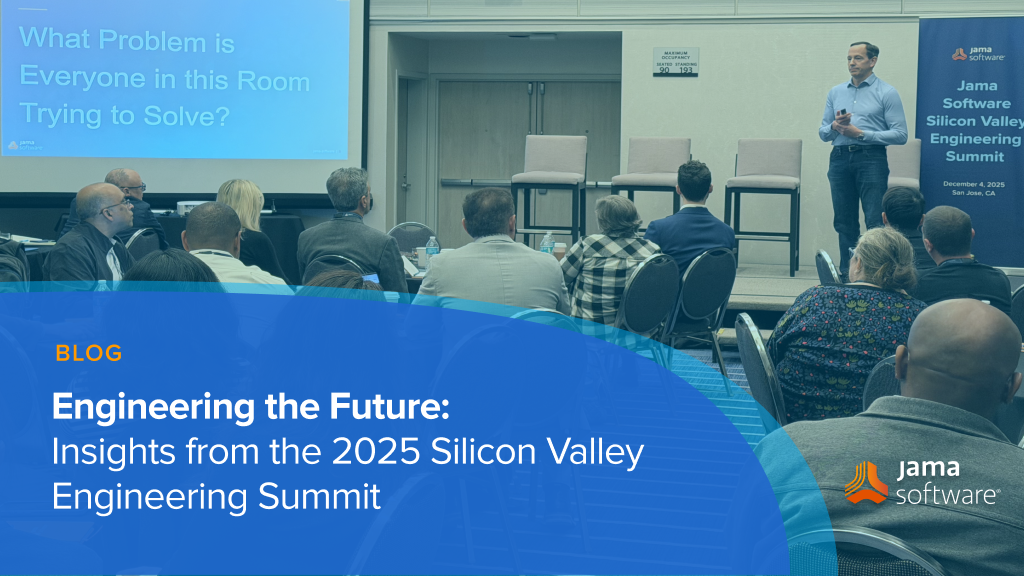
Marc Osofsky, CEO of Jama Software, presenting at the 2025 Silicon Valley Engineering Summit.
Engineering the Future: Insights from the 2025 Silicon Valley Engineering Summit
On December 4, 2025, top engineering leaders, product innovators, and compliance professionals gathered to discuss and explore the future of digital engineering. More than just a conference, this one-day, focused event was an intimate and collaborative forum designed to foster deep connections and facilitate the exchange of innovative ideas across high-stakes industries.
Attendees gained value from expert panels on emerging topics like AI-assisted engineering and cybersecurity, interactive sessions with senior industry leaders, and Jama Software executives. Beyond thought leadership, the event fostered meaningful cross-industry networking, collaborative learning, and real-world case examples that helped professionals benchmark their practices and explore innovative tools and techniques to advance engineering excellence within their fields
This post will recap the key moments, valuable discussions, and collaborative spirit that defined the summit, which was held at the San Jose Hilton.
A Convergence of Industry Leaders
The summit brought together a diverse group of leaders and professionals from aerospace and defense, medical devices and life sciences, semiconductors, and industrial manufacturing. The setup and structure of the event allowed for focused and meaningful discussions to take place. Unlike larger trade shows, this setting allowed for genuine collaboration. Participants could share specific challenges and discover cross-industry solutions that have delivered measurable impact.
The day was designed to move beyond high-level theory. It focused on practical strategies for improving engineering governance, navigating regulatory complexities, and integrating innovative technologies like AI and automation into established workflows.
Keynotes and Panels: Setting the Stage for Innovation
The morning sessions set a forward-looking tone for the day. Jama Software’s SVP of Product Management, Patrick Richardson, kicked things off with a keynote that outlined his vision for the future., while highlighting key product themes and core investment areas.
This was followed by a compelling presentation from HTEC’s Alfred Olivares and Craig Melrose on “AI Driven Innovation with Engineering Governance Built In.” They demonstrated how to embed governance from the start to unleash AI’s potential without sacrificing control or compliance.
Philomena Zimmerman, former Director of Engineering Tools and Environments at the U.S. Department of Defense, explored how digital engineering helps organizations clarify intent, reuse knowledge, and collaborate across organizational boundaries. In her session, “From Systems to Systems-of-Systems,” she offered a strategic perspective on aligning with the DoD’s push to move beyond slow, traditional acquisition models toward a culture of speed and agile execution—while also navigating the latest DoD acquisition reform directives.
A major highlight was the fireside chat with Chris Smith, Corporate Vice President at AMD. He and Jama Software’s Neil Stroud discussed pressing semiconductor market trends and shared lessons applicable to any complex engineering field. The morning concluded with an interactive panel where keynote speakers answered audience questions, creating a dynamic town hall atmosphere. Finally, Jama Software CEO Marc Osofsky shared his vision for leading the next era of digital engineering.
Tailored Insights in Collaborative Breakout Sessions
The afternoon was dedicated to deep dives into industry-specific challenges and solutions. Attendees split into 2 main focused breakout sessions, allowing for more targeted discussions and peer-to-peer learning. Topics by each industry are listed below.
Aerospace & Defense
This track featured leaders like Dr. Corey Hendricks, VP & Chief Engineer at Leidos, who discussed leveraging global scale with robust engineering governance as well as strategies for enabling business unit-level standardization on digital engineering excellence in speed, quality, and reuse efficiencies. Speakers shared strategies for driving efficiency and quality while preparing for evolving industry trends, including the acceleration of AI adoption. Christopher Delp, Systems Engineer Instructor at Caltech CTME, provided an engaging session titled “The Era of Blended Intelligence for Goal-Based Engineering of Sophisticated Systems.” He focused on how modern engineering teams can navigate growing system complexity by adopting digital and model-based systems engineering practice,s ultimately targeting a breakthrough approach of mission-driven engineering.
Medical Device & Life Sciences
Technical Fellow Bijan Elahi led a session on risk management techniques for digital health products. The track also tackled the complex regulatory landscape for AI/ML-enabled Software as a Medical Device (SaMD). A panel of industry leaders discussed everything from data security and human factors to using quality as a competitive advantage.
Semiconductors
This session addressed why engineering governance is becoming the standard for innovation in the semiconductor sector. Leaders gained fresh insights into requirements engineering at scale and heard firsthand how a leading company transformed its processes with Jama Connect. Sarah Gregory, Principal Systems & Solutions Engineer and Consultant, delivered a presentation titled “Challenges from the Semiconductor Trenches,” where she shared how what had been thought of as a complicated requirements management problem was in fact a more complex leadership interdependency challenge. Additionally, the Jama Software team introduced their new Semiconductor Solution Framework, designed to help clients accelerate time to market with customized PRD and MRD item types, tailored reports, and a comprehensive procedure guide, an approach that can have reusability across any industry or program’s development process that incorporates semi-conductor development.
Industrial Tech
Sheila King from Rockwell Automation shared the journey of her team’s adoption of Jama Connect, offering valuable insights and lessons learned along the way. Her story resonated deeply with the overarching theme presented by other speakers: the idea that processes are not static. Instead, they evolve through experimentation, reflection, and adaptation. Whether it’s refining processes, adjusting configurations, or embracing change, Sheila’s narrative underscored the importance of learning from each step and applying those lessons to drive continuous improvement.
Throughout the day, networking was woven into the agenda. From the welcome breakfast to the closing happy hour, attendees had ample time to connect with speakers and peers. These conversations were where the true value of the intimate setting became clear.
This collaborative environment sparked new ideas and forged valuable professional relationships that will extend far beyond the event itself. Participants left not just with notes, but with new connections and a renewed sense of community.
Shaping the Future of Digital Engineering
The Jama Software Silicon Valley Engineering Summit was more than just a recap of current trends; it was a collaborative look into the future. Attendees gained a cross-industry perspective on what top innovators are focusing on and left with actionable strategies to consider for implementation within their own organizations.
The key takeaway was clear: the future of complex product development relies on breaking down silos, embracing digital transformation, and fostering a culture of continuous innovation. By providing a platform for this exact purpose, the summit empowered every attendee to return to their work ready to build the next generation of groundbreaking products.
Change Management Best Practices: Protecting Your Software Tests
In the world of software development, ensuring the quality and reliability of a product is paramount. Yet, as teams face increasing pressure to deliver more features faster, maintaining disciplined processes can become a challenge. This is especially true when it comes to managing changes and ensuring that tests remain accurate and up to date.
The Value of Traceability
Traceability is a cornerstone of effective software quality management. By mapping feature requirements to test cases, teams can establish a clear connection between what needs to be built and how it will be validated. This approach not only ensures comprehensive test coverage but also enables teams to quickly identify and update tests when requirements change.
When supported by a requirements management tool, traceability becomes even more powerful. Features like traceability matrices and suspect triggers allow teams to see exactly which tests are impacted by upstream changes. This visibility enables faster reactions to changes, reducing the risk of defects slipping through the cracks.
However, as development teams grow smaller and the demand for rapid delivery increases, maintaining this level of discipline can become difficult. Detailed specifications may become less frequent, and the traceability between requirements and tests can erode.
Without traceability, managing changes becomes a manual and error-prone process. Late-stage changes, if not communicated effectively, can introduce regressions that go unnoticed until after release. This can lead to critical defects being discovered in the field, often by customers, which can have significant financial and reputational consequences.
The Cost of Defects
The cost of addressing defects increases exponentially the later they are discovered in the development lifecycle. Defects found during early stages, such as requirements definition or initial testing, are far less expensive to fix than those identified after release.
When defects are discovered in production, the impact extends beyond the immediate cost of fixing the issue. It can involve customer dissatisfaction, increased support workload, and even audits or reviews of the development process. These situations are not only costly but can also damage trust and relationships with key customers.
To avoid these pitfalls, teams must prioritize traceability and leverage tools that support it. Requirements management tools with built-in testing capabilities can provide features like suspect triggers, which notify teams of changes and help ensure that tests remain aligned with requirements.
By staying informed and proactive, teams can prevent costly mistakes and maintain the quality and reliability of their products. Traceability is not just a best practice; it’s a critical safeguard against the risks of rapid development cycles.
Looking Ahead
Proactive measures like traceability and impact analysis are essential for managing change effectively. In the next article, we’ll explore how impact analysis can help teams stay ahead of change and ensure that their processes remain robust.
Until then, remember: good tests deserve good processes. Don’t let bad things happen to them.
Note: This article was drafted with the aid of AI. Additional content, edits for accuracy, and industry expertise by Mario Maldari.
Why Live Traceability™ Matters for Medical Device Compliance
For design, quality, and regulatory teams in the medical device industry, launching a new product is a balancing act. You’re driven to innovate and perfect the design, but you’re also bound by strict regulatory requirements that demand meticulous documentation. This documentation often feels like it slows you down, forcing you to choose between progress and paperwork. The common approach of documenting traceability in spreadsheets after the fact is a high-stakes gamble that risks audit findings, delayed submissions, and costly rework.
TL;DR: Stop building traceability matrices at the end of your project. By using a platform that enables live traceability, you can create a complete digital thread as you work. This not only ensures you are always audit-ready but also speeds up your project, reduces risk, and allows your engineering teams to focus on innovation instead of paperwork.
The High Cost of After-the-Fact Traceability
When development teams rely on spreadsheets and documents to track traceability, they often postpone the task until the end of the project. This “spreadsheet scramble” is a familiar pain point for many engineers, and it’s fraught with risk.
Manually creating a traceability matrix by connecting thousands of requirements, risks, and test results is not just tedious; it’s a significant bottleneck that introduces substantial dangers:
Delayed Submissions: The sheer time required to manually assemble and verify a traceability matrix can push back your launch dates, especially when gaps or errors are found late in the game.
Increased Audit Risk: A static, manually created matrix is prone to human error and inconsistencies. Incomplete or inaccurate traceability is a major red flag for regulators and a common source of audit findings from bodies like the FDA and EU Notified Bodies.
Costly Rework: Without real-time visibility, a change to a single requirement can have unforeseen impacts on downstream tests and risk mitigations. Discovering these impacts late in the cycle leads to expensive and time-consuming rework.
Stifled Innovation: When your most skilled engineers are spending their final, critical weeks hunting down data for a spreadsheet, they aren’t innovating. Their time is diverted from design and testing to administrative tasks.
The key takeaway: Treating traceability as a final documentation step is a high-risk strategy. The true cost is not just the hours spent on paperwork, but the project delays, compliance failures, and missed opportunities for innovation that result from a disconnected process.
Live Traceability: Unlike a traditional matrix created at a single point in time, live traceability is a dynamic, real-time view of the relationships between all your development artifacts. As engineers define requirements, conduct risk analysis, and write test cases in a centralized platform, the connections are built automatically. It is always up-to-date, providing an accurate, living map of your project’s progress and coverage.
Digital Thread: The result of live traceability is a complete digital thread. This is an end-to-end, interconnected record of your entire development lifecycle. It provides an unbroken, auditable trail from the highest-level user need down to the individual test case that verifies it, including all associated risk controls along the way.
By establishing a single source of truth for all development data, you eliminate the ambiguity and risk associated with disconnected documents and create a robust foundation for compliance and quality.
Best Practices for Implementing Live Traceability
Shifting from a manual process to a live, integrated one doesn’t have to be complicated. It starts with adopting a new mindset and the right tools.
Step 1: Move Beyond Spreadsheets and Documents
The first and most critical step is to move all your requirements, risk, and test data out of isolated documents and into a centralized platform. This creates the single source of truth necessary for live traceability.
Step 2: Build Traceability as You Work
Instead of waiting until the end, teams should link items as they are created. When a new requirement is written, it should be immediately linked to its parent user need. When a risk mitigation is defined, it should be linked to the design requirement that implements it. This incremental approach makes traceability a natural part of the development workflow.
Step 3: Leverage a Purpose-Built Platform
While the concept is simple, execution is best handled by a dedicated tool. A modern requirements management platform like Jama Connect® is designed to facilitate this process. It provides the framework to not only capture all your data but also to create, view, and analyze the live traceability between items in real-time. This automates much of the work and provides powerful views to instantly identify gaps, perform impact analysis, and generate audit-ready reports.
Q: What is the difference between traditional traceability and live traceability? A: Traditional traceability usually involves manually creating a matrix in a spreadsheet at specific project milestones or at the very end. It’s static and quickly becomes outdated. Live Traceability™ in Jama Connect is a dynamic, real-time view of the connections between all development items (requirements, risks, tests) within a single platform. It is always current and provides instant visibility.
Q: How does a digital thread help with regulatory submissions (e.g., FDA, EU MDR)? A: A complete digital thread provides regulators with an easily auditable, end-to-end record of your development process. It demonstrates that every requirement has been tested, every risk has been identified and mitigated, and that the entire process was conducted under a state of control. This significantly strengthens your submission and simplifies the audit process.
Q: Can we start implementing live traceability mid-project? A: Yes. While starting with a modern platform from day one is ideal, it’s possible to migrate existing data from documents and spreadsheets into a system like Jama Connect. This allows you to establish a single source of truth and begin building a live digital thread, helping you get a handle on traceability and risk even if the project is already underway.
Take Control of Your Development Process
Stop letting manual traceability processes create bottlenecks and introduce risk. By adopting an integrated approach with a live digital thread, you can pass audits with confidence, accelerate your time-to-market, and empower your engineers to focus on what truly matters: innovation.
Note: This article was drafted with the aid of AI. Additional content, edits for accuracy, and industry expertise by Tom Rish, Mario Maldari, and Decoteau Wilkerson.
2026 Predictions Series: Insights from Leading Experts
As we move closer to 2026, product development feels more like an evolving journey than a fixed destination. It is a path full of fresh ideas, complex challenges, and real opportunities to create something better.
This multi-part series cuts through the noise to deliver actionable foresight. We have gathered leading experts to explore the critical shifts defining the next era of innovation. Whether you are looking to pivot your strategy or refine your roadmap, these insights will help you stay ahead of the curve.
Across every industry, we are tracking the threads that connect them all. This series provides a holistic view of the landscape, covering topics such as:
Emerging Technologies
AI and Automation
Ethical and Responsible
Cybersecurity
Regulatory & Compliance
Stay Ahead of the Curve
Predictions will appear below as they are published. Stay tuned to this space for ongoing updates and fresh expert insights as the series unfolds.
2026 Predictions for Consumer Electronics Product Development: AI, Sustainability, and the Rise of Connected Ecosystems
In part one of this series, Patrick dives into how AI is shaking up the design process, why making products more sustainable and built to last matters more than ever, and how connected ecosystems are rewiring our expectations. He also tackles big-picture topics like data privacy and the need to build stronger, more adaptable supply chains.
Keep reading as Patrick takes a closer look at where consumer electronics might be headed, from the latest tech breakthroughs to the real-life hurdles and wins shaping the industry’s next chapter.
2026 Predictions for Medical Device & Life Sciences: AI, Wearables, and Navigating Regulatory Change
With 2026 on the horizon, the medical device and life sciences industries are moving through a landscape defined by fast-paced innovation, changing regulations, and dynamic market shifts.
From the transformative potential of Artificial Intelligence (AI) in product development and diagnostics to the growing role of wearables and personalized medicine, the industry is embracing change while addressing critical challenges like cybersecurity, data privacy, and supply chain resilience.
In part two of this series, we’ve gathered insights from leading experts across the field, including:
Tom Rish, Senior Business Development Manager, Medical Device & Life Sciences
Together, they explore the opportunities and hurdles that lie ahead, offering a glimpse into the future of medical devices and life sciences.
Join us as these experts share their perspectives on the technologies, strategies, and innovations that will define the next chapter of the industry. From AI’s growing influence to the challenges of regulatory harmonization and the rise of wearables and personalized medicine, this piece highlights the trends shaping 2026 and beyond.
2026 Predictions for Aerospace & Defense: AI, Sustainability, and the Digital Transformation Frontier
As we approach 2026, the aerospace and defense (A&D) industry stands at the crossroads of innovation and transformation. With rising geopolitical tensions, increased defense spending, and technological advancements, the sector is navigating a complex landscape of opportunities and challenges.
From the integration of AI and digital twins to the push for sustainable aviation and the modernization of legacy systems, A&D organizations are embracing cutting-edge technologies to enhance efficiency, safety, and mission readiness. At the same time, they face critical hurdles, including supply chain disruptions, evolving regulatory frameworks, and the need to attract a future-ready workforce.
Together, they explore the trends and technologies shaping the future of aerospace and defense. From AI-driven design optimization and autonomous systems to the rise of sustainable aviation fuels and the challenges of digital engineering, this piece highlights the innovations and strategies that will define 2026 and beyond.
Please note: This blog features content from writers in the UK and the US. Spelling variations (e.g., ‘defense’ vs. ‘defence’) may appear due to regional differences.
2026 Predictions for Automotive: AI, Electrification, and the Road to a Connected Future
As 2026 approaches, the automotive industry is about to enter an exciting phase marked by cutting-edge technologies, sustainability requirements, and shifting consumer expectations. The industry is navigating a changing landscape of opportunities and challenges, from the emergence of autonomous driving systems and vehicle-to-everything (V2X) communication to developments in electrification and AI-driven innovation.
The integration of emerging technologies is reshaping vehicles into interconnected, software-defined systems, while sustainability goals are driving rapid advancements in battery technology, charging infrastructure, and renewable energy integration. At the same time, the industry faces critical hurdles, including cybersecurity threats, regulatory complexities, and the need for seamless collaboration across OEMs, suppliers, and technology partners.
Together, they explore the trends and technologies shaping the future of the automotive industry. From AI-driven predictive maintenance and edge computing to the challenges of electrification and the rise of subscription-based ownership models, this piece highlights the innovations and strategies that will define 2026 and beyond.
2026 Predictions for Semiconductors: AI, Chiplets, and the Path to Sustainable Innovation
As we step into 2026, the semiconductor industry stands at the crossroads of unprecedented technological advancements and complex global challenges. From the rise of AI-driven chip design and heterogeneous integration to the growing emphasis on sustainability and geopolitical shifts, the sector is navigating a transformative era.
The next wave of innovation will be defined by breakthroughs in advanced lithography, chiplet architectures, and quantum computing, while sustainability efforts will reshape manufacturing processes to address energy efficiency, water usage, and materials recycling. At the same time, the industry faces critical hurdles, including talent shortages, supply chain realignments, and the need for robust cybersecurity measures.
Together, they explore the trends and technologies shaping the future of semiconductors. From AI-driven automation and edge computing to the challenges of regulatory shifts and the promise of chiplet-based architectures, this piece highlights the innovations and strategies that will define 2026 and beyond.
2026 Predictions for AECO: AI, Digital Twins, and the Path to Sustainable Transformation
As we step into 2026, the Architecture, Engineering, Construction, and Operations (AECO) industry is poised for a transformative leap. From the integration of AI and digital twins to the adoption of robotics and advanced materials, the sector is embracing innovation to tackle its most pressing challenges: sustainability, efficiency, and collaboration in a hybrid world.
This year’s predictions explore how emerging technologies like generative design, predictive analytics, and automation are reshaping the project lifecycle. We’ll dive into the role of advanced digital tools in achieving net-zero goals, the growing importance of cybersecurity in a connected ecosystem, and the long-term trends that will define the industry for years to come.
2026 Predictions for Nuclear Energy: Innovation, Safety, and the Path to a Sustainable Future
The nuclear energy industry stands at a pivotal moment where innovation and tradition intersect to tackle the world’s most urgent challenges: decarbonization, energy security, and sustainability. From the emergence of small modular reactors (SMRs) and advanced reactor designs to the adoption of AI, automation, and digital engineering, the sector is embracing transformative technologies that are set to redefine how nuclear power is designed, operated, and perceived.
Key trends shaping the nuclear landscape include the transition from conceptual innovation to deployable solutions, the role of digitalization in enhancing safety and efficiency, and the evolution of regulatory frameworks to support next-generation technologies. Additionally, cybersecurity, workforce development, and global collaboration are becoming essential pillars of the industry’s future, ensuring that growth and innovation remain firmly grounded in the safety-first principles that define nuclear energy.
In this final blog of the 2026 prediction series, we bring these insights to life with perspectives from Jama Software’s industry expert, Patrick Garman, Solutions Manager for Energy, Industrial, and Consumer Electronics sectors. Patrick shares a forward-looking vision for 2026 and beyond, exploring the deployment of SMRs and advanced fuels, the integration of predictive analytics and real-time monitoring, and the innovations, strategies, and cultural shifts that will shape the nuclear industry’s role in a clean energy future.


![[Webinar Recap] Transform Engineering Processes: Bridge Gaps Between Teams and Tools Effectively](https://www.jamasoftware.com/media/2025/01/Transform-Engineering-Processes.png "[Webinar Recap] Transform Engineering Processes: Bridge Gaps Between Teams and Tools Effectively")