Tag Archive for: Product Development & Management Page 6
Tag Archive for: Product Development & Management
Jama Software Provides a Single, All-in-One Solution for Requirements, Risk Management, and Validation
Organizing requirements, managing risk, and ensuring validation are complex processes on their own. For teams in the medical device industry, these tasks are even more challenging due to stringent regulatory standards and the critical nature of the products themselves. Jama Connect®, a robust software tool designed specifically for such pressures, offers a seamless, all-in-one solution.
What to Look for In a Requirements Management Tool
At the 2024 INCOSE Healthcare Conference, one of the presenters delivered an insightful presentation highlighting the essential features their organization identified as necessary in a requirements management solution to effectively support complex risk management procedures.
This blog post provides a detailed breakdown of how Jama Connect is specifically designed to address each of these critical areas discussed during the presentation.
End-to-End Traceability for Risk Analysis and Validation
Why It’s Important: Without clear traceability, unverified requirements or overlooked risks can result in delays, missed compliance, or worse, product failure.
How Jama Connect Helps:
Jama Connect provides traceability across all items in the development process, linking risk analysis elements to requirements, mitigations, and verification items.
Suspect triggers and impact analysis. Any upstream change triggers “suspect links,” highlighting potential downstream impacts, so no critical changes are overlooked. Impact analysis features allow for a proactive approach to understanding the scope of a change BEFORE it occurs.
Configurable views and export templates ensure efficient reporting to compliance agencies, showing validation evidence clearly and concisely.
Example: Teams can easily export views with verification columns from Jama Connect into Word or Excel for seamless external reporting.
Supports seamless data imports from applications like Microsoft Excel or Word, using reusable import wizards for faster and repeatable imports.
Pre-configured framework for Medical Device & Life Sciences, reduces time-to-value, allowing teams to get up and running quickly.
SOC2 Compliance, combined with the robust capabilities of a Validated Cloud and Validation Kit, provides systems engineers with effective solutions to meet stringent security and regulatory compliance requirements.
Additionally, the focus on user experience allows for a fast time to value across project teams.
Flexible Configurations for Different Workflows
Why It’s Important: Medical device companies don’t all operate under the same workflow, and tools must accommodate that diversity.
How Jama Connect Helps:
Pre-configured frameworks for compliance streamline setup time while allowing for configuration to suit unique organizational processes.
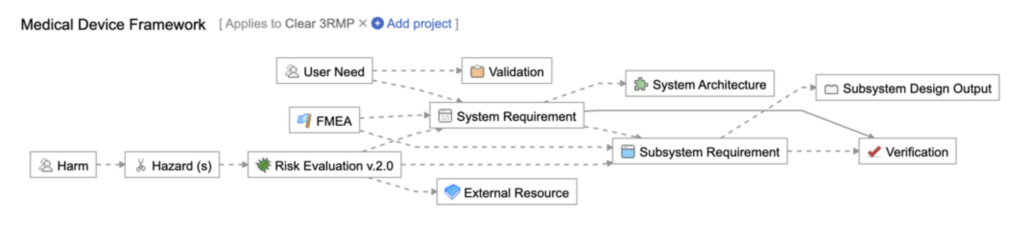
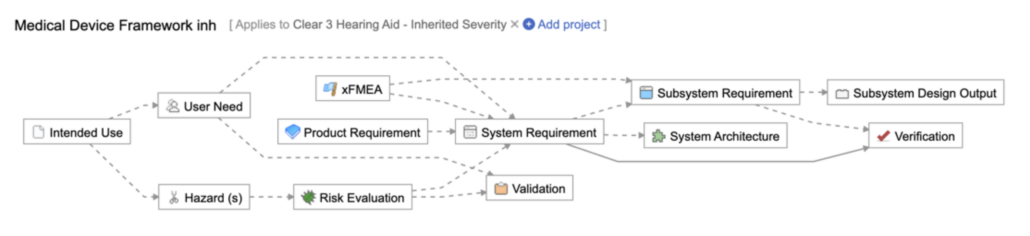
Provides users with the Traceability Information Model, visualizing traceability chains to ensure nothing falls through the cracks.
From aligning with new SOPs to creating testing and validation workflows, customization ensures this tool adapts as projects evolve.
Scalable Solution for Large Projects
Why It’s Important: Medical device development often spans multiple teams and product lines, increasing complexity.
How Jama Connect Helps:
Provides for the ability to break large projects down into smaller, manageable subcomponents while maintaining traceability across product lines.
Supports cross-project traceability and reusability, which is ideal for future scaling.
This modular approach makes it easy for businesses to simplify operations without losing sight of critical compliance elements.
Risk management and requirements traceability go hand-in-hand, forming a critical component of any successful project. A well-configured tool should seamlessly align with your existing processes while offering the flexibility to adapt to your specific needs.
To illustrate, here are three examples of how Jama Connect’s Traceability Information Model can be configured to enhance and support a comprehensive risk management process. These configurations are designed to streamline workflows, improve traceability, and ensure better alignment with your risk management objectives.
Example 1 (from Jama Connect’s Medical Device Framework)
Example 2 (from Jama Connect’s Medical Device Framework)
Example 3: Customized Workflow
Conclusion:
Jama Connect is a purpose-built solution designed to meet the complex and stringent requirements of the medical device industry. Offering robust capabilities like end-to-end traceability — from risk analysis through to verification — it ensures seamless oversight across the entire development lifecycle. With capabilities, such as FMEA and alignment with critical regulatory standards for the medical device industry, Jama Connect simplifies compliance and elevates requirements management to the next level.
With award winning usability, Jama Connect features an intuitive interface, customizable configurations, and powerful change management capabilities. These features enable teams to work efficiently while staying aligned with regulatory needs. By fostering real-time collaboration and bridging the gaps between stakeholders, Jama Connect empowers organizations to accelerate product development without compromising on safety or quality.
Structured Collaboration in Semiconductor Development
Any semiconductor product development team has experienced the challenge of managing data from different components of a highly complex system of systems. In today’s hypercompetitive market, requirements management is a high-stakes effort navigating tight operational margins with little room for data integrity errors. Because different components of a semiconductor product may evolve along different timelines, building a coherent product from multiple data streams requires new methodologies and practices to continuously deliver these products to the market quickly and with high quality – no easy feat!
Many of these organizations struggle to keep pace with the rapidly changing product development environment, especially when their teams work in silos using either business applications (Word, Excel) or legacy requirements management systems to house their definitional data. As businesses continue to shift focus to faster time-to-market and customer-driven product development, deeper structured collaboration amongst teams is not only desired but necessary.
What is Structured Collaboration
Structured collaboration is centered around the idea that people can work and interact with one another, moving toward specific and measurable goals. This approach works in two parts, utilizing technology and process frameworks to define new and innovative ideas that drive business outcomes.
By combining asynchronous but interdependent collaboration with elements of content management (content about your product or system), development process management, and task management — all integrated into a workflow process that coordinates multiple activities from several teams — cross-functional teams can produce the results that drive the business forward.
The absence of structured data and practices early in the Product Lifecycle can lead to wasted time, untraceable changes, lost context for decisions that were made, and missed opportunities for innovation.
Bringing together innovators across cultures, organizations, and geographic regions to accomplish goals can revolutionize a sector. It also presents unique challenges with each group having their own standards and entrenched way of tackling the task at hand. So, how do these teams tackle complicated divides without their differences becoming impediments?
Unify Goals: When cross-functional teams have a shared purpose and unified goals for developing a product, innovation, or service, they can better overcome challenges inherent to collaborating in a complex environment.
Clarify Roles: Clearly communicating expectations for how and when each team member will be asked to participate helps alleviate the uncertainty that comes with collaborating in a new way. Documenting areas of accountability and tracking collaboration each step of the way keeps programs moving forward smoothly.
Encourage Expression of Unique Points of View: Unlocking the creativity needed for innovation requires harnessing insights and unique perspectives across different stakeholders. Encouraging team members to speak up and share alternative perspectives results in robust and better-considered ideas for implementation. Having representation from across the team will also help better assess the impacts of decisions made and identify issues before they become problems.
Use the Right Tools: We’re fortunate these days to have a wealth of collaboration tools from Slack, Discord, and Microsoft Teams to Zoom and Google Meet. As teams seek real-time input and feedback critical to capturing insights, these tools serve a vital purpose. These only scratch the surface in eliciting the type of collaboration necessary for modern systems engineering, though.
Enable Cross-Team Alignment with Live Traceability™
While meetings, emails and instant messaging channels serve a purpose, they are insufficient for making and tracking key decisions that impact an entire silicon program. Modern systems engineering must include means for live data to be shared and accessed by teams anywhere in the world at any point in time.
As members of the product team seek to communicate requirements and project status across departments, roles, and geographic boundaries, the golden age of sharing documents and spreadsheets will no longer serve its purpose. Without a digital thread that connects people and processes — from definition to delivery — development teams face increased risk, challenges meeting compliance, and delays that can impact time-to-market and product and systems stability.
Live Traceability™ in Jama Connect® provides a single-source of truth, cross-team collaboration, and end-to-end visibility which forms the digital thread through siloed complex product, systems, and software development.
Eliminate Collaboration Silos to Enable Strategic Partnerships
Today’s semiconductor ecosystem requires companies to consider strategic partnerships as they sell into varied dynamic and often integrated markets such as robotic factory automation, autonomous driving, and AI-enhanced medical diagnostic equipment. With these new partnerships and integration comes greater sharing of data across distributed teams, business units, and with partner companies. Teams that operate in silos with legacy systems will not be equipped to meet demands set by the market.
For engineers accustomed to working in internal, siloed groups, these new partnerships present previously unforeseen challenges. Structured and strategic team collaboration and careful data governance and security are critical to improving the product development process for all participants – and this includes everyone across the supply chain.
People working together is at the very core of all product development. For companies to turn the research of today into the products of tomorrow, it is critical that their teams stay connected, synchronized and unified. By aligning business objectives with a system in place that allows for structured reviews and collaboration, teams can elicit feedback, review product features with stakeholders in real-time and track critical decisions across teams and locations. Simply put, it gives companies that ideate, design, develop and deliver highly complex semiconductor products a critical edge in an industry where the speed, precision, and quality of process enable the speed, precision, and quality of products.
Jama Connect provides a robust yet flexible framework to enable accelerated design and development. Contact us to learn more about reducing collaboration friction through shared data across your semiconductor system of systems.
Expert Perspectives: The Shift Towards Systems Engineering in the Architecture, Engineering, and Construction (AEC) Industry
Welcome to our Expert Perspectives Series, where we showcase insights from leading experts in complex product, systems, and software development. Covering industries from medical devices to aerospace and defense, we feature thought leaders who are shaping the future of their fields.
Robust requirements management in the construction industry, enabling teams to better meet client needs, comply with regulatory standards, and deliver projects efficiently
The adoption of systems engineering in construction projects
The challenges faced in implementing these methodologies, and how major companies are adapting to this change
Kenzie Ingram: Welcome to our Expert Perspectives series where we showcase insights from leading experts in complex product, systems, and software development. Covering industries from medical devices to aerospace and defense, we feature thought leaders who are shaping the future in their fields. I’m Kenzie, your host, and today I’m excited to welcome Burzin Tampal, a well-respected Senior Requirements Manager from Toronto, Canada with more than 10 years of experience in systems engineering.
Burzin has worked on major projects within infrastructure, energy, and mining markets across all phases of the project lifecycle. He specializes in developing and implementing processes for requirements management, verification and validation, and interface management on complex projects. Joining Burzin is Jama Software’s own Joe Gould, a seasoned Senior Account Executive with extensive experience in sales within the architecture, engineering, and construction industry. Today, Burzin and Joe will be speaking with us about the shift towards systems engineering in the architecture, engineering, and construction (AEC) industry. Without further ado, I’d like to welcome Burzin Tampal and Joe Gould.
Joe Gould: Hello, everyone. I’m Joe Gould, Senior Account Executive with Jama Software, and welcome to today’s interview with an expert. I’m thrilled to have Burzin Tampal with us, a seasoned expert in systems engineering. Today, Burzin will be sharing insights into the challenges and benefits of adopting a systems-focused approach in the AEC industry. Burzin, thank you for joining us. It’s a pleasure to have you here.
Burzin Tampal: Thank you, Joe. I’m honored to be here.
Gould: Great. Well, Burzin, let’s jump right in. Can you describe your journey and what prompted the shift towards adopting systems engineering in construction projects?
Tampal: Certainly. So I’ve had the opportunity to work in the medical, financial, and software development sectors prior to working on major projects in the AEC where I initially started off in the rail and transit division. Unfortunately, not all projects were successful by project management standards and most ended either over budget, over schedule, or had quality issues. These projects would sometimes lead to lawsuits, and I had heard that this was somewhat typical for these projects.
I was quite concerned that this was status quo for a 200 plus year old industry, so I started doing some independent research and went down a path which led me to learning more about systems engineering. I came across a popular study. You might know or heard of it. It’s the 2015 Chaos Report by The Standish Group. And although it was not specific to the rail and transit industry, I felt it was very applicable.
If my memory serves me correctly, the outcome stated that something like the top three, the top five reasons, rather, for failed projects was related to poor requirements management practices. I guess I really tried to right the ship after that. I could start to see where the current practices on these major engineering and construction projects were failing to meet the needs of the complex project.
And after gaining some modest successes, I was determined to rethink how we implement systems engineering best practices efficiently across all engineering and construction projects. I developed my own strategy for deploying a lean systems engineering solution on projects, and I’ve been using systems engineering principles on all construction projects ever since.
Gould: That’s great. It’s fascinating to hear how your organization’s moved towards systems engineering. I know that shift can often come with its own set of challenges, but I’d love to see this thought leadership in our industry, Burzin. Next question, can you explain how requirements management plays a role in your construction projects?
Tampal: Absolutely. So requirements management, as most people think about it, has typically been used on systems projects, which inherently have a lot of complexity. If we take a step back, however, without getting into details about a rigorous process or beneficial tools, requirements management at its core is simply meant to track and trace stakeholder needs and project requirements throughout the project lifecycle with the end goal of ensuring compliance and satisfying the stakeholder needs.
Now, I can’t think of a project, systems or not, which wouldn’t benefit from the practice with that definition. One that is meant to ensure that the handed over project meets the needs of the client as formally agreed to. So with that in mind, requirements management really forms the backbone of systems engineering and even project management to a certain degree on engineering and construction projects that I’ve been working on.
Gould: Yeah, it sounds like requirements management really sounds like a crucial aspect here, Burzin. I imagine keeping track of requirements in a way that aligns all stakeholders can make an absolute huge difference.
Tampal: Absolutely. 100%. That’s fundamental.
Gould: So tell me what benefits you’ve experienced moving to a more systems engineering focused approach.
Tampal: Well, where do I start? There are many obvious benefits of using systems engineering that you could read about in a lot of systems engineering materials. The INCOSE Handbook is a great resource. But I think I’ll expand on some of the benefits that are not typically highlighted. So the first benefit I would mention is consistency. Leveraging a standard systems engineering process enabled consistent outputs and deliverables.
While this may sound underwhelming, it was actually the foundation for many of the other benefits we were able to attain. Some other more common benefits include a reduction in error quality issues, which meant reduced corrective effort, improved communication, which resulted in reduced duplication of effort. And once the processes were standardized and we were getting consistent outcomes, we could then implement process efficiencies which resulted in reduced resources or effort required to perform the work.
Gould: Wow, that’s excellent. It’s great to hear that you’ve realized those tangible benefits. Sometimes there are those moments where new processes open up even more possibilities.
Gould: So what are some of the unique challenges construction projects face compared to say traditional industries like automotive or aerospace when it comes to implementing systems engineering, Burzin?
Tampal: That’s a great question. There are a lot of unique challenges. So conceptually, systems engineering best practices involve the requirements development process to be performed collaboratively with all stakeholders participating in the creation, review, and approval of the project requirements set. Traditional industries specializing in manufacturing and product development such as the automotive industry benefit from the ability to own their requirements management process from inception.
Most major architecture, engineering, and construction or AEC projects, however, are managed based on project requirement input documents and schematics in PDF, especially in the public sector. While it might not seem like much of a challenge at first, the fact that the initial baseline of project requirements is provided in a PDF document requires a great deal of upfront effort to review, extract, and manage project requirements.
Additional challenges include the fact that request for proposal (RFP) and contract documents are typically created by multiple people or teams in silos from each other over a long period of time. This practice tends to lead to incomplete requirements causing scope gaps, duplicate requirements causing duplicate effort, and even conflicting requirements causing quality issues across the project requirements set.
A final legal review of those requirements and edit of those documents typically compounds the challenges by adding a layer of ambiguity to the requirements set. Furthermore, different contract models and strategies come with their own unique set of challenges, almost always impacting efficiency of requirements change management.
Gould: I think I’ve been through some of those PDF reviews before, Burzin, so that makes a lot of sense. Construction does seem to have a unique constraints compared to industries like automotive or aerospace. Can you talk a little bit about the challenges of keeping everyone in sync and aligned on a complex project?
Tampal: Absolutely. It’s commonly known that communication is key. This is even more so true when it comes to large projects where there’s a complex stakeholder relationship structure involving a mix of clients, contractors, suppliers, sub-consultants, vendors, and third parties. Ensuring that you are providing the most up-to-date information to the correct stakeholders is certainly a challenge.
Since construction projects can range in duration from weeks to years and even decades, key things to consider include the frequency, mode, and the level of detail in communications. Ensuring everyone is aligned and contributing towards the next major milestone involves meticulous planning and consistent monitoring and execution.
Gould: So Burzin, staying aligned on a complex project has to be a major priority for everyone, especially with so many moving parts in construction projects.
Tampal: Absolutely. At times there can be up to a hundred or more stakeholders that you have to manage and keep informed.
Gould: That’s a lot of alignment. Definitely a lot of alignment. So Burzin, how do you handle the integration of evolving project requirements throughout the construction process? I mean, what best practices do you follow to manage changes without disrupting progress?
Tampal: Well, this is certainly a challenge on all projects and more so on large complex AEC projects. We all know the inverse relation graphic of cost of changes over time on a project and the opportunity to influence or make a change on a project where there is more opportunity and lower cost to implement a change early on in the project life cycle and much less opportunity and higher cost to implement a change later in the project life cycle.
Without an industry-recognized requirement software tool like Jama Connect®, it would nearly be impossible to identify the changes, perform an impact assessment, review the changes with the change control board for approval, and then implement all the approved changes, ensuring all impacted requirements and other items are resolved as required. Because changes during construction are typically more costly, we want to ensure that the project is adhering to a well-defined configuration management and change control process.
Some of the best practices that we implement include using a functional tool to track the proposed changes, trace the changes to all impacted items, this could be evidences or other requirements, include all relevant stakeholders in the CCB or Change Control Board when reviewing and deciding to approve a change, and adequately communicating the approved change to teams for all impacted items. Although this will not eliminate disruption, this will greatly reduce the potential of negatively impacting the project’s quality, schedule, or budget.
Gould: Wow. It sounds like balancing evolving requirements with project stability is no small feat, especially in a field as dynamic as construction. I’m sure your approach to managing this balance is a key factor in keeping your projects on track despite the inevitable changes.
Tampal: Absolutely.
Gould: So Burzin, what role does technology such as software tools for requirements management play in the shift towards systems engineering, do you think?
Tampal: Well, throughout this interview, I’ve mentioned many challenges which come with the territory when participating in construction projects, particularly large and complex AEC projects. Technology such as software tools for requirements management play an integral role in the shift towards deploying a standards-based systems engineering solution in line with industry best practices.
The technology shift has contributed to both increasing the complexity on projects as well as providing software tools that can better calculate, simulate, and manage the solution. Projects have already shifted to digital delivery, and leveraging the best tool fit for purpose is detrimental to project success.
When used correctly, requirements management tools such as Jama Connect, design management software such as AutoCAD, MBSE tools for modeling, and construction management software such as Autodesk Construction Cloud or ACC can significantly reduce the effort required to produce a deliverable while improving the quality at the same time. However, with the available software tools in the market, it is becoming increasingly more important to ensure the tools can integrate with each other and establish a digital threat,d and streamline the overall process.
Over the past two years, there have been a boom in artificial intelligence and machine learning. We are now in a time where data is the most valuable currency, and therefore, understanding how to get the most out of the technology and software solution deployed on a project is detrimental to long-term success.
Gould: I couldn’t agree more. It sounds like technology really supports teams in navigating the complexities of systems engineering. I can imagine that certain features in requirements management tools make a significant impact on how effectively you implement this approach.
Tampal: Absolutely.
Gould: Well, Burzin, I think we’re out of time. I want to thank you so much for sharing your insights and your experiences with us today. It’s been for me incredibly valuable to hear about your journey in integrating systems engineering. We appreciate your time and openness and look forward to seeing the continued success of your projects. Burzin, thank you again.
Tampal: Thank you for having me, Joe. Appreciate it.
Ingram: Thank you for joining us in this episode of our Expert Perspectives series. We hope you’ve enjoyed this conversation between Burzin Tampal and Joe Gould on systems engineering and architecture engineering in construction industries. If you’re an existing customer and want to learn more about Jama Software, please reach out to your customer success manager or consultant.
If you’re not yet a client, please visit our website at JamaSoftware.com to learn more about us and how we can help optimize your development processes. Thank you and stay tuned for our upcoming episodes of Expert Perspectives. Please note that the views expressed in the interviews and commentary are solely those of the individuals providing them and do not reflect the opinions of Jama Software.
THIS HAS BEEN A PREVIEW OF OUR VIDEO AND TRANSCRIPT –
CLICK HERE TO WATCH THIS INTERVIEW IN ITS ENTIRETY:
Mastering Configuration and Customization in Jama Connect®
Jama Connect® is a powerful platform designed to streamline requirements management and foster process standardization across organizations. Its flexibility allows teams to tailor the system to their unique workflows while maintaining consistency. This article delves into effective strategies for configuring and customizing Jama Connect to align with your organization’s processes.
Embrace Process Standardization
While Jama Connect offers extensive configurability, it’s essential to prioritize process standardization. Aligning team-specific needs with a unified process ensures consistency and efficiency. Before implementing custom configurations, evaluate whether existing setups or minor adjustments can meet your requirements. This approach minimizes complexity and promotes a cohesive workflow.
As your team interacts with Jama Connect, new configuration needs may emerge. Establishing a Configuration Change Control process helps manage these requests systematically. Form a configuration change board responsible for reviewing and approving configuration changes. This board assesses requests to determine if they can be addressed through process alignment, existing configurations, or user training. Such governance ensures that changes are deliberate and beneficial.
Customize Item Types Thoughtfully
Item types in Jama Connect define various artifacts like requirements, test cases, and risks. While creating custom item types can cater to specific needs, it’s advisable to limit their proliferation. A streamlined set of item types simplifies management and enhances reporting consistency across projects. Before adding new item types, consider adapting existing ones to serve multiple teams, ensuring they are not over-configured with unnecessary fields. Remember, changes to item types affect all projects, as they cannot be customized individually.
The Explorer Tree is central to navigating projects within Jama Connect. Users can tailor this feature to display information most pertinent to their roles:
Access Explorer Settings: Click the gear icon at the top of the Explorer Tree.
Adjust Preferences: In the settings window, choose options such as displaying item IDs, showing only folders, or enabling outline numbering.
Apply Changes: Save your settings to customize your view.
These adjustments enhance usability and focus, allowing users to concentrate on relevant project components.
Jama Connect allows you to fully customize your workflow process to align with your unique organizational needs. Whether your workflow follows a simple pattern, such as “Draft → Reviewed → Approved,” or a more complex series of states, you have the flexibility to define and manage it directly within Jama Connect. This customization ensures alignment with your team’s processes, facilitating smoother transitions between stages and maintaining clear visibility into the current status of your work items. By tailoring workflows, teams can improve efficiency, maintain compliance, and ensure that the right steps are followed throughout the project lifecycle.
The Review Center within Jama Connect also supports significant levels of configuration and customization, empowering teams to manage reviews effectively. For example, you can enable features like voting mechanisms to gather stakeholders’ input, implement electronic signatures for requirements to ensure traceability and compliance, or lock items automatically once they reach a specific state in the review process. These configurable options provide enhanced control over collaboration, allowing teams to tailor the review process to meet business goals while fostering accountability and transparency among all participants.
Enhance Test Execution with Custom Fields
During test execution, capturing specific data can be crucial. Adding custom fields to the Test Run item type allows testers to input additional information:
Access Test Run Configuration: Go to Admin > Item Types > Test Runs.
Add Custom Field: Click ‘Add field,’ complete the form, and save.
Utilize in Test Runs: The new fields will appear during test execution for data entry.
This customization enables teams to collect all necessary information during testing, enhancing the quality and traceability of test results.
As projects evolve, so do processes and requirements. Regularly revisiting Jama Connect configurations ensures they remain aligned with current needs. Schedule periodic reviews to assess the effectiveness of existing setups and make necessary adjustments. This proactive approach keeps the platform responsive and relevant.
In conclusion, effectively configuring and customizing Jama Connect involves a balance between flexibility and standardization. By thoughtfully implementing changes, governing configurations, and maintaining regular reviews, organizations can harness the full potential of Jama Connect to support their unique workflows while ensuring consistency and efficiency.
Editors Note:This blog post was written using our Jama Software Help resources and leveraging AI assistance for organization and streamlining purposes. This article is not meant to be comprehensive. For help configuring or customizing your Jama Connect instance, please reach out to your customer success manager. If you are not yet a Jama Software client, but interesting in speaking more about Jama Connect, please visit this page: https://www.jamasoftware.com/platform/jama-connect/trial/
Functional Safety in Industrial Manufacturing: Navigating IEC 61508, ISO 13849, IEC 10218 for Safer, Smarter Operations
In the dynamic world of industrial manufacturing, the stakes have never been higher. As factories grow smarter and more interconnected, ensuring the safety of workers, equipment, and processes is paramount. Functional safety, a concept grounded in preventing and mitigating risks through system design and operational safeguards, has become a cornerstone of modern industrial practices.
This eBook serves as your comprehensive guide to navigating the complex but essential landscape of functional safety standards. From the foundational principles of IEC 61508 to the robotic-focused provisions of ISO 10218, we will delve into the key frameworks that underpin safer, smarter operations.
Whether you’re an engineer, safety professional, or business leader, understanding these standards is not just about compliance — it’s about future-proofing your operations in an era of rapid technological advancement. Let’s explore how to harness the power of functional safety for a more resilient and innovative manufacturing environment.
What is Functional Safety? Functional safety ensures that industrial systems operate safely even when they fail. It encompasses risk assessment, hazard mitigation, and the implementation of controls that reduce risks to acceptable levels. Unlike general safety measures, functional safety directly addresses equipment malfunctions and system failures.
Why is Functional Safety Critical?
Protecting Lives and Assets: Reduces the likelihood of accidents, injuries, and damage.
Ensuring Compliance: Meets legal and regulatory requirements for industrial operations.
Boosting Operational Efficiency: Reduces downtime by preventing catastrophic failures
Real-World Examples
The importance of functional safety becomes evident through real-world scenarios where its absence or presence has significantly impacted outcomes. Below are several real-life examples that have been generalized for educational purposes:
Chemical Processing Plant: A chemical manufacturer experienced a significant incident due to the failure of a pressure control system. The lack of redundancy and inadequate safety measures led to a dangerous overpressure scenario, causing equipment damage and a toxic gas release. This incident underscored the need for comprehensive risk assessments and safety instrumented systems (SIS) compliant with functional safety standards.
Improvement Through Functional Safety: Another plant, learning from such failures, implemented an SIS aligned with IEC 61508 standards. By incorporating redundancy in pressure sensors and automated shut-off valves, they successfully mitigated similar risks, resulting in zero incidents over a five-year period.
Automotive Industry: A global automotive manufacturer faced challenges in ensuring brake system reliability. Initial designs lacked sufficient fault-tolerant measures, which could have led to brake failure under specific conditions. Applying functional safety principles, the company developed a braking system that met SIL 3 requirements, enhancing reliability and customer trust.
Food Processing Machinery: A food processing company faced frequent machine shutdowns due to sensor malfunctions. This not only disrupted production but also posed safety risks to operators. By redesigning their systems to comply with ISO 13849 and implementing real-time diagnostics, the company reduced unplanned downtime by 40% and improved operator safety.
Renewable Energy Sector: A wind turbine operator encountered significant downtime due to control system errors. By adopting functional safety standards, they redesigned their turbine control systems to include failsafe mechanisms and predictive maintenance features, minimizing operational disruptions and ensuring safer energy production.
These examples illustrate how functional safety principles, when applied effectively, can prevent accidents, enhance reliability, and improve operational efficiency across diverse industries.
IEC 61508 is the umbrella standard for functional safety, applicable across industries. It provides comprehensive guidelines for designing, implementing, and maintaining safety-related systems. This standard is particularly valuable for manufacturers dealing with complex systems that demand a high level of safety integrity.
Key Concepts
Safety Integrity Levels (SIL): These levels define the required risk reduction for safety functions, guiding system designers in their choice of components and processes.
System Lifecycle Approach: A holistic framework that considers safety at every stage, from concept to decommissioning.
Risk Reduction: This involves combining advanced technology, rigorous processes, and human expertise to address potential hazards.
Practical Application
Manufacturers can integrate IEC 61508 to design fail-safe systems that detect, prevent, or mitigate failures before they escalate. For instance, in process industries like oil and gas, SIL assessments ensure that critical safety functions meet stringent reliability requirements.
IEC 61508 provides a structured approach for designing safety-related systems, ensuring they meet rigorous reliability and risk-reduction criteria. In industries like oil and gas, this standard is applied to Safety Instrumented Systems (SIS) that monitor and control critical processes. For instance, pressure sensors integrated into pipelines detect potential overpressure conditions. When thresholds are breached, the SIS activates emergency shutdown valves to isolate affected sections, preventing catastrophic equipment failures or environmental hazards. The standard’s lifecycle model ensures these systems are developed, tested, and maintained systematically, reducing the likelihood of failures during operation.
Another practical application is in renewable energy, where wind turbine control systems must operate reliably under varying conditions. By adhering to IEC 61508, manufacturers can incorporate fault-tolerant designs, such as redundant control modules and predictive maintenance algorithms. These enhancements ensure that turbines continue to function safely even when a component fails, maximizing energy production and operator safety. The standard’s emphasis on traceability and verification provides confidence that safety requirements are met throughout the system’s lifecycle, making it a cornerstone for functional safety across diverse industrial settings.
Real-World Applications
One notable example of IEC 61508 implementation is in the chemical processing industry, where automated safety instrumented systems (SIS) are crucial. These systems monitor critical parameters, such as pressure and temperature, and activate protective actions when thresholds are exceeded. For example, a major oil refinery implemented an SIS compliant with SIL 3 to prevent catastrophic equipment failure. The system included redundant pressure sensors and automated valve shutdown mechanisms, effectively reducing the risk of explosion.
Similarly, the automotive industry leverages IEC 61508 for the development of electronic control units (ECUs). A global automotive manufacturer used the standard to design braking systems that maintain performance even during sensor or actuator failures. By adhering to the lifecycle approach outlined in IEC 61508, the company ensured high reliability while minimizing development costs through early risk identification.
These cases highlight the adaptability of IEC 61508 across various sectors, demonstrating its value in achieving both safety and operational excellence.
This standard focuses on the functional safety of machinery, specifically the design and validation of safety-related parts of control systems (SRP/CS). It is essential for environments where machinery interacts closely with operators, ensuring that even complex systems remain safe.
Performance Levels (PL) vs. SIL
While Safety Integrity Levels (SIL) measure risk reduction across systems, Performance Levels (PL) evaluate the probability of dangerous failures in machinery control systems. ISO 13849’s PL framework is particularly relevant for addressing mechanical hazards in automated production lines.
Ensuring Compliance To comply with ISO 13849, manufacturers must:
Identify potential hazards in machinery.
Design control systems with adequate fault tolerance.
Conduct thorough validation and testing.
In industries like automotive or food processing, where machinery operates at high speeds, ISO 13849 provides the tools to ensure both productivity and operator safety.
IEC 62061 – Functional Safety for Machinery Systems
Overview IEC 62061 builds on IEC 61508 and ISO 13849, offering a structured approach to machinery system safety. It provides a detailed methodology for assessing risks, setting safety requirements, and validating safety-related systems.
Integrating Safety
By adopting IEC 62061, manufacturers can:
Transition seamlessly between PL metrics and SIL frameworks, ensuring consistency across systems.
Develop comprehensive safety lifecycle plans that align with operational goals.
Optimize machinery designs for reliability and compliance.
Key Benefits
IEC 62061 emphasizes adaptability, allowing manufacturers to apply its principles to diverse machinery systems. For example, in semiconductor manufacturing, it ensures that high-precision equipment operates reliably under strict safety protocols.
[Webinar Recap] Navigating AI Safety with ISO 8800: Requirements Management Best Practices
As artificial intelligence (AI) becomes increasingly embedded in automotive and semiconductor applications, ensuring its safety is critical.
In this webinar recap, Matt Mickle from Jama Software and Jody Nelson from SecuRESafe (SRES) dive into the newly introduced ISO/PAS 8800 provides a framework for managing AI-related safety requirements in road vehicles, addressing the challenges of functional safety, system reliability, and risk mitigation.
What You’ll Learn:
The importance and framework of ISO/PAS 8800 for AI safety in road vehicles
How to derive and manage AI safety requirements effectively
Addressing insufficiencies in AI systems and ensuring traceability to related standards
Practical strategies for integrating ISO 8800 into a structured requirements and systems engineering workflow
Below is an abbreviated transcript of our webinar.
Jody Nelson: Appreciate the invitation from Jama Software for this discussion. I think it’s a very important topic as we’re going to be talking about a newly released standard, the ISO/PAS 8800. And our agenda for today, we’re going to first start out and talk about the framework and importance of the 8800. In order to do this, we have to pull in other standards. So as we’ll discuss in this discussion, the 8800 is not a standalone standard. It does have dependencies on ISO 26262 and ISO 21448. So we’ll start out from some framework for ADAS, automated drive systems, and then we’ll go into deriving and managing AI safety requirements. And this is a very difficult topic to go through. So this is where it is really great in this partnership with Jama Software to walk through it with a requirements management tool because it’s much easier to see once we’re in a tool environment.
And we’ll talk about addressing insufficiencies. This is something that we talk about a lot in Safety of Intended Functionality (SOTIF.) Now, we’re going to drive that down into lower levels into the AI system, including down to the machine learning model level. And with all of these safety standards that we talk about and with all these aspects of safety, we need traceability. So we’ll talk about in 26262 traceability between requirements to verification testing to your safety analysis. And these are the aspects that we want to show in today’s webinar. And then we’ll actually jump into the tool itself and show you a practical example of how to use 8800 and just show that flow.
So before we get into that, I do want to lay out a little bit of an AI requirements landscape. And before we jump into the AI safety landscape, let’s take a step back because it’s very important that we harmonize and ground ourselves with where we’re at now prior to these AI safety standards.
Well, the Automotive Functional Safety Development, as most of you know, the ISO 26262, was released in November of 2011. We have this pyramid of development. And it’s very common, and one of the biggest advantages of 26262 is almost everything’s built into the standard. So we don’t look out of the standard much when we’re in the traditional functional safety world. It’s all built into the standard.
Well, we start out with this quality management system (QMS) layer, this quality management system layer, and that’s the one exception to that last statement. This is where we point out to an outside standard such as ISO 9001, IATF 16949. These are the most commonly used in automotive, and that sets up our basis for our quality management layer. So that’s setting the initial processes.
Nelson: But that’s not sufficient enough for safety. So we build on top of that functional safety processes, functional safety policies, which we call our functional safety management. And the majority of that is captured in Part 2 of the standard ISO 26262. So that’s the layer that we build on top of the QMS.
And then of course, we need a path forward. We need an understanding of the steps that we need to follow, and this is within our functional safety lifecycle. Again, this is built within the standard. We can jump into Part 2 of ISO 26262. It provides us an overall life cycle from concept phase all the way to decommissioning. So we’re talking about 15, 20-year lifetime.
And then on top of that is where we do the actual development, and that’s where in the standard’s Parts 3 through 7 goes into the concept phase, driving functional safety requirements, technical safety requirements, driving down into your hardware and software, and then coming back up to this V cycle where we do verification and eventually validation.
Now, this framework is well established. As I mentioned, since 2011, we’ve been following ISO 26262, and nearly the entire framework is built in. As we transition into autonomous drive and to AI safety, it gets a little bit less clear and less straightforward as this. So I readapted that first pyramid and looked at now the AI safety aspects of our development in automotive.
So in the bottom layer, we’re going to have to have an AI management system. So we’re still going to use our 16949 or 9001 QMS, but we need to extend beyond that. And what was released in 2023, late in 2023, is a standard called ISO/IEC 42001, which I’ll discuss briefly today. This sets up the nuances that we need to consider when we’re talking about AI, data governance, ethical concerns. All these kinds of responsible AI aspects are included into this framework of the 42001. 42001 is not meant to replace 16949. It’s meant to play with it to work together with your QMS. So it’s not about getting rid of your QMS processes. It’s about adding in the inclusions for our concerns or relevance with AI.
Well, just as we had in functional safety, we have to build in an AI safety management on top of that. Now, we’re going to start pulling in, for example, ISO/PAS 8800 that we’ll be talking about today, but in conjunction with the 26262 because 26262 still helps us establish the safety management. 8800 gives us the specific aspects of AI to that.
Nelson: And then our lifecycle, we will be following aspects of 26262 lifecycle, but also SOTIF. So the ISO 21448 will be a critical aspect as well because we’re going to be combining both of these ideas into what will lead into the aspects that we need for the ISO 8800. So all three of those will be incorporated to build in this AI safety lifecycle.
Then of course, for the AI safety development, we’re going to have aspects of 26262. We’re going to have aspects of SOTIF, 8800 as we discussed today. And then we have some kind of complementary standards that will help us round this out. The ISO/IEC 5469, this will be replaced by an actual technical standard in the future. But as of now, this is a technical report. It is informal so it provides us only guidance that there’s no shells or requirements in it, but it’s going to help us. And we’ll see in the 8800 as you go through the standard, it points out to 5469 in some cases. And then soon to be released or currently released, the ISO 5083, which will be a replacement to the ISO 4804. This will help again align to ISO 26262 to that V cycle, that V-Model that we’re commonly used in 26262 world. But help us with more of the verification, validation activities in autonomous drive.
So I called this the new automotive model. As I mentioned before, we do have to point out to a few other standards. I do understand there is in some cases standards fatigue. We’re trying to boil this down into the most condensed version that we can present here.
So just briefly, I’ll look into a couple of these standards. As I mentioned ISO/IEC 42001, if you’re not familiar with this, it was released late in December of 2023. It is agnostic to industry, it’s agnostic to size of company, and it’s for both organizations that use AI or that develop AI. So it’s a very broad standard. Again, it is our QMS layer, but with the specific aspects of AI that we need to talk about. So it helps us ensure this responsible development of using AI systems. It does address ethical considerations, transparency, safety, and security, and it does provide a risk-based approach. Most of our functional safety standards and safety standards that we talk about in automotive are a risk-based approach. So within 42001, we talk about risk analysis, risk assessments, risk treatment, how we’re going to control these risks, and then an impact assessment of the overall risks that remain. So that’s our bottom layer.
And then I just wanted to point out the ISO/IEC 5469. Again, this is informative, meaning there’s no shells in the standard or in the technical report. It just provides us guidance and draws in this connection between functional safety and using AI systems either as a safety mechanism or somehow the AI system can impact safety.
Cybersecurity in Unregulated Industries: Proactive Strategies for Mitigating Risk
In today’s modern, digital landscape, cybersecurity threats are not limited to heavily regulated industries like aerospace, automotive, and medical devices. While government mandates drive compliance in regulated sectors, industries without strict cybersecurity oversight for specific products — such as consumer electronics, financial services, insurance, industrial manufacturing, and software development — are increasingly taking proactive steps to address cybersecurity risks. With cyberattacks growing in frequency and sophistication, companies in these industries must prioritize security to protect intellectual property, maintain customer trust, and prevent costly disruptions.
Cybersecurity Challenges in Unregulated Industries
Unlike regulated markets, where adherence to standards such as ISO 21434 (for automotive) or DO-326A (for Aerospace & Defense) is required, many industries operate without formal cybersecurity frameworks. However, recent high-profile breaches have underscored the need for stronger security measures:
Consumer Electronics: A leading smart home device manufacturer recently faced scrutiny after vulnerabilities in its IoT ecosystem allowed hackers to access users’ security cameras. Without strict regulatory oversight, companies must self-impose cybersecurity best practices to safeguard consumer data.
Industrial Manufacturing: A ransomware attack on a global industrial equipment provider disrupted production lines and resulted in significant financial losses. As manufacturers embrace Industry 4.0 and connected systems, cybersecurity must become a core consideration.
Software Development: Open-source software dependencies have become a major target for cybercriminals. The recent exploitation of a widely used software library demonstrated how vulnerabilities in third-party components can create widespread security risks.
Insurance: A major insurance provider suffered a data breach when cybercriminals exploited weaknesses in its cloud-based claims processing system. The breach exposed sensitive policyholder information, including Social Security numbers and financial details, highlighting the need for robust encryption and access controls in an industry handling vast amounts of personal data.
Financial Services: A global investment firm fell victim to a sophisticated phishing attack that compromised employee login credentials, allowing attackers to execute fraudulent transactions. As financial institutions increasingly rely on digital banking and AI-driven trading, strengthening identity verification and fraud detection measures is critical to mitigating cybersecurity threats.
Even without formal regulations, companies in these industries recognize that cybersecurity is a business imperative – and also crucial to remaining trusted and respected in the market. Many are implementing best practices, such as adopting secure development methodologies, integrating threat modeling, and enhancing collaboration between security and development teams.
How Jama Connect® Supports Cybersecurity in Unregulated Industries
While unregulated industries may not face the same compliance pressures as sectors like automotive, medical devices, or aerospace & defense, they still need robust cybersecurity risk management. Jama Connect provides the tools necessary to build a strong cybersecurity foundation by:
Embedding Security into Development Processes: Jama Connect enables teams to integrate cybersecurity considerations throughout product, project, and program development, ensuring that security is addressed from the earliest stages.
Enhancing Collaboration and Risk Visibility: With real-time collaboration and traceability, teams can proactively identify, assess, and mitigate security risks before they escalate.
Facilitating Secure Software Development: By providing structured frameworks for security requirements and risk assessments, Jama Connect helps organizations adopt secure coding practices and threat modeling techniques.
Supporting Industry-Specific Best Practices: Even without formal regulatory requirements, Jama Connect allows organizations to implement cybersecurity frameworks aligned with industry standards such as NIST Cybersecurity Framework and Secure Software Development Lifecycle (SSDLC).
As cyber threats continue to evolve, companies in unregulated industries must take proactive steps to secure their products and operations. By leveraging Jama Connect, organizations can establish a structured, security-first approach that reduces vulnerabilities and builds resilience against emerging cyber risks.
Note: This article was drafted with the aid of AI. Additional content, edits for accuracy, and industry expertise by Mario Maldari, Brian Morrisroe, and Kenzie Ingram.
Synopsys Bold Prediction: 50% of New HPC Chip Designs Will Be Multi-Die in 2025
Monolithic chips have been the workhorses behind decades of technological advancement. But just as the industrial revolution saw workhorses replaced with more efficient and powerful machinery, the semiconductor industry is on the cusp of a similar revolution.
Multi-die and chiplet-based designs — which integrate multiple specialized dies in a single package or stack integrated circuits vertically — stand to deliver far greater performance and flexibility than monolithic chips, capable of supporting the insatiable processing demands of high-performance computing (HPC) and AI-driven workloads. But pursuing these advanced chip designs has required the deepest of pockets and most advanced R&D capabilities.
Until now.
Multi-die technologies, tools, flows, and IP have matured rapidly. Engineering expertise has evolved. And foundry capacity continues to expand. With this in mind, we predict 50% of new HPC chip designs will be 2.5D or 3D multi-die in 2025.
Foundries preparing for wave of 2.5D and 3D multi-die designs
It takes more than R&D to bring 2.5D and 3D multi-die designs to market. It also requires high-bandwidth, low-latency interconnects (3DIO), advanced manufacturing processes with sufficient capacity, and sophisticated design tools and IP.
Open industry standards like UCIe (Universal Chiplet Interconnect Express) continue to mature, helping simplify and strengthen the connectivity between heterogeneous chiplets while reducing risk and accelerating design cycles. The increased adoption of UCIe for HPC, AI, data center, and edge applications is driving significant demand for 2.5D and 3D multi-die designs.
In addition to the maturation and proliferation of advanced interconnects, foundries are preparing for the oncoming wave of 2.5D and 3D multi-die designs. This includes new manufacturing processes that offer denser bumps and higher performance. Additional package, interposer, and integration options provide cost and architectural flexibility. And expanded production capacity means more designs and prototypes can be brought to market.
Developing these cutting-edge chips would not be possible without the most advanced design solutions, and Synopsys remains at the forefront of 2.5D and 3D multi-die innovation. Our comprehensive and scalable multi-die solutions, including design automation tools and IP, enable:
Early architecture exploration
Rapid software development and system validation
Efficient die/package co-design
Robust die-to-die and chip-to-chip connectivity
Improved manufacturing and reliability
In particular, our 3DIC Compiler is the industry’s only unified exploration-to-signoff platform for 2.5D and 3D multi-die designs. Certified by all major foundries, it supports feasibility exploration, multi-die partitioning, and foundry technology selection for prototyping and floorplanning. This enables analysis-driven design implementation (including advanced packaging and die-to-die routing) with golden signoff verification.
3DIC Compiler also integrates with 3DSO.ai, our AI-driven system analysis and optimization solution. The integrated solutions help maximize system performance and quality of results for thermal integrity, signal integrity, and power network design.
We also offer the highest performance, lowest latency, lowest power, and smallest area die-to-die IP solutions, including UCIe and proprietary controllers, physical layer devices (PHYs), and verification IP. The UCIe-based IP is compliant with the latest UCIe specification, and the proprietary die-to-die IP delivers 40Gbps performance, maximum die-edge and power efficiency, low latency, and support for standard and advanced packaging technologies.
Our 2.5D and 3D multi-die solutions have helped achieve several silicon successes across multiple foundry processes. Customer adoption and foundry capacity continue to increase. And 3DIO standards continue to mature.
For these reasons and more, we believe at least half of new HPC chip designs will be 2.5D or 3D multi-die in 2025.
Understanding ISO 26550: Managing Variability in Systems and Software Engineering
As products become more complex, companies need better ways to manage different versions and configurations. ISO 26550 helps organizations handle variability in systems and software engineering, making it easier to develop, maintain, and update product lines while ensuring quality and compliance.
What is ISO 26550?
ISO 26550, Software and Systems Engineering — Reference Model for Product Line Engineering and Management, provides a framework for managing product variations. It helps organizations develop multiple product versions efficiently by identifying shared components and differences, reducing duplication, and improving consistency.
Jama Connect makes it easier to follow ISO 26550 by providing:
Live Traceability™: Tracks changes across product versions to maintain compliance.
Variant Management: Helps teams manage multiple configurations efficiently.
Requirements Management: Organizes and links requirements across product lines.
Collaboration & Reviews: Improves teamwork and decision-making.
Compliance & Audit Support: Provides workflows and reports to simplify audits.
Conclusion
ISO 26550 helps organizations manage product variability effectively, improving efficiency and compliance. Jama Connect supports this by providing tools for traceability, variant management, and collaboration. If your organization needs a better way to handle product variations, Jama Connect can help simplify the process.
Note: This article was drafted with the aid of AI. Additional content, edits for accuracy, and industry expertise by Matt Mickle, McKenzie Ingram, and Decoteau Wilkerson.
Utilize Artificial Intelligence and Natural Language Processing to Produce High-Quality Requirements with Jama Connect Advisor™
When discussing the requirements management process with my clients, I’ll often say, “the first step in maturing your requirements management process is to use an enterprise tool such as “Jama Connect.” This allows for scalability of their process and more importantly, the ability to manage change across their product lifecycle. Features such as the Review Center, Baseline Capture and Compare, Collaboration, Suspect Triggers and Variant Management are all necessary parts of the process that allow for tight control and the ability to meet the most rigorous of standards. Once that message becomes clear to my clients and the benefit realized, the next aspect of the conversation is, “Can you write GOOD, high-quality requirements?” It’s one thing to get your requirements into a formal tool, but what if the requirements aren’t any good to begin with? As the old adage says, “garbage in, garbage out”. This problem becomes magnified to a dangerous extent when your requirements define life-saving devices or mission-critical hardware and software.
How Jama Connect® Uses Natural Language Processing to Improve Quality
Enter Jama Connect Advisor to the conversation. Jama Connect Advisor is a state-of-the-art requirements authoring guide and optimizer powered by natural language processing that helps a system engineer or a product developer write effective, well-organized requirement specifications based on industry-accepted INCOSE (International Council on Systems Engineering) rules and the EARS (Easy Approach to Requirements Syntax) notation.
Jama Connect Advisor allows you to analyze requirements text to provide a quality score based on the INCOSE and/or EARS rules the user chooses to validate against. This analysis can be done on a single item or “in bulk” against multiple requirements. Reports provide a detailed overview of the quality and score of the requirements. This allows for requirements authors to iterate on their requirements and improve the scores, ultimately resulting in better quality requirements across the entire lifecycle.
When all of your downstream requirements and tests are dependent on how a requirement is defined, it is extremely important that the quality of the requirements are there from day one. With the proliferation of Artificial Intelligence and Natural Language Processing, it is a natural extension to apply these techniques to requirements management creation and elaboration.
A Continued Investment in AI and How it Relates to Better Requirements Management
Jama Software continues to make strides in this area and we have recently relaunched our Jama Labs Website. Some of the exciting functionality we are exploring includes:
Automatically detecting high-risk areas in requirements by analyzing review comments
AI-generated test cases derived from requirements
Auto-scanning existing IP, to discover reuse candidates, which improves efficiency and saves time.
The maturity and scale of your requirements process doesn’t end with managing them in a formal tool. There must be a focus on defining good, quality requirements and the ability to detect and report on the quality in real time easily. This visibility allows for authors to quickly update their requirements for better quality from the beginning. When everything downstream depends on it, the quality of your requirements truly does matter.