Tag Archive for: Product Development & Management Page 12
Tag Archive for: Product Development & Management
Jama Software is always looking for news that would benefit and inform our industry partners. As such, we’ve curated a series of customer and industry spotlight articles that we found insightful. In this blog post, we share an article, sourced from Engineering News-Record, titled “ENR 2024 Top 500 Sourcebook: Plant Tests Ocean Carbon Dioxide Removal” – originally published on July 16, 2024, and written by David Godkin.
Arup begins feasibility study of commercial-scale facility set for Canada site
Engineering has begun on a project its developers say could mark a new foray into ocean-based carbon dioxide removal.
The Quebec-based plant would be North America’s first commercial-scale, ocean-based carbon dioxide-removal facility, according to startup developers Equatic Inc., based in Los Angeles, and Deep Sky Inc., a Montreal firm. They say the facility would remove nearly 110,000 tonnes of carbon dioxide from the atmosphere annually—10% of which will be ocean-borne emissions. It also would produce 3,600 tonnes of hydrogen.
The plant technology uses a seawater electrolysis process developed at the UCLA Samueli School of Engineering’s Institute for Carbon Management. The system draws ocean seawater into an electrolysis chamber where carbon dioxide molecules are separated from the water and its natural acidity is neutralized. “This in turn allows the ocean water to draw down more CO2,” says Phil De Luna, Deep Sky chief carbon scientist and head of engineering. “These carbon emissions are some of the hardest to abate and most difficult to electrify.”
Extracted carbon dioxide is stored in the form of solid calcium and magnesium-based substances that the firm says could be used to produce construction materials.
The technology is based on a $20-million demonstration plant, called Equatic-1, which is set to commission next year in Singapore in collaboration with its national water agency, the developers said.The commercial plant will have easy access to the ocean-connected St. Lawrence River, and could tap into Quebec’s massive hydroelectric grid.
The facility would use less than 1.4 MW hours per ton of carbon dioxide, with removal cost estimated at less than $100 per ton by 2030, according to Equatic. Luna estimates the project’s cost at about $366 million. The plant may also be in line for carbon removal credits under a new U.S. Energy Dept. program, Equatic says, noting that such credits, as well as green hydrogen from this plant and future ones “have been pre-sold to companies such as Boeing, and further sales are ongoing.”
Engineering firm Arup has just begun a six-month plant feasibility study that is set to launch front-end engineering design work, environmental assessment and permitting, with a final investment decision estimated at the end of 2026.
If affirmed, construction on a 30-acre site would begin shortly after, with startup set for 2028. Deep Sky is currently exploring a plant location about 900 km northeast of Montreal, with a final site decision to be made by the end of 2024, the firm says.
In this blog, we’ll recap our recent webinar, “Managing Functional Safety Development Efforts for Robotics Development” – Click HERE to watch it in its entirety.
Managing Functional Safety Development Efforts for Robotics Development
Industrial manufacturing firms are undergoing rapid transformation as they navigate talent shortages, supply disruptions, digital adoption acceleration, and more. At the same time, they work diligently to accelerate time to market, streamline risk management, and keep accuracy and safety at the forefront.
In this webinar, learn about functional safety challenges during the development of complex robotics systems, and how to conform to IEC 61508. Also, learn about how Jama Software’s new robotics solution allows developers to quickly leverage a template and documentation to kickstart development efforts ensuring quicker time to market, and higher quality and safer products.
You’ll learn more about:
Functional safety development challenges
IEC 61508 best practices
Tips and tricks on certification
Jama Software’s new robotics solution offering and benefits
Below is a preview of our webinar. Click HERE to watch it in its entirety.
The following is an abbreviated transcript of our webinar.
Managing Functional Safety in Development Efforts for Robotics Development
Steven Meadows: Hi everyone, and welcome to the webinar on Managing Functional Safety and Development Efforts for Robotics Development. In terms of the agenda today, this is what we’re going to be covering. We’re going to start off with a speech and company introductions. We’ll then look at functional safety and providing IEC 61508 overview, associated challenges, and associated best practices. We’ll then switch gears and talk a little bit around Live Traceability™ followed by robotics development best practices. And then we’ll finally wrap up with Jama Software’s Robotics Solution. So let’s start with some speaker introductions. Go ahead, Nicole.
Nicole Pappler: Okay. Hey everybody. My name’s Nicole Pappler. I am a Senior Functional Safety Expert at AlektoMetis. I started working with safety-critical systems more than 20 years ago, working with automation, working with automotive, and other domains, and always moving around in safety-critical projects with safety-critical systems, being a developer, being a tester, being on the complete system side. About 10 years ago, I started then to work as an assessor of for functional safety at TÜV SÜD. And about three years ago, started together with my business partner, AlektoMetis to provide independent consulting and assessment services using all the experiences that we had up to now. If you want to Google me, I’m also active in several open source for functional safety, so you should be able to follow me around. If you want to contact me, my social media handle is nicpappler, so you can find me on GitHub Discord, and usually wherever you want to look.
As AlektoMetis, our company, together we have more than 20 years of experience. We provide a network of experts for functional safety, for cybersecurity, for multiple domains, so automation, railway, and automotive. And also, we can provide you with services regarding license compliances, processes, and quality management. We have a set of trainings and workshops available for functional safety, for security, or with our network, also for other topics that you need to cover for critical systems and to keep up to date and to drive topics forward, we participate actively in international committees for standard digitization like the IEC, ISO or DIN or also industry networks like the Bitkom, or the Industry Business Network 4.0.
Nicole Pappler: So first of all, I’d like to give you an overview of what’s all this about with functional safety and with IEC 61508. So I’m sure you are here because you already heard about functional safety. Maybe you’re a pro or beginner with functional safety. So first of all, functional safety is the topic that’s associated with reducing risks that are associated with products that can be caused either by random faults, which means faults of a sense, or faults by the controller, just random things stop working or start working in a very inconsistent way. So one of the big topics in functional safety is really avoiding random faults, avoiding faults due to hardware components just dying on you. And the other big topic in functional safety is the avoidance of risk due to systematic faults.
So systematic faults are usually faults that happen during the development, that happen during deployment, or maintenance of a product that is due to topics that are not covered, that are due to hazards you have not considered. This is due to functions you haven’t implemented correctly or that haven’t been tested if they are correctly implemented and then go into the field in an inconsistent or insufficient way. So functional safety can be achieved then by the methods of engineering and of process application. It means the random faults you avoid by systematically identifying what are the critical components, what are critical parts, and other critical functions within your system. Then choose suitable and robust system architectures suitable and robust components and hardware parts to be integrated into your system.
And then to avoid systematic fault by applying a suitable development process, by applying suitable verification measures, by using a suitable deployment and maintenance process. And then also going into a suitable change management process for your system, so that you don’t add bugs and sufficiencies to your system that wouldn’t be there by definition. So easily, you don’t need to start thinking about how to do this on your own. So there are standards around. And the main functional safety standard is the IEC 61508. It’s a standard that talks about functional safety for electrical and electronic and in any kind of ways programmable safety related systems. And although there are a lot of other safety standards around, IEC 61508 is still not only the most generic, but also the most used and most applied standard, not only in other industries but specifically also in the automation industry.
Pappler: So what will IEC 61508 help you with? So what is defined there? Most of it really consists of methods and definitions and explanations, how to do engineering and how to do the planning of your engineering, of the safety-relevant systems and equipment. Then with the process, how to reduce your development issues by planning ahead, by planning your resources, and by deciding what kind of methods are suitable for your kind of development. There are standard planning methods defined. You need to have a safety plan that’s more or less the project management plan thingy for your safety-relevant tasks. You have the definition of processes, so everything will be done in a consistent and traceable way. You will have templates though that you won’t have to invent the structure of a document that invents the structure of your definitions every time. Again, the standard also talks, let’s say on a very high level, but on a very important level about safety architectural requirements.
It walks you through a few basic architectural topics like one-channel systems, two-channel systems, and three-channel systems. How do you need to set them up? What are the minimum requirements regarding diagnosis you want to do live on these channels? So that already gives you a lot of help with the basic setup. What is the minimum requirement? And then you can go from there really deciding if is this sufficient for my use case. IEC 61508 also is very strong in the definition of verification activities, be this on the one hand side for inspections, for analyzers, for reviews of your plant concept, of your requirements of your specifications. And also on how to do testing on multiple stages of your development after deployment or during maintenance. It also guides you then after development, after production of your system, how to mitigate the issues or to avoid issues that might be introduced during installation or during the integration of your system into a bigger system.
This has been an abbreviated transcript of our webinar.
Jama Connect® Features in Five: Cameo Systems Modeler Integration
Learn how you can supercharge your systems development process! In this blog series, we’re pulling back the curtains to give you a look at a few of the powerful features in Jama Connect®… in about five minutes.
In this Features in Five Integration Series video, Gary Hayes, Senior Solutions Architect at Jama Software® – will demonstrate the Cameo Systems Modeler integration with Jama Connect® using Intercax Syndeia.
VIDEO TRANSCRIPT
Gary Hayes: Hello, and welcome to the Features in Five Integration series. My name is Gary Hayes, and I am a Senior Solutions Architect at Jama Software. Today, we will be walking through the Cameo Systems Modeler integration for Jama Connect. We make it possible for you to integrate Jama Connect with preferred best-of-breed software to achieve Live Traceability™ across the end-to-end development cycle. Live requirements traceability is the ability for any engineer at any time to see the most up-to-date and complete upstream and downstream information for any requirement, no matter the stage of systems development or how many siloed tools and teams it spans. This enables significant productivity and quality improvements, dramatically reduces the risk of product delays, cost overruns, defects, rework, and recalls, and ultimately results in faster time to market.
Let’s start off today by looking at the two environments that we’ll be working with, Jama Connect and Cameo Systems Modeler. In Jama Connect, in our project here, we have a folder called swarming along with five requirements we’ve identified that we wanna be using. If we look over the Cameo System Modeler, you notice that we have the same folder, but we only have four requirements listed there.
Hayes: We can easily compare the items that exist in both environments, the four that you see here. We go into the plug-in that we’re using, identify the SysML repository, and we drill down on that folder that contains those requirements, and we can do a comparison between the source and the target. The plug-in will do the comparison for us. We don’t have to drill down and do a close examination.
When we get our results, we see that everything is green, indicating to us that the items in the folders that have been synchronized indeed match at this point. We can close this out for the time being, but you’ll keep in mind that we only have four requirements in Cameo, but we have a fifth one that does not exist currently in Cameo that is in Jama Connect. So we want to make sure that both environments do indeed match, and we can do that easily by dragging and dropping using that same plug-in.
We go back into our dashboard. We find our SysML repository, and we find our Jama Connect project that we’re working with. Drill down on that to find those requirements that currently are being synchronized between the two environments. We can easily see that we have the swarming folder along with its five requirements from Jama Connect and four from our Cameo environment. And to match those up, we want to drag and drop this into our Cameo environment.
And you’ll notice over here as it brings that over, you notice in the background, the cameo environment updates automatically to reflect the fact that we’ve brought a new requirement into the cameo environment. We can further confirm that by doing a synchronization check, doing that comparison once again at the folder level, compare our source and target, and hopefully, we’ll get all green one more time to show that the environments do indeed match up. But we don’t always have the luxury of dragging and dropping and never making any changes in any environment, so what we’ll want to do is make a change in one environment and push that from one side to the other. So let’s go into this individual requirement, broadcast to Swarm, and it’s annotated that it is indeed from Jama Connect. So we’re gonna remove that annotation in its title.
Hayes: We’ll go ahead and save that in our Jama Connect environment. You’ll notice that’s updated. Now we want to be able to show that same type of update. We’ll do that comparison first to see where we’re at because we never know when changes will occur. We can do our compare, make sure that comparison actually works, and flag us for a change. And indeed, we do. It comes up as pink or red, depending on your monitor, and flags us that there has been a there’s a discrepancy between the two environments. And you’ll notice too that it does the comparison. It doesn’t automatically make the change, and you can see that in the background. And in our Cameo environment, that change has not rolled over from Jama Connect to Cameo. So let’s make that change, permanent now. Let’s go ahead and do that push. We can push from our target to our source.
Keep your eyes on the Cameo environment in the background. As we make that change and it gets pushed over, you’ll notice that the name or the description of the requirement in Cameo indeed has changed, and so that has been updated automatically for us. We can do one last check with our compare tool, comparing source and target. So we get all green just for one additional factor of confidence that we get there, and you can see it there. So that’s one way to keep your Cameo and Jama Connect environments in sync using a plug-in.
Thank you for watching this Features in Five session on the Cameo Systems Modeler integration for Jama Connect. If you’re an existing customer and want to learn more, please reach out to your customer success manager or consultant. If you’re not yet a client, please visit our website at jamasoftware.com to learn more about the platform and how we can help optimize your development process.
In this blog, we’ll recap our recent webinar, “Excelling in Requirements Management for Successful Software Delivery and Implementation” – Click HERE to watch it in its entirety.
Excelling in Requirements Management for Successful Software Delivery and Implementation
Are you interested in understanding the fundamentals of effective requirements gathering and analysis for the delivery of software?
In this webinar, Steven Meadows, Principal Solutions Lead at Jama Software®, discusses the challenges posed by traditional document-centric requirements processes to support customer-focused projects.
You’ll gain an understanding of:
Best Practices: Transitioning to more Agile and collaborative requirements management approaches to enhance project execution.
Case Studies: Real-world examples highlighting successful adoption of modern requirements management practices in vendor implementation projects.
Key Metrics: Learn how a requirements management platform can help improve project metrics for customer implementations.
Below is a preview of our webinar. Click HERE to watch it in its entirety.
The following is an abbreviated transcript of our webinar.
Meadows: Effective requirements management not only accelerates project timelines but also improves stakeholder collaboration and reduces the risk of project deviations.
An integral part of today’s discussion will be a deep dive into Jama Connect, a powerful tool designed to facilitate comprehensive requirements management. We’ll explore its features and functionalities that enable teams to capture, trace, and validate requirements throughout the implementation of software.
Whether you’re new to Jama Connect or seeking to optimize your current usage, this segment will provide valuable insights into leveraging the platform effectively.
Lastly, I’ll describe a case study that illustrates a successful implementation of requirements management strategies. This real-world example will demonstrate how an organization has overcome challenges, implemented best practices, and achieved tangible benefits using advanced tools and methodologies for the implementation of solutions.
By the end of this webinar, you should gain actionable insights to enhance your approach to requirements management, ultimately driving greater efficiency and success in your software delivery projects.
Now, before we get started, I’d like to briefly introduce myself and my background. With a robust background in requirements management, I bring over 10 years of experience in implementing software solutions across a broad spectrum of industries, successfully managing complex project engagement.
Throughout my career I’ve had the privilege of working closely with incredibly innovative and life-changing organizations, helping them navigate the intricate landscape of software implementation and delivery.
From defining clear and actionable requirements to optimizing workflows and ensuring seamless collaboration across teams, I’ve witnessed firsthand the transformative impact of effective requirements management.
Meadows: At Jama Software my focus has been on empowering teams to achieve their project goals efficiently and with precision. Whether it’s harnessing the full capabilities of Jama Connect or strategizing for complex project scenarios, my passion lies in delivering tangible results that drive innovation and enhance operational excellence.
Today I’m excited to share insights, strategies, and practical advice that can help you elevate your approach to requirements management. Together we’ll explore key principles, delve into best practices, and then cover strategies that can empower your organization to excel in software delivery and implementation.
I’d like to spend a moment quickly introducing Jama Software, the company that I represent. Jama Software provides the sweetest solutions that span the entire product and systems development lifecycle, from capturing and managing requirements traceability to enabling collaboration among diverse teams, Jama Software has engineered a platform that aligns with the evolving needs of today’s businesses.
You’ll see on this slide some of the verticals that we support, including regulated industries like medical devices and aerospace and defense, as well as pure software development and industrial manufacturing.
Some of the ways that we help our customers realize value is by reducing project cycle times, increasing process efficiency, and gaining visibility and control into implementation and development efforts.
Before we get to the main content of this webinar, I want to spend a moment just quickly defining what is meant by software implementation and delivery.
This is mainly related to the implementation of off-the-shelf software, as well as highly configurable applications. We work with a lot of vendors who implement their proprietary software for their customers, in particular, we have several customers in the benefits and HR space, healthcare, as well as other regulated industries including non-regulated industries. Although we’ll be touching on software development throughout this webinar, we’ll mainly be focusing on the implementation activities of applications, the challenges that come along with the implementation, and best practices to mitigate issues throughout the delivery of software for customers.
This has been an abbreviated transcript of our webinar.
Jama Software is always looking for news that would benefit and inform our industry partners. As such, we’ve curated a series of customer and industry spotlight articles that we found insightful. In this blog post, we share an article, sourced from AECMagazine, titled “Cyberattacks: safeguarding contractors” – originally published on May 22, 2024, and written by Ben Wallbank.
Cyberattacks: Safeguarding Contractors
It’s every construction firm’s biggest nightmare: criminals taking control of their data and holding them to ransom. Ben Wallbank, Trimble, shares some best practices to mitigate cyberattacks
Cybersecurity and cybercrime often conjure up images of hackers in dark hoodies, sneaking in the digital back door. In reality, nearly 90% of corporate cybercrime, such as phishing or ransomware attacks, is a result of employee error.
The UK construction industry is no exception and could be an even greater target than other industries. Protecting massive amounts of data, including warranty and latent defect remediation periods, makes contractors attractive to cyber criminals. Cybersecurity is so crucial to construction that the National Cyber Security Centre produced a construction industry-specific guide, along with the Chartered Institute of Building (CIOB).
Cybercriminals who target the construction industry usually do so by accessing, copying, and sharing data illegally or by installing malware on a company’s computers and network, taking control of files, and holding them for ransom. It’s called ransomware, and it’s probably the most common and one of the most debilitating types of cybersecurity breaches in the construction world.
Each year, we hear of new cyberattacks, taking critical infrastructure offline and crippling construction businesses worldwide, including many here in Europe. These attacks cost billions of pounds a year and can cause whole cities, businesses, and services to grind to a halt.
UK contractors should follow these best practices to safeguard against cyberattacks and improve outcomes in case of an attack.
Create a business continuity plan
Preparing for the worst puts your business in the best position moving forward because you can act quickly and have more control of the outcome. A solid cyber security disaster plan can get quite detailed. It should be consistently reviewed, practiced, and updated to net the best results in case of an incident. At a minimum, a business continuity plan should include the following:
Name of a leader to act as a central resource to manage disaster recovery across multiple departments.
A communication plan for sharing key messages and managing crises with employees, clients, and additional project stakeholders.
A maintenance plan for a continually updated (and backed up) list of employee contact information and asset inventory.
A crucial aspect of any good cyber security plan is to make sure that everything is backed up, preferably on the cloud or physically on an offsite server that’s not on your network. Backups should be frequent and automated, so ask your IT provider to set them up so that they either happen in real-time (if you’re backing up to the cloud) or that they run daily after everyone has left the office.
Secure mobile devices
Mobile devices are more challenging to secure than other data systems, but just as critical. Utilizing an enterprise management platform, such as Cisco Meraki, allows you to maintain enterprise-level control over all of your devices. These kinds of platforms ensure that individual devices are still managed centrally, and contractors can limit software installation, track devices using GPS, disable devices, and more.
Protect software and servers
When it comes to software and security risks in construction, contractors should choose platforms and software providers that take security seriously. Granular permissions, user-friendly management systems, and multi-factor authentication, for instance, are all must-haves in any construction software.
By using cloud-based, connected construction software, contractors shift the responsibility of maintaining servers, ensuring SOC 2 Type II compliance, and data backup and storage. Project and business data backups happen automatically, providing daily protection, with costs often included or rolled into users’ subscription costs. New software features and security functionality are also rolled out automatically.
By coupling the backups with cybersecurity protections, cloud vendors use the latest technologies to thwart cybercriminals and provide an extra level of protection not otherwise achieved through in-house backups. When shopping for business software, make security one of your first discussion points.
Additionally, your web and email servers need to be properly protected to avoid online attacks. Physical network servers need to be secured, and you need to ensure that any cloud-based solutions you’re using also implement rigorous security protocols.
Cybersecurity protection in construction requires every employee at every level to be fully engaged and actively vigilant. There are several steps to take to make that happen:
Ensure all employees receive regular cybersecurity training, especially if online workflows or procedures change.
Welcome feedback from team members and update cybersecurity policies and processes as needed.
Counsel employees on everyday things to look for before opening email, like spelling and grammar errors, verifying sender’s email address, and never opening unexpected attachments.
Take the first step: get started
The most important step is the first one. The UK government offers two certifications – Cyber Essentials and Cyber Essentials Plus – that are crash courses in the basics to keep businesses safer from cybercrime. While they don’t replace a cybersecurity risk assessment, they will show you how to do one and how to select the security measures your business needs.
Anywhere your data is stored or used is a potential entry point into your company’s digital existence. It only takes one slip to allow malicious code or ransomware in, and once it’s there, it can cause millions of pounds worth of damage.
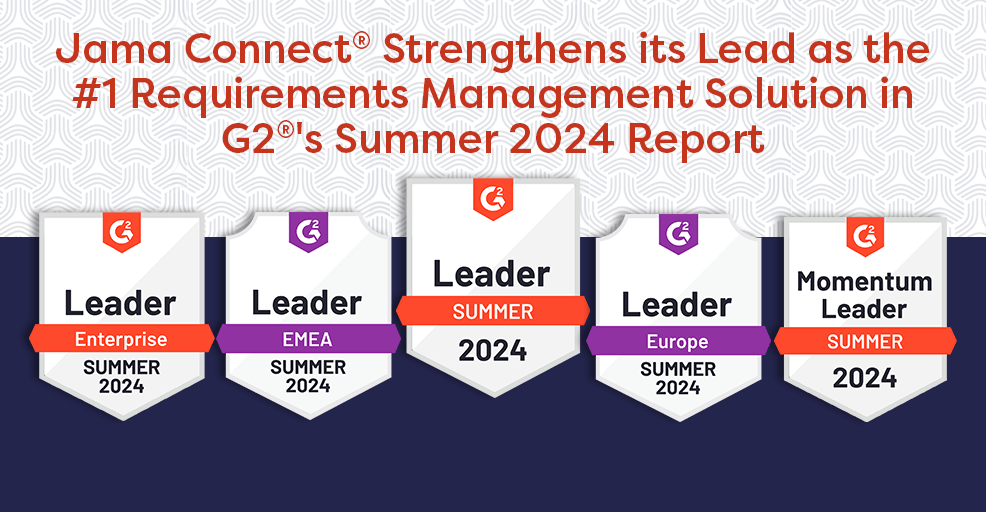
Jama Connect® Strengthens its Lead as the #1 Requirements Management Solution in G2®’s Summer 2024 Report
We are thrilled to announce that Jama Connect® has once again been named the overall leader in the G2 Grid® Report for Requirements Management Software for Summer 2024.
G2’s rankings are based on authentic user reviews and data gathered from online sources and social networks, analyzed through their unique v3.0 algorithm. The Summer 2024 G2 Grid® Report reflects scores calculated up until June 4, 2024.
In addition to being recognized as the top requirements management software, Jama Connect® has earned several other accolades for Summer 2024:
Overall Leader
Enterprise Leader
EMEA Leader
Europe Leader
Small-Business Leader
Mid-Market Leader
Momentum Leader
Learn more about the Summer 2024 G2 Grid for top Requirements Management Software products: DOWNLOAD IT HERE
Jama Software® is honored to receive this recognition, which highlights the value we bring to our customers, especially those moving from document-based approaches to complex product, systems, and software development. We are grateful to our customers for their valuable feedback on our product, services, and support.
Customer Feedback Highlights
“Jama [Connect] is not only a ‘document-oriented’ ALM tool, it gives the organization the ability to map the project structure the product structure making it an easy entry point for R&D folks. Configured properly, it is a real technical and regulatory ‘single source of truth.” – Frederic Fiquet, Director, Systems Engineering
“Product Design teams need a requirements management tool like Jama [Connect]. Using Jama Connect allows our software development team to have a well-organized and well-written set of requirements. It allows us to more easily maintain a baseline of features in our continuously evolving software.” — Mark M., Mid-Market
Our commitment is to provide the best possible experience for our users, and being named the overall leader is a testament to their satisfaction and success with Jama Connect.
From all of us at Jama Software, thank you!
How to Overcome Development Challenges: Proving Regulatory Compliance in Complex Product and Systems Development
As we enter the second half of 2024, development of complex products and systems often encounters the intricate web of regulatory compliance. From medical devices and automotive components to aerospace systems and software applications, ensuring adherence to stringent regulations is critical for both market access and consumer safety. However, proving regulatory compliance presents a multitude of challenges that can impede development timelines, inflate costs, and complicate project management. Fortunately, tools like Jama Connect® offer robust solutions to these challenges, streamlining the compliance process and enhancing overall efficiency.
The Challenges of Proving Regulatory Compliance
1: Diverse and Evolving Regulation
Complexity: Different industries are governed by a myriad of regulatory bodies, each with its own set of rules and standards. For example, the medical device industry must comply with FDA regulations in the U.S., CE marking in Europe, and various other international standards.
Evolution: Regulations are not static; they evolve to keep pace with technological advancements, emerging risks, and geopolitical changes. This continuous evolution necessitates constant monitoring and adaptation.
2: Traceability and Documentation
Traceability: Ensuring traceability from requirements through to testing and validation is essential for demonstrating compliance. This involves linking every design decision, change, and test result back to the initial regulatory requirements.
Documentation: Regulatory bodies demand extensive documentation as proof of compliance. Managing and organizing these documents can be a herculean task, particularly in large-scale projects with numerous stakeholders.
3: Collaboration and Communication
Interdisciplinary Teams: Complex systems development typically involves interdisciplinary teams, including engineers, designers, testers, and compliance officers. Effective collaboration and communication across these teams are crucial for ensuring that compliance is maintained throughout the development lifecycle.
Stakeholder Alignment: Aligning all stakeholders on compliance goals and processes can be challenging, especially in large organizations with decentralized teams.
4: Risk Management
Identification: Identifying potential risks related to regulatory compliance early in the development process is critical. These risks can stem from technological uncertainties, supply chain issues, or changes in regulatory requirements.
Mitigation: Developing and implementing strategies to mitigate identified risks requires a proactive and systematic approach, integrating risk management into the overall development process.
Jama Connect is a comprehensive requirements management platform designed to address the complexities of regulatory compliance in product and systems development. Here’s how it helps teams navigate and overcome these challenges:
“We develop complex products that require multidisciplinary work and V-cycle traceability. A tool like Jama Connect is required, and Jama Connect does the job well.” – Nicolas Ohlmann, CTO, CIXI
1: Centralized Requirement Management
Unified Platform: Jama Connect provides a centralized platform where all requirements, tests, and risks can be managed and tracked. This unified approach ensures that all compliance-related information is easily accessible and up-to-date.
Real-Time Updates: With real-time updates and version control, teams can ensure that everyone is working with the most current information, reducing the risk of compliance breaches due to outdated data.
“Jama Connect is a modern solution for requirement management. Other tools are either outdated, cheap, modern-looking clones of IBM DOORS, or insufficient in functionality.” – Requirement Manager, Professional Services Company
2: Enhanced Traceability
End-to-End Traceability: Jama Connect enables end-to-end traceability by linking requirements, design decisions, test cases, and validation results. This comprehensive traceability ensures that all regulatory requirements are met and can be easily demonstrated during audits.
Audit Trails: Detailed audit trails provide a clear record of all changes and decisions, facilitating smoother and more efficient compliance audits.
3: Collaboration and Communication Tools
Cross-Functional Collaboration: Jama Connect fosters collaboration across interdisciplinary teams through its integrated communication tools. This ensures that all team members are aligned on compliance objectives and can easily share information and updates.
Stakeholder Engagement: The platform supports stakeholder engagement by providing customizable dashboards and reports, enabling clear and effective communication of compliance status and progress.
“Investing in a good requirements management tool is a logical step to avoiding the common pitfalls of software development projects. Jama Connect provides the necessary tools to allow a team to manage huge amounts of requirements.” – Director, Solutions Delivery
4: Robust Risk Management
Risk Identification and Assessment: Jama Connect includes tools for identifying and assessing compliance risks, integrating risk management into the overall development process from the outset.
Risk Mitigation Plans: The platform supports the development and tracking of risk mitigation plans, ensuring that potential compliance issues are addressed proactively and systematically.
“I have used various requirements management tools throughout my career spanning over two decades and Jama Connect scores big when it comes to user interface. It is very easy to onboard the tool into the system with minimal training needs for the user groups. This does not belittle the functional core that a creator could do with the tool configuring it. I highly recommend Jama Connect for any organization working on safety-critical systems.” – Senior Manager, Biotechnology Company
Proving regulatory compliance in complex product and systems development is fraught with challenges, from navigating diverse and evolving regulations to ensuring traceability and effective collaboration. Jama Connect provides a powerful solution to these challenges, offering a centralized platform for requirement management, enhanced traceability, robust collaboration tools, and comprehensive risk management capabilities. With Jama Connect, teams can keep up with the ever-changing regulations thanks to our solutions developed and updated by our leading industry experts. By leveraging Jama Connect, teams can streamline the compliance process, reduce risks, and ultimately deliver high-quality, compliant products to market more efficiently.
“We use Jama Connect for requirements, risk, and verification/validation management, as well as integrating Jira and Enterprise Architect. Having traceability in one tool is going to be so helpful for our product development.” – Principal Systems Engineer, Health Care Providers & Services Company
Whether you’re developing cutting-edge medical devices, innovative automotive systems, or advanced software applications, Jama Connect can help you navigate the complexities of regulatory compliance and achieve your development goals with confidence.
Note: This article was drafted with the aid of AI. Additional content, edits for accuracy, and industry expertise by McKenzie Jonsson, and Mark Levitt.
The Top Six Things You Should Know About
In the quest for innovation, product testing, compliance, and safety certifications remain key to accessing markets and gaining customers. No one wants to buy a product, service, or process that hasn’t been thoroughly vetted by an independent body. In the context of global markets, few certifications carry the importance or significance of those from TÜV SÜD, but in the United States, the various companies that are part of the TÜV Association are not widely known. So, what is TÜV SÜD, and why is it so important to product development?
1: What does TÜV SÜD stand for?
“TÜV” stands for “Technischer Überwachungsverein,” which translates to “Technical Inspection Association” in English. There are several independent companies that are part of the TÜV Association; TÜV SÜD is headquartered in Munich and employs approximately 25,000 people around the globe.
2: What type of company is TÜV SÜD?
TÜV SÜD is focused on protecting people and the environment through rigorous testing, certification, auditing, and advisory services. The company helps ensure regulatory compliance of new and updated technologies, especially in automotive innovation and development, and it functions as a notified body in Europe for medical devices. The TÜV companies trace their origins back to the 1860s when they were first formed to oversee the safety of steam engines.
3: What is the difference between TÜV SÜD and TÜV Rheinland?
TÜV SÜD and TÜV Rheinland are different companies that both provide similar services. All TÜV companies are at least 25.1% owned by the TÜV Association. There are currently six main members of the TÜV Association, all of whom are denoted by the brand “TÜV” plus the regional suffix, such as SÜD or Rheinland. The other TÜV companies include TÜV Nord, TÜV Thüringen, TÜV Saarland, and TÜV Austria.
A TÜV SÜD Certification assures governing bodies and consumers that a product, service, or process has passed relevant safety testing and meets relevant compliance requirements. The certification process is rigorous and comprehensive and involves multiple steps, including steps to review requirements and establish processes followed during development.
5: Why is achieving TÜV SÜD Certification so important?
TÜV Certification is recognized internationally as a sign of quality and thorough review—similar to an ISO or UL certification. Although it originated in Germany, it is regarded globally as evidence that your product, service, or process has attained high standards of safety, quality, and sustainability. With a TÜV SÜD Certification, you can achieve access to additional markets and give your customers peace of mind.
6: Is Jama Connect® certified by TÜV SÜD?
Jama Connect received its first TÜV SÜD certification in 2016. Jama Connect is TÜV SÜD certified for developing safety-related products according to ISO 26262 (up to ASIL D) and IEC 61508 (up to SIL 3). Jama Software is the first vendor that is both SaaS and Agile to receive the certification. In 2019, Jama Software completed additional certification for Jama Connect as a software tool for the development of medical devices according to IEC 62304 and railway applications according to EN 50128.
Don’t neglect important certifications. Even if you are already pursuing other certifications, the TÜV SÜD Certification could be an important addition to your automotive, medical, or railway products and services. Jama Connect can help you meet the requirements tracing and process needs that will set you up to achieve the TÜV SÜD Certification and expand to new markets and customers. To learn more, contact us.
SysML is Not Enough: Why You Still Need a Requirements Management Tool
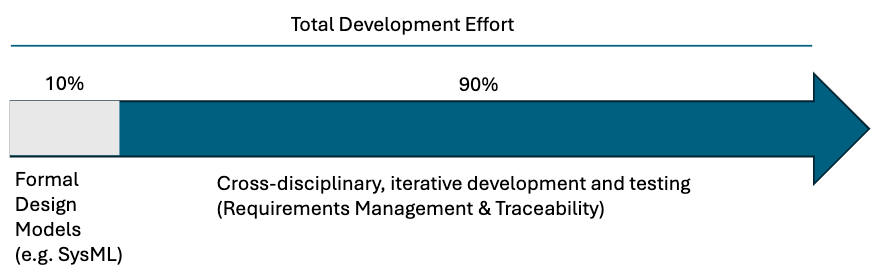
All engineering process models (Agile, waterfall, spiral development, V-model, concurrent engineering, iterative…) describe managing requirements as the most critical key to success. Well-understood requirements provide a single connection point for communication across the engineering teams. Using a Systems Modeling Language (SysML) tool alone to manage requirements instantly creates a silo between engineering teams.
Requirements, tests, architectures, and risks are utilized by every stakeholder when developing a new product or building or modernizing a new system. Customers generate needs and requirements and care what the development status of those are and whether the development team is following the necessary process especially if it requires contract adherence or must meet regulatory laws or industry standards.
Software, hardware, and testing teams also access requirements to be able to analyze, develop, and test. Additionally, they are creating requirements at their given subsystem level too.
Systems Engineers work across all levels of requirements and coordinate the other engineering disciplines. NASA best describes it as, “Systems engineering is a holistic, integrative discipline, wherein the contributions of structural engineers, electrical engineers, mechanism designers, power engineers, human factors engineers, and many more disciplines are evaluated and balanced, one against another, to produce a coherent whole that is not dominated by the perspective of a single discipline.” – NASA
As you can imagine functionality such as configuration management of requirements, traceability between needs, requirements, tests, risks, and architecture are necessary. Systems engineers have been using various tools and even manual techniques for decades to do this.
SysML is a graphical modeling language that is used within some systems modeling tools (such as Dassault’s Catia Nomagic) that enables systems engineers to perform “engineering” of the system. SysML “supports the specification, analysis, design, verification, and validation of a broad range of systems and systems-of-systems.” – Wikipedia
SysML is only a decade old; already a new, more complex version has recently been released; and SysML is yet to be widely adopted. It is widely thought to hold promise for the discipline of model-based systems engineering (MBSE). It is not the only language in use for MBSE though; LML and OPM are examples of modeling languages too, being used within other systems modeling tools.
However, a SysML model is difficult even for those trained in the language. Some indicate the learning curve is steep and the mechanics in the tools are difficult as cited in a recent article by Technology Strategy Partners. Additionally, the variety of tools that support SysML don’t consider themselves as a replacement for a true requirements management tool either. Capabilities from a dedicated requirements management tool such as Jama Connect have built-in collaboration, configuration management, baselines, managing traceability across multiple levels of objects, managing the verification and validation activities, controlling access and change to objects using role-based permissions, and showing real-time workflow states at the object level.
“What SysML lacks is its usage during key Systems Engineering (SE) phases like detail design or implementation phases wherein specific solutions like CAD, Software coding or network design for embedded systems are used,” said Kiran Jacob, Dassault Systems.
Also challenging is usage by software teams during later-stage design phases. Communication of the model (its requirements) becomes critical when needing to validate requirements with the customer, with product managers, and with other engineering disciplines outside of the SysML Scribe (tool jockey). The greater responsibility of the systems engineer as a cross-disciplined communicator requires the use of tools outside of the SysML tool to communicate. Effective communication of requirements is best represented in dedicated requirements management tools.
In conclusion, while SysML and other modeling languages offer significant promise for the discipline of model-based systems engineering, they are not without their challenges. The complexity of SysML, along with its steep learning curve and the limitations of the tools supporting it, often hinders its effectiveness in later stages of design and implementation. As such, relying solely on SysML can create silos within engineering teams, impeding the critical communication and coordination necessary for successful systems engineering.
Effective requirements management remains the cornerstone of any engineering process, ensuring all stakeholders — from customers to software and hardware teams — are aligned and informed. Dedicated requirements management tools, such as Jama Connect, offer robust features like collaboration, configuration management, and traceability, which are essential for managing the multifaceted aspects of modern engineering projects. These tools facilitate clear communication of requirements, verification, and validation activities across all engineering disciplines, thereby supporting the holistic, integrative approach championed by systems engineering.
Ultimately, the synergy between specialized requirements management tools and SysML can provide a comprehensive solution, leveraging the strengths of both to enhance the efficiency and success of engineering projects. As the field continues to evolve, adopting a balanced approach that incorporates the best practices and tools from both domains will be key to navigating the complexities of modern systems engineering.
In this blog, we recap our webinar, “Expert Perspectives: A Deep Dive Into Risk Management and Designing for Cybersecurity & Patient Safety” – Click HERE to watch it in its entirety.
Expert Perspectives: A Deep Dive Into Risk Management and Designing for Cybersecurity & Patient Safety
Welcome to our Expert Perspectives Series, where we showcase insights from leading experts in complex product, systems, and software development. Covering industries from medical devices to aerospace and defense, we feature thought leaders who are shaping the future of their fields.
With more than 30 years of experience and a mission to elevate knowledge and proficiency in medical device risk management, Bijan Elahi has worked with both startups, and some of the largest medical device companies worldwide.
In this presentation on Risk Management and Designing for Cybersecurity & Patient Safety, Bijan covers:
Significance of a comprehensive risk management approach, including safety & security, for medical devices
Interfaces between safety and security risk management processes, and how they interact/complement each other
Upcoming industry trends that impact risk management (safety, security) like AI/ML, rise in connected devices, wearables devices
Below is a preview of our webinar. Click HERE to watch it in its entirety.
The following is an abbreviated transcript of our webinar.
Kenzie Jonsson: Welcome to our Expert Perspective series where we showcase insights from leading experts in complex product, systems, and software development. Covering industries from medical devices to aerospace and defense, we feature thought leaders who are shaping the future of their fields. I’m Kenzie your host, and today I’m excited to welcome Bijan Elahi, a world-renowned expert on safety risk management for medical technology. With more than 30 years of experience and the mission to elevate knowledge and proficiency in medical device risk management, Bijan has worked with both startups and some of the world’s largest medical device companies. Without further ado, I’d like to welcome Bijan who’ll be presenting on risk management and designing for cybersecurity and patient safety.
Bijan Elahi: Hello. My name is Bijan Elahi. I’m delighted to be speaking to you about cybersecurity and medical device risk management. Before I start, I’ll briefly introduce myself. I am a technical fellow, a professor, and the founder of MedTech Safety, an education and advisory company. To give you a little background about myself, I come from the industry and have been a medical device product developer for most of my career. Most of the products that I have developed have been class III implantable devices such as pacemakers, defibrillators, and deep brain simulators. Now I’ve also developed a kidney dialysis system, which includes disposables. I’m based in Florida, but I teach and advise worldwide. Risk management is my passion. I have trained over 10,000 individuals worldwide in the latest knowledge and best practices in risk management.
Elahi: The companies that have benefited from my training range from small start-ups to the largest MedTech companies in the world. And here’s the sampling. I am also active in academia, for example, at Delft University of Technology and Eindhoven University of Technology in the Netherlands where I teach a graduate course to doctoral students in engineering. I am also an affiliate professor at Drexel University Graduate School of Biomedical Engineering and Health Science, where I teach safety risk management for medical devices. And lastly, I’m a contributor to the standard ISO 14971, and the author of two very popular books on medical device risk management published by Elsevier Publishing in the UK under the label of academic press. My publisher tells me that my books are bestsellers in the genre of medical books for them, and they’re available at all major booksellers such as Amazon.
So now let’s talk about cybersecurity and safety risk management. The threat of cybersecurity on medical devices is a rising concern as there’s an ever-increasing interconnectivity, interoperability, and reliance on digital technologies. Medical devices such as pacemakers, insulin pumps, and imaging systems often contain sensitive patient data and are integral to patient care. Cyber attacks on these devices can lead to severe consequences, including tampering with the device functions, unauthorized access to patient information, and destruction of critical healthcare services. The potential for harm is significant. For example, incorrect diagnosis, treatment delays, or even direct physical harm to patients. As cyber threats become more sophisticated, we need robust security measures, smart designs, and continuous monitoring to protect these vital components of modern healthcare systems. The safety impact of cybersecurity exploits must be considered in the overall residual safety risk of medical devices.
Safety risk management is distinguished from cybersecurity risk management. Safety risk management is primarily concerned with the safety of patients, users, and the performance of medical devices. This involves identifying, evaluating, and controlling the risks of harm to patients or users due to device malfunctions, use errors, or adverse interactions with the human body. The focus is on ensuring that the device functions safety and effectively under normal and fault conditions. On the other hand, cybersecurity risk management is focused on protecting the device and its data from malicious cyber-attacks and unauthorized access, which may have nothing to do with safety. Many hospital systems are currently under ransomware attacks with the intention of financial exploitation. Security risk management involves implementing measures to protect the data confidentiality, integrity, and availability of healthcare systems. Although these topics are distinct, there is an overlap between them.
Elahi: As mentioned before, there are different exploits that cyber attackers seek. Some are not safety-related. For example, private patient data, software codes or algorithms, financial data, money, et cetera. A famous example is the WannaCry cyber attack, which unfolded in May of 2017 causing widespread disruption across the globe. It all started on the 12th of May 2017 when many organizations began to notice that their computer systems were being encrypted and locked by ransomware demanding payment in Bitcoin to unlock them. The ransomware known as WannaCry exploited invulnerability in Microsoft Windows. The attack affected hundreds of thousands of computers in over 150 countries. Major organizations and institutions were hit, including the UK’s National Health Service, also known as NHS, FedEx, and many others. The impact on the NHS was particularly severe because medical staff were unable to access patient records leading to significant disruptions in healthcare services.
As you can see, this was a cyber attack with the intention of financial exploitation, but it ended up having a patient safety impact as well. A comprehensive risk management strategy for medical devices must integrate both safety and security measures. This ensures not only that devices are safe from operational risks, but also that they are protected against growing threats of cyber attacks, thereby safeguarding patient health and data integrity in a holistic manner. An interesting side note to the WannaCry story is that this vulnerability was known by Microsoft and they had released a security patch in March of 2017, two months before the cyber attack, but many hospitals and organizations have not applied the patch and remain vulnerable. This is a common issue even today, and many medical devices and healthcare systems remain vulnerable despite the available protections.
![[Webinar Recap] Managing Functional Safety in Development Efforts for Robotics Development](https://www.jamasoftware.com/media/2024/08/Functional-Safety-Webinar-Recap-Blog.png "[Webinar Recap] Managing Functional Safety in Development Efforts for Robotics Development")


![[Webinar Recap] Excelling in Requirements Management for Successful Software Delivery and Implementation](https://www.jamasoftware.com/media/2024/07/Excelling-in-Requirements-Management-for-Successful-Software-Delivery-and-Implementation-1.png "[Webinar Recap] Excelling in Requirements Management for Successful Software Delivery and Implementation")