Mergers and Acquisitions in MedTech: Positioning Your Company for Success
The MedTech Mergers and Acquisitions (M&A) scene is more active than ever. As global healthcare needs grow and regulatory landscapes shift, strategic acquisitions are becoming a key route to innovation, growth, and market expansion. For emerging MedTech companies, understanding this environment and positioning themselves smartly within it can shape their future.
Recent activity shows that opportunity is abundant for companies that are prepared. Strategic buyers are on the lookout for innovative technologies, strong product pipelines, and solid regulatory foundations. But having a breakthrough product is not enough. Success in M&A hinges on preparation, documentation, and systems that can stand up to intense due diligence.
The Current M&A Landscape: A Shifting Landscape
The MedTech M&A scene has evolved dramatically over the past year, marked by fewer deals but significantly larger transactions. While deal volume dropped by over 40%, the average deal size surged to $636 million, driven by strategic acquisitions like Stryker’s $4.9B purchase of Inari Medical and Thermo Fisher’s $4.1B buyout of Solventum’s filtration business.
Strategic Focus: Bigger Bets, Sharper Targets
Major players like Johnson & Johnson and Medtronic continue to lead the charge, but their strategies are shifting. J&J, for example, has spent over $30B on acquisitions since 2022, including Shockwave Medical ($13.1B) and Abiomed ($16.6B). These deals weren’t just about scale as they targeted technologies that redefine standards of care, particularly in cardiovascular intervention.
Medtronic, meanwhile, is leaning into tuck-in acquisitions to transform slower-growth units into innovation hubs. With 11+ deals in the past five years, the company is focused on strategic adjacencies and long-term portfolio optimization.
Trends Driving the Market
Portfolio Shifts: Companies are divesting non-core assets and doubling down on high-growth areas like robotics, diabetes, and structural heart technologies.
Private Equity’s Role: PE firms are increasingly active, both as buyers and partners in divestitures, helping streamline portfolios and unlock value.
Cultural Fit Matters: Executives emphasize that successful deals go beyond financials. Shared values and aligned visions for patient impact are now critical to integration success.
What Strategic Buyers Seek: The Acquisition Criteria That Matter
To attract the right buyer, emerging MedTech companies need to align with what strategic acquirers value most. Here is what consistently matters:
Technology Differentiation & Market Position
Buyers want technologies that offer real clinical advantages such as better outcomes, simpler procedures, or cost savings. Proprietary tech backed by strong patents is especially attractive.
The best targets complement the buyer’s existing portfolio and address unmet clinical needs. Think AI diagnostics that plug into existing imaging platforms or minimally invasive tools that expand surgical options.
Regulatory Clarity
A clear regulatory strategy is a major plus. Companies that have engaged with the FDA, gathered solid clinical data, and understand approval pathways stand out.
Detailed documentation like pre-submission notes, trial protocols, and quality systems reduces risk and speeds up integration. It also boosts valuation.
Commercial Potential
Buyers assess market size, competition, and go-to-market strategy. Companies with clinical relationships, distribution channels, or early traction are more appealing.
Technologies that target large markets with clear reimbursement paths, and show signs of physician adoption, are especially valuable.
Financial Performance and Scalability
Even early-stage companies need to show a viable business model. Efficient use of capital, clear milestones, and scalable operations build credibility.
Detailed financials like cost breakdowns, revenue forecasts, and funding needs help buyers model ROI and integration scenarios.
Getting Acquisition-Ready: Preparing for Due Diligence
Due diligence represents the most critical phase of any acquisition process. Companies that invest in comprehensive documentation and systematic organization significantly improve their chances of successful transactions and favorable valuations.
Product Documentation
Keep everything up to date: design requirements, risk files, and testing protocols. Use document control systems to manage versions and changes.
Requirements management is key. Acquirers want to see how products were developed, validated, and maintained. Full traceability from concept to release builds trust.
Risk & Quality Systems
Risk documentation such as hazard analyses, mitigation controls, and post-market surveillance plans is essential. Quality systems should be fully implemented and certified (ISO 13485 is a big plus).
Design controls should be complete and easy to navigate: planning, inputs/outputs, reviews, V&V protocols, and change logs. A well-organized design and development file makes due diligence smoother and less risky.
Testing and Validation Evidence
Strong testing documentation is essential to prove your product’s safety and performance. This includes everything from software testing protocols and biocompatibility studies to electrical safety tests and clinical evaluations.
To stand out, companies should maintain:
Detailed test plans
Clear procedures
Organized results
This shows a systematic approach to validating product performance. When testing documentation is thorough and easy to navigate, acquirers can quickly assess technical risks and regulatory readiness.
Validation should not stop at product launch. Ongoing monitoring, post-market studies, and performance tracking signal a commitment to continuous improvement — something buyers value highly.
Your IP and regulatory documentation are more than just paperwork — they are strategic assets. Patent portfolios, FDA submissions, and clinical data all play a key role in valuation and deal structure.
To prepare:
Keep patent files current
Document freedom-to-operate analyses
Develop a clear IP strategy
On the regulatory side, maintain organized records of:
FDA correspondence
Clinical trial data
Post-market surveillance reports
Well-managed documentation shows a strong compliance history and gives acquirers confidence in your ability to navigate future regulatory hurdles.
How Jama Connect® Supports M&A Readiness
Requirements management and traceability are critical for M&A success and that’s where Jama Connect shines.
The platform helps companies maintain acquisition-ready documentation throughout the product lifecycle by:
Connecting requirements to design decisions, tests, and regulatory submissions — giving acquirers full visibility into development processes.
Organizing documents with version control — making it easy for due diligence teams to trace product history and compliance.
Generating detailed reports — showcasing the maturity of your quality management system and development discipline.
Supporting collaboration across teams and locations — ensuring documentation integrity even in distributed environments.
With Jama Connect, medical device and life sciences companies can confidently present their development story and proof of compliance, a major advantage during acquisition discussions.
Building Long-Term Value Through Strategic Preparation
The MedTech M&A landscape is evolving fast. As healthcare needs grow and technologies advance, new opportunities are emerging for companies that are ready.
Success isn’t just about having a great product. It’s about:
Operational excellence
Regulatory sophistication
Systematic development processes
Investing early in documentation, requirements management, and quality systems pays off. These capabilities lead to faster development, lower regulatory risk, and better product quality.
If you’re looking to strengthen your M&A readiness, start by evaluating your documentation systems. Book a demo with Jama Software to see how structured requirements management can streamline your development and boost acquisition appeal.
Note: This article was drafted with the aid of AI. Additional content, edits for accuracy, and industry expertise by Tom Rish and Decoteau Wilkerson.
An Inside Look at the Airborne Fire Control Radar Market: The Sky’s AI
These days, air superiority isn’t just about speed and firepower; it’s also about data and information. At the center of this data-driven battlespace is the Airborne Fire Control Radar (AFCR), a cutting-edge system that gives pilots unparalleled situational awareness. The AFCR systems on an aircraft act as its eyes and brain, enabling it to track, detect, and engage targets with remarkable accuracy from a considerable distance. They have a significant impact on the outcome of aerial engagements and the effectiveness of combat aircraft, making them vital to military aviation.
This blog will examine the ever-changing AFCR market. We’ll look at the current developments that are fueling its expansion, such as evolving geopolitical environments and technological advancements. The main participants in the industry, their difficulties, and the prospects for this crucial defense technology will also be discussed.
What is an Airborne Fire Control Radar?
Military fighters, bombers, and attack helicopters are the main aircraft equipped with the advanced sensor system known as an Airborne Fire Control Radar. An AFCR offers the high-resolution information required to direct weapons to a target, in contrast to conventional surveillance radar, which merely detects objects. It provides the aircraft’s fire control computer with the target’s range, altitude, speed, and trajectory. This enables the pilot or system to fire cannons or launch missiles with a high chance of hitting a target directly, even if the target is moving quickly or evasively.
It is impossible to exaggerate the significance of these systems. They enable a single aircraft to engage multiple threats at once, monitor large areas of airspace, and discriminate between friendly and hostile forces. To put it simply, an air force that has a better AFCR system has a clear combat advantage.
Current Drivers and Trends in the Market
A number of important factors are propelling the global AFCR market’s steady growth. The main drivers are global air force modernization and geopolitical tensions. Countries are investing in new-generation fighters with cutting-edge technology and updating their current fleets of aircraft with more sophisticated radar systems.
The primary force behind change in the AFCR market is technology. There are two noteworthy developments:
AESA Radar Dominance: The industry standard today is Active Electronically Scanned Array (AESA) radars. Because AESA systems can electronically steer their beams, they can track multiple targets in different directions simultaneously, unlike older mechanically scanned radars. They are essential for contemporary air forces because they are more dependable, more difficult to detect, and more resilient to electronic jamming.
AI and Cognitive Radar: “Cognitive” radars are being produced by combining machine learning and artificial intelligence. These systems have the ability to learn from their surroundings, adjust in real time to new threats, and more accurately separate targets from clutter. By lessening the pilot’s workload and accelerating decision-making, this technology has the potential to completely transform air combat.
Increasing Need for Unmanned Systems
A new area for AFCR systems has been made possible by the widespread use of Unmanned Aerial Vehicles (UAVs), also known as drones. Sophisticated, portable radars are necessary for advanced combat drones to conduct autonomous missions and surveillance. Compact and effective AFCR solutions designed for UAVs will become more and more necessary as their use in military operations grows.
Obstacles in the Market
The AFCR sector still faces many obstacles in spite of its expansion. These difficulties may affect development schedules, expenses, and the general growth of the market.
High Costs of Development and Production
The complexity of AFCR systems necessitates years of study and billions of dollars in funding. They are costly to manufacture and maintain because they require sophisticated electronics and exotic materials. The potential market size may be constrained by these exorbitant expenses, which may act as a deterrent for smaller countries seeking to update their air forces.
The export of sophisticated AFCR systems is strictly regulated since it is a vital military technology. To keep sensitive technology out of the wrong hands, governments enforce stringent regulations. Market expansion may be slowed by these export restrictions and international arms control laws, which can make international trade and cooperation more difficult.
Complexity of System Integration
One of the biggest engineering challenges is integrating a new radar system into an existing aircraft. Aircraft hardware types and avionics interfaces differ from manufacturer to manufacturer, creating interoperability challenges. For the radar to function flawlessly with the aircraft’s other avionics, mission computers, and weapon systems, significant hardware and software adjustments are needed. Program upgrades take longer and cost more because of this complexity.
Prospects for the Future and New Technologies
With ongoing innovation poised to unlock new capabilities, the AFCR market appears to have a bright future.
The shift to multifunction RF systems is among the most exciting developments. Future aircraft will use a single, integrated aperture that can do all of these tasks at once, rather than having distinct systems for communications, radar, and electronic warfare. This will significantly increase an aircraft’s capabilities while decreasing its size, weight, and power consumption.
The creation of distributed and networked radar is another expanding field. This idea uses real-time radar data sharing between various platforms, including fighters, drones, and satellites, to produce a single, complete image of the battlespace. This networked strategy increases the effectiveness and survivability of all friendly assets and makes it nearly impossible for an adversary to hide.
In conclusion, a market ready for innovation
A key component of the contemporary defense sector is the market for airborne fire control radars. The need for more capable and intelligent radar systems will only increase due to technological advancements and the ongoing requirement for air superiority. Despite ongoing regulatory obstacles and exorbitant costs, the industry is progressing. The sky’s eye is growing more potent than before with the introduction of AI-driven cognitive radars, multifunction systems, and networked capabilities, giving pilots the advantage they need to manage the air.
Note: This article was drafted with the aid of AI. Additional content, edits for accuracy, and industry expertise by Mario Maldari, Cary Bryczek, and Decoteau Wilkerson.
Engineering Governance: The Engine Behind Automotive Excellence
The automotive industry is a world of constant change. Engineering governance is the invisible engine that keeps everything humming smoothly.
Innovation to support AI-powered software-defined vehicles, electric and hybrid drivetrains, and sustainability initiatives are navigating where the automotive sector is going. But while technology makes headlines, what happens behind the scenes to manage the complexity of automotive development to stay on the right course is just as critical.
What Is Engineering Governance?
Engineering governance is a system of policies, processes, and standards that guides everything from vehicle design to production. It serves as the GPS for automotive engineering teams to ensure that they are building the right vehicles in the right way, so that every decision aligns with regulatory, safety, and quality standards and the broader goals of the company. It helps with the unification of the hardware and software siloes to not only avoid defects resulting in costly recalls and accelerate product development, but also provide an holistic operational overview of the complete engineering organization reducing risks and driving efficiency.
When designing a new hybrid, for example, engineering governance ensures that the final product adheres to emissions laws, passes stringent safety tests, and meets customer expectations. It
touches every stage of a vehicle’s lifecycle — from initial design to when it rolls off the assembly line and beyond.
AI is accelerating development of systems to enhance safety, enable convenience, and make maintenance more effective. Engineering governance will ensure that concerns about cybersecurity risks and ethical decision-making are addressed. OEMs face the significant challenge of seamlessly integrating diverse software from hundreds of suppliers. Modern premium vehicles have more than 100 million lines of software code — far exceeding the 14 million lines of code in the Boeing 787 Dreamliner. Dealing with safe-critical, non-safe, secure, open-source, and proprietary software, each with its own requirements and standards, necessitates robust engineering governance, efficient collaboration, and cutting-edge tools to ensure that the systems coexist harmoniously.
For automotive companies, failure to follow strong engineering governance risks expensive recalls, lawsuits, and fines, as well as harm to customer health and property, leading to significant negative brand impact. Here’s why getting it right matters so much:
Ensuring Compliance with Regulations: Automotive companies operate within a tightly regulated environment. Engineering governance provides a structured approach to ensure compliance with all relevant regulations across markets where vehicles are sold.
Managing Risks Proactively: Helps identify and mitigate risks early before they escalate. Without comprehensive safety and quality testing, defects might surface after vehicles are delivered to customers, rather than during development when fixes are much less costly.
Maintaining Quality Standards: A robust framework ensures that vehicles meet or exceed performance and reliability specifications without cutting corners during design, manufacturing, or testing. It enables a comprehensive view of all aspects of vehicle safety by unifying hardware and software development siloes.
Driving Innovation Responsibly: Innovation without governance can spiral into impractical or unsafe ideas. Engineering governance ensures innovation is balanced with feasibility, compliance, and cost control. Companies racing ahead with autonomous vehicle technology, for example, need engineering governance to ensure that these vehicles undergo rigorous safety tests, align with evolving regulations, and deliver innovations responsibly.
Achieving Sustainability Goals: Sustainability has become a business imperative for automakers in response to demands from governments and consumers. Engineering governance helps automakers achieve sustainability goals by embedding eco-friendly practices into every stage of development and production.
Here’s how engineering governance plays a role at every step in the development of any new vehicle or system:
Design Phase: Ensures vehicles comply with emissions standards and fuel efficiency standards in the United States, the European Union, and other regions.
Testing and Validation: Frameworks ensure rigorous testing of every component — from the engine to the suspension system and software. Engineers follow defined processes to simulate driving conditions to ensure safety and durability.
Supply Chain Oversight: Identifies system or parts suppliers whose products and processes meet quality and sustainability standards.
Post-Market Monitoring: Even after vehicles are sold, engineering governance mechanisms monitor performance through data collection to identify recurring issues and develop structured response plans to ensure quick fixes that reduce customer dissatisfaction.
For automotive executives, engineering governance is more than a technical concern; it’s a business strategy driving competitive advantage by ensuring that reliable, innovative, and compliant vehicles hit the market faster than the competition. It builds customer trust, bolsters investor confidence, and helps companies stay ahead of the constant changes in regulations.
How Jama Software Helps
Jama Software empowers automotive companies to excel in their engineering governance initiatives by providing a centralized platform called Jama Connect® that ensures traceability, compliance, and collaboration across complex development projects. By facilitating real-time alignment between teams and maintaining a clear connection between regulatory requirements, development processes, and business goals, Jama Connect helps streamline decision-making and reduce risk. This enables organizations to confidently manage innovation, comply with regulatory standards, and accelerate time to market — all while maintaining high levels of quality and accountability.
Onera Health Chooses Jama Connect to Provide Flexibility and Consistency for Sleep Diagnostic System Development Customer Story
About Onera
Onera Health develops clinical-grade remote diagnostics and monitoring solutions, making home polysomnography broadly accessible and user-friendly for anyone who needs it, wherever they are.
Customer Story Overview
Onera Health has developed a sleep diagnostic system utilizing four patch-based sensors that patients could apply at home. Initially, the Onera STS 1 product development team conducted pilot studies and relied on Microsoft Excel and Word to manage requirements and create the necessary documentation for successful Medical Device Directive (MDD) and Food and Drug Administration (FDA) submissions.
With the development of the company’s second-generation commercial product, the Onera STS 2, and its integration into Onera’s enhanced end-to-end solution, Onera Health took an active approach in recognizing and acknowledging the increased complexity of its second product. The company began seeking a more structured procedure for managing requirements, tests, and risks.
The new solution needed to provide better access, efficiency, and collaboration for teams working in different disciplines so they could accelerate development with confidence. Onera Health chose Jama Connect because it enabled faster iterations, greater consistency of requirements after changes are made, and visibility into risks and related mitigations.
Faster iterations on requirements due to less time spent in alignment, review, and audit meetings
Consistency of requirements, terminology, configurations, and documents for all teams affected by design changes
Visibility into risk identifications and mitigations for internal and regulators’ teams
“We needed a more structured approach due to the complexity involved in maintaining consistency across our entire documentation set. With our first generation, tracking the impact of a design change or updates impacting multiple disciplines was time-consuming and came with its own challenges.” – PIETER ERMERS, FOUNDER AND VP QUALITY & REGULATORY, ONERA HEALTH
Challenges
Complexity of product design, regulations, and document strategy lacking efficiency, scalability, consistency, and accessibility.
Managing requirements and tests, while maintaining document consistency, was generally challenging due to product and regulatory complexity, as well as the limitations of an on-premises document database. Additionally, accessing the database required a VPN which can slow work or interrupt progress when the connection was down.
“We chose Jama Connect because of its intuitive user experience, cloud-based availability, and flexible output that our global team needed. Jama Software Consultants were very supportive in helping us understand how to set up Jama Connect to achieve our goals.” – PIETER ERMERS, FOUNDER AND VP, QUALITY AND REGULATORY, ONERA HEALTH
One cloud-based system, accessible and user-friendly, with integrated collaboration and reviews, automated test input, and flexible reporting.
The evaluation demonstrated that Jama Connect could easily be accessed and used to manage requirements, tests, and risk based on its intuitive user interface, authoring, collaboration, reviews, and verification. Automated input of test results and flexible output in generating reports provide a tailor-fit to the company’s needs.
“When making changes in a requirement used in multiple sensors, we must maintain consistency of requirements, tests, and documents across teams and disciplines. Jama Connect’s structured approach for automatically checking that everything is covered is very beneficial for us.” – PIETER ERMERS, FOUNDER AND VP, QUALITY AND REGULATORY, ONERA HEALTH
Outcomes
With Jama Connect, the Onera team has experienced the following benefits:
Faster iteration on requirements due to less time spent in alignment, review, and audit meetings
Consistency of requirements, terminology, configurations, and documents for all teams affected by design changes
Visibility into risk identifications and mitigations for internal and regulators’ teams
Accelerate Nuclear Design Assessments and Reduce Certifications and Engineering Costs with Jama Connect® for Nuclear Reactor Design and I&C Development
Designing and constructing nuclear systems and facilities, with instrumentation and control systems, is one of the most intricate and regulated endeavors any organization can undertake. The process of managing, defining, and tracing functional, safety, security, design, performance, independence, reliability, and special treatment requirements for complex nuclear reactors, along with their facilities, systems, subsystems, structures, and components, is compounded by strict, country-specific regulatory guidance and standards.
The design process is iterative and driven by continuous risk, safety, hazard, accident, and security analysis and mitigations. Revisions during and post-design and construction, based on safety/risk assessments and regulatory feedback lead to rework and reengineering, increasing costs and elongating timelines.
Effective requirements management, end-to-end traceability across the entire systems engineering process, continuous risk analysis and mitigations across the entire design cycle, and a single source of truth for systems engineering data aggregated across the digital thread are critical for project success. Failure to accurately categorize safety and security functions, classify structures, systems and components (SSCs), and assess the criticality of initiating events and hazards in compliance with the applicable regulations (IEAE,ONR, etc.) can delay certifications and project completion, dramatically increase costs, and jeopardize the safe state of the nuclear plant.
KEY BENEFITS
Streamline safety design assessments: Jama Connect offers a single source of truth for the digital safety assessment of a nuclear system, including qualitative hazard evaluations, probabilistic safety assessments, design failure, accident, and dose consequence analysis, FHA, security analysis, and combined risks mitigations.
Enhance collaboration across development teams and supply chain: Jama Connect natively enables co-development within the supply chain and external subcontractors, and improved communication and alignment between cross-functional teams and with external safety assessors.
Achieve end-to-end traceability across your development toolchain: Jama Connect’s Traceability Information Model™ outlines an end-to-end process for the requirements and design definition and decomposition, V&V, risk/safety/security analysis, and system implementation. With Live Traceability™, exchange system implementation specific data like models, architectures, parts/assemblies, tasks continuously with MBSE, PLM, work management, and P&ID tools.
Automate risk categorization and classification: Replace manual, error-prone categorization of risks and classes by letting Jama Connect automatically assess and calculate the criticality, categorization and classification of events, functions, and SSCs.
Jama Connect for Nuclear Reactor Design and I&C Development is purpose-built to guide engineers through the systems development and digital safety assessment of a nuclear system, automatically measure the completeness and quality of traceability across the entire digital thread, and enable the automated creation of digital safety reports.
Jama Software’s nuclear framework is oriented towards and based on the guidance of the NRIC for the usage of digital engineering tools for nuclear DSAs (digital safety assessments), the guidance of IAEA and ONR for the Categorization and Classification of Functions and SSCs, and IEC 61513, and IEC 61508 for the development of I&C systems.
Here’s how Jama Connect can help your team streamline processes, improve safety outcomes, and meet regulatory requirements:
End-to-End Traceability Across All Levels
With Jama Connect, you can ensure complete traceability across the design and engineering process – from product definition and design to V&V, safety and security classifications, categorizations and analysis, and product implementation. Our platform connects every design element — from mission-level objectives down to individual components, assemblies, and parts. Live Traceability not only satisfies regulatory demands but also provides critical insights into how changes at any level and any stage impact the entire system.
Traceability at every level: From mission needs and platform designs, to systems, subsystems to individual components, Jama Connect traces risks, requirements, V&V, and implementation elements are connected in an iterative, risk-driven process.
Event-function-SSC traceability: Map initiating events, safety, and security functions, and SSCs seamlessly, helping ensure safety-critical events are covered at every level.
Dynamic risk-response integration: Feed critical information like initiating events, identified hazards, safety, security and reliability requirements, and special treatments directly into the design, ensuring risks are evaluated and mitigated throughout the lifecycle.
Streamlined Safety Design Assessments
Regulatory requirements for nuclear reactor certification differ from country to country, but the principles of risk/safety/security analysis, safety and security classification, and categorization remain universal. Jama Connect simplifies this process by guiding teams through compliance-specific workflows.
Safety and security classification and categorization: Automate initial and final classification of safety/security functions, SSCs, and events. Automatically assign safety categories using calculated fields and lookup metrics based on global or country-specific nuclear standards.
Iterative compliance support: Conduct preliminary safety assessments early and refine security functions as the design evolves. Ensure that every regulatory stage is met with precision, from early safety categorizations to final licensing approvals.
Digital export for documentation: Generate detailed certification-ready documentation of classification assignments, risk analyses, and hazard outcomes for key documentation items like safety and security cases or preliminary and final design safety reports.
Seamless Integration Across Digital Engineering Tools
To ensure every aspect of the development process stays connected and enable the DSA (Digital Safety Assessment), Jama Connect integrates with industry-standard tools used for model-based systems engineering (MBSE), product lifecycle management (PLM), and after simulation:
MBSE: Collaborate effectively by connecting Jama Connect with tools like Cameo Systems Modeler (aka CATIA Magic) or Enterprise Architect to exchange architecture, models, and design data.
PLM: Sync parts, assemblies, and change requests with PLM tools like PTC Windchill, Aras PLM, or Siemens Teamcenter to manage parts and mechanical implementations efficiently.
P&ID: Diagram synchronization (either direct or via PLM) with tools like PTC Creo or Siemens NX.
Software development and work management: Easily sync tasks, stories, and epics with tools like Jira or Azure DevOps to ensure software requirements are implemented.
Digital threads: Create and manage a fully integrated digital thread that ties all relevant data from requirements and designs, V&V, MBSE, PLM, simulation and visualization, safety assessment, and risk management, enabling end-to-end traceability, completion measurements, change impact analysis, and the automatic detection of gaps and risks.
Risk Analysis and Hazard Management
Risk analysis is the backbone of safety in nuclear reactor design. Jama Connect supports rigorous risk, safety, and security analysis throughout the iterative design lifecycle, from the initial qualitative hazard evaluation to the analysis of initiative events, classification and categorization of functions and SSC, DID analysis to the probabilistic safety assessments, SSA, and DCA.
Initiating events from qualitative hazard evaluation: Identify events that could jeopardize the safe state of the nuclear power plant. operation, including those rooted in design, external hazards, or past regulatory findings.
Hazard analysis and mitigation – probabilistic safety assessment: Collect and analyze identified hazards, assess severity, and create safety requirements that feed directly into system updates. Out of the box HARA and HAZOP data models.
SAA, FHA, DQA, and combined risks: Conduct severe accident analysis, fire hazard analysis, dose consequence analysis, combine/enveloped risk assessments, and derive mitigations and special treatments as part of Jama Connect’s end-to-end traceability.
By centralizing all information within a single source of truth, Jama Connect eliminates inefficiencies, reduces rework, and fosters alignment between teams.
Agile-compatible iterations: Adapt requirements and designs iteratively as new risks or design details emerge.
Collaborative team environment: Share updates and insights in real time, ensuring stakeholders, engineers, and regulators remain aligned at every stage. Easy to initiate and complete reviews and approvals.
Automated workflows: Save time by automating time-intensive, repetitive tasks like hazard categorization and safety classification.
AI-enabled Intelligent Engineering
AI analysis and automation with Jama Connect Advisor™ improves productivity and product development outcomes.
Requirements quality intelligence: Enhance the quality and clarity of requirement language to significantly reduce a major cause of defects.
Test case intelligence: Streamline verification by automatically generating test cases derived from requirements.
Organizations at the forefront of nuclear innovations — including those overseeing and developing small modular reactors (SMRs) — recognize Jama Connect as a transformative tool in navigating the unique challenges of the industry.
From guiding teams through compliance workflows to empowering iterative risk analysis, Jama Connect for Nuclear Reactor Design and I&C Development is reshaping how the nuclear industry approaches design and certification. Its ability to combine traditional systems engineering approaches with modern digital iterative processes and digital safety assessments are redefining what’s possible in a nuclear reactor development.
To learn more about managing your nuclear requirements, tests, and risks with Jama Connect, visit jamasoftware.com
Dexcom Achieves 60% Systems Engineering Efficiency Improvement with Jama Connect®
Centralized requirements, Live Traceability™, and enhanced collaboration power Dexcom’s development of life-changing CGM technology.
About Dexcom:
Develops, manufactures, produces, and distributes Continuous Glucose Monitoring (CGM) systems for diabetes management
Headquartered in San Diego, California, USA
Dexcom was founded in 1999 to make diabetes management better with the world’s first real-time, integrated CGM system, the Short-Term Sensor (STS). This, and subsequent generations of the device now named the G series, combines hardware, software, and firmware to deliver an optimal user experience for making decisions about insulin and food intake.
After most of its history as a single product company, Dexcom developed Stelo, a wearable glucose biosensor available over-the-counter for people with type 2 diabetes who don’t require insulin.
Siloed Tooling: A document-centric approach and legacy tools created barriers to adoption and collaboration across engineering disciplines.
Traceability Gaps: Lack of a unified view of traceability made change management complex and created confusion across teams.
Regulatory Overhead: Manual processes for generating regulatory document templates caused significant delays and administrative burden.
System Complexity: Managing a complex set of interconnected hardware, software, and embedded requirements lacked a single source of truth.
Disconnected Ecosystem: Poor connectivity between requirements management and other engineering tools hindered end-to-end visibility.
Dexcom’s products combine software, hardware, and firmware, each with their own requirements and tests that must be managed and traced for compliance. As the company scaled, the existing processes, which relied on a mix of legacy tools, spreadsheets, and documents created information silos. Teams were often uncertain if they were working with the latest requirements, leading to rework and inefficiencies.
Generating audit-ready documents for regulatory compliance was a time-consuming, manual effort. The engineering and quality organizations invested significant time in manual documentation to ensure their products were always safe, effective, and compliant.
“We have a lot of smart people who joined Dexcom with expectations about doing great things. Having them spend a significant amount of their time manually copying and pasting in spreadsheets and Word documents is not the best use of their talent and expertise,” says Sri Harsha Maramraju, Senior Manager, Systems Design Engineering at Dexcom
A central repository to keep all stakeholders informed of requirements status and changes.
An intuitive user experience to encourage broad adoption and cross- functional collaboration.
Full end-to-end traceability of all requirements and tests to support design controls and compliance.
Dexcom identified the need for a modern, centralized platform to manage requirements, tests, reviews, and documentation. The goal was to find a system with an intuitive interface and clear traceability to improve efficiency, stakeholder engagement, and compliance readiness. After a thorough evaluation of several leading solutions, the stakeholders selected Jama Connect. The platform’s exceptional usability, robust traceability visualization, and deep-rooted acceptance in the medical device industry made it the clear choice.
Key evaluation areas where Jama Connect excelled were its ease of use and powerful document generation capabilities. Another critical factor was its ability to provide clear visibility into the end-to-end traceability of all hardware, software, and firmware requirements and tests.
“Other tools have traceability, but only Jama Connect has a visual, configurable model that shows exactly what traceability looks like and accommodates our product’s complex configuration.” Sri Harsha Maramraju – Senior Manager, Systems Design Engineering at Dexcom
“The built-in support for standards like ISO 14971 and the validated package included with Jama Connect give us the confidence to demonstrate that we are following industry best practices,” says Maramraju.
Streamlined change management and reviews for monthly releases using Jama Connect’s Review Center.
Achieved a 60% productivity boost for the systems engineering team, enabling faster project completion.
Successfully migrated active projects to Jama Connect, ensuring a smooth transition to a modern platform.
Driving reuse of requirements and tests across projects to support product line engineering (PLE) goals.
“If you’re building a centralized ecosystem for product development and design controls for the long term, you can rely on Jama Connect. Its usability, traceability, and industry-wide acceptance make it a cornerstone of our engineering process.” – Sri Harsha Maramraju – Senior Manager, Systems Design Engineering at Dexcom
Dexcom now depends on Jama Connect to efficiently manage requirements, changes, and reviews for its aggressive release cadence. Having one centralized place for these activities has improved systems engineering efficiency by 60%. The intuitive collaboration and review functionality in Jama Connect has increased stakeholder engagement. Quality and Regulatory teams now actively participate in the process within the tool, appreciating the structure and auditability it provides. “The conversation has shifted. Instead of discussing tool limitations, our teams now have productive, data-driven discussions about the work itself within Jama Connect. When other departments see what we are doing, they ask how they can get their projects onto the platform too,” says Maramraju.
Jama Connect’s Live Traceability™ has enabled Dexcom to track requirements through all stages of development, with integrations that sync requirements data to development activities in other tools like Jira. Looking forward, Dexcom is leveraging Jama Connect to drive reuse and synchronization of requirements across different platforms, a key step toward their product line engineering goals.
INBRAIN Chooses Jama Connect ® to Provide Clarity, Stability, and Confidence in Quality Control for Neural Implant Systems Development
INBRAIN Neuroelectronics develops GRAPHENE NEURAL implant systems for central and peripheral neuroelectronic applications including autonomous BCI Therapeutics to restore movement control and other important lost functions in Parkinson’s disease, Epilepsy or Stroke in addition to organ related therapeutics
Customer Story Overview
The company started looking for a requirements management tool to use in developing their first product. They knew that building implants would involve a huge number of requirements to be written, checked, reviewed, and iterated on. Connecting to related software development activity in Jira and test management systems would be critical to ensuring quality and maintaining traceability.
They determined that using Excel for requirements and test traceability would be too cumbersome, time consuming, and risky. Ensuring regulatory compliance and product quality was too important for successful product development and delivery to rely on a manual, document-based process prone to human mistakes.
INBRAIN chose Jama Connect because it greatly increased confidence in quality control by enabling the entire team to work collaboratively and efficiently on requirements, tests, and risk management. This provided the stability for the team to focus on the development effort rather than worry about data integrity or quality control issues.
With Jama Connect, Users Experience:
Greater confidence in quality control thanks to distributed collaboration that enabled the entire team to work in parallel with consistent, shared, up-to-date information
Ability to start working immediately after fast configuration and setup of integrations assisted by Jama Software’s Services team
Centralized platform for integrated requirements, tests, and risk management professionally supported by Jama Software’s Support team
“The massive collaboration in Jama Connect, where everything is controlled and checked and where reuse is supported, makes the whole management of requirements much easier.”
– MARTIJN HAZENBERG – HEAD OF EMBEDDED ENGINEERING, INBRAIN
When developing highly complex medical devices, the use of Excel for manual tracing of large volumes of requirements and tests through multiple iterations and reviews would have been too time-consuming, cumbersome, and risky from a compliance and quality perspective.
“We wanted to avoid spending so much time on manual efforts such as modifying data in Excel sheets and performing manual traceability. By using Jama Connect, all of that wasted time disappears, and we can focus on the things that truly matter, such as our development effort.” – ALBERT MOLINS – SYSTEMS ARCHITECT, INBRAIN
Evaluation
Integrated solution for managing requirements, tests, and risks in connection with Jira and test automation systems.
The evaluation demonstrated that Jama Connect could provide the integrated, efficient, collaborative solution that the company needed for both current and future needs. The team also appreciated how quickly Jama Software’s Solutions Architect and Support staff responded to questions and requests during and after the evaluation.
“Jama Connect has given our team much greater clarity, stability, and confidence in control quality to focus on development.”
– ALBERT MOLINS – SYSTEMS ARCHITECT, INBRAIN
With Jama Connect, the INBRAIN team has experienced the following benefits:
Confidence in the development process based on consistent, shared, up-to-date information
Ability to start working immediately after fast configuration and setup of integrations
Distributed collaboration enabling the entire team to work in parallel managing requirements and tests used to prepare regulatory documents
Centralized, professionally supported platform for integrated requirements, tests, and risk management
Experiencing the distributed collaboration in Jama Connect gave the entire team confidence to focus on the development work that mattered. During verification of requirements, everyone was engaged in running test cases and other activities in parallel to ensure quality. They continue to benefit from continuous support available from their local Jama Software consultant whenever they have questions that could hinder development progress.
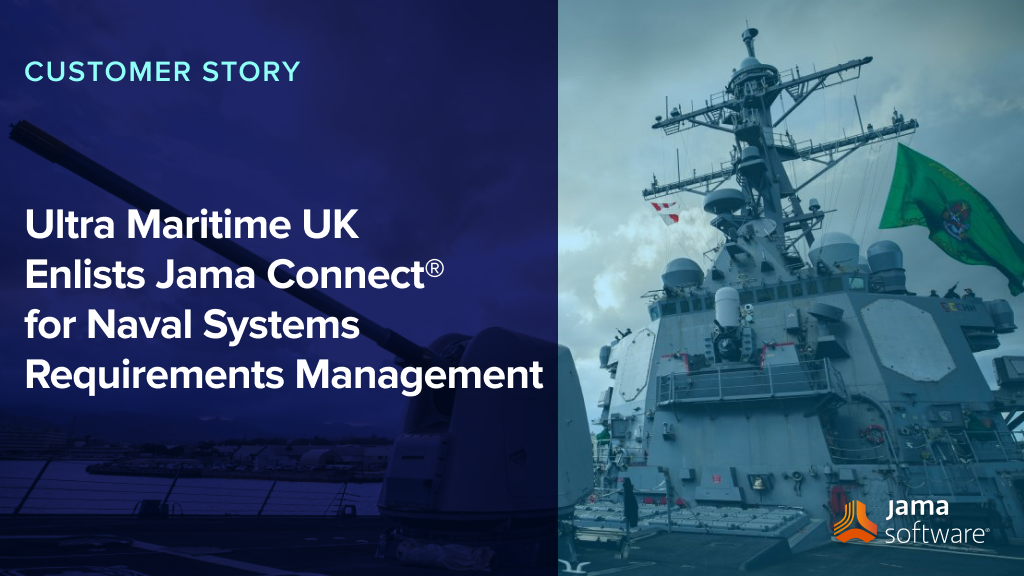
Ultra Maritime UK Enlists Jama Connect for Naval Systems Requirements Management
UK operation chooses Jama Connect for its ease-of-use and administration.
About Ultra Maritime UK
Founded in 1944 and acquired in 2021 by Advent International
Over 2,300 employees across fifteen locations worldwide
Premier provider of undersea warfare systems, products, and solutions to US, UK, Canada, Australia, and allied navies worldwide.
CUSTOMER STORY OVERVIEW
This customer story is about Ultra Maritime UK, a division of Ultra Maritime, which develops equipment for surface, subsurface, and unmanned platforms, including acoustic and sonar systems and torpedo defense and radar sensor solutions. Customers include the Royal Navy of the UK, the U.S. Navy, the Royal Canadian Navy, the Royal Australian Navy, and the Indian Navy.
Since the Ultra Group’s acquisition by U.S. private equity firm Advent International in 2021, Ultra Maritime has operated as an integrated company with lines of business headquartered in the USA, UK, Canada, and Australia, responsible for developing both worldwide and localized solutions.
Ultra Maritime UK’s products and solutions must adhere to the highest quality, security, and safety standard,s including ISO 9001-2015, ISO 14001:2015, ISO/IEC 27001:2013, and ISO 45001:2018. In addition, the products must satisfy customer requirements and regional naval standards, including U.S. DoD/MIL-STD and UK MOD DStan.
Challenges
Enabling collaborative remote working on requirements
Managing both project and product requirements effectively
Becoming more product-focused to balance global and local requirements
Evaluation Criteria
Intuitive user interface for quick adoption
Low administrative overhead
Support for reuse of requirements and test evidence
Outcomes
Consistency across projects
Business mandatory requirements tool for all new projects
Quick user adoption with minimal training
Easy tracking of progress with dashboards and standardization
Reduced risk with pre-built standardized project structures
Easy management of large numbers of objects and changes
Easy initiation and completion of reviews to action items sooner in development
After years of managing project requirements with IBM® DOORS® Classic, these challenges drove Ultra Maritime UK to find a user-friendly collaborative tool that would enable them to increase their requirements management effectiveness and deliver projects faster.
Enabling collaborative remote working on requirements
Managing both project and product requirements effectively
Becoming more product-focused to balance global and local requirements
EVALUATION CRITERIA
Ultra Maritime UK identified several requirements management tools as potential replacements for DOORS Classic, including Jama Connect, which a member of the engineering team suggested. They then established criteria to be used for the evaluation.
Intuitive user interface for quick adoption
Low administrative overhead
Integrable with development and test software tools
Support for reuse of requirements and test evidence
First, a top priority was for the new solution to have a modern, intuitive user experience for teams to get up and running quickly with their new projects. They needed software that people would want to work in. Otherwise, people might opt out of using the tool and work in disparate documents, which would introduce risk, impede productivity, and hamper efficiency. Second, it would need to have low administrative overhead that did not require team members to become full-time administrators. Third, it would need to be integrable with development and test software tools from different vendors. Fourth, it would need to support the reuse of requirements and test evidence from past development programs when starting new products or projects.
During the evaluation process, Jama Connect stood out from the competition as the solution that would best meet the company’s needs. “Looking at all the features, the user’s ease of use, and the low level of administrative time required, Jama Connect came out on top compared to the other tools reviewed,” says the Senior Systems Engineer.
In its search for a modern solution that would be quickly adopted, Ultra Maritime UK found that Jama Connect’s intuitive user experience made adoption extremely easy for engineers to get started managing requirements and test evidence more efficiently and intelligently. Tracking and finding information quickly and easily was achievable with Jama Connect’s powerful filtering and the ability to add hyperlinks to any architectural elements, requirements, test items or other objects. In addition, the ability to create a Definitions database and Glossary in Jama Connect was particularly useful for getting everyone informed and up-to-speed about projects. “Jama Connect has a highly intuitive user interface and allows for engineers to quickly and easily become accustomed to using it,” says the Senior Systems Engineer.
Having a simple and quick way for systems engineers to initiate reviews and for stakeholders to complete their reviews in a timely manner was a key area where Jama Connect’s Review Center led the way. The fact that reviewers were not required to be licensed as full-time users made Jama Connect more attractive. “Jama Connect certainly makes it much easier to initiate and manage reviews and be aware of progress through them,” says the System Design Authority and Functional Lead.
“Jama Connect proved to be extremely useful for making sure that we’ve got complete coverage and traceability of a given set of artifacts to see which ones have or haven’t reached the approved step. This helps ensure we haven’t missed any anomalies such as system requirements missing verification cases to avoid rework,” says the System Design Authority and Functional Lead.
Support for multiple IDs for the same object in Jama Connect made it easy to identify opportunities for reuse of older product requirements and test evidence for new products to efficiently manage shared elements of core and variant products. “The ability to identify, distinguish, and reuse global requirements across products and projects to reduce development time and cost is a strength of Jama Connect,” says the System Design Authority and Functional Lead.
In addition to product capabilities, team expertise, and training resources provided during the evaluation demonstrated that Jama Software would be a good fit as a partner for Ultra Maritime UK. “We were impressed by Jama Software’s responsiveness to our questions and the online training, forums, and support available to our team,” says the System Design Authority and Functional Lead.
Jama Software is always looking for news that would benefit and inform our industry partners. As such, we’ve curated a series of customer and industry spotlight articles that we found insightful. In this blog post, we share an article from VDA, titled “Automotive Industry Signs Memorandum of Understanding”, written by Lena Anzenhofer and published on June 23, 2025.
Automotive Industry Signs Memorandum of Understanding
Automotive industry signs Memorandum of Understanding for joint software development based on open source
Collaboration for more speed, efficiency, and security in software development and the basis for an open and collaborative ecosystem
With the support of the German Association of the Automotive Industry (VDA), 11 companies in the automotive industry have agreed on pre-competitive cooperation in open source software development.
A corresponding Memorandum of Understanding (MoU) was signed today at the 29th International Automotive Electronics Congress (AEK).
With the increasing importance and complexity of vehicle software, it is becoming critical for the industry to increase speed and efficiency in development while ensuring high quality and safety.
A significant portion of the vehicle software is not directly accessible to the user and therefore not differentiating. This fact allows the corresponding software modules to be developed jointly in an open and collaborative ecosystem.
In order to achieve the necessary functional safety for automotive series software, a groundbreaking development process for open source was developed in preparation for certification according to the relevant standards.
In addition, by providing executable software modules instead of detailed specifications, standardization and increased development speed are achieved through the so-called code-first approach.
The software development takes place in a transparent and vendor-independent environment of the Eclipse Foundation as part of the S-CORE project.
This ecosystem is open, both through software interoperability with relevant industry standards and for contributions and collaboration from other European and international companies.
The initiative’s timeline envisages that the software scope for series development of a platform for autonomous driving will be available in 2026.
The modular software scope can be adapted or expanded and then made available to the industry as a customized distribution for series development. This allows manufacturers and suppliers to focus on differentiating features while maintaining core components together. This creates a strong foundation for innovation – and the freedom to focus on what makes the difference for the customer.
“Together we are building a future-proof and powerful software ecosystem – open, transparent and secure,” VDA Managing Director Dr. Marcus Bollig said.
BMW Group Dr. Christoph Grote, SVP Electronics and Software
“The BMW Group believes that integrated ecosystems with open-source platforms and tools are a key driver for the development of mobility solutions. A shared code-first approach will be the foundation for functional innovations in our future products. We are committed to ECLIPSE S-CORE as a promising open-source approach for our upcoming projects.”
Continental AG Karsten Michels, Head of Product line “High Performance Computer”, BA “Architecture and Network Solutions”
“By uniting open-source and virtualization with safety certification and standardization, Continental’s contribution to an open and safe HPC Middleware Stack accelerates the transition to Software Defined Vehicles and significantly reduces time-to-market.”
ECLIPSE Foundation Mike Milinkovich, Executive Director
“Collaboration in the development of secure and open-source automotive platforms is a critical factor for the automotive industry. The Eclipse Foundation’s governance model enables open collaboration between OEMs, tiers, and tech players within the Eclipse SDV Working Group. We recognize the trust placed in us as the stewards of such a strategic initiative and embrace the challenge of making it a success.”
ETAS GmbH Dr. Thomas Irawan, CEO
“Building on our role as a pioneer in automotive platform software, we are driving industry-wide innovation through an open source ecosystem, accelerating time to market, and delivering safe and sustainable solutions for the mobility of tomorrow.”
HELLA GmbH & Co. KGaA Dr. Dietmar Stapel, Vice President Product Segment Radar
“We are pleased to support the Automotive Grade Open Source Ecosystem. Open, common standards are essential for secure integration and form the foundation for delivering innovative, value-added automotive features.”
Mercedes-Benz AG Magnus Östberg, Chief Software Officer
“As the creators of the automotive open source ecosystem, we are actively driving the future of automotive software with our code-first strategy. This is our clear commitment to open standards as the foundation for innovation.”
Qorix Markus Schupfner, CEO
“Qorix is committed to a powerful, open software ecosystem that combines functional safety and the speed of innovation – from architecture to production deployment.”
Robert Bosch GmbH Dr. Mathias Pilin, CTO Mobility
“We promote software solutions that integrate seamlessly across vehicle platforms, systems, and supplier technologies – for a software-defined mobility of the future.”
Valeo Brain Division Joachim Mathes, CTO
“Valeo has decided to join S-CORE and contribute key elements of its vOS to the stack. We are confident that a greater level of standardization and reuse will benefit the entire industry.”
Vector Informatik GmbH Dr. Matthias Traub, Managing Director
“With our joint initiative for an open software ecosystem for automotive ECUs, we are adding a powerful tool to the industry’s HPC full-stack toolbox.”
Volkswagen AG Dr. Oliver Seifert, Vice President R&D Infotainment and Connect at Dr. Ing. h.c. F. Porsche AG
“Through this open source ecosystem in automotive development, we shorten the time to market, reduce application development effort, and drive innovation.”
ZF Friedrichshafen Torsten Gollewski, Executive Vice President Corporate R&D Innovation & Technology
“Software development based on open source is the key to greater efficiency and speed. This is necessary to remain internationally competitive. The VDA initiative is a good example of the benefits that collaboration can bring.”
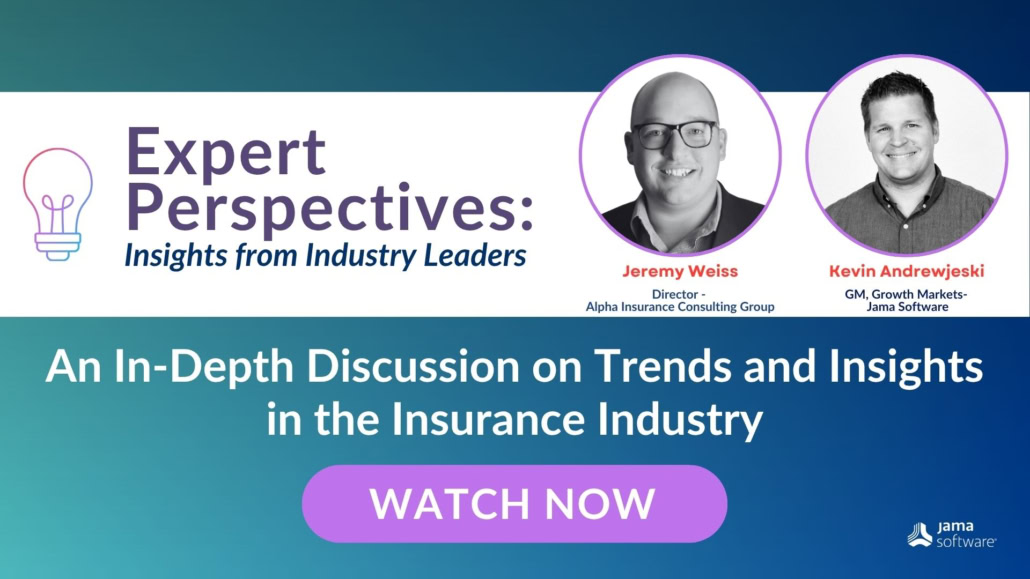
Expert Perspectives: An In-Depth Discussion with Jeremy Weiss from Alpha Financial Markets Consulting on Trends and Insights in the Insurance Industry
Welcome to our Expert Perspectives Series, where we showcase insights from leading experts in complex product, systems, and software development. Covering industries from medical devices to aerospace and defense, we feature thought leaders who are shaping the future of their fields.
The biggest challenges insurers face in managing the product filing process
How insurers can remain compliant while still being agile in product development
How technology is transforming the way carriers develop, manage, and file new products
VIDEO TRANSCRIPT
Kenzie: Welcome to our Expert Perspectives series where we showcase insights from leading experts in complex product systems and software development. Covering industries from medical devices to aerospace and defense, we feature thought leaders who are shaping the future in their fields. I’m Kenzie, your host, and today I’m excited to welcome Jeremy Weiss, the director of the Insurance Consulting Group at Alpha Financial Markets Consulting. With more than 10 years of experience, Jeremy works with multiple insurtech and technology organizations to develop their products to meet the needs of insurance carriers. He’s also very active in the AI space, imagining what the future of insurance looks like with AI.
Joining Jeremy is Kevin Andrewjeski, Jama Software’s own general manager. Kevin leverages more than a decade of experience and requirements and digital transformation to aid customers looking to modernize and transform their product development processes. We hope you enjoy this conversation on trends and insights that they’re seeing in the insurance industry. Without further ado, I’d like to welcome Jeremy and Kevin.
Kevin Andrewjeski: So thanks Kenzie. Hi everyone. Thanks for joining. My name is Kevin Andrewjeski. I’m the general manager for the finance and insurance space here at Jama Software. I’ve been with Jama for 11 and a half years and have had the pleasure of working with many of our customers in this space. Joining me today is Jeremy Weiss from Alpha FMC. Jeremy, if you would introduce yourself.
Jeremy Weiss: Yeah, great. Thanks Kevin. Jeremy Weiss, Director here at Alpha FMC. I lead our front office consulting practice, so product pricing, underwriting as well as distribution, sales and marketing. A variety of management consulting work both in the technology space as well as the business consulting space, but spend the majority of my time really at the intersection of those two.
Andrewjeski: Thanks Jeremy. So for today’s discussion and as part of our Experts Perspectives series, we want to have an in-depth discussion around trends and insights in the insurance industry. And Jeremy, before we kind of dive too deep into some of the things that you’re seeing, could you talk a little bit about the role of product management within the insurance space? What does that mean to folks in the insurance world?
Weiss: Yeah, great question. I would say there’s a number of definitions of how we think about product. There’s certainly the insurance product side, that is the filed product in most cases that’s being sold in the market that provides the coverage that folks are seeking with insurance. And then there’s other product definitions like an internal built product, et cetera. But for today, I think it’s really about that insurance product that’s really that insuring vehicle that is the coverages and sub-coverages that make up the entirety of what’s being protected under the insurance, at least in property and casualty, but very similar in the life space with protecting the human life, et cetera.
Andrewjeski: Thank you. Thank you for that. And when you look across the industry and as you’re interacting with the various clients that you’re seeing, are you seeing any trends as far as some of the challenges that are consistent across different insurers in the space?
Weiss: We built product for, gosh, over 100 years it seems at this point. So we’ve been doing it the same way for a while. Regulatory processes, although they’ve started a bit to come into a new modern age, it’s been a bit slow. When I look at trends, I think more organizations today than even two years ago are more focused on the product management function and they’re really saying, “How do I enable product into the future to be able to support the business better? How can I transform my products to better meet customer expectations? How can I do that more quickly? How can I shorten what is often a 6 to 12 plus month cycle of ideation of a product to actually getting something filed and in the market?”
So companies are really starting to see the opportunity there to say, “How do I be more efficient? How do I add tooling in that space?” And product largely has been an area that hasn’t had a lot of investment in, gosh, as long as I can remember. There haven’t been massive product management overhaul projects at really any of the clients that I’ve worked heavily with.
Andrewjeski: Yeah, I would agree. I think from our perspective, we see a lot of investment in the, say, software development side of product, but not necessarily in the product management space. And it seems to be a place where there has been less technology investment in the past. So not surprising to see that you’re seeing folks looking at that as an area for ways to improve. What are some of the things that you’ve seen people try to do to help with the inefficiencies in this space?
Weiss: Yeah, it’s interesting. So gosh, 10 years ago or so when we started to talk a bit about agile within an IT development, we talked about this concept of a product and building that minimum viable product and taking it to market. And we thought of it in that context more as a physical cardboard box that had a package in it, that was the product. I see in the product management space for insurance product, we’re starting to think about it in a bit more of those terms. So think about it a bit as the supply chain elements, right? So what are all those pieces and component parts that help us get to that ultimate end result?
So really looking at it more of the factory floor type model. What are all of the activities that need to be built into that product? Who does them? How do they happen? How long do they take? Where is there efficiency to be gained? What are the most important elements of that? What do we maybe do today that we don’t need to do tomorrow? So thinking about it in that factory model of how do I churn through product development more quickly to get to market, or at least to get to the regulatory side? That filings process, maybe I have a little less ability to influence how quickly that happens. I’m working with state regulators, et cetera, but at least I can get that kind of internal product making piece done and get to that regulatory start.
So I see folks really focused on what are the opportunities kind of looking internally. And when I say product management, and a lot of organizations, that doesn’t really mean one specific product organization. Certainly there are product managers that are accountable for maybe ideating or building the product, maybe managing the performance of the product, but you also have legal and compliance and IT and underwriting and a variety of other stakeholders really in the mix on what product management means, which adds to that complexity.
So really clearly defining what those roles are, what the underlying requirements are that make up a product, how it should function, how it should function in a system, how the filings should be prepared, all of that kind of makes up that overall product management factory model. And we see companies starting to take a deeper look at that, look at tooling that can help to support streamlining that model and getting all of those parties, those six, seven, eight parties that I talked about to one cohesive understanding and definition for that source of truth.
Andrewjeski: Got it. And one of the drawbacks we see from people still trying to manage a lot of this information say in Excel and sort of some of the other manual ways is if these teams aren’t aligned, it’s more likely that something would be missed or perhaps somebody is working off of maybe some outdated information and that will slow their filing process down because there’ll be rework and things like that. Are those some of the things that you’re seeing or are there other kind of bottlenecks or other areas where you’re seeing issues in the process?
Weiss: Yeah, there’s definitely a lack of documentation certainly. There’s organizations that have strong documentation, it just might not be in a super modern tool like Excel. That’s hard to keep up to date when you have those eight different parties or eight different parts of the organization all with multiple people in them really working on the same product definition. So that makes it really a challenge to keep documents up to date and really understand what that single definition of product is ultimately. It also impacts how we get to the regulatory process where I have to at times defend the product, why we made decisions, how it applies across different territories or geographies, et cetera. And so that can really be quite a challenge.
The other piece to comment I made previously, we’ve had a number of years of not a lot of investment in products. So a lot of these products have been sitting there largely in the market, but they haven’t changed a whole lot, right? And so a lot of those are individuals who maybe built that product at the beginning are no longer with the organization, and so the documentation maybe wasn’t kept up to date or was kept up to date with 80%. And so there’s a lot of question and answer trying to understand what did we do here, why did we get there, what’s actually filed, what are we selling, what’s developed in the system, and so that adds to that part of that challenge.
So now when organizations have a chance to look at it and do a refresh and say, “Okay, this is actually what our product is,” it’s about how do you get that in one spot and then how do you manage it going forward in that factory type model that keeps that product definition up to date. So you don’t ever have that problem of saying, “We just need to stop doing what we’re doing today and build a single version that actually reflects the product that we’re selling in the market and the product that the end customer thinks that they’re ultimately getting.”
Andrewjeski: Interesting. So it’s not just about trying to capture what this product does or is supposed to do, but also the context around why it evolved or how it evolved into that version of the product that they’re ultimately bringing to market and seeking to get regulatory approval for.
Weiss: Yeah, exactly. And there’s a few ways to look at that. Sometimes it’s just an insurance carrier wanting that knowledge to be recorded in some way, like a change log, right? Why did we make the change? What did we update? What was it? In some cases, to your point, from a regulatory approval perspective, if I’m changing business rules about how a product is applied, I do have to keep a record of what those were on a given day versus what they might be at a future moment in time after I update them in a system or keep them in the documentation.
Andrewjeski: Yeah, so it sounds like there’s a lot of, as you mentioned, the product management role might mean and often means more than just the product organization. It might mean a lot of different stakeholders and a lot of different folks are involved in that process. And so really, one of the goals for improving this process is just better collaboration and better engagement from these various stakeholders along the way to make sure that everybody’s on the same page and things are happening kind of in an efficient manner. How do you see technology helping kind with this transition and trying to help bridge this gap or maybe break down some of these collaboration barriers that exist today?
Weiss: Yeah, there’s a variety of factors from a technology perspective. I think first and foremost, it’s about more of that workflow, routing of work, assigning tasks to someone. You know who’s on next and who needs to do it and when is it done. And I know that when I’ve completed my legal review, I pass it off to this person, maybe it goes back to the product manager, right? A system could be able to know that and automatically route it as part of that next step in the journey. And so you’re also able to give some context of why that is the step in the process.
And so that’s very much an important part that we need to see in tooling, as well as keeping that bit of a change log, those detailed requirements, all of the background that you want behind them. Maybe you’re able to easily see impact to the changes that you’ve made, right? If you make a lot of changes, what’s that going to do to your product? How does that impact what needs to be filed or what ultimately goes in a system? And so all of those pieces become a really important part of the journey.
Andrewjeski: Yeah. Obviously, one of the big buzzwords right now across not just this space but all of the industries is AI and how can AI help me do my job more efficiently and help make things easier. What role do you see AI playing in helping product management within the insurance space?
Weiss: I think when we look at the impact of artificial intelligence, I think we can think about it more from a development perspective as well of how can it take some of the requirements that we’re keeping and how does it turn those into code that are actually developed in the system. If I have really well-defined requirement, it should be relatively easy to transition those into a system, especially a low-code, no-code type system. If I’m keeping the documentation, I’m really almost 50% of the way there. So can we use AI to get them into a system? I don’t see a lot of carriers really to that point yet, but I could definitely see that happening maybe in the future.
I think we can do a fair amount of comparison as well with AI. So we probably hear a lot in the industry about document compare. You can certainly do that with product compare, comparing what product an individual has today versus what I may be trying to offer them for their future product tomorrow. Being able to see those differences. The same can be true in really helping with that legacy use case that I mentioned of, gosh, we have this old product, I hope this is what we filed. Can we compare our filing against the documentation that we have against maybe the documentation that someone else has and is kept on their desktop to understand the delta between the three? And so that can get you to hopefully that one version of the truth or maybe that one messy version that you need to go through to determine what is the truth. But it’s not as much today a manual compare. AI can really support that working more efficiently.
Andrewjeski: Yeah. And I think you mentioned the quality of the requirements really being a key there, right? The better that the product management team and the internal folks can do it, writing proper requirements, the easier it is for a machine to be able to interpret those requirements and create code or potential low-code, no-code situations like you mentioned. Also, we see test cases being a downstream impact of that as well, right? If we have properly written requirements, much easier for AI to be able to suggest or create ways for those requirements to be tested as well.
You mentioned the regulatory aspect, and obviously that is a huge factor in this space. Ultimately, it’s a race to sort of get into the regulatory review process. As those regulatory requirements are evolving, how can insurers ensure that they’re remaining compliant while still trying to be agile in this process and try to iterate and go faster like we’ve been talking about?
Jeremy Weiss: Yeah. I think it’s about keeping effective documentation, first and foremost, and that will streamline your ability to get to the filing and then hopefully reply to any of the objections that might come from a regulator so you’re able to move through that process more quickly. When you’re updating a product, certainly having that change log or change control log that you could surface to a regulator to have a conversation about what may be changing and why you’re updating the product, why it looks different in this new version, what necessitated the change, what specifically did you change, that log will be super helpful.
And then as you get through the process, really having that check the box review and approval process so that you understand when you have received regulatory approval back. Remember, a lot of the carriers that we work with are filing business across 50 states, right? And so they’re managing 50 different ways, or at least 35 or so different ways to do things. That’s a lot to track and manage, especially if you’re one person or a team of three maybe that are focused on the product. And so having that type of a view that gives you a dashboard for product X, where have I filed, where not, where am I waiting for information from an internal stakeholder, from external legal counsel, from the regulator, where are we at with objections, et cetera, that dashboard view can also be super helpful.
Andrewjeski: Yeah. And I would think as you get that feedback from those regulators, being able to tie that back to or go back to your notes or your records to be able to say answer those questions, whatever those questions be from the regulators, that’s where having that single source of truth that you talked about would be super helpful to be able to go and say, “Okay, if I’ve got a question about this, not only can I go look at what we wrote down, but I can get more of that context, more of the decisions, maybe look at where it was reviewed, where it was approved, or how it evolved into ultimately what we submitted for regulatory approval.” Something that would be challenging if you’re trying to manage that or search through a bunch of emails or other places where some of those decisions sometimes were ultimately made.
Weiss: Yeah. Replying to objections is, well, I would say it’s not really a fun process, right? But a lot of times you’re going to get the same objection or a similar type objection. So to your point, the reusability even of objection management is something that you can use tooling to consider how you manage that information, how you write the same response to this state that you already wrote to that state four months ago as part of that process, that definitely streamlines your ability to get them a response back, and hopefully their ability to review it quickly and approve the product so you can then go use it in the market in the states that you’re required to have that approval.
Andrewjeski: Yeah. And it sounds like, I mean, obviously we’ve talked about some of the evolution that you’re seeing and some of the ways that technology could be helpful in this process. Are you seeing insurers already taking this journey or investing in these areas or how early in the process are we?
Weiss: Yeah, it’s a great question. I think we’re seeing the start of this in more of the requirements management space, definitely coming out of IT or business analysis type activities, starting to maybe bleed over or enable into the product management function, largely a business function at the core. And so we’re starting to see some of that tooling have an impact slowly as we’re starting to think about it. I think if we could paint the picture on the back end of reusability of a product, a product definition of the individual requirements that make up a product, that will help the end users to see the need to do the work on the front end, right?
This isn’t easy. Tooling is not always the easiest to implement. It’s not like snap my fingers and magically we have our product definition written in a brand new tool that allows us to streamline it and manage it on the way forward. But if we see that benefit on the back end and can really understand how it impacts our entire process, I think we’ll start to see more traction over time. Folks are definitely feeling the pain of needing to get to market more quickly with product of the desire to have far more products tomorrow than I had in the market today to meet customers changing needs, needs of a business changing, et cetera. And so I think we’ll see that continue to increase as we move into the future, of the desire to have more bespoke product offerings that will actually make this even more important than it is today.
Andrewjeski: Yeah. And I think that right now, I guess, one of the other macro factors that we see in the market is there’s a lot of uncertainty, political uncertainty around tariffs, but also potentially less regulation occurring in the market as well. So that can be sort of paralyzing sometimes for companies figure out which direction to go or do we invest in new tooling or technology advancements for things like this. I mean, what is your approach or guidance? I mean, what have you seen in the space for people looking around at the macroeconomic marketing and being uncertain about whether now is the right time to make these kinds of changes?
“If we can get a break in some of the regulatory pressure, I would say there’s actually probably no better time to implement this than now. Because you hopefully have freed up some capacity to start to think about how we do this in the future. If there’s one thing we know about how politics impact the insurance world, it’s probably going to go back and forth at the state level, at the federal level over time, right? And so we’re going to see an increase in regulation, we’re going to see a decrease… And so we’re going to need tooling to support really both sides of that.”
Weiss: Yeah. Well, if we can get a break in some of the regulatory pressure, I would say there’s actually probably no better time to implement this than now. Because, you hopefully have freed up some capacity to start to think about how we do this in the future. If there’s one thing we know about how politics impact the insurance world, it’s probably going to go back and forth at the state level, at the federal level over time, right? And so we’re going to see an increase in regulation, we’re going to see a decrease… And so we’re going to need tooling to support really both sides of that. But especially when we see an increase in regulation, the best time to do a project that supports that would be when there isn’t a significant amount of regulatory scrutiny or an increase in objections, et cetera. So now is probably that great time to implement that type of a product.
And I hear you on the tariff side, what will that do to construction costs on homes and buildings and autos, et cetera. And so that definitely is something to manage as we think about how that will impact investment on the way forward into the future. But what I will say is a lot of these solutions that are available in the market, really that can help to enable solution to these problems are not massive behemoth, super costly solutions. They don’t require thousands of hours of implementation expertise. It’s something that can be done on more of a smaller project scale. You can right-size it, maybe it start with one or two products, and then think about it growing into more of an enterprise implementation that can maybe house all of your products, but you don’t have to start there. You can start with a more smaller subset. Maybe it’s one business unit, for example, or even one single but somewhat complex product.
Andrewjeski: Yeah, no, that’s a good point about it isn’t an all or nothing proposition and that companies can find those ways to innovate or to try to innovate and test things out. And I think that that can be a good way for them to kind of dip their toe in the water, so to speak, of maybe making some of these changes rather than trying to change things on a massive level across all 50 states or all the products that they offer. And I guess in our lifetime, we’ve seen other uncertainty and other kind of macro challenges, right? And obviously not that long ago, companies in this space and across the globe were dealing with things like COVID where there was a lot of uncertainty. Can you draw any parallels, I guess, to the uncertainty that exists today and how companies got through that period of time, which was only a few short years ago?
Weiss: Yeah, I think it looked different for every company, and maybe that changed over time. But the organizations that decided to invest, maybe they paused for a while at the beginning of COVID. Let’s be realistic. Almost every organization pressed pause on a few things, maybe a lot of things. We were all living into what would eventually become a bit of a new normal for a period of time. But then the organizations that are the most successful in the market today are those that took those few years that we had and continued on that transformation journey. They didn’t go to sleep, they didn’t press pause. They said, “Let’s take this as an opportunity to continue to evaluate how we do business.”
Is how we do business in the market different today than two years ago? Yes, to some degree, but there’s a lot of parallels and a lot is still the same. And so the organizations that took that time to transform and double down on the operation and say, “Let’s take this as a chance to streamline what we’re doing. Let’s think about new products. Let’s ideate on what the market might look like coming out the other side of COVID.” Those are the organizations that are in the market today with new products or slightly different products, and more important than anything, they’re able to adapt to a changing market.
So in the tariff example and the political uncertainty example, they understand what that impact could be and they’re able to turn the corner quickly versus staring at how do I even go about developing a new product? Maybe that’s going to take me 18 months to get to market. Well, hopefully we’ll be through all the tariff pressure by then, and hopefully we’ll be at a more stable place politically and know what’s next. And so finding a way to be able to adapt quickly is super important today, and I think we can take COVID as a learning from the organizations that are most successful today.
Andrewjeski: Yeah, it sounds like the folks that continued to invest throughout the uncertainty are now seeing a bit of a competitive advantage, right? Because the one thing that’s constant throughout time, and it’s not just now and back in COVID, it’s always is change is constant, right? And so the companies that are investing in ways to improve their process and improve the efficiency of the way that their teams, specifically in say the product management space, are able to adapt to those change allows them to deal with that uncertainty at a much higher pace than say some of the companies that are still trying to do these things in a very manual way.
Weiss: Absolutely. The one thing I will add is there’s no set it and forget it when it comes to transformation. So I can do all the planning effort and start a transformation program today on a two-year journey. That program will likely not be successful if I continue on that full two-year journey, and I don’t look at everything that’s happening around me. So organizations in the middle of transformation or even in transformation planning need to understand how am I going to take what’s happening in the broader ecosphere and understand the impacts to individual projects or programs or the overall direction that we’re going, find a way to assess what’s happening. And then being able to steer those transformation programs as well.
So you can’t forget completely about what’s happening around you, but you do need to keep your eyes on the ball and what you’re focused on and change that goal if you need to, if it makes sense. But definitely have everything working toward that shared goal or shared vision.
Andrewjeski: Well, Jeremy, I appreciate the insights and the discussion on trends within the insurance space. And for folks that might want to learn more about Alpha FMC and how your group might be able to help them, how would they go about reaching out to you?
Weiss: Yeah, definitely. Visit alphafmc.com to learn more or adding me on LinkedIn, happy to have a conversation as well. As I mentioned at the beginning, we are in the management consulting space. We exclusively serve financial services organizations, so in the wealth and asset management as well as insurance domains with a number of experts across our solutions, really across all of insurance and much broader than that in financial services. But really the entirety of the business operation, technology operations, new technology enablement, as well as M&A type activity, all really in our sweet spot. And as I mentioned as well, really it’s that intersection of business and technology, much like a lot of what we talked about today, how do I leverage technology solutions to be able to enable the business to do things better and more efficiently than maybe they’ve ever been able to do them before.
Andrewjeski: Sounds great. Thank you, Jeremy, and appreciate the time and look forward to having you on again in a future session.
Weiss: Thank you. Appreciate it.
Kenzie: Thank you for joining us on this episode of our Expert Perspectives series. We hope you’ve enjoyed this conversation between Kevin Andrewjeski and Jeremy Weiss on trends and insights in the insurance industry. If you’re an existing customer and want to learn more about Jama Software, please reach out to your customer success manager or consultant. If you’re not yet a client, please visit our website at jamasoftware.com to learn more about us and how we can help optimize your processes. Thank you, and stay tuned for upcoming episodes of Expert Perspectives. Please note that the views expressed in these interviews and commentary are solely those of the individuals providing them and do not reflect the opinions of Jama Software.