2026 Predictions for Automotive: AI, Electrification, and the Road to a Connected Future
 |
|
|
|
As 2026 approaches, the automotive industry is about to enter an exciting phase marked by cutting-edge technologies, sustainability requirements, and shifting consumer expectations. The industry is navigating a changing landscape of opportunities and challenges, from the emergence of autonomous driving systems and vehicle-to-everything (V2X) communication to developments in electrification and AI-driven innovation.
The integration of emerging technologies is reshaping vehicles into interconnected, software-defined systems, while sustainability goals are driving rapid advancements in battery technology, charging infrastructure, and renewable energy integration. At the same time, the industry faces critical hurdles, including cybersecurity threats, regulatory complexities, and the need for seamless collaboration across OEMs, suppliers, and technology partners.
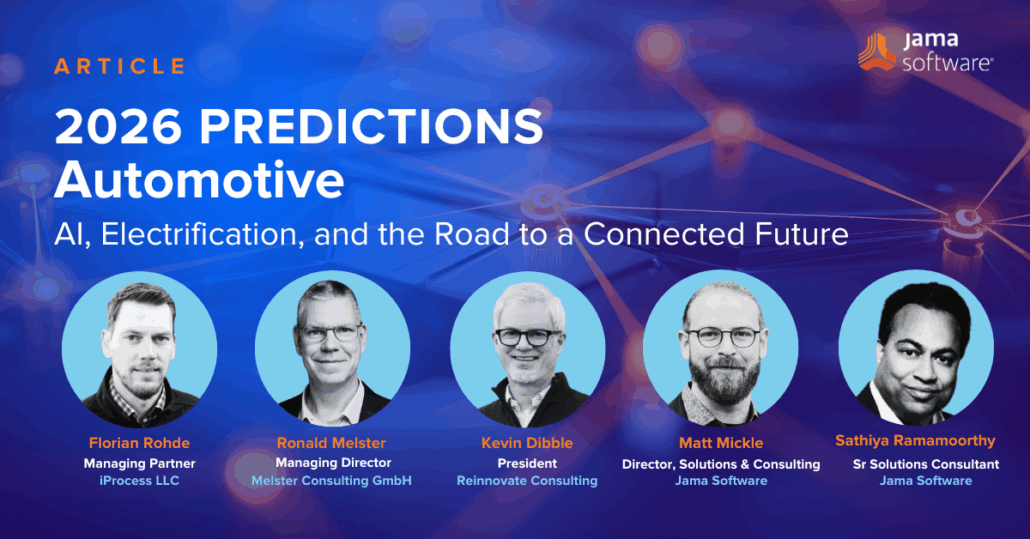
In this year’s predictions series, we’ve gathered insights from leading automotive experts:
Together, they explore the trends and technologies shaping the future of the automotive industry. From AI-driven predictive maintenance and edge computing to the challenges of electrification and the rise of subscription-based ownership models, this piece highlights the innovations and strategies that will define 2026 and beyond.
Curious about what’s happening in other fields? Read part one on consumer electronics, part two on medical device & life sciences, part three on aerospace & defense, and stay tuned for our upcoming predictions on Semiconductors, AECO, and more.
Florian Rohde: There is no ONE next big thing. The most transformative impact will be created by the integration of many emerging technologies. We see fast-paced innovation in a lot of sectors, and the most successful product will be the one with the best overall user experience. Whether driving manually or autonomously, mobility will encompass much more, with integration into the environment and a fully customized experience emerging as the winning combination. The emergence of AI will definitively be the biggest enabler for the next generation of mobility, for several areas, first for the user interface, which will see orders of magnitude in improvement, and next then also for driving and integration functions, as well as shared mobility, or public transportation.
Ronald Melster: While ADAS and autonomous driving progress as expected, V2X (Vehicle-to-Everything) communication is the underestimated game-changer for the next five years. V2X addresses fundamental sensor limitations. Instead of struggling to recognize speed limit signs in poor weather, vehicles receive information directly from infrastructure. Studies suggest V2X-enhanced ADAS could address eighty-eight percent of vehicle collisions. Over ten million V2X-capable vehicles are expected by 2025, with regulatory mandates in Europe, the US, China, and Japan driving adoption. For companies integrating V2X, three areas are critical. First, functional safety, where ASIL-grade components are required to ensure reliable communication in safety-critical scenarios. Second, security architecture where authentication and privacy protection must be built in from day one to prevent spoofing and data breaches. Third, a clear technology strategy, as the landscape is rapidly consolidating around dominant standards. The challenge is infrastructure dependency. Systems must operate in mixed environments where V2X complements traditional sensors. This complexity demands structured development processes to maintain safety throughout the vehicle lifecycle.
Matt Mickle: All of these technologies will be impactful as they shift vehicles from isolated products to interconnected, software-defined systems, but only if they’re integrated safely and at scale, using AI to support a backbone of well-established processes and strong cross-industry partnerships.
Sathiya Ramamoorthy: 5G-V2X, satellite-enhanced V2X, high-precision GNSS, and the steady progress of L4 autonomous driving will strongly shape the industry over the next five years. Recent 5GAA demonstrations showed how reliable hazard warnings, emergency messages, and seamless satellite–terrestrial switching can support safer automated functions, while precise GNSS improves lane-level positioning. L4 autonomy is already moving from pilot projects to real robotaxi services in several cities, with more deployments expected from 2026 onwards, while L5 will remain long-term and limited to special scenarios. To prepare, companies need software-defined architectures, strong cybersecurity, and integrated testing that connects road, cloud, GNSS, satellite, and automated-driving systems.
Rohde: We are seeing extremely quick improvements in all areas related to EVs. A lot of engineering resources and investments are going into advancing cell technology, infrastructure, and electronics. Additionally, cars are transitioning into SDV architectures, which makes the ongoing integration of new technology faster and easier. The regulatory landscape needs to adapt to this new pace of the industry in order not to be the braking block of innovation. I observe openness on the lawmaker’s side; collaboration is key.
Melster: The technical challenges of electrification are well documented, but the software complexity is often underestimated. Charging systems require communication with external infrastructure. Unlike traditional vehicle functions in a closed embedded environment, two development worlds collide: embedded software with real-time and safety requirements meet cloud software with external interfaces and different security models. Every charging station becomes a potential attack vector. The solution lies in a unified development process across both domains. ASPICE-compliant processes must extend to backend development, and the new ASQMS standard explicitly requires this scope of expansion. Success requires structured processes that bridge these domains and integrated security practices throughout the development lifecycle.
Kevin Dibble: In many countries, the grid simply can’t support the charging infrastructure required to support a highly electrified mobile society. Cars, buses, and heavy trucks demand more power than grids can supply. New technologies for large energy stores will be critical for establishing charging infrastructure that is powered by green energy.
Mickle: Electrification and renewable integration are inevitable, and the technology is moving in the right direction; however, there will be challenges such as keeping up with the demand for batteries, expanding the grid capacity for widespread vehicle charging, and maintaining products that meet the needs of regulations that lack harmonization. All of this will require tight alignment between OEMs, suppliers, and regulators.
Ramamoorthy: Connected vehicles will use real-time data from onboard sensors, other vehicles, and smart infrastructure to improve safety, reliability, and overall driving experience. Recent 5GAA road tests showed how sharing hazard and sensor information can prevent accidents and support safer maneuvers. The main challenges will be protecting personal data, securing networks, and ensuring this information is used in a safe and trustworthy way.
Rohde: Until now, car makers had to over-engineer their products due to lack of knowledge of how they are actually used. The only form of feedback for the engineers came through return parts, an indicator that the product has not performed well. But there was no clear understanding to what extent the parts were over-engineered if they did not break. They might be using 99% of their capability and useful life, or maybe just 5%, engineers never knew at scale. Now, with data, either evaluated inside the vehicles or in an anonymized data lake, we can see the real use. How often are doors opened? How many turns does a steering gear do over the years? What capacity of batteries is necessary for 90% of the users? These and more questions can now be answered and add valuable insights for R&D engineers to make the product better, without making it exorbitantly more expensive.
Melster: Connected vehicles fundamentally change verification. Millions of vehicles capture edge cases no test team could ever cover. When all vehicles collect data from day one, you get comprehensive real-world coverage and real-time mapping of road conditions and system behavior. The challenge: companies drown in terabytes without clear processes for filtering and feeding insights back into development. Most collect everything and learn nothing. Success requires closing the loop from field data to requirements to implementation.
Mickle: There is a ton of opportunity in collecting vehicle data for things like predictive maintenance and improving ADAS functions with real-time road and traffic conditions, but data privacy and security still remain major concerns. Success will require strong data-governance processes and clear traceability from collected data to the actions that are taken in order to ensure that trust and security are maintained.
Rohde: The first big step to the success of AI is to understand it. There’s no “THE AI”; there are a lot of different components to AI, and the industry has to put in the effort to understand what all of these are and how they can come together and help us. Overall, it is without a doubt that artificial intelligence will change the way we are engineering our products and the way our products will behave. Already today, AI is greatly used in the areas of documentation, specification, and test engineering. But this is completely different AI than what will drive our autonomy or predictive maintenance. Right now, we’re talking server AI, machine learning producing algorithms it’s getting sent to the vehicle. The concept of edge AI, where we have real decision-making in the car based on ongoing learning, will be powerful, yet it’s still a while out (see last question).
Melster: AI will have a massive impact: in-vehicle systems, development processes, and predictive maintenance. The real challenge is the conflict between non-deterministic AI behavior and regulatory requirements for deterministic safety proofs. Non-determinism makes AI powerful, but regulations demand verifiable requirements and predictable behavior. How do you prove compliance when behavior emerges from training data rather than code? ISO 26262 and ASPICE weren’t designed for this. Companies need new verification approaches that demonstrate safety boundaries without requiring deterministic behavior. The scaling challenge isn’t computational – it’s process maturity.
Dibble: AI will continue to be the centerpiece of self-driving car technology. However, large gains are coming through the automation of the development workflow for many aspects of automotive engineering. The exponential growth of software in the car needs Agentic AI workers to improve quality and speed up delivery. Requirements management and test management are 2 areas that should light up in 2026.
Mickle: The biggest concerns here are model transparency and quality training data in order to maintain safety and regulatory expectations. AI-driven decisions need to be explainable and validated using solid governance practices. More standards, such as ISO PAS 8800, are still being developed to help with this and will need to be put into practice.
Dibble: AI agents should be considered teammates or collaborators alongside systems and software engineers. Human-in-the-loop staffing practices will be critical for error reduction and to certify systems for safety, cyber, and quality. Planning for AI workflows must include consideration of ethical issues like bias.
Mickle: Organizations should treat AI as part of their safety and quality management system, rather than as a bolt-on technology. This means validating it against well-structured requirements and keeping humans in the loop for high-risk decisions.
Rohde: Cars in the future will not have a selectable number of customizations for features. Instead, features will be truly customizable with the help of AI interfaces so that drivers or users can make them actually one of their own. While this is creating challenges on the development side for implementation of those AI-driven features, it creates even higher, bigger challenges on the side of validation. From that point on, the features will not be defined only by the requirements, but the user will have significant input in their design and use.
Mickle: Innovation will need to focus on energy efficiency, connectivity, and flexibility to adapt to each individual’s needs. Software-defined features delivered through over-the-air updates, along with the use of sustainable materials, will be critical to achieving this.
For example, Rivian’s “Smart Charging Schedule Recommendation” can automatically shift charging to off-peak hours. A software update which can help with environmental goals without a needed hardware change.
Ramamoorthy: Consumers will expect cars to feel like personalized digital devices, not just machines. We already see this with BMW adopting Android Automotive OS and offering paid digital features through its ConnectedDrive store and charging services. In the future, OEMs will rely more on software, subscriptions, sustainable materials, and regular OTA updates to keep vehicles fresh and aligned with fast-changing customer expectations.
Melster: The biggest impact in 2026 won’t be any single new regulation—it’s the sheer volume of standards and norms hitting developers of a single product. ISO 26262, ISO 21434, ASPICE, ASQMS, UN R155/R156, EU Cyber Resilience Act—each brings its own audits and assessments. Developers spend more time in audits than actually developing. Every project gets audited separately, creating redundancy, inefficiency, and audit fatigue. The only viable solution is shifting from project-based to organization-based assessments. Certify the organization and its processes once, not every project individually. Build trust through organizational-level certificates. This allows developers to focus on development, makes audits efficient, and keeps innovation possible despite increasing regulatory complexity.
Mickle: Standards such as ISO 21434 and ISO 26262 will become even more tightly integrated into development processes, while SOTIF and ISO/PAS 8800 will take a growing foothold as AI-based systems expand. In addition, major updates to the Euro NCAP protocols planned for 2026 will have a significant impact on how vehicles are designed and validated.
Rohde: Cybersecurity in automotive is still in its infancy. Both OEMs and Suppliers have yet to build up strong cybersecurity defense teams and strategies. Many systems in a car today are not designed to be resistant against cyber-attacks. The future will bring quantum computing, and with that, even bigger cybersecurity threats. The car industry has to react now in order to prepare for that scenario.
Melster: Cybersecurity is not a compliance checkbox – it is an operational discipline. Most OEMs treat ISO 21434 and UN R155 as audit exercises: pass the assessment, move on. Real security requires security by design: threat modeling in architecture, security champions in teams, continuous penetration testing—not just before audits. The bigger challenge is post-production. Threats will evolve after type approval. Companies need Security Operations Centers (SOCs) for vehicle fleets: continuous monitoring, incident detection, and coordinated OTA updates when vulnerabilities emerge. Security is not a milestone—it is ongoing operations.
Dibble: Developing secure vehicle architectures should be the focus. These architectures must be resilient to new and increasing threats from AI-based cyber-attacks.
Mickle: Cybersecurity will need to be treated as a continuous lifecycle activity, fully integrated with functional safety and requirements management processes rather than handled as an independent effort.
Ramamoorthy: Cybersecurity will be central to protecting system integrity, passenger safety, and vehicle data as connectivity increases. The 2025 JLR cyber-attack showed how a single breach can disrupt operations and expose supply-chain weaknesses. With new rules like the EU Cyber Resilience Act, the EU AI Act, and China’s GB 44495-2024, companies must focus on secure architectures, strong OTA processes, and continuous fleet monitoring. To build trust, OEMs should enforce strict supplier security audits, run regular penetration tests, secure OTA updates, and maintain fast, well-practiced incident-response actions.
Rohde: The collaboration between the different players in the industry has to be redesigned. Those long-existing barriers between OEMs, Tier 1s, and Tier2s are hindering the progress. To achieve proper continuous integration and validation results, a much closer collaboration is necessary. On top of that, we’re seeing the emergence of open-source software in the automotive industry, which has its definite Pros like avoidance of double work and extra efforts. But it also comes with new challenges like certifications and responsibility questions.
Melster: Modern vehicle development is one integrated project spanning OEMs and multiple supplier tiers. However, assessments treat each company separately. The same processes are audited repeatedly at each supplier, creating massive redundancy. The solution requires two elements. First, supply chain certificates. If a supplier holds a valid certificate, the OEM accepts it without re-auditing. Second, agreed toolchains. Requirements management, change management, and configuration management must use compatible tools across company boundaries. Without tool alignment, traceability breaks down. Certificates reduce redundancy; shared tools enable traceability.
Mickle: It will be essential to maintain full traceability across integrated systems, with shared visibility across interfaces between organizations to ensure alignment on safety and security goals. This means a shared ecosystem of compatible tooling that allows for close communication feedback loops.
Rohde: Edge AI will be the biggest thing. AI that continues to get smarter and better while learning from the environment, eventually. I believe we will see a paradigm shift as soon as edge AI hardware makes a big impact, and from there on, mobility will be nothing like it is today.
Melster: Mastering AI will be the key. Not just deploying AI features in vehicles, but mastering AI-driven development, validation, and operations. AI for automated testing. AI for anomaly detection in fleets. AI for predictive maintenance. Companies that integrate AI across the entire development lifecycle will dominate.
Dibble: The megatrend that will change the industry permanently is the pay-as-you-go subscription type ownership models, and away from traditional ownership models. This will focus OEMs on developing more fleet cars, wipe out dealerships, give the OEM direct control over the customer experience, and allow for a new wave of middle-tier companies to potentially manage the service.
Mickle: Technology advancements such as central compute with zonal architecture will have a major impact, reducing complexity and improving overall reliability while enabling lower costs and much faster innovation. Otherwise, of course, AI is going to have a major impact with all avenues of advancement.