Modern organizations face the challenge of balancing speed, compliance, and innovation, particularly when managing complex systems across multiple product lines. ISO 26580 provides a structured approach to addressing these challenges by standardizing Agile Product Line Engineering (APLE). But what exactly is ISO 26580, and why is it important? Let's break it down.
ISO 26580 is an international standard that defines best practices for Agile Product Line Engineering (APLE). It bridges the gap between Agile methodologies and Product Line Engineering (PLE), enabling organizations to efficiently develop and manage product variations while maintaining agility in development processes.
The standard provides guidance on:
- Integrating Agile principles with PLE frameworks
- Managing shared assets across multiple product variations
- Streamlining development cycles without sacrificing quality
- Ensuring regulatory compliance within Agile environments
RELATED: Traceable Agile™ – Speed AND Quality Are Possible for Software Factories in Safety-critical Industries
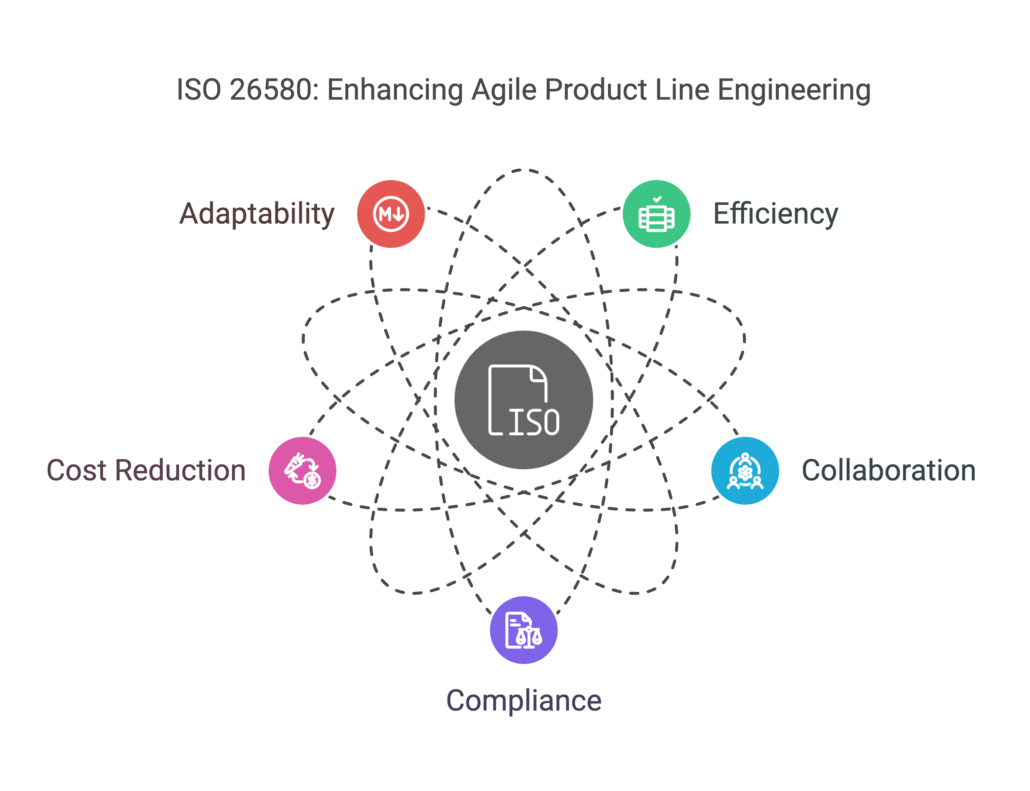
As industries shift towards mass customization and digital transformation, companies need robust strategies to manage evolving product lines efficiently. ISO 26580 helps businesses achieve this by:
- Enhancing Efficiency: Organizations can reuse core components across product variations, reducing duplication and accelerating time-to-market.
- Improving Collaboration: By integrating Agile methodologies, teams across different domains can collaborate more effectively, reducing silos.
- Ensuring Compliance: Many industries, such as automotive and aerospace, require rigorous compliance. ISO 26580 helps align Agile processes with industry regulations.
- Reducing Costs: With a structured approach to managing product variations, organizations can significantly cut development costs and resource expenditures.
- Increasing Adaptability: Agile PLE enables companies to quickly adapt to market changes and customer demands without overhauling entire systems.
Who Benefits from ISO 26580?
Industries that manage complex systems with multiple variations, such as:
- Automotive (e.g., different models of electric vehicles with shared software platforms)
- Aerospace & Defense (e.g., modular avionics systems)
- Medical Devices (e.g., regulatory-compliant software variations for different regions)
- Software Development (e.g., product suites with configurable features)
RELATED: Buyer’s Guide: Selecting a Requirements Management and Traceability Solution
Final Thoughts
ISO 26580 is a game-changer for organizations balancing innovation, compliance, and efficiency in Agile product development. By standardizing Agile Product Line Engineering, it empowers businesses to streamline processes, improve collaboration, and accelerate market responsiveness. For companies navigating complex product variations, adopting ISO 26580 isn't just an advantage — it's a necessity.
Note: This article was drafted with the aid of AI. Additional content, edits for accuracy, and industry expertise by Matt Mickle, McKenzie Jonsson, Mario Maldari, and Decoteau Wilkerson.