Tag Archive for: Requirements & Requirements Management Page 7
Tag Archive for: Requirements & Requirements Management
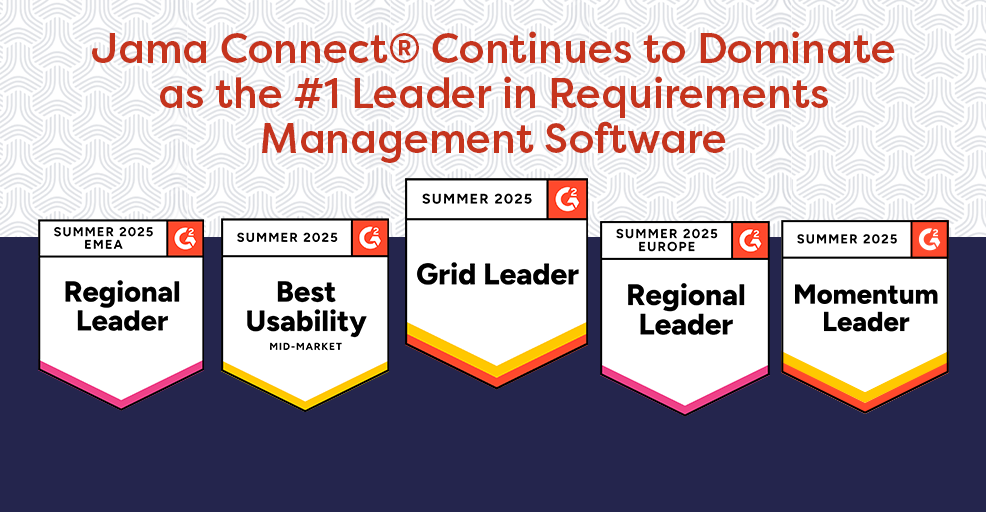
Jama Connect® Continues to Dominate as the #1 Leader in Requirements Management Software
We’re proud to share that Jama Connect has once again proven its excellence, securing the #1 spot in G2’s Summer 2025 Grid® Report for Requirements Management Software! This marks the sixth consecutive quarter that we’ve been named the overall leader, solidifying our position as the go-to solution for teams managing complex product and software development lifecycles.
This recognition, driven by the feedback and trust of our users, continues to place Jama Connect ahead of competitors like Polarion, IBM® DOORS®, and Codebeamer. It’s a testament to our commitment to innovation and customer satisfaction.
G2’s Grid Reports rank software solutions based on real user reviews, data from online sources, and analysis via G2’s proprietary algorithm. With this rigorous evaluation, the Summer 2025 report highlights the industry’s top performers, and Jama Connect leads the pack yet again.
For this quarter, Jama Connect achieved a customer satisfaction score of 97, accompanied by over 150 unique reviews praising our ease of use, unmatched collaboration features, and ability to streamline traceability across projects.
This quarter, Jama Connect didn’t just hold onto its top spot — we earned recognition across a wide array of categories. Here’s a breakdown of the accolades we garnered in the G2 Summer 2025 report:
Overall Leader
Momentum Leader
Small-Business Leader
Mid-Market Leader
Enterprise Leader
EMEA Leader
Europe Leader
These achievements underscore the versatility and scalability of Jama Connect, making it an ideal choice for teams of any size, across multiple industries and regions.
What Our Users Are Saying
We owe this success to the valuable insights shared by our customers, whose feedback drives us forward. Here are just a few highlights from recent G2 reviews:
“Jama Connect is extremely intuitive. Team members are able to use it immediately without any prior training. We do have a training program that is recommended for the entire team but that serves to show everyone how to take the best out of the tool.” – Alexandre, Systems Engineer, Mid-Market
This recognition bolsters our mission to help organizations transition from outdated document-based processes to a modern requirements management platform. With Jama Connect, teams can achieve:
Enhanced clarity and accountability through real-time collaboration
Seamless traceability to manage requirements, risks, and test cases
Compliance with industry-specific regulations and standards
Our continued focus on innovation ensures that we meet the evolving needs of organizations navigating increasing product complexity and regulatory demand.
A Heartfelt Thank You
This milestone is not just our achievement but a shared success with our users. Your trust and feedback inspire us to deliver outstanding solutions that simplify your workflows and enhance your product lifecycle management.
Thank you for being part of this incredible journey. Rest assured, we’re committed to pushing the boundaries of what’s possible with requirements management.
The semiconductor industry is evolving rapidly, with growing challenges in managing System-on-Chip (SoC) complexity and expanding Intellectual Property (IP) portfolios. How can your team stay ahead while maintaining efficiency and collaboration?
In this webinar, Steve Rush, Principal Solutions Consultant at Jama Software, discussed how Electronic Design Automation (EDA) organizations can adopt a more integrated and controlled approach to IP and SoC management using Jama Connect®.
This webinar provides key insights and practical guidance, including how to:
Overcome critical challenges in scaling SoC design and managing growing IP portfolios
Implement more integrated and efficient workflows using Jama Connect
Achieve measurable improvements in collaboration, scalability, and development outcomes
Steve Rush: It’s a pleasure to be here today to talk to you about this subject. I’ve worked with many customers and prospects across many different verticals, and semiconductor is certainly a vertical that has its own unique set of challenges. This subject is kind of near and dear to a lot of the conversations that I’ve been having, so I really hope that you find this insightful.
In this webinar, we’ll address some of the challenges that many semiconductor design companies are facing when kicking off SoC projects, leveraging the IP that they’ve already developed. Hopefully the audience out there finds this timely and relevant. We’ll level set a bit on the challenge itself, and then discuss three strategies for scaling SoC projects, along with product administrations to support each strategy, and then we’ll wrap up with some Q&A.
First, let’s start with some definitions: IPs and SoCs, what are they? What do we mean? IP cores, sometimes called IP blocks or foundational elements for systems on chip design. They’re really modular building blocks that are designed and purpose-built, and can be compiled to develop an SoC. An SoC, the system-on-chip, is an integrated circuit that comprises all of the system components onto one piece of silicon, which is made up of different IPs.
Our SoC here contains a processor core, a memory IP network on chip, and then multiple IPs themselves, which in and of themselves might be considered projects. When we zoom in to a particular IP, you can see the multiple components of that IP: the microcontroller that acts as the brain of the IP, designed to perform specific tasks and hold processing instructions. The ROM and SRAM, read-only memory and static access memory, are the internal communication fabric, the on-chip network, controlling multiple components, interrupts, controlling electrical current flow, the IO interface, and the input-output interface, which allows IP to communicate to the outside world.
You might be managing this information in a Jama Connect project for an IP core, multiple projects for multiple IP cores, or even multiple versions of those IP cores, depending on your version management strategy. Now that we’ve level-set a bit, let’s move on to some relatable challenges that you might have found yourself in. As semiconductor companies scale, individual IP projects need to be combined onto a single piece of silicon, these SoCs. As we saw in the last slide, different IPs may need to be combined to compile and build that SoC.
Organizing and tracking which IP, and importantly which versions of those IPs, which might be scattered across multiple repositories following different processes, can be daunting. You can imagine if you’re not using a system like Jama Connect, that might require a lot of manual effort, a lot of copy and paste, a lot of data reentry, and that can feel chaotic. For folks out there that are not using Jama Connect or just don’t have a well-defined process in Jama Connect, you might be relying on a lot of institutional knowledge when the time comes to compile these different IPs to build your SoC.
Rush: Maybe your lead engineer knows which versions of the IPs you need to use, or what third-party software licenses you need to monitor and update, but it’s just not well-documented. You don’t really have a system in place to manage all of this. If someone walks out the door, a lot of that knowledge walks out the door as well. Of course, you do what you can to capture that knowledge, and do a knowledge transfer, but it’s still just a very fragile system that you’re relying on.
Maybe you do have some semblance of a system, but it lacks consistency and unification. The IP core requirements are maintained in different systems, maybe different requirement management repositories. Maybe they’re just documented on Wikis, like Confluence, which comes to mind, but there’s no unifying data model. Without that, this creates traceability risk when you recompile everything to build your SoC project. How can you be sure that you’re completely covered and you have no traceability gaps?
Now, I’m not advocating that everyone has to follow the exact same process down to the T. Some level of autonomy might be necessary for different teams managing different SoC projects, and that is necessary, but there should be some unifying model and some unifying process that teams can follow to address these different gaps and risks. Here’s a slide that might resonate with you all. The current challenges you might be facing, the impact of those challenges, the goals, and business outcomes are all sort of documented here.
This represents a cross-section of a lot of customers and prospects that I’ve been talking to in the semiconductor design industry. The strategies that I’ll discuss and impart today speak to both of those personas: a prospect that’s not using Jama Connect or an existing Jama Connect, that just needs to scale up and optimize their use of Jama. Let’s look and talk about some of these challenges. Customers need to scale SoC management on Jama Connect.
Scale, that can be a vague and overused term, but what I think about when I hear this is that customers are really looking for control, a plan, and a tool with the right functionality to help them manage this complexity. Versions of IPs are scattered across multiple projects or systems. A couple things come into mind right away here: that immediate clarity when it comes to either applying a change, or resolving a defect, or figuring out what third-party software is being used for which project or product, it just is impossible.
Rush: Future projects are coming down the pike, requiring reusing out-of-context IPs for in-context SoC projects, possibly needing to maintain both the out-of-context IPs and then the new in-context IPs, which make up the SoC. Again, a plan, a process, and a tool are needed to support this. Let’s discuss some of the impacts of these challenges. Disorganization, because you need to manage content across projects or potentially across systems, there can be just a lot of lost time, a lot of lost hours in terms of re-documenting things, and just generally a lot of confusion.
There can be traceability risks, especially if the data that you’re managing does not have a unified data model, or that data is just not integrated across systems. How can you be sure there are no traceability gaps? Future projects just take longer to spin up, because there’s a lot of rework. Yes, you can save that content as and work from there, but syncing those changes across the different copies that you’re making at scale just really isn’t possible without a tool like Jama Connect.
Let’s talk about some of the goals that we hope to achieve by adopting some of the strategies that I’ll outline. We want to scale SoC management, and again, what I think this means is developing a plan, using a tool that can support these use cases, and implementing a controlled yet flexible process. Leveraging libraries and variants to compile your IPs for reuse. This will be one of the strategies that we’ll discuss later on.
Immediate version clarity, both for software licensing and defective change management, and applying those changes across different projects in a scalable way, which leads us to the outcomes. What we hope to achieve by adopting some of these strategies we’ll streamline SoC projects coming down the pike by using and leveraging existing IP in a controlled and organized method. This will give us high-quality source control, using a library approach in Jama Connect, so that defects and changes can be applied to working projects at scale and easily.
Maintaining licensing becomes clearer in this library-managed system, and the path to regulatory compliance can even be eased, as with all the processes we’ve adopted, traceability risks can be mitigated and reduced. A look into live traceability is possible, and we’ll unpack that a little bit later in the webinar today. You can increase time to value, manage change, and increase product confidence with all of these strategies.
Ultra Maritime UK Enlists Jama Connect for Naval Systems Requirements Management
UK operation chooses Jama Connect for its ease-of-use and administration.
About Ultra Maritime UK
Founded in 1944 and acquired in 2021 by Advent International
Over 2,300 employees across fifteen locations worldwide
Premier provider of undersea warfare systems, products, and solutions to US, UK, Canada, Australia, and allied navies worldwide.
CUSTOMER STORY OVERVIEW
This customer story is about Ultra Maritime UK, a division of Ultra Maritime, which develops equipment for surface, subsurface, and unmanned platforms, including acoustic and sonar systems and torpedo defense and radar sensor solutions. Customers include the Royal Navy of the UK, the U.S. Navy, the Royal Canadian Navy, the Royal Australian Navy, and the Indian Navy.
Since the Ultra Group’s acquisition by U.S. private equity firm Advent International in 2021, Ultra Maritime has operated as an integrated company with lines of business headquartered in the USA, UK, Canada, and Australia, responsible for developing both worldwide and localized solutions.
Ultra Maritime UK’s products and solutions must adhere to the highest quality, security, and safety standard,s including ISO 9001-2015, ISO 14001:2015, ISO/IEC 27001:2013, and ISO 45001:2018. In addition, the products must satisfy customer requirements and regional naval standards, including U.S. DoD/MIL-STD and UK MOD DStan.
Challenges
Enabling collaborative remote working on requirements
Managing both project and product requirements effectively
Becoming more product-focused to balance global and local requirements
Evaluation Criteria
Intuitive user interface for quick adoption
Low administrative overhead
Support for reuse of requirements and test evidence
Outcomes
Consistency across projects
Business mandatory requirements tool for all new projects
Quick user adoption with minimal training
Easy tracking of progress with dashboards and standardization
Reduced risk with pre-built standardized project structures
Easy management of large numbers of objects and changes
Easy initiation and completion of reviews to action items sooner in development
After years of managing project requirements with IBM® DOORS® Classic, these challenges drove Ultra Maritime UK to find a user-friendly collaborative tool that would enable them to increase their requirements management effectiveness and deliver projects faster.
Enabling collaborative remote working on requirements
Managing both project and product requirements effectively
Becoming more product-focused to balance global and local requirements
EVALUATION CRITERIA
Ultra Maritime UK identified several requirements management tools as potential replacements for DOORS Classic, including Jama Connect, which a member of the engineering team suggested. They then established criteria to be used for the evaluation.
Intuitive user interface for quick adoption
Low administrative overhead
Integrable with development and test software tools
Support for reuse of requirements and test evidence
First, a top priority was for the new solution to have a modern, intuitive user experience for teams to get up and running quickly with their new projects. They needed software that people would want to work in. Otherwise, people might opt out of using the tool and work in disparate documents, which would introduce risk, impede productivity, and hamper efficiency. Second, it would need to have low administrative overhead that did not require team members to become full-time administrators. Third, it would need to be integrable with development and test software tools from different vendors. Fourth, it would need to support the reuse of requirements and test evidence from past development programs when starting new products or projects.
During the evaluation process, Jama Connect stood out from the competition as the solution that would best meet the company’s needs. “Looking at all the features, the user’s ease of use, and the low level of administrative time required, Jama Connect came out on top compared to the other tools reviewed,” says the Senior Systems Engineer.
In its search for a modern solution that would be quickly adopted, Ultra Maritime UK found that Jama Connect’s intuitive user experience made adoption extremely easy for engineers to get started managing requirements and test evidence more efficiently and intelligently. Tracking and finding information quickly and easily was achievable with Jama Connect’s powerful filtering and the ability to add hyperlinks to any architectural elements, requirements, test items or other objects. In addition, the ability to create a Definitions database and Glossary in Jama Connect was particularly useful for getting everyone informed and up-to-speed about projects. “Jama Connect has a highly intuitive user interface and allows for engineers to quickly and easily become accustomed to using it,” says the Senior Systems Engineer.
Having a simple and quick way for systems engineers to initiate reviews and for stakeholders to complete their reviews in a timely manner was a key area where Jama Connect’s Review Center led the way. The fact that reviewers were not required to be licensed as full-time users made Jama Connect more attractive. “Jama Connect certainly makes it much easier to initiate and manage reviews and be aware of progress through them,” says the System Design Authority and Functional Lead.
“Jama Connect proved to be extremely useful for making sure that we’ve got complete coverage and traceability of a given set of artifacts to see which ones have or haven’t reached the approved step. This helps ensure we haven’t missed any anomalies such as system requirements missing verification cases to avoid rework,” says the System Design Authority and Functional Lead.
Support for multiple IDs for the same object in Jama Connect made it easy to identify opportunities for reuse of older product requirements and test evidence for new products to efficiently manage shared elements of core and variant products. “The ability to identify, distinguish, and reuse global requirements across products and projects to reduce development time and cost is a strength of Jama Connect,” says the System Design Authority and Functional Lead.
In addition to product capabilities, team expertise, and training resources provided during the evaluation demonstrated that Jama Software would be a good fit as a partner for Ultra Maritime UK. “We were impressed by Jama Software’s responsiveness to our questions and the online training, forums, and support available to our team,” says the System Design Authority and Functional Lead.
Simplify Airborne Systems Lifecycle Milestones with Categories
Gain Clarity, Reduce Risks, and Stay Compliant.
Struggling to keep track of deliverables across complex aerospace projects? You’re not alone. Managing deadlines and milestones often feels like navigating a maze of documents, spreadsheets, and shifting priorities.
In this webinar, you’ll discover how Jama Connect®’s Categories feature can bring order to your milestones, improve transparency, and align deliverables with key compliance standards like ARP4754.
What You’ll Learn:
How to Enable Categories: Simplify system development milestone tracking from start to finish.
Clarity on Deadlines: Learn how to make engineering deadlines easier to understand and act on.
Improving On-Time Performance: Organize milestone deliverables and optimize workflows to avoid delays.
Compliance Alignment: Map development milestones to standards such as ARP4754 with ease.
VIDEO TRANSCRIPT
Patrick Knowles: I’m Patrick Knowles. It’s great to meet all of you. Today, we are going to be looking at simplifying airborne systems, specifically lifecycle milestones, by using Categories in Jama Connect. As I mentioned, my name is Patrick Knowles. I’m a senior solutions consultant here. And it’s just a pleasure to work with y’all. I’m in our aerospace and defense vertical, so my expertise comes from that within the industry. And now I’m happy to be sharing that with you all as I work through consulting, as well as webinars. Today’s agenda, we’re going to tackle really the core problem, the complex challenge of milestone deliveries. From there, I’m going to introduce this category’s functionality and features to all of you. If it’s something you’re familiar with, this will be a breeze. If it’s something new to you, I hope this is a great introduction to how it works.
Then we’ll talk about how you categorize information specifically with some best practices. So, for even those who are used to using Categories, this should be a refreshing little bit with maybe some new tricks that you can utilize. And then finally, we’re going to talk about deploying this to your collaborative teams, which is really critical. Because if the data’s Categorized on day one and then the data changes or new data comes in, your teams are going to need to know how to manage this, how to look at the information. And it’s going to help solve that complex challenge of milestone delivery and some of the issues that we’re going to talk about there.
So, this complex challenge, deadlines, and stress. There’s data everywhere. It’s disconnected, it’s disparate, it’s annoying. That’s the core root problem here. But to elaborate on it, engineering in the digital age can feel like a maze. There’s sometimes a lack of top-down visibility to deliverables. So, if you’re a program manager or a lead systems engineer or a chief engineer, you might struggle to see all the work that your teams are doing. And sometimes there’s a lack of bottom-up visibility to the milestone. So, if you’re an engineer, you might not know about what milestone comes next, what’s due at that milestone. A lot of the time, that information is on a Word document or an Excel sheet, or maybe a Confluence page at best, where it’s listing out everything that’s due, but it doesn’t inherently connect to anything that is due and what those exact bits of information on.
And that leads to some unclear methods for contributing. How do I, as an engineer, ensure that we’re going to meet this deadline? I know what I see on my scrum board or I see from my manager, or whatever it might be, but maybe at the end of the day I don’t really understand exactly how my little bit of data is getting into that greater picture for this delivery to our customer or to our internal stakeholders. And then, of course, the common issue is always that data is disconnected, but that’s what Jama Connect is here to help with. We’re here to help you guide through that maze and to connect your data together to solve these key issues.
So, the risky scenario here is that your data is disconnected from a milestone, and that maybe you forget to deliver a certain part of the data, or you deliver outdated bits of data, or anything else that might happen there. And it’s pretty common across engineering. It doesn’t really matter where you work, there’s always this struggle to get everything ready from pencils down to delivery or whatever it might be. There are bigger views related to all of this work. There are stakeholders, customers, and, of course, the program leaders who need to see this information. And they need to see the most up-to-date, correct information. And without a clear way to connect your requirements specifically, because that’s what we’re going to mostly talk about here, is requirements. But without a really clear way to connect your requirements to your milestones or the rest of your data to milestones, you run the risk of simply leaving things behind.
Knowles: So, how can Jama Connect help? Well, the specific use case we’re going to talk about today is enabling our Categories functionality in the tool. And we’re going to line it up with milestones from regulatory documents. Specifically, this example is going to be based on ARP4754B. However, if you are running the NASA systems engineering life cycle and you know the milestones in there, you could also line this up to that or any other number of product lifecycle milestones. We’re going to categorize data directly into things. And that’s going to help you really line it up to each of these listed items over there in the screenshot on the right. And then your members of the team are going to be able to filter, and view this data, and see it grow and add to it. And it’s going to be very transparent for them, how they’re connecting their information to the greater milestone.
With our foundation laid, there on what the problem is, I want to talk more about what Categories are. So, what exactly is a Category? Why do we believe this is a great option for you and the team to try and enable within your tool? Specifically, Categories have a similar feel to some other features within Jama Connect, like tags and pick lists. However, Categories win out overall with this specific use case for a number of reasons. First and foremost, Categories are admin-enabled and controlled, so your general user can’t populate a Category. They can assign information to a Category, but they can’t create new ones. Which means that, unlike tags, this is a kind of configuration managed by your admins. Pick lists are also configuration managed by your admins. However, they aren’t globally accessible to all item types. You’re going to have to create a field for every single pick list that you want assigned different item types.
Categories, however, can be globally applied to an entire project or to the whole instance of Jama Connect. That means that you don’t have to go and assign them to each of your item types. They’re going to connect to folders. They’re going to connect to texts. They’re going to connect with your specific requirement types, whatever it might be. And so, that’s an advantage that Categories have. Also, Categories can be available across multiple projects or just one specific project, which helps if you have a kind of multi-layered approach to your Jama Connect development of requirements. Finally, I’ll explain why not to use tags and pick lists. Tags, again, are creatable and by the user, and prone to error. If you type a capital letter in the wrong spot or put the wrong vowel in the wrong place, that’s going to be there in perpetuity, unless you have really strong tag cleanup processes.
And pick lists and multi-selects, you have to create it for each item type. You have to maintain the pick list. And then if an item type is introduced to a project, you’re going to have to re-add that pick list to it, and so on and so forth. So Categories is a little broader, but also just as controlled. And so, you’re able to kind of manage in a smoother way. So, how do you set up Categories? Well, you go to admin, Categories. And then over there on the far right of the screenshot, you’ll see enable Categories is turned on. It’s defaulted off for most instances, so make sure you turn it on first. From there, we’re going to set up all the Categories you see in front of you on the screenshot, as well as any number of other Category you may want to enable.
Knowles: Now, once you’ve got everything enabled, it’s all about how do you Categorize the information. So, we’re going to walk through some instructions, some best practices, and then we’ll do some demonstration, of course, here at the end of this section of the slides on how you do all this work. The first thing, like we mentioned, is enabling Categories. You do that through the admin. You assign things to either projects or global within your Jama Connect instance, and then you start utilizing them. One of our best practices here is to manage Categories through logical organizers, so folders, sets, components. That allows you to then click into the list view of that logical organizer and then assign all the Categories to the items within it. You don’t have to do this. This is just one of the more efficient ways, especially if you’re enabling an architecture-forward approach within your database. And of course, you can manage Categories in bulk, otherwise this whole explanation wouldn’t make much sense.
So, some of the tips, tricks, and best practices. Here, we’ve got the managing in bulk. And I’ll show you how to do that live. We’ll view categorized information in the exploratory via a filter, and so we’ve got to set up filters. Of course, those same filters can be exported or sent to reports, and then you can use multiple Categories on the same item. So, if one item is going to be delivered at the first milestone and you want to continue to deliver it at the next milestone, you simply add both Categories to it. And finally, you can always create baselines of everything filtered. So, these filters that we’re going to use to shrink down and narrow down the exploratory are also going to be very, very useful for baselining, for exporting, and for a number of other things.
So, now it’s time to demonstrate some of these best practices. The first things first is enabling Categories. As we discussed earlier, there’s this enable Categories button here on the far right. Once enabled, you’ll be able to add Categories with the add button here. Doing that is as simple as populating a single field with the information and hitting add. I, of course, have the whole system ddevelopment phase added already, and so I want to show you exactly what that looks like, how these things got nested underneath each other, and so on and so forth, by adding an eighth step. So, for today, the webinar phase is what we’re going to add to our development phases here. When we add, it’s going to actually add it at the top level. And so, then we need to drag it down into the system development phase.
We are going to use the move functionality here, as that’s the best practice in this scenario, where the copy Category functionality is better for using this for variant management. Now you can see that the webinar phase has been added to the system development phases. And you can also see that the system development phase is a project Category. This was done by managing access here on the right side, where you can pick the specific projects you’d like this Category to be assigned to. Or if this is something you want globally accessible, you can use the globally accessible button here. When you hit that, you’ll see that it turns orange and has a globe, instead of the project specific icon that you saw originally.
Now let’s look at how we categorize information within the tool. Our screenshots were showing this functions portion of this project, and so we’re going to dive into that to continue the continuity of this example. This specific set here, we’ll view the details of it, and we’ll simply scroll down and manage Categories. So, if we wanted to add that eight system development phase, webinar phase, we’ll simply select it, and click add and it will be added to this set of information. From there, we can bulk edit everything underneath the set by selecting all the items and clicking manage Categories. Same pop-up shows up, and we’re able to add that eighth phase of the lifecycle.
Now, this is really, really fantastic. If we want to go see everything in the eighth phase of the lifecycle, we can select the Categories feature over here. We can expand our system development phase and select webinar phase, where we see the items that were added there, including the set up here, and are able to kind of view this information in the list view. Now, if we wanted to see this in the explorer, we would go to filters and we’re just going to rely on this pre-built one here. And we’re going to right click apply filter to explorer. This is going to show us the information in a more succinct way. And we’ll talk more about this as we go on.
Knowles: Now that we’ve looked at how to enable Categories, we want to talk about how we develop this and deploy this data and these Categories for your collaborative team. I talked a little bit about this and showed you these exact steps here to narrow down your explorer tree, but what really is the benefit here? Well, you can set up a simple filter that’s based on the Category itself and right-click apply that filter to the explorer. This lets teams see just the information they need to care about coming up, especially if your sets, components, and folders are all categorized. This will show a team that, hey, we need to make sure all of the aircraft functions are populated for this coming milestone, because that set is there. Same with the aircraft validations, the requirements, and the plans and assessments.
Each of those logical organizers are categorized, showing the team this is something that is due at the upcoming milestone. The team then will populate information underneath that and they will categorize those items as well to bring them into the overall filter. Now, public filters are just kind of one of the ways we want to see this deployed to the team. We also need to demonstrate to the team how do you bookmark the filters, and how do you even manage Categories in general? So, in the next step here, I’m going to demonstrate managing Categories for single items, as well as a couple other little nuances within the tool that the teams will need to understand as they go ahead and use this in the deployed environment.
When deploying this information to the teams, it’s really critical that you’ve set your filters to be public. A quick way to note if something is public is if it’s got the asterisk next to the name here. You can always right-click and edit your filter and click the make public, and that will denote that it is public to all users using this project. Once your filters are all built out, you’re going to have them there. You’re going to teach your users exactly how to use them, of course, with the apply filter to explore. But also, if they need to send these for a review and get signatures on them or add a baseline, there’s also these features available to them.
And of course, bookmarking is really, really critical. Without it bookmarked, you can see I’m now missing phase one, so I have to go to all, and then go find phase one, and add it to my bookmarks and it’ll now show up in my bookmarked section here. Users most of the time are going to be adding new items to the tool. And so, if we add a new item here, we’re going to populate this new item, a new item for webinar. And that’s going to be our example item here to show that once we’ve saved it, this is when we get to add the Categories. It’s not a field that’s available directly when editing a brand new item. It shows up after the fact here down at the bottom with the managed Categories button.
You’ll then grab the applicable Categories that you want to add to this item, save it, and you’ll see them here. This helps, and it automatically adds things to the filter. You’ll see here that we’ve gone up in the number of items, and our new item for the webinar right here is now part of the filter automatically. Additionally, you can show your users that they can come directly here in the category section to see the same information, just without the filter and without some of those right-click functionalities that you get to see when you’re in the filter section. It’s been fantastic to work with you all today and show off these features in the tool.
Jama Connect Named as the 2025 TrustRadius Top Rated Winner in Requirements Management
We are thrilled to announce that Jama Connecthas been honored as a 2025 TrustRadius Top Rated Award winner in the “Requirements Management” category! This recognition underscores our commitment to delivering industry-leading tools that empower teams to efficiently manage requirements and associated processes. But what makes this achievement particularly meaningful is that this award is based entirely on the candid feedback of those who use Jama Connect in real-world scenarios.
Why the TrustRadius Top Rated Award Matters
The TrustRadius Top Rated Awards are among the most trusted accolades in the B2B technology space. Unlike analyst-driven awards, these honors are determined exclusively by verified customer reviews. To win, products must meet strict criteria, including a high volume of positive reviews, consistent high ratings, and a strong trScore, which evaluates reviews for quality, recency, and depth.
Earning this recognition signifies that Jama Connect excels in meeting the needs of our users, as acknowledged by the very people who rely on our solution to deliver remarkable outcomes.
Reflecting on the Value of Jama Connect
Jama Connect is a trusted partner for teams navigating complex development projects across industries. Whether it’s supporting product innovation in aerospace, ensuring compliance in highly regulated medical fields, or improving efficiency in agile software development, Jama Connect provides the tools necessary for collaboration, traceability, and success.
Here’s what some of our customers have to say about their experience:
“Jama Connect has the best UI compared to DOORS, Codebeamer, and [PTC Integrity]. It’s the clearest to use with the best usability. For example, making traces between requirements is as straightforward as clicking a button. The trace matrix view is highly configurable to show anything you need.” (Verified User, Medical Device Company)
“We are using Jama Connect to be more than just a requirements management tool – we are using Jama Connect as the single source of truth to contain not just the requirements, but also the why and how the system is the way it is. It helps us engage stakeholders, both junior and senior, due to its user-friendly interface.” (Chris Armstrong, Lead Systems Engineer, JFD)
“We use Jama [Connect] for centralized requirements administration of sector-wide projects and development. The intuitive review module and quick-marking features make managing requirements seamless.” (Verified Professional, Oil & Energy Company)
At Jama Software, we consider user feedback to be a critical component of our development process. We consistently listen to customers and translate their insights into actionable improvements. One reviewer highlighted this commitment, stating:
“We pretty much use it (Jama Connect) for the entire software development lifecycle and utilize its review/approval and baselining system for our controlled documents.”
Our agility and dedication to continuous improvement help ensure that Jama Connect remains a market leader to support evolving customer needs.
Why Organizations Choose Jama Connect
What differentiates Jama Connect is not just its robust features but the way it revolutionizes how teams manage the product lifecycle. By bringing stakeholders together and enabling clear, traceable processes, we make it easy for organizations to focus on outcomes, even in the most challenging and regulated environments. Key benefits include:
Live Traceability™: A hallmark of Jama Connect, this feature enables teams to maintain real-time visibility into the interconnections between requirements, decisions, and test cases, ensuring that everyone is working with up-to-date information.
Streamlined Regulatory Compliance: Simplify alignment with frameworks like ISO 26262 and FDA 21 CFR Part 11 using Jama Connect’s built-in templates and automated tracking.
Collaboration at Scale: Empower distributed teams with tools like stakeholder commenting, intuitive workflows, and export functionality to foster engagement and decision-making.
“The export tools to PDF and Word for our regulatory needs have saved us a ton of time. We use Jama Connect for risk management, validation, and planning. It’s well organized and helps streamline collaboration across teams.”
Winning the 2025 TrustRadius Top Rated Award inspires us to continue innovating and elevating the Jama Connect experience. We are actively working on updates that incorporate more automation, deeper analytics, and enhanced user experiences, helping customers tackle emerging challenges with efficiency and confidence.
We’re always listening to your feedback and using it to make Jama Connect even better. Our goal is to keep evolving alongside your needs and ensure it stays the go-to tool for requirements management.
Experience the Future of Requirements Management
This recognition solidifies why thousands of professionals trust Jama Connect to guide their projects to success. If you haven’t yet discovered what sets our platform apart, now is the time.
Whether you’re seeking to improve compliance, streamline product development, or simplify communication across teams, Jama Connect has the solution you need.
A Heartfelt Thank You
To our incredible community of users, thank you for making this milestone possible. Your trust and feedback inspire us to push boundaries and continue delivering tools that help your teams thrive. This achievement is as much yours as it is ours, and we look forward to supporting you for years to come.
Jama Software is always looking for news that would benefit and inform our industry partners. As such, we’ve curated a series of customer and industry spotlight articles that we found insightful. In this blog post, we share an article from AEC Business, titled “Construction’s Next Leap: AI as a Strategic Partner”, and written by Aarni Heiskanen and published on May 24, 2025.
Construction’s Next Leap: AI as a Strategic Partner
In this episode of the AI AEC Show, Aarni Heiskanen welcomes back René Morkos, PhD, the visionary founder and CEO of ALICE Technologies, to explore the latest advances in artificial intelligence for construction scheduling and project optimization.
The Shift: Generative AI Comes to Construction
Since their last conversation, René highlights the most significant change in the construction tech landscape: the rapid rise of generative AI and large language models (LLMs). These tools are fundamentally altering how project data is accessed, analyzed, and leveraged across the industry.
René explains how ALICE Technologies has embraced this transformation by developing two AI-driven scheduling agents. These agents don’t just generate optimized schedules—they can also interact conversationally with planners, offering insights into delays, critical tasks, progress updates, and more. This represents a leap from static scheduling tools to dynamic, intelligent collaboration.
One persistent challenge in construction is fragmented and unstructured data. AI offers a promising way forward. René points to solutions like Trunk Tools, which allow users to query entire project datasets in natural language—”Show me the change orders” or “Summarize this RFI”—without needing to manually sift through files.
This democratization of data access, powered by AI, is eliminating a long-standing bottleneck in construction project management.
A Platform for Optimization
René also discusses how ALICE’s platform not only helps plan construction projects but actively explores “what-if” scenarios—testing and comparing thousands of possible construction strategies. This simulation-based approach enables teams to reduce risk, save time, and improve project outcomes with confidence.
Looking forward, René envisions an increasingly automated construction planning ecosystem. As he puts it, we’re moving toward a future where the question is not just “what’s the plan?” but “what’s the best possible plan, and how do we know?” AI will provide the answers.
Takeaway: AI is not just a support tool—it’s becoming a decision partner in designing, scheduling, and executing construction projects.
Self-Hosted and Cloud: Flexible Deployment Options for Your Requirements Management with Jama Software
Efficient requirements management is vital for the success of any organization, especially in industries like aerospace, defense, and government, where compliance, security, and accuracy are paramount. Jama Software provides a sophisticated and adaptable requirements management solution, ensuring that your teams stay ahead in competitive and highly regulated fields.
But did you know that Jama Connect® isn’t only available as a cloud solution? Depending on your organization’s unique needs, you can also choose a self-hosted deployment option. This flexibility is the perfect answer for industries requiring strict data sovereignty, air-gapped environments, or regulatory compliance.
While Jama Connect is well-known for our cloud deployment option, we actually originated as a self-hosted product more than twenty years ago. And two decades later, we remain committed to delivering the best platform and customer experience for our self-hosted and cloud customers.
Curious about which deployment option best suits your business? This post will break down when to choose Jama Connect Cloud versus the self-hosted deployment. We’ll also answer frequently asked questions to help you make informed decisions.
When to Choose Jama Software Cloud vs. Self-Hosted
Jama Connect Cloud and Jama Connect Self-Hosted both empower effective requirements management. However, certain use cases demand one option over the other.
Jama Connect Cloud
Best for organizations that value ease of deployment, automatic updates, and seamless access. Key benefits include:
Automatic Updates and Maintenance: Benefit from the latest features and security enhancements without manual effort.
Anywhere, Anytime Access: Teams can access data on-demand, enabling global collaboration without roadblocks.
Cost Efficiency: Eliminate the need for large IT infrastructure spendings; we handle hosting for you.
Geographically Distributed Hosting: To ensure reliability and security, Jama Software hosts data in highly secure and strategic cloud locations. For customers in the US, we host data in Oregon, with a backup in Ohio. For EMEA customers, data will not leave the EU in line with GDPR. Two copies of the data is hosted in Ireland, with a backup in Germany. Jama Connect add-ons – Jama Connect Interchange™ and Jama Connect Advisor™ – can also be hosted in the US or EU.
Ideal for industries like tech startups, mid-sized enterprises, and companies prioritizing agility and scalability in requirements management.
Jama Connect Self-Hosted
Organizations working in highly regulated industries often need tighter control over their data. This deployment ensures robust security and customization on your own infrastructure. Benefits include:
Data Sovereignty: Maintain control of sensitive data and ensure compliance with local regulations.
Air-Gapped Environments: Operate without internet connectivity, ideal for sectors like aerospace and defense that mandate offline solutions.
Regulatory Compliance: Handle development processes under strict standards like ITAR, ECJU, and EAR.
Ideal for industries such as government, aerospace, and defense, where security and compliance are non-negotiable.
Jama Connect Deployment Options
Jama Connect ensures that your needs are met, whether you lean toward cloud solutions or prefer in-house deployment. Here’s how Jama Connect offers robust flexibility in deployment:
Cloud Deployment
Our cloud-based SaaS solution takes the burden of infrastructure management off your shoulders. It ensures faster setup, seamless updates, and scalability as your teams grow. Collaborate easily across distributed teams while we manage the heavy lifting of security and operational efficiency.
Self-Hosted Deployment
Need control down to the last detail? Self-host Jama Connect within your IT infrastructure. This option provides your team with complete autonomy over data, operational configuration, and security measures. Your infrastructure, your rules.
Do you have questions about configuring a self-hosted deployment? Our experts are here to help. Schedule a consultation to explore the best option for your business.
FAQ: Common Questions About Jama Software Deployment Options
Still not sure which deployment is right for you? Below are answers to some frequently asked questions.
Is switching between Jama Connect Cloud and Self-Hosted possible?
Yes, we offer migration support to ensure your data transitions smoothly between deployment types when upgrading or restructuring operations.
Do both deployments support compliance with industry standards?
Absolutely! Whether cloud-based or on-premises, Jama Connect supports compliance with requirements like ISO 26262, DO-178C, DO-254, and other critical regulatory standards. Your choice of deployment will not limit compliance functionality.
What level of IT support is required for the self-hosted deployment?
Self-hosted deployments require your organization to manage backups, updates, and server maintenance. However, we provide technical guidance to your IT teams to ensure a smooth setup.
Does the cloud option support multi-location teams?
Yes! With the cloud deployment, all team members, regardless of their geographic location, can work collaboratively without latency or access issues.
What security measures are in place for both deployment options?
For Self-Hosted: You’ll adhere to your internal security protocols (including CMMC security requirements) and configurations.
Jama Software Provides a Smarter Approach to Requirements Management
When it comes to requirements management, there’s no “one-size-fits-all.” Jama Connect adapts to your unique organizational needs, whether you need a hands-off cloud solution or an air-gapped, team-managed infrastructure.
Experience seamless collaboration, reduce compliance risks, and ensure stakeholder alignment across your organization with Jama Software. Are you ready to optimize your requirements management process?
Explore our deployment options and see how Jama Connect aligns with your vision of compliance, security, and efficiency.
Empowering Complex Medical Device and Life Sciences Development with Responsible AI and Machine Learning
Artificial intelligence (AI) and machine learning (ML) are transforming industries across the globe, and the medical device and life sciences sectors are no exception. Today, the development of complex medical devices is being accelerated and optimized with the integration of responsible AI. From enhanced product design to improved compliance and streamlined workflows, AI is allowing teams to accelerate their workflows.
This blog aims to explore the expected impact of AI on medical device development — including current industry trends, regulatory considerations, and how companies like Jama Software are empowering organizations to leverage AI responsibly.
Types of AI Medical Devices
AI medical devices are rapidly transforming healthcare by introducing advanced diagnostic, therapeutic, and monitoring capabilities. Among the 950 AI-powered medical devices currently identified, several core categories stand out:
Diagnostic Tools: AI-driven diagnostic devices are designed to assist in identifying diseases and conditions with greater accuracy and efficiency. These include imaging systems equipped with machine learning algorithms to detect abnormalities in X-rays, MRIs, and CT scans, as well as AI software for analyzing pathology reports or genetic data. Such tools are especially beneficial in early disease detection, reducing diagnostic errors, and improving patient outcomes.
Monitoring Devices: Another significant category is AI-enabled monitoring devices. These systems continuously track patient vitals, such as heart rate, blood pressure, glucose levels, or oxygen saturation, and can alert healthcare providers to early warning signs of complications. Wearable sensors and remote patient monitoring platforms powered by AI are playing a crucial role in providing real-time health insights, especially for chronic disease management.
Therapeutic Systems: AI-powered therapeutic devices support or enhance treatment strategies. Examples include robotic surgery platforms with AI for precise surgical execution, as well as AI software that tailors treatment plans using patient-specific data. These systems are helping doctors optimize therapies and deliver more effective and personalized care.
Decision Support Applications: AI-based decision support tools are designed to assist clinicians in making informed decisions. These devices analyze vast amounts of medical data to provide evidence-based recommendations or predict potential complications. They are widely used to guide treatment strategies and manage complex conditions with a data-driven approach.
By focusing on these categories, it becomes clear that AI medical devices are not only advancing the standard of care but also addressing critical gaps in healthcare delivery through innovative applications of artificial intelligence.
Medical device manufacturers are leveraging AI and ML in several groundbreaking ways. The U.S. Food and Drug Administration (FDA) has already approved over 950 AI-enabled medical devices as of mid-2024. This reflects a dramatic rise over the past decade and highlights the growing adoption of AI technologies. Here are key areas where AI is making a difference in medical device development:
Current Regulations for AI and ML in Medical Device Development
While the potential of AI is evident the successful adoption of these technologies requires adherence to evolving regulatory frameworks. The FDA has been actively addressing the need for guidelines in this space, ensuring a balance between innovation and safety.
FDA Guidance and Regulations
The FDA oversees AI-enabled devices through various pre-market pathways, including:
Premarket Notification (510(k))
De Novo Classification
Premarket Approval (PMA)
To accommodate the complexities associated with adaptive AI/ML-enabled devices, the FDA has released multiple resources, such as the 2024 Artificial Intelligence and Machine Learning Action Plan, which outlines the agency’s vision for regulatory oversight. Key highlights include:
Development of Good Machine Learning Practices (GMLP).
Introduction of frameworks for Predetermined Change Control Plans, allowing for post-market updates to AI systems without requiring new approvals.
Enhanced transparency for AI-powered medical devices.
New FDA Guidance: To learn more about recent guidance provided by the FDA, read these two articles:
Beyond the U.S., regulatory developments in Europe, including the EU AI Act and MDR compliance, are impacting how organizations worldwide approach AI implementation in medical devices.
Staying compliant demands robust traceability, stringent risk management protocols, and adherence to data security standards.
Trends and Insights for AI-Powered Medical Device Development
The trajectory of AI in medical device development is poised to grow exponentially, driven by several key trends:
Shift to Software-Defined Devices
Medical devices are increasingly becoming software-centric. Traditional hardware is giving way to platforms that can be continuously enhanced through software updates.
Integration of Generative AI
Generative AI algorithms are now being used by medical device manufacturers to create simulations, generate testing data, and optimize device designs. Companies like NVIDIA are spearheading this trend with platforms supporting robotics and digital surgery.
Rise of Collaboration and Ecosystem Growth
Partnerships between MedTech companies, academic institutions, and tech giants are fueling innovation. Startups like Moon Surgical and Aidoc demonstrate how collaborations can lead to cutting-edge AI implementations in laparoscopy and diagnostic tools.
Broader Applications Beyond Radiology
While radiology remains at the forefront, AI is expanding rapidly into fields like:
Neurology: Detecting brain activity anomalies.
Cardiology: Spotting arrhythmias through AI-powered stethoscopes.
Oncology: AI-enabled tools for precision cancer diagnosis.
Jama Software’s AI Initiatives for Medical Device Development
With the rise of AI-enabled medical devices, Jama Software is focused on how organizations can incorporate AI applications in their product development processes to improve quality and accelerate development. Here are a few example use cases Jama Connect® is focused on:
Jama Connect Advisor™
Jama Connect Advisor analyzes your product requirements against industry standards such as INCOSE Rules and EARS Notation, then recommends improvements. This fast, accurate analysis and advice helps your requirements align with engineering-focused natural language and best practices.
Benefits of using Jama Connect Advisor:
Improves the quality, accuracy, and usability of your requirements across your organization.
Assists development teams in standardizing the process and language of requirement authoring.
Saves time for authoring, reviewing, and updating requirement statements.
Helps deliver programs and projects on time and on budget.
Reduces the risk of late-stage errors.
Test Case Intelligence
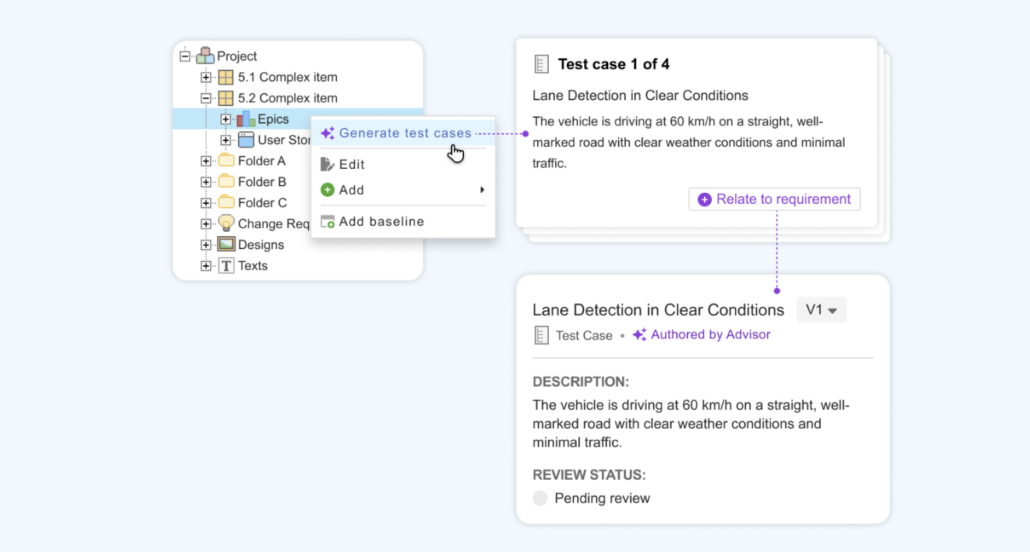
Streamline verification and accelerate to market with AI-generated test cases derived from requirements.
Intelligent PDF Parsing
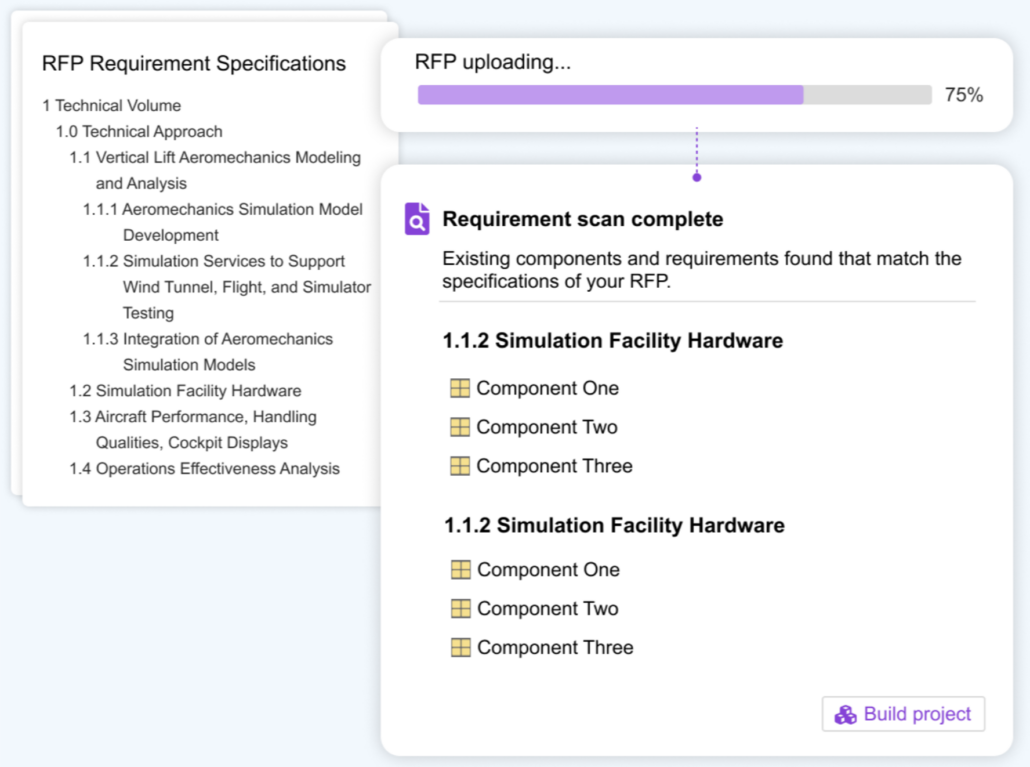
Quickly parse PDFs and Office files, match to existing IP, or generate new requirements for review and collaboration. AI enhances reuse, speeds RFPs, streamlines supply chain collaboration, and boosts product quality.
Integration of AI and ML is already accelerating and changing medical device development. From enabling groundbreaking technologies to revolutionizing patient care, AI is laying the foundation for the medical devices of tomorrow. However, success in this domain requires balancing innovation with compliance, backed by robust tools that alleviate complexity.
Jama Software’s AI solutions empower organizations to tackle these challenges head-on, reducing risks, streamlining workflows, and ensuring quality at every step of medical device development.
Want to see how AI can streamline your product development?
Book your free demo today and experience the power of AI in revolutionizing requirements management for medical devices.
Improve Traceability and Enhance Coverage with Live Trace Explorer™
Engineering teams today face growing challenges in maintaining requirement coverage, managing risks, and making informed, data-driven decisions, all while working with siloed tools and tight deadlines. Simply meeting the minimum traceability requirements isn’t enough to stay competitive.
Live Trace Explorer™ helps teams visualize end-to-end trace relationships, identify gaps, validate coverage, and ensure quality in real time. With advanced filtering capabilities, you can focus on what matters most to keep your projects on track, compliant, and aligned with traceability best practices.
In this session, host Francis Trudeau will show you how Live Trace Explorer enables engineering teams to visualize trace relationships, validate coverage, pinpoint gaps, and ensure quality, all in real-time. You’ll also learn how advanced filtering capabilities help you focus on what matters most, while aligning your traceability practices with industry best practices.
What You’ll Learn:
The vision behind Live Trace Explorer and its evolution
How to use filtering to enhance clarity, control, and support traceability best practices
Strategies for leveraging traceability to manage risk and ensure compliance
This is your chance to gain actionable insights, contribute to the evolution of traceability tools, and stay ahead in managing risk and compliance.
VIDEO TRANSCRIPT
Francis Trudeau: My name is Francis Trudeau, and I’m a Product Manager at Jama Software. I’m also a curious Scout leader who thrives in the great outdoors and enjoys a good story. Now, picture me as a hiker standing at the foot of a mountain, and that mountain represents the path of development, the climb towards a vision that guides our every step. My specific role is to give you a clearer, elevated view, helping you navigate your projects from start to finish, measuring progress, and managing risks along the way. The summit of the mountain represents that ideal, managing the development process through data. In other words, making decisions based on available information, think metrics, graphics, trend lines, dashboards, etc. But like any true vision, it’s not just a destination. It’s a challenge. Can we even get there? Is there a taller peak hidden behind this one? That mystery is part of the adventure.
In today’s webinar, I invite you to tag along on this journey. I’ll show you the progress we’ve made so far, offer a glimpse of the path ahead and share how you can contribute to making this vision a reality. So we are set for a journey, and our first milestone along the way is the Live Trace Explorer, which is essentially a visual dynamic representation of the V-Model for evaluating coverage, addressing gaps and managing associated risks. Focusing on the diagram, each tile represents a component or set connected with trace paths. These paths are gray if there are no relationships between the items in adjacent tiles and they turn green and red to indicate the number of valid or suspect relationships between those tiles.
On the right side, the verifications and validations branch shows the number of test cases linked to items within the container on its left no matter where they appear in the project. At the bottom of each tile, you’ll find a metric representing the ratio of those test cases included in a test plan.
On the requirements side, the top part of each tile displays stats including the number of items by type and any open conversations. In the bottom half, you’ll find coverage metrics, essentially the ratio of existing relationships to expected ones as defined by the Traceability Information Model.
Overall, the Life Trace Explorer is meant to expose the coverage completeness as the ratio of existing over expected relationships and a measure of the validity of relationships by exposing a metric of suspect relationships between related items included in two adjacent tiles. By creating a diagram for a simple project, one can easily get a big picture of a project, spot gaps, and keep track of progress. Beautiful, isn’t it? Are we there yet?
Well, not quite. As we catch our breath and take in the view, it becomes clear that the view, while impressive, is a little foggy. We’ve reached a breathtaking lookout. The elevated view is structured, informative, even beautiful, but for many of the customers we’ve consulted, the information still feels cloudy. Yes, the coverage percentage and suspect indicators are valuable. They give us a sense of direction, but there’s a key limitation. The Life Trace Explorer currently measures everything without distinction. In real projects, not every item should count towards coverage. To get a metric that truly reflects reality, we need the ability to focus, to filter in only the relevant items and filter out the noise. Only then can we sharpen the view and get a clearer, more meaningful measure of completeness.
Trudeau: Let’s take a look at a few real examples customers have shared with us. The first one is about filtering out items that shouldn’t be included in coverage. For instance, many teams keep items in their project that were originally considered but later rejected. They’re still useful for historical context, but they don’t need to be part of the coverage calculation. The same goes for draft items. They’re still in progress and not ready to be measured yet.
The second example is about narrowing the scope. Sometimes teams want to measure coverage or track suspect links only for a specific slice of the project. A good example is when using prioritization methods like MoSCoW, where a team may only want to focus on must-have items.
Another example is when tailoring views for different stakeholders, say admins, primary users, or partners, and only showing what’s relevant to each group. Now, Jama Connect® is highly configurable, so these are just a few common examples. What matters here is that the filtering we’ve added to the Live Trace Explorer works with any picklist field and only picklists for now. So with that in mind, let’s jump into Jama Connect and see how it works.
Here we are in the ACME demo project. The Traceability Information Model or TIM flows simply from left to right, starting with higher-level needs, then moving down to requirements and designs. Each of these is validated and verified by test items. It’s a straightforward setup that follows the logic of the V-Model.
To begin, we’ll generate a diagram for the entire project and open the Trace Score™ calculator so we can keep track of the metrics used in the calculation. Our first filter will focus on the design items. Right now, we have three designs, and the coverage is showing 66%. Let’s take a closer look. In our project, each design has a status chosen from a picklist: draft under review, approved or rejected. One of them is currently marked as rejected. We’re going to apply a filter to ignore rejected designs. To do this, open the configuration settings, open the configuration applied to the specification tiles, click the funnel icon to set the filter, set the rule using the picklist field for design status, in the second drop-down choose is not equal to, then select rejected, set the filter, and apply. We now have two items instead of three. Coverage for the items that matter is 100%, and the Trace Score is updated accordingly. Also, notice the funnel icon. It shows that a filter is now applied to this item type in this tile.
Next, let’s move to the requirements. At ACME, we use the MoSCoW method to prioritize them. Suppose we want to focus only on the must-have items. We’d apply a similar filter as we did for designs. Here we have four requirement items, but only one is marked as must. Back in the diagram, we follow the same steps to set the filter. Before I hit apply, you can probably guess the item count will drop to one, but watch what happens with the suspect and coverage metrics. We now notice a clear coverage gap with the designs. On the verification side, test cases are linked, but they’re not included in a test plan yet. As for the suspects, there are three needs pointing to this must requirement, and one of those needs has changed, which makes the relationship suspect.
For our last example, let’s look at those needs. Each one is tagged with one or more user groups. Let’s say we only want to measure the needs relevant to partners. We go back to the configuration panel. Since this is a multi-select picklist, our rule options are contains and does not contain. We choose the content and select a partner. Before I hit apply, pay attention to the suspect links, the test metrics, and open conversations. See that all these related metrics are refreshed to only consider information from filtered items.
Trudeau: To wrap up, this configured filtered diagram gives us a Trace Score specifically for the partner’s needs, focusing on must requirements and excluding rejected designs. Finally, we can save this configuration, for example, as ACME for Partner, so we can return to it later.
That was a quick tour of how Live Trace Explorer filtering works, a simple, flexible way to sharpen your focus and configure what you actually want to measure. Now let’s talk about what’s next. Filters will be available to all cloud customers in Jama Connect 9.24 scheduled for release in the coming weeks. In July, Live Trace Explorer will be part of our customer-validated cloud rollout, and note that this version is based on Jama Connect 9.22, so filters won’t be included in that CBC release. For self-hosted customers, Live Trace Explorer with filtering will be available later this fall. Our team remains fully dedicated to the future development of Live Trace Explorer, and this includes further refinements on filters, specifically developing nested filters, supporting and or clauses for more than one filtering rule. Remember in the demo when I excluded rejected designs, what if I wanted to exclude draft or rejected designs? The nested filters will allow for this sort of logic.
Beyond these near-term improvements, we are exploring ideas inspired by customer feedback, ways to make Live Trace Explorer even more configurable and actionable. Driving action is about clicking a metric to drill into a filtered trace view, showing only items with missing coverage, suspect links or open conversations. Tailoring is about tailoring the diagram layout itself, hiding irrelevant tiles or reordering them for clarity or to reveal suspect status between different locations. We’re also looking beyond the diagram towards future metrics that can help you manage your projects with confidence.
When the team brainstormed avenues for the Live Trace Explorer, many possible metrics were envisioned. Trend lines over time to tell the story of your project and identify bottlenecks. Coverage gaps per item owner to visualize specific user. What about an item status breakdown? Is this worth monitoring? And what do you think of the relationship health for visualizing change and rework? Is a measure of aging for suspects interesting? What about test execution status? Not just test coverage? These are just a few examples, and of course, we’re always looking for more ideas, but the metrics that really matter are the ones aligned with your goals. I guess the question is, what do you want to manage? What do you want to measure?
Jama Connect is already helping teams bridge requirements and testing, but we want to support you further with insights that reflect your priorities, your goals, and your way of working, so here’s my invitation. Join us in this journey. If the idea of managing the development process through data resonates with you, if you’re excited about defining and evolving the right metrics, if you want a map and compass of your mountain climb, a way to see not just where you are but where you’re going, then let’s keep the conversation going. Reach out to your customer success manager, ask to connect with product management, and help shape the future of Live Trace Explorer and the tools that power your work.
Navigating the New DOGE Impacted FDA: How MedTech Companies Can Build a Competitive Advantage
The Center for Devices and Radiological Health (CDRH) is a key branch of the FDA that is responsible for ensuring the safety and effectiveness of medical devices. Companies interact with the CDRH through premarket submissions, quality inspections, recalls, and a variety of other activities.
In 2025, the Department of Government Efficiency (DOGE) was established to streamline federal operations, reduce redundancy, and improve cost-effectiveness across agencies. While its goals are rooted in efficiency, the implementation has led to substantial structural and operational shifts that will have a profound impact on the industry.
For companies developing medical devices, understanding these changes is essential for navigating the evolving regulatory landscape. This blog will help you learn all about those changes and provide actionable strategies to stand above the competition while navigating the new frontier.
One of the most immediate and highly publicized impacts has been a reduction in staffing. The CDRH has experienced layoffs, hiring freezes, and a mandated attrition ratio. These changes have affected teams working on new technologies, slowing down review processes and resulting in a reduction in internal expertise.
Budget and Operational Adjustments
DOGE reforms have also reduced discretionary funding, increasing the CDRH’s reliance on user fees from industry sponsors. This shift has created operational bottlenecks, particularly in areas not directly supported by these fees, such as early-stage innovation and public health initiatives.
Regulatory Process Reforms
With fewer staff and resources, the CDRH has had to adjust some of its regulatory workflows. It has been reported that pre-submission meetings are less frequent, and review timelines have lengthened. While the agency remains committed to scientific rigor, the capacity to provide interactive feedback has diminished.
Despite the challenges mentioned above, CDRH plans to continue advancing its strategic priorities. The FDA has released its 2025 guidance agenda which includes the following amongst a larger list of items:
Cybersecurity in Medical Devices: Updated guidance on quality system considerations and premarket submissions.
AI Lifecycle Management and Change Control Plans: Recommendations for predetermined change control plans.
Use of Real-World Evidence in Regulatory Decisions: Revised guidance to support regulatory decision-making.
Updated Q-Submission Program Guidelines: Updates to improve feedback and meeting processes for device submissions.
These initiatives reflect CDRH’s ongoing commitment to modernization, even amid structural constraints resulting from DOGE actions.
In another move to improve efficiency and modernize the agency, the FDA has begun using Elsa, a generative AI tool to assist in the scientific review of medical device submissions. This tool will help automate repetitive tasks such as document parsing and data extraction, allowing human reviewers to focus on more complex portions during the evaluation. The rollout is expected to be complete by mid-2025, with early results showing promise in reducing review times and improving consistency.
Proven Strategies for Navigating the Changes
For those in the medical device industry, these changes present both challenges and opportunities. Companies that embrace the changes and take a proactive approach to interacting with the FDA will find themselves at the forefront of the new era.
Here are some key approaches to consider:
Prioritize Proactive Regulatory Planning: A clear and complete regulatory plan is a vital piece of every new product development project. It will be especially important now as you should prepare for longer review times and less interaction with reviewers. Build extra time for regulatory approvals and work with regulatory consultants to anticipate and address obstacles.
Maintain Clear Communication with the FDA: Given the FDA’s reduction in resources, clear and targeted communication is more important than ever. Leveraging the FDA’s pre-submission program allows you to gain valuable insights early in the submission process. Regular interaction will help build rapport with the agency while addressing concerns before they delay approvals.
Collaborate Across Teams to Document All Product-Related Information: Interdepartmental alignment is critical when interacting with the FDA. Your product development, QARA, and manufacturing teams must communicate effectively to address compliance needs and streamline decision-making. Working together to tell a cohesive and complete story about your device will be imperative when interacting with reviewers. It will be especially important in the future as AI tools may flag inconsistencies or gaps more rigorously than human reviewers.
Leverage Digital Transformation: Investing in digital tools is no longer optional for medical device product development teams. Modern platforms help teams track requirements, manage testing, and maintain documentation seamlessly. Digital platforms also ensure traceability, streamlining compliance audits, and reducing risks of regulatory missteps. Additionally, automated workflows and AI-powered solutions can reduce manual effort and free up critical resources to do what they do best, designing life-changing technologies.
When navigating regulatory pressures, Jama Software is the trusted partner MedTech companies need. Our platform empowers organizations to overcome compliance challenges while maximizing efficiency. Here’s how Jama Connect will help you navigate the changes at the FDA:
Simplify Regulatory Compliance: Jama Connect® simplifies compliance with FDA regulations by providing complete traceability throughout product development. Built-in templates for ISO 13485, ISO 14971, and FDA requirements help teams comply effortlessly with the regulations.
Reduce Submission Errors: Errors in FDA submissions can lead to costly delays and loss of potential revenue. Jama Software’s traceability matrix ensures all requirements are accounted for and verified, reducing the likelihood of mistakes that can delay review times or even result in resubmissions.
Accelerate Time-to-Market: Our real-time collaboration and requirement management tools optimize project workflows, reducing rework and enabling faster decisions. This means your products reach the market sooner, even when facing FDA review delays.
Improve Risk Management: With Jama Connect’s risk management capabilities, teams can capture failure modes and hazard analyses for medical devices, ensuring adherence to safety requirements under FDA guidelines.
Stay Aligned Across Teams: Jama Connect’s centralized platform fosters alignment between engineers, designers, and quality assurance teams. Eliminate silos, improve team collaboration, and keep every stakeholder fully informed at all stages of development.
Create a Competitive Advantage in the New Era of MedTech: The DOGE-era FDA brings unprecedented change to the MedTech industry. With the right strategies and tools, your organization can turn these challenges into opportunities to build resilience, operational efficiency, and create a competitive edge.
To streamline product development, tackle complex compliance requirements, and stay ahead in the fast-evolving MedTech landscape, consider partnering with Jama Software. Curious how Jama Software can help your team thrive? Learn More Today.
![[Webinar Recap] Managing System-on-Chip (SoC) Complexity: Strategies for Scalable Design](https://www.jamasoftware.com/media/2025/07/Managing-System-on-Chip-Complexity.png "[Webinar Recap] Managing System-on-Chip (SoC) Complexity: Strategies for Scalable Design")