
Engineers rely on established processes, checklists, and other methods to ensure compliance to industry standards throughout product development, starting with how requirements are written and reviewed. This reliance is due, in part, to required standards and regulations that enforce specific, auditable processes.
In regulated industries, such as aerospace and defense, this manifests itself in DO-178C, DO-254, and MIL-STD-882E . Government agencies, regulatory bodies, and internal auditors rely on documented evidence for smooth and thorough audits, and to assess compliance to applicable standards.
How Do Teams Accomplish Compliance Today?
Nominally, teams record compliance in a number of small unique ways. For some, this is done manually through large spreadsheets or shared documents. For others, this is through documents saved in PLM tools associated with different gates or milestones. The common theme is that these processes are not inherently tied to the source of truth for the data in question.
The Problem With Disconnected Compliance Data
Unfortunately, nearly everything is disconnected in modern tooling with respect to large compliance efforts. During my career, I have seen teams build extremely custom documents, scripts, and tools to help guide the overarching process. But even with those dedicated and custom approaches, the live data is not tied directly to the compliance result. Beyond just the time to create the custom functionality, teams also spend enormous numbers of hours reviewing, fixing, and finalizing this data. Typically, all this time is done all at once, at the end of a milestone or gate period.
How Late-Stage Compliance Findings Lead to Rework
Completing compliance at the end of a cycle leads to rework. Not only are teams spending time customizing and completing the review, but they are also susceptible to hours of rework from late finds in the lifecycle. Had the work been reviewed during development, the rework and associated efforts would be smaller and reduce downstream fallout.
How Failed Compliance Efforts Put Programs at Risk
Rework, unfortunately, does not just end with the re-engineering of the product. In fact, more often than not, it leads to teams failing audits. Meaning the whole product development effort is delayed, rescheduled, and in some cases cancelled.
How Can Teams Avoid the Fallout?
Much of this sounds like doom and gloom, and much of it truly is. So how can teams avoid such tough situations? The core answer is, connect your data. The most successful custom approaches I have come across in my career are as connected as possible. They still miss the mark on being truly connected to live data, but they are close.
Connecting Live Data With Live Traceability™
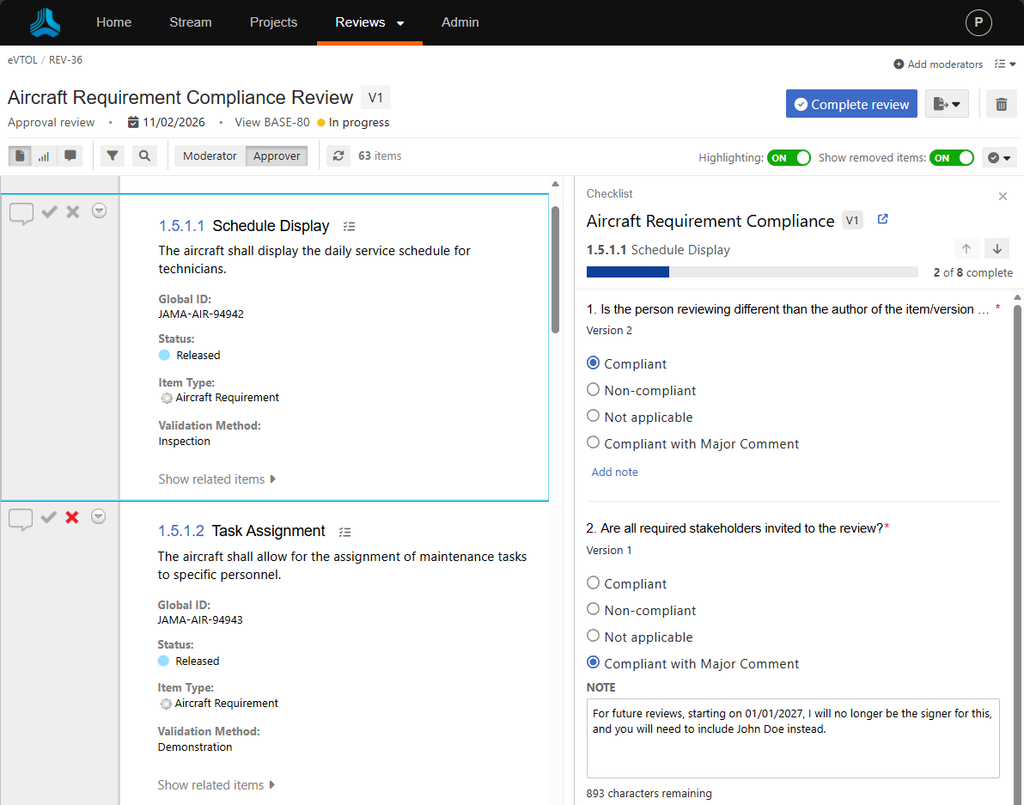
Connected live data means that the source of truth is also home to the final compliance result. Jama Connect® now includes this exact functionality. Through a combination of the Review Center and Live Traceability (TM), teams can now see the full lifecycle for a compliance effort. Tying checklists directly to requirements, verifications, and other artifacts within Jama Connect allows teams to actively keep everything up-to-date and in-sync.
Early Identification of Engineering and Process Issues
Keeping compliance data aligned with the current baseline allows issues to be identified early. Whether that is a non-compliance in the design or something else, teams are able to see that right when it is identified. This means no more waiting until a week or two before a gate review. This also means no more rushing right at the gate to get something fixed. Work is iterated regularly, and issues are ironed out immediately.
Simple and Informative Metrics
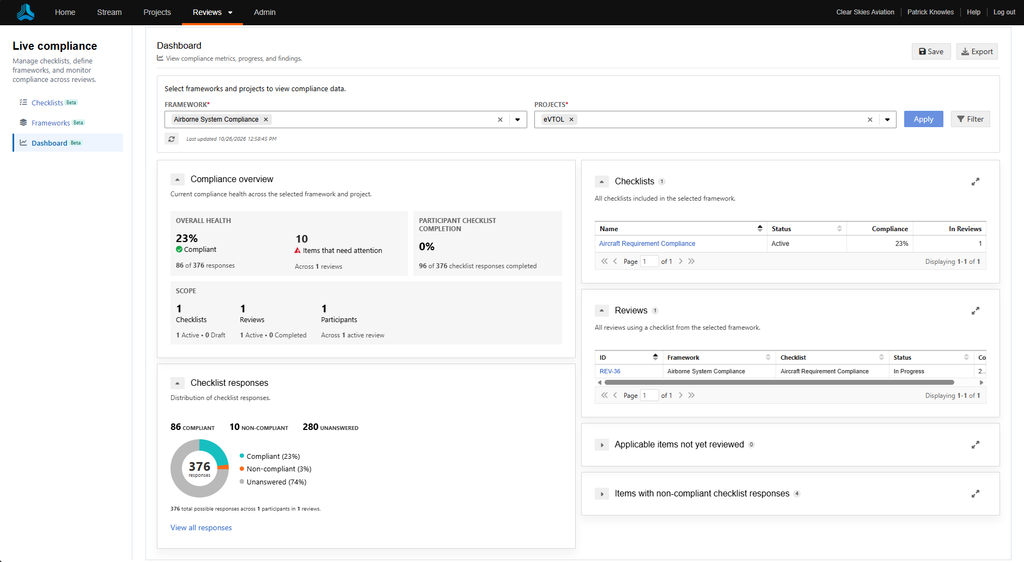
But how can a team really see this data? The Review Center will first and foremost show enough information for the average user. For the people who live and breathe compliance, new dashboards dedicated to this information are available as well. These dashboards give views of entire projects, groups of major checklists, and a number of other precise measurements to ensure a team is on track.
What Connected, Live Compliance Data Can Do for You
At the end of the day, throughout my career, I have never seen an option like this that keeps data connected and live for all users. Engineering and compliance teams can use Jama Connect with confidence, knowing that everything will be right at their fingertips.
The result is reduced rework, fewer engineering hours spent on compliance activities, and less time searching for data in every nook and cranny across disconnected systems.
Explore how Jama Connect® helps teams in regulated industries simplify compliance and maintain Live Traceability throughout development.